Case duty
One-way, reusable or engineered project?
Programme and acceptance methodsCUZI PLY packing plywood is produced for one-way crates, reusable export cases, equipment panels, liners and drawing-controlled cut components. Choose utility poplar or mixed core, calibrated poplar/combi or denser hardwood and eucalyptus constructions in 3–30 mm, with 8–12% moisture for reusable-case grades, interior or exterior bond options, cut-to-size, drilling, slots and part labelling. Three programmes cover economical one-trip use through engineered heavy-equipment cases at USD 200–580/m³, with density, fastener interface, packing and destination documents stated in the quotation.
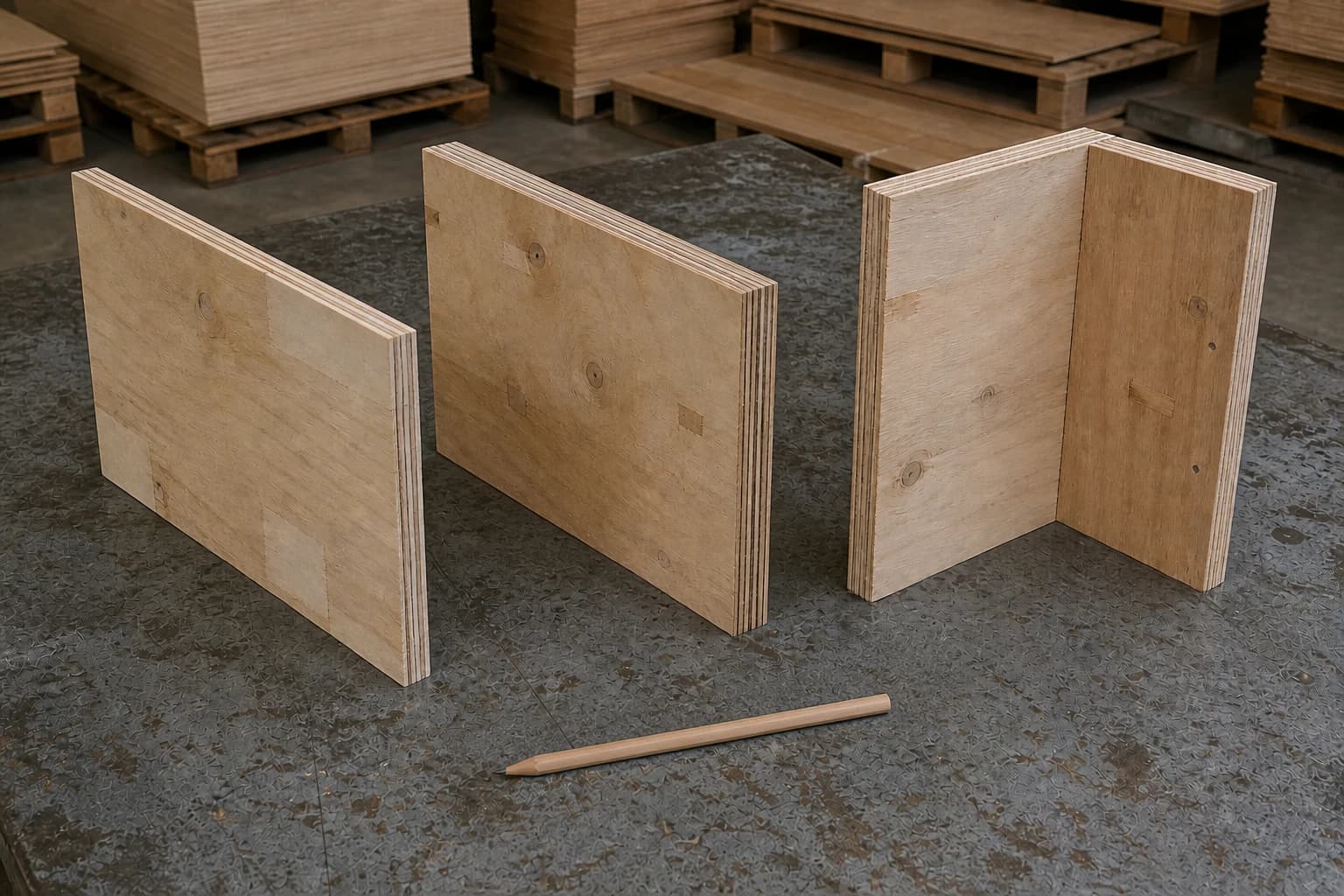
Utility, reusable-case and denser project constructions show distinct sanded faces and cross-laminated veneer edges beside their species, lay-up, density and repair decisions.
One-way, reusable or engineered project?
Programme and acceptance methodsWhich handling and inspection cycle is expected?
Material and system inputsMass, support, sensitivity and restraint points?
Packaging-design next stepsParent format, blanks, holes, slots and labels?
Nesting and first articleWhich panel, sourcing, system and import files?
Order supporting documentation scheduleSide, end, top and base subpanels experience different spans, restraints, impacts, weather exposure and assembly operations. The plywood order records the intended role, parent-sheet option and manufacturing acceptance inputs; it cannot infer a safe complete-case design from cargo mass alone.
A cut blank becomes useful when its drawing identifies datum, face direction, holes, slots, labels and pack sequence. The same nominal sheet can produce very different outcomes when frame centres, fastener position or unsupported edges change.
Frame centres, edge support, handling impacts and closure method
System designer owns span and load path.Access, weather cover, fasteners and removal frequency
panel constructions does not certify stacking.Bearing, concentrated feet, restraint and skid interfaces
Base frame and lift design remain system scope.Drawing, datum, direction, openings, label and case-set sequence
Manufacturing follows the approved geometry.This page specifies plywood construction, density, moisture, dimensions, cut processing, panel-to-frame trial inputs, lot controls and panel packing. It supports a case design but does not publish a universal load, span, impact or reuse rating.
Our Industrial Packaging guide covers cargo restraint, load path, frame spacing, lift points, stacking, complete-package tests and system failure analysis. Our Structural Plywood guide covers declared engineering properties. Our Poplar and Hardwood guides cover species-led material decisions.
Use this programme for one-way or limited-handling case panels where functional flatness, reasonable panel weight, basic fastening and cost control lead the purchase decision; it does not assign a universal case load.
Use this programme for repeat-use industrial cases and drawing-controlled components that require tighter core, calibration, dimensional, fastening, label and reorder controls without claiming permanent exterior structural performance.
Use this project programme when cargo mass, longer spans, concentrated interfaces, complex machining and higher fastening demand must be carried into a first article and complete-package validation; engineered describes the verification process, not an unlimited panel rating.
Compare One-Way Case, Reusable Export Case and Engineered Heavy-Duty across 50 construction, processing and delivery fields.
| Decision field | One-Way Case | Reusable Export Case | Engineered Heavy-Duty |
|---|---|---|---|
| Intended case duty | One-way cases, liners, covers and simple closure panels | Reusable export cases and drawing-controlled equipment panels | Project-defined heavy equipment cases, larger spans and complex cut components |
| Expected reuse cycle | One trip or limited handling; no fixed cycle promise | Repeated handling plans confirmed with the complete case design | Project reuse expectation converted into complete-case trials and inspection points |
| Cargo description / sensitivity | Non-fragile cargo described before thickness selection | Equipment geometry, sensitivity and contact restrictions recorded | Heavy, delicate or high-value cargo mapped with restraints and load interfaces |
| Gross mass input | Buyer supplies gross cargo and complete packed mass estimate | Verified gross mass enters frame and fastener review | Engineering file records cargo, case, restraint and handling mass separately |
| Load distribution input | Even or known support condition stated by buyer | Concentrated feet, rails and restraint points marked on drawings | Full bearing map and load paths handed to the packaging-system designer |
| Unsupported span / frame-spacing input | Simple frame centres stated before panel confirmation | Maximum unsupported panel span frozen on approved drawing | Each span, opening and discontinuity reviewed with the complete frame system |
| Stacking and storage input | Expected warehouse stack and short storage option stated | Stack height, duration and support alignment recorded | Compression, long-storage and stacking option assigned to complete-package validation |
| Lift and handling input | Manual, pallet or forklift handling method declared | Fork entry, sling or lifting-zone interfaces identified | All lift points, accelerations and handling orientations included in the system file |
| Vibration / shock input | Normal shipment mode noted without a generic rating | Known distribution hazards inform core and fastening trials | Project profile selects applicable ASTM, ISTA or buyer package procedure |
| Climate / moisture exposure | Dry covered handling or brief controlled exposure defined | Humid export option with exterior-bond option and edge plan | Named climate, duration, condensation and storage risks drive project construction |
| Face grade | Utility C/D or equivalent functional face after sample | C/C, BB/CC or selected packing face with tighter repair limits | Selected industrial face with mapped fastening and machined zones |
| Back grade | Utility back allowing agreed sound repairs | Balanced packing back with controlled open defects | Selected back matched to restraint, frame and exposed-zone requirements |
| Face veneer species | Poplar or approved mixed utility veneer | Poplar, eucalyptus or selected hardwood face option | Project-selected hardwood, eucalyptus or other qualified veneer face |
| Core species | Poplar or legal mixed-wood core | Poplar, combi or selected eucalyptus option | Selected hardwood, eucalyptus or dense combi construction |
| Core construction | Functional utility core for one-way panel duty | Calibrated multi-ply core with controlled repair and edge quality | Void-controlled project lay-up qualified around fastening and cut geometry |
| Lay-up / ply count | Recorded symmetrical schedule for ordered thickness | Ply count and veneer schedule frozen by approved sample | Project ply schedule retained by SKU, size and thickness lot |
| Core gap / overlap / repair rule | Utility limits agreed on a representative edge | Tighter gap, overlap and repair limits at fastener and cut zones | Zone-specific limits mapped for holes, edges, restraints and high-demand interfaces |
| Bond / adhesive option | Interior or moisture-resistant option matched to covered duty | Exterior phenolic option available for humid export handling | Project bond specifications selected with exposure and complete-case verification plan |
| Panel density | indicative price ranges typically 450–600 kg/m³ after core approval | indicative price ranges typically 480–650 kg/m³ with lot check | Project range typically 580–750 kg/m³; exact density frozen after build approval |
| Calculated sheet weight | Calculated from approved density × ordered width × length × thickness | SKU weight calculated and checked against handling and pack payload | Actual project density and dimensions drive sheet, component and pack mass schedule |
| Moisture content | Typically 8–15% planning target at release | Typically 8–12% controlled range for reusable export cases | Typically 6–10% project target after conditioning and exposure review |
| emission requirements when required | Destination requirement confirmed before selecting adhesive | Order-specific E1/E0 or buyer requirements available on request | Exact construction and destination method included in the supporting documentation schedule |
| Standard panel formats | 1220×2440 mm | 1220×2440 and 1250×2500 mm | 1220×2440 and 1250×2500 mm reference formats |
| Project / oversize formats | No oversize option; cut blanks from approved 1220×2440 sheets | 1525×3050 mm after lay-up, press, flatness, handling, nesting and pack validation; 1220×3800 mm after long-panel support, press, handling, payload and pack validation | 1525×3050, 1220×3800 and 2100×2800 mm only after full project validation of equipment, lay-up, flatness, support, machining, packing and logistics |
| Finished thickness | 3–21 mm indicative price ranges | 4–25 mm indicative price ranges | 6–30 mm project indicative price ranges |
| Thickness tolerance | Typically ±0.7 mm after construction confirmation | Typically ±0.5 mm after calibration and sample | Typically ±0.3–0.5 mm after project construction confirmation |
| Length / width tolerance | +0 / −3 mm planning target for full sheets | +0 / −2 mm for approved panels or blanks | Drawing tolerance assigned to each finished component and machining option |
| Squareness / diagonal | Utility full-sheet diagonal check | Measured diagonal difference frozen with blank drawing | Part-specific squareness, datum and inspection method recorded |
| Flatness / bow / twist | Full-support visual acceptance for one-way duty | Conditioned flatness check on approved parent panel and blanks | Measured project limit after conditioning, machining and support simulation |
| Surface / sanding | Unsanded or utility sanded face by order | Two-face sanded and calibrated for labels, contact and clean handling | Selected sanding and surface limit by restraint, coating or equipment-contact zone |
| Edge condition | Clean saw-cut parent edge or simple blank edge | Controlled cut quality with sealed or protected edge option | Machined edge acceptance, repair and project protection schedule |
| Cut-blank dimensions | Simple rectangles after buyer drawing confirmation | Drawing-controlled rectangles and profiles with SKU tolerances | Complex blanks, openings and interfaces released through first-article approval |
| Nesting / yield approval | we propose simple yield plan for confirmation | Buyer approves parent sheet, grain direction, quantity and offcut rule | Revision-controlled nesting file links every component to project and pack sequence |
| Saw / CNC / drilling / slot option | Straight saw cutting and simple drilling after trial | CNC, slots and hole patterns qualified on a first component | Tooling, datum, cut order and critical interfaces frozen in project process plan |
| Part numbering / labels | Basic SKU or case-set label | Unique part code, orientation and case-set sequence | Revision, component, case, lot and assembly position controlled by label file |
| Grain / face direction on drawings | Direction marked when it affects cut yield | Face direction and datum arrow fixed for every repeated blank | Direction, face, orientation and assembly side form part of the controlled drawing |
| Frame material interface | Buyer names solid-wood or other frame material and contact face | Frame species, section, moisture and panel bearing detail provided | Frame, bearer, restraint and panel connections specified in the case drawing |
| Fastener type input | Buyer identifies nail, staple or screw family | Diameter, head, point, coating and installation tool stated | Project fastener specification and substitution rule tied to the complete case |
| Fastener edge distance / spacing | Buyer drawing states basic edge distance and centres | Trial drawing freezes edge distance, spacing and frame penetration | Interface schedule varies by panel zone, joint, load path and fastener system |
| Screw / nail holding trial | Simple assembly coupon available after inputs are supplied | First-article holding and installation observations recorded | Project trial or nominated method linked to exact panel, frame and fastener |
| Splitting / pull-through observation | Visual observation on representative coupon | Edge split, head pull-through and local crushing checked on first article | Acceptance criteria and failure record assigned by the packaging-system engineer |
| First-article panel or component | One representative rectangle or case-side panel | Complete labelled component set before series cutting | Project subassembly with frames, fasteners, openings and critical interfaces |
| Lot inspection and sampling | Appearance, dimensions, moisture and pack check by lot | Construction, density, blanks, labels and first-article references sampled | Project control plan defines sample frequency, records and retained components |
| Species / source / legality record | CUZI PLY species declaration and origin information by order | Transaction-specific legality and sourcing packet available on request | Project chain-of-custody, due-diligence and change record configured to destination |
| Bond / dimension / material supporting documentation | our inspection record for the approved utility build | Bond and dimension supporting documentation available on request for the exact export programme | Named methods, specimens and acceptance documents scheduled for project construction |
| Complete case test next steps | Panel data handed to buyer; no complete-case rating implied | Panel and first-article records support the buyer's package test plan | Complete crate/shipping-unit test belongs to ASTM, ISTA, ISO or buyer system scope |
| Solid-wood bearer / dunnage option | Separate component declaration; plywood itself follows processed-wood exemption option | Solid-wood battens, pallets and dunnage checked for destination ISPM 15 trigger | Importer and packaging designer confirm every solid-wood component, treatment and mark option |
| Face protection / panel packing | Aligned pallet, top/bottom protection and parallel straps | Dry wrap, edge/corner protection, aligned bearers and SKU separation | Project sequence packs, non-damaging supports and component-level protection plan |
| MOQ / SKU / pack sequence | Typically 100–300 sheets per thickness or reviewed cut-blank lot | Typically 100–500 sheets or a mixed labelled programme after nesting review | Project MOQ follows SKU count, material build, machining, first article and pack sequence |
| Loading, lead time and change control | Payload calculated; typically 20–35 days after specification confirmation | SKU payload plan; typically 25–45 days after sample and drawing confirmation | Project payload and sequence; typically 35–60 days after first article; material or drawing changes require sample reconfirmation |
Parent-panel dimensions and component dimensions are different records. The nesting file aligns part quantities, face direction, saw kerf, machining allowance and offcut rules before material is committed.
Each repeatable component receives a unique SKU, drawing revision, orientation and case-set sequence. A first article checks edge quality, holes, slots, frame fit, label placement and pack order before series cutting.
1220 × 2440
1250 × 2500
1525 × 3050
1220 × 3800
2100 × 2800
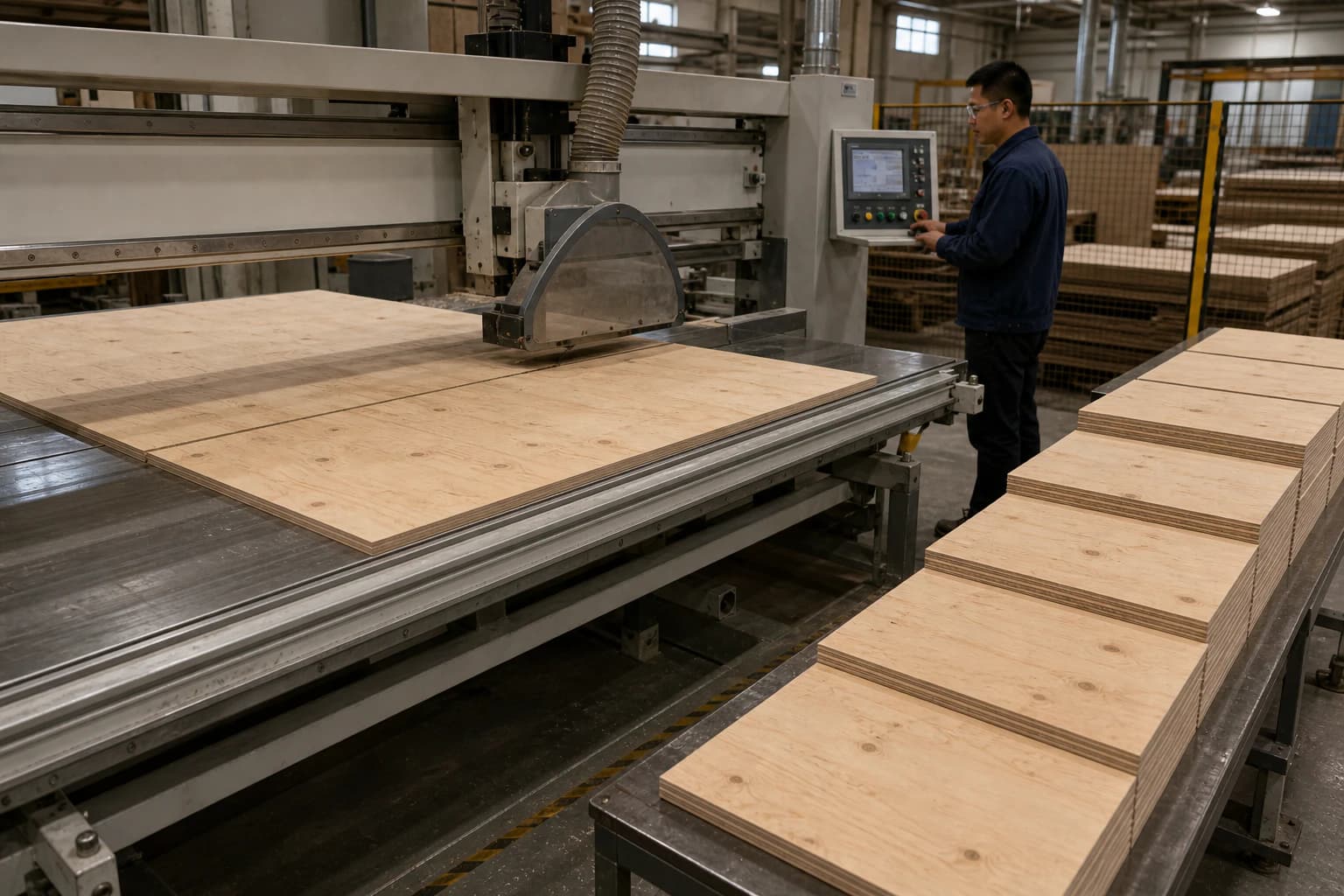
A full-size sheet is continuously supported through drawing-controlled cutting. Component labels distinguish part, orientation and case-set sequence.
Holding performance depends on core species, density, lay-up, voids, panel thickness, frame material, fastener geometry, edge distance, spacing and installation. A generic screw-holding number cannot replace the actual interface.
The trial records splitting, local crushing, head pull-through, penetration and installation consistency. Acceptance belongs to the case designer or nominated project authority, while we retain the approved panel and component reference.
Core, density, lay-up, thickness, edge condition and moisture
Material, section, moisture, bearing face and joint geometry
Type, diameter, head, point, coating, tool and penetration
Edge distance, centres, joint support, openings and direction
Splitting, crushing, pull-through, withdrawal and installation consistency
Plywood standards and order records cover panel construction, bond and dimensions. Complete-package procedures address the assembled and filled transport unit under selected distribution hazards. Sourcing, legality and biosecurity options answer transaction and destination questions.
ISPM 15 provides a processed-wood exemption option for wholly processed material such as plywood. Solid-wood battens, bearers, pallets or dunnage used in the complete packaging may still trigger treatment and marking obligations, so the importer and case designer must confirm the actual construction and destination.
ISO 12465, ISO 12466 / EN 314 option, dimensions and buyer material controls
Defines the supplied plywood construction and supporting documentation.ASTM D4169, ISTA, ISO 12048 and applicable crate/box methods
Applies to the assembled and filled package under a selected test programme.ISPM 15 component check, FSC/PEFC transaction requirements, EUDR or destination due diligence
Depends on the actual transaction, solid-wood components, importer and destination.One-Way Case planning band; exact value depends on face, utility core, bond, thickness, cut yield, quantity and pack.
Reusable Export Case planning band; tighter core, calibration, exterior-bond option, labels and repeat controls apply.
Engineered Heavy-Duty planning band; denser construction, project machining, first article and supporting documentation scope are major variables.
Compare quotations on the same 1220×2440×12 mm reference panel or the same released cut-component schedule. Align face and back grade, core species, lay-up, bond, density, moisture, tolerance, cut yield, drilling or slots, first-article inspection, labels, SKU mix and pack sequence. Final pricing then reflects the confirmed quantity, destination, Incoterm, shipment point, packing and required product or import documents.
Quotation variables: Face/back grade, species, core construction, lay-up, bond, density, moisture, panel and cut dimensions, tolerance, nesting yield, machining, first article, SKU quantity, inspection, labels, documents, packing, payload and lead time.
Reference constructionPacking plywood, 1220×2440×12 mm reference panel
Main price variablesCore, bond, cut yield, machining, SKU quantity and packing
Reference date2026-08-22
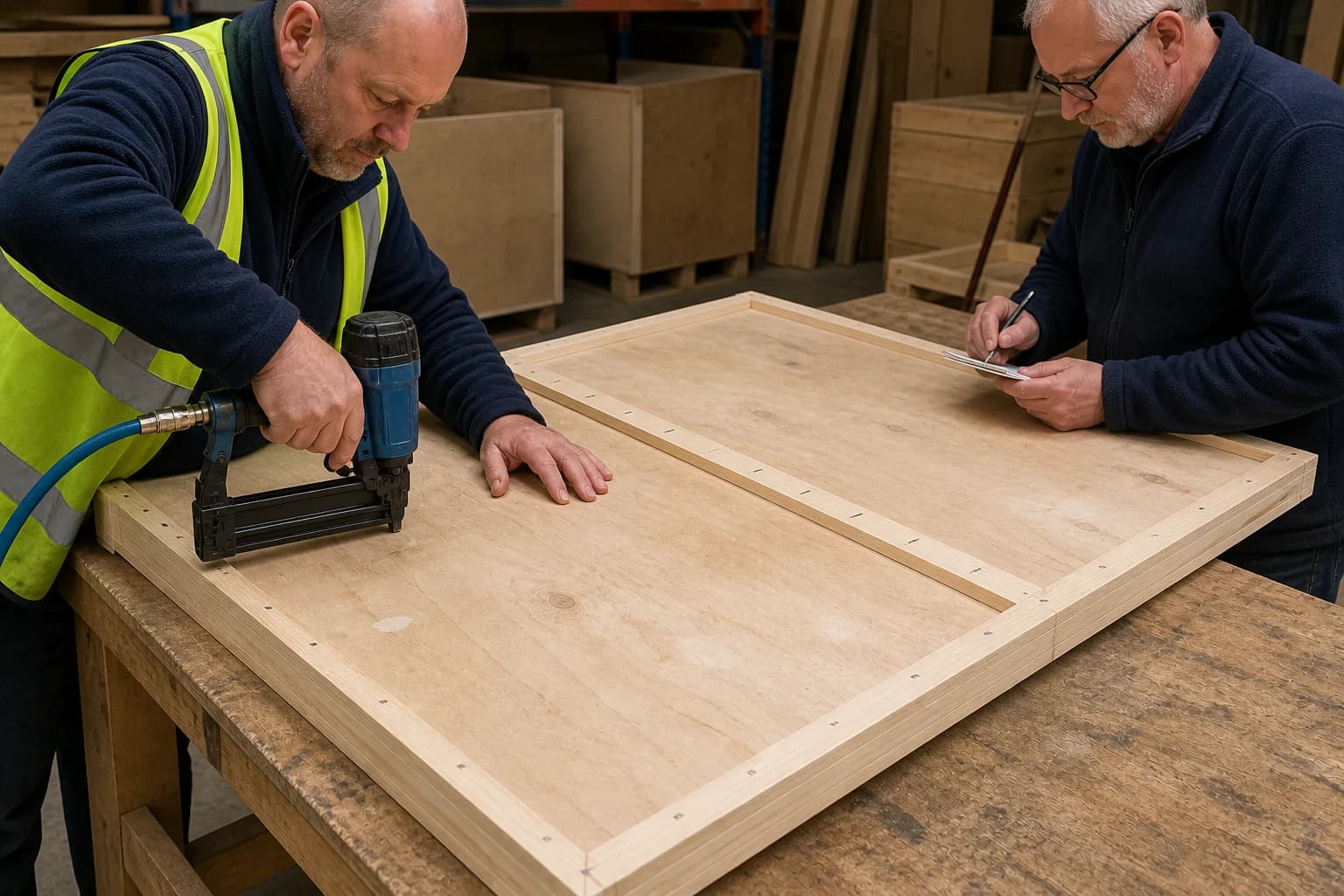
A panel-to-timber-frame trial keeps support, fastener line, edge distance, local crushing and splitting observations in the same interface check.
indicative prices use a 1220×2440×12 mm reference and indicate three manufacturing positions; they are not fixed quotations or offers. The final amount depends on core, density, bond, dimensions, cut yield, machining, inspection, supporting documentation, SKU mix and packing.
Keep the approved sample, wood species, dimensions, component drawings, first article, labels and packing sequence with the order revision. Confirm changes to materials, dimensions or processing before repeat production.
ISO 12465 and ISO 12466 / EN 314 option for the exact panel; not a complete-case rating.
Panel and component dimensions, moisture, density, tolerances and approved sample.
ASTM D4169, ISTA or buyer procedure selected for the assembled, filled shipping unit.
ISO 12048 or nominated method for the complete filled transport package.
ISPM 15 applies according to actual raw solid-wood battens, bearers, pallets or dunnage and destination; processed plywood follows the exemption option.
FSC, PEFC, EUDR, Australian due diligence or buyer requirements only when transaction and destination scope apply.
Before the purchase order
Packing plywood is a purpose-selected panel for crate sides, ends, tops, base subpanels, liners and drawing-controlled cut components. The order states face and back grade, core, bond, density, moisture, dimensions, tolerances, machining, fastening interfaces, inspection and pack sequence.
We manufacture plywood panels and cut components to the agreed specification. For complete-case requirements, see our Industrial Packaging guide covering cargo restraint, load paths, frames, lifting points, stacking, handling and package testing.
Poplar or approved mixed utility cores can fit a one-way programme. Reusable cases often start with calibrated poplar, combi or selected eucalyptus. Heavy-duty projects may require denser hardwood, eucalyptus or qualified combi lay-ups. Actual suitability still depends on spans, fasteners, cargo and the complete case design.
Start with panel role, unsupported span, frame spacing, cargo interfaces, fastener layout, cut-outs and handling conditions. The listed 3–30 mm programme ranges are planning options, not universal load tables; the case designer must confirm the complete system.
Wholly processed plywood follows the processed-wood exemption option. Raw solid-wood battens, bearers, pallets or dunnage used in the same case are checked separately and may require ISPM 15 treatment and marking according to the destination. The packing list identifies each solid-wood component for importer confirmation.
Yes. Provide parent format, drawings, datum, face direction, dimensions, tolerance, holes, slots, part quantities, labels and pack sequence. A complete first-article set is recommended before repeat cutting.
The trial uses the approved panel, actual frame material, nominated fastener and intended edge distance and spacing. It records splitting, crushing, head pull-through, penetration and installation consistency; acceptance belongs to the case design or project authority.
PKG-B can review 1525×3050 and 1220×3800 mm after their stated production and logistics checkpoints. PKG-C can additionally review 2100×2800 mm. Every oversize option requires construction, equipment, flatness, support, machining, packing and transport validation.
The option follows expected climate, storage, condensation risk and service duration. Covered one-way duty may use an interior or moisture-resistant build; reusable or exposed handling may require an exterior phenolic option. Neither label replaces an exact exposure and edge plan.
Send case duty, cargo and gross mass, case or component drawings, frame material and spacing, fasteners, parent and cut sizes, thickness and tolerance, core or weight target, bond and moisture exposure, expected reuse, distribution inputs, quantity by SKU, labels, destination, supporting documentation needs and target date.
Provide intended case duty, cargo description and gross mass, case or component drawing, frame material and spacing, fastener type and spacing, panel size, cut blanks and machining, thickness and tolerance, core, density or weight target, bond and moisture exposure, expected reuse, handling, stacking and distribution inputs, quantity by SKU, labels and pack sequence, destination, sourcing, import, biosecurity and document needs, and target date. Our team can recommend the suitable Incoterm.
Plywood enquiry
Provide intended case duty, cargo description and gross mass, case or component drawing, frame material and spacing, fastener type and spacing, panel size, cut blanks and machining, thickness and tolerance, core, density or weight target, bond and moisture exposure, expected reuse, handling, stacking and distribution inputs, quantity by SKU, labels and pack sequence, destination, sourcing, import, biosecurity and document needs, and target date. Our team can recommend the suitable Incoterm.
CHAT WITH CUZI PLY↗