CUZIPLYFactory-direct plywood
Get a quote
PLYWOOD TECHNICAL GUIDEGLUE SYSTEMS + EMISSION REQUIREMENTS

Plywood Bond Types, Glue Systems and Emission Options

Select plywood glue and emission requirements from the intended use, moisture exposure, panel construction and importing market. This guide explains how UF, MUF and phenolic/PF systems are commonly applied; how MR, exterior bond and WBP wording should be completed in a purchase specification; and how E0, E1, CARB Phase 2, TSCA Title VI, CANFER and JAS/F-star differ. It also shows the test methods, reports, certification records, labels and lot details buyers can request. Use the comparison tables to align quotations on the same construction and test basis, then send the selected requirements with finished dimensions, quantity, packing and destination for a product-specific quotation.

Prepare your specification
Bond performance
Selected for the expected moisture and exposure conditions.
Emission requirement
Matched to the destination, product type and stated test method.
Panel identity
Face, core, lay-up, thickness and surface are stated with the result.
Order documents
Reports, programme records, labels and lot references are agreed before production.
COMMON BUYER QUESTIONS

Clear answers for MR, MUF, PF, WBP and emission terms.

What is a plywood bond type?

A plywood bond type describes how the adhesive lines between veneers are expected to perform under stated moisture and exposure conditions.

What it covers
A complete specification combines the adhesive family with the product construction, test method and acceptance criterion.
Write in the RFQ
State the end use, expected wetting and required bond test or product standard.

What does MR plywood mean?

MR is a common trade description for plywood intended for dry interiors or occasional humidity, depending on CUZI PLY and market.

What it covers
Its practical meaning comes from the stated test condition and acceptance requirement.
Write in the RFQ
Add the service condition, product construction and agreed test method to the order.

What is MUF plywood glue?

MUF is melamine-urea-formaldehyde adhesive used in selected interior and moisture-resistant plywood constructions.

What it covers
The formulation, pressing process and tested panel determine the resulting performance.
Write in the RFQ
Confirm the intended exposure, bond test and emission requirement for the finished panel.

What does phenolic/PF bond mean?

PF refers to phenol-formaldehyde adhesive, commonly used for exterior-oriented, formwork and selected marine or structural plywood constructions.

What it covers
The finished panel is qualified through its complete construction and the applicable product and bond tests.
Write in the RFQ
State the product standard, exposure class, pre-treatment and pass criteria.

What does WBP mean in a purchase order?

WBP is widely used in trade for weather-and-boil-proof or water-boil-proof performance.

What it covers
Comparable offers state the same pre-treatment, test method, acceptance criterion and panel construction.
Write in the RFQ
Write the required boil or weather test and the report or inspection document to be supplied.

How is exterior-bond plywood specified for marine or structural use?

Begin with the exterior bond requirement, then add the veneer grade, core construction, product standard, marking and performance requirements for the intended use.

What it covers
Marine and structural plywood each use a fuller product specification than the glue line alone.
Write in the RFQ
Name the marine or structural standard and the required certification or test documents.

How should E0, E1, CARB, TSCA and F-star be compared?

Compare them by test method, unit, product coverage, jurisdiction and document requirement.

What it covers
Each term belongs to a defined market or programme; quotations are comparable when the same basis is stated.
Write in the RFQ
Name the destination and the exact emission programme or laboratory method required.

What belongs in a bond-and-emission RFQ?

Include the panel construction, intended use, exposure, destination, bond requirement, emission requirement, dimensions, quantity and requested documents.

What it covers
Drawings, buyer specifications and importing-country requirements help determine the appropriate test and document package.
Write in the RFQ
Send the known requirements and mark any undecided fields as to be confirmed with CUZI PLY.
TWO REQUIREMENTS

Specify bond durability and formaldehyde emission separately.

The glue line is tested for the intended exposure. Formaldehyde release is assessed for a defined product under a named method or destination programme.

Bond durability

Performance to define
Glue-line performance after the pre-treatment required for the intended service condition
Test or programme
EN 314-1 with EN 314-2, an applicable product standard or another buyer-specified method
Documents to request
Test report for the stated construction together with production and lot records
Acceptance contact
Buyer, project specification or product certification requirements

Formaldehyde emission

Performance to define
Formaldehyde release from the stated panel construction under a named method or market programme
Test or programme
EN 717-1, ISO 12460, TSCA Title VI, CARB, CANFER, JAS or a buyer-specified method
Documents to request
Product-specific report, certification or TPC record, label details and lot identification
Acceptance contact
Importer, regulator, certification body, project specification or buyer
ADHESIVE APPLICATION

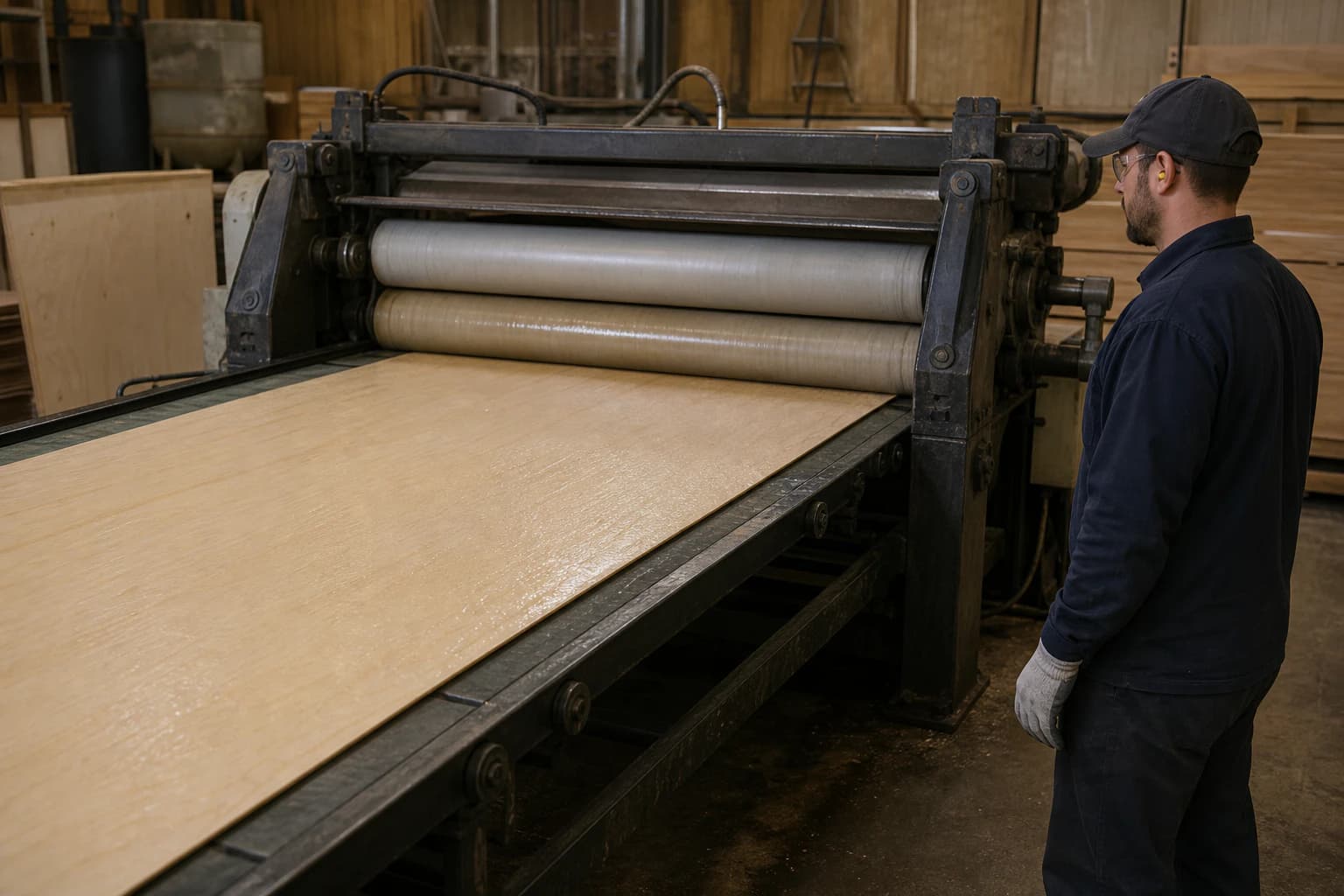
The resin system, process settings and panel identity remain traceable through production.

Complete plywood veneer sheet supported on a conveyor while passing through one industrial roller glue spreader
Supported veneer through one roller glue spreader

The adhesive-application plate shows one complete veneer continuously supported through the glue spreader.

ADHESIVE FAMILY COMPARISON

Match the glue system to the panel, moisture exposure and destination requirement.

Adhesive familyTypical applicationsService conditionsProduction controlsEmission requirementDocuments to requestRelevant productsConfirm with the order
UF / interior-orientedDry interior furniture or concealed componentsDry service; wet cycling not inferredResin identity, mix, spread, assembly and press controlsFormaldehyde option must be separately nominatedOrder technical documents plus named emission methodCommercial, Furniture Grade, Birch, PoplarMR, exterior, marine, structural or low-emission status
MUF / moisture-resistantInterior-to-moisture-resistant programmes selected by projectIntermittent humidity only as testedMelamine content option, catalyst, pot life and cureMUF is not a finished melamine face or emission classBond test plus separate emission documents and test resultsFurniture Grade, Commercial, selected exterior filesMelamine Plywood, WBP, marine or universal MR
PF / phenolic exterior-orientedExterior-oriented, formwork and selected marine/structural productsWetting/drying or severe pre-treatment as nominatedResin, spread, veneer moisture, assembly and hot pressPF chemistry does not replace programme testingBond method/class plus product-specific supporting documentationFilm Faced, Marine, Structural, HDO/MDOMarine, structural, waterproof assembly or fixed reuse
Qualified low-emitting / NAF / ULEF programmeDestination-regulated or buyer-controlled interior productBond exposure remains a separate axisApproved resin option, line, product type and QC programmeStatus follows the exact programme and approval scopeTPC/programme, report, label and lot recordsFurniture Grade, Commercial, Melamine, HPLExterior durability or coverage of every construction
Project-specific alternative / secondary laminationSpecial adhesive or overlay-to-substrate bondDefined by finished assembly and buyer methodSubstrate, surface preparation, adhesive, cure and balanceSecondary adhesive and substrate emissions both need reviewAssembly test and scope-matched reportHPL, Melamine, Laser-Cutting, project requirementsThe plywood core glue line or whole assembly compliance
PURCHASE TERMINOLOGY

Turn MR, WBP and exterior wording into a complete specification.

TermHow it is usedComplete order wordingDocuments and testsAlso specify
MRtrade shorthandNamed moisture condition, bond method and acceptanceCUZI PLY declaration plus scope-matched testOne universal standard or waterproof panel
Interior bonduse/exposure directionDry-service class or nominated methodProduct standard and bond reportLow emission or furniture grade
Moisture resistantperformance descriptionExposure cycle and measurable acceptanceNamed test/pre-treatmentExterior, marine or permanent immersion
Exterior bondbond durability directionExact exterior class and methodBond test and product fileMarine, structural or finished-system waterproofing
WBPcommercial performance termExact boil/weather pre-treatment and pass criteriaNamed method plus reportA universal standard, glue species or certificate
Phenolic / PFadhesive familyPF option plus method, product and exposureResin declaration and bond test recordsPhenolic film, marine or low-emission status
A-bondregional bond-class termApplicable AS/NZS option and exact product scopeProduct standard/certification supporting documentationAn EN class or universal exterior claim
EN 314 bonding classstandard requirement optionEN 314-1 method plus EN 314-2 classScope-matched reportProduct grade, marine or structural status
Marine plywoodproduct standard/market fileNamed marine product standard and complete constructionProduct, bond, veneer and document and test requirementsExterior glue alone
Structural plywoodproduct standard/design fileNamed structural standard, grade and supporting documentationCertification, marking and design values as requiredExterior glue alone
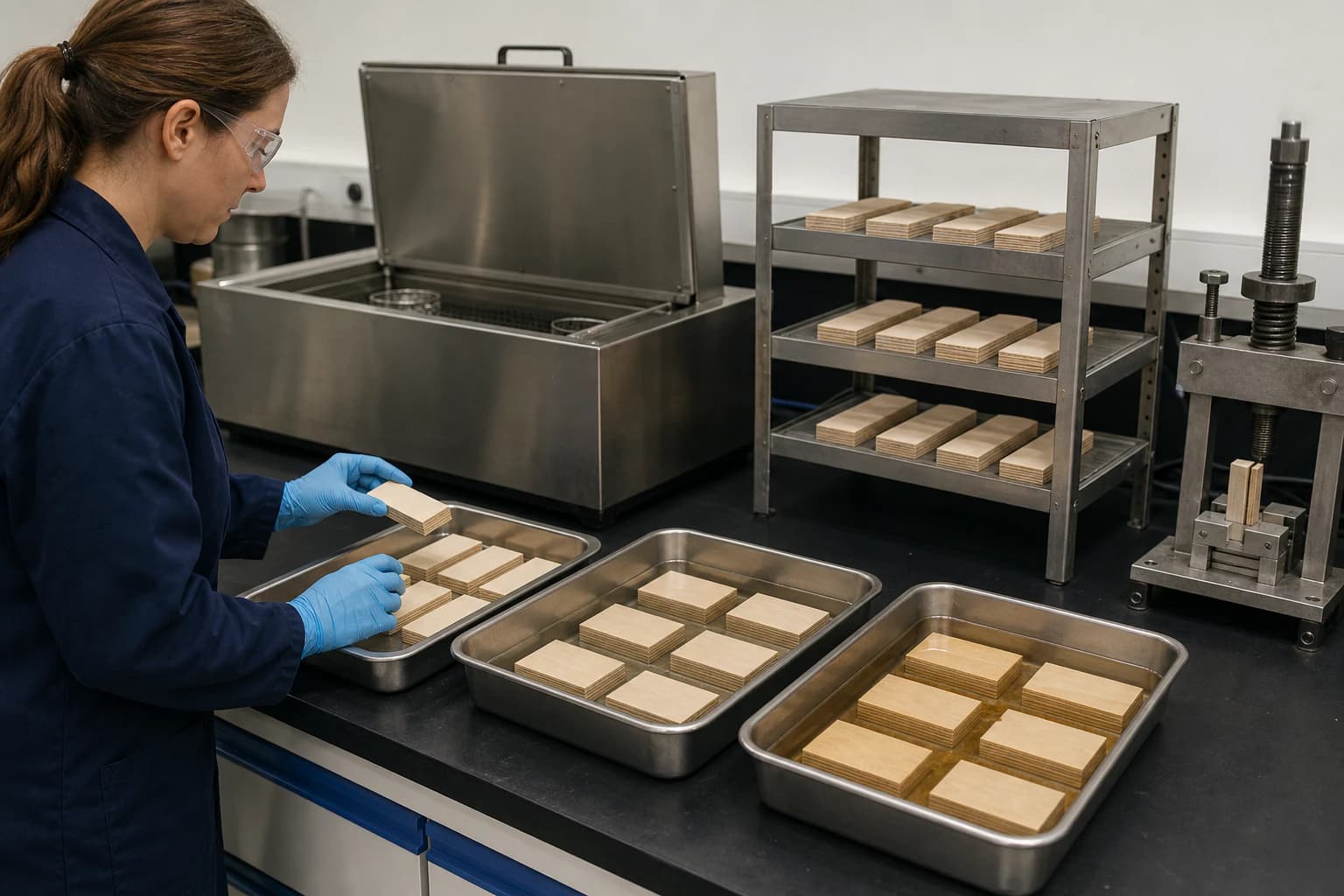
BOND-DURABILITY SPECIMEN PREPARATION

Pre-treatment, specimen identity and acceptance remain part of the result.

Plywood bond test specimens separated between dry racks and stainless treatment trays in a quality laboratory
Separated specimen preparation and treatment steps

Bond-test preparation separates dry racks, treatment trays and identification controls before testing.

PRODUCT + USE GUIDE

Choose the product first, then match its bond and emission requirements.

Commercial / interior distribution ↗

Intended use
Dry interior panels
Typical bond choice
UF or buyer-nominated interior
Emission requirement
Destination emission target?
Product page
Commercial Plywood
Documents
Construction-specific report
Specification note
Not an exterior declaration

Furniture Grade ↗

Intended use
CNC, carcass and interior component
Typical bond choice
UF/MUF or qualified low-emitting
Emission requirement
Machining and programme scope?
Product page
Furniture Grade Plywood
Documents
Approved sample, report, lot
Specification note
Not one universal furniture glue

Film Faced / formwork ↗

Intended use
Wetting, cleaning and site cuts
Typical bond choice
PF/exterior-oriented option
Emission requirement
Project emission requirement?
Product page
Film Faced Plywood
Documents
Bond, edge and product specifications
Specification note
Film colour does not establish bond

Marine / exterior joinery ↗

Intended use
Severe moisture option
Typical bond choice
Product-standard bond specifications
Emission requirement
Destination product documents and test results?
Product page
Marine Plywood
Documents
Marine construction and report
Specification note
Exterior glue alone is insufficient

Structural ↗

Intended use
Design-controlled construction
Typical bond choice
Named structural bond specifications
Emission requirement
Regulated product scope?
Product page
Structural Plywood
Documents
Certification/grade supporting documentation
Specification note
No design value from resin name

Packing / industrial cases ↗

Intended use
Transit and storage exposure
Typical bond choice
Interior or exterior per option
Emission requirement
Importer/buyer emission trigger?
Product page
Packing Plywood
Documents
Case-panel specification
Specification note
Not complete-case performance

Laser-Cutting ↗

Intended use
Heat-sensitive precision process
Typical bond choice
Trial-selected adhesive option
Emission requirement
Smoke/emission programme?
Product page
Laser-Cutting Plywood
Documents
Machine trial and lot control
Specification note
No guaranteed cut result from glue name

Birch / Hardwood / Poplar ↗

Intended use
Species-led product file
Typical bond choice
Use-selected bond specifications
Emission requirement
Exact construction coverage?
Product page
Core Materials & Species
Documents
Species/lay-up plus report
Specification note
Species does not determine bond

Melamine Plywood ↗

Intended use
Decor-faced interior panel
Typical bond choice
Substrate glue plus face-balance option
Emission requirement
Finished product programme?
Product page
Melamine Plywood
Documents
Substrate and finished-panel supporting documentation
Specification note
MUF is not melamine facing

HPL Plywood ↗

Intended use
Secondary-laminated assembly
Typical bond choice
Core glue plus lamination adhesive
Emission requirement
Assembly/product scope?
Product page
HPL Plywood
Documents
Substrate and lamination file
Specification note
HPL adhesive does not define core bond

HDO/MDO ↗

Intended use
Overlay construction
Typical bond choice
Product-selected exterior option
Emission requirement
Project programme?
Product page
HDO/MDO Plywood
Documents
Overlay/core/bond test records
Specification note
Overlay does not replace bond test

Anti-Slip ↗

Intended use
Wear surface and substrate
Typical bond choice
Use-selected bond specifications
Emission requirement
Destination/project requirements?
Product page
Anti-Slip Plywood
Documents
Surface plus substrate file
Specification note
Pattern does not establish durability
EMISSION TERMS + PROGRAMMES

Read every emission term with its method, unit, product coverage and market.

E0, E1, CARB Phase 2, TSCA Title VI, CANFER and JAS/F-star use different definitions and programme requirements. Compare quotations only when the same method and product coverage are stated.

E1EN 13986 Annex B classification requirements
Requirement type
classification
Method / unit
Classification basis plus the named EN 717-1 method and unit must be stated
Products covered
Applicable wood-based panel and product scope under the nominated EN 13986 edition
Documents
Scope-matched report plus classification basis
Acceptance contact
Buyer/project
Confirm again when
EN 13986 Annex B, method or acceptance revision
E0market/buyer term
Requirement type
commercial classification
Method / unit
No single global definition
Products covered
Exact product and nominated criteria
Documents
Buyer-approved report
Acceptance contact
Buyer/importer
Confirm again when
Destination definition changes
E2EN 13986 Annex B classification context
Requirement type
classification/context
Method / unit
Nominated EN 13986 edition, EN 717-1 method and unit are required
Products covered
Applicable wood-based panels within that edition; current buyer and market acceptance must be confirmed
Documents
Scope-matched report and buyer acceptance; not promoted as a default option
Acceptance contact
Buyer/project
Confirm again when
EN 13986 Annex B, method or market-acceptance change
EN 717-1BSI / EN
Requirement type
test method
Method / unit
Chamber conditions and units fixed by method
Products covered
Wood-based panels within report scope
Documents
Laboratory report
Acceptance contact
Buyer/project
Confirm again when
Edition/status change
ISO 12460 familyISO
Requirement type
method family
Method / unit
Part, edition, conditioning, chamber and unit required
Products covered
Defined products and test purpose
Documents
Laboratory report and correlation where required
Acceptance contact
Buyer/programme
Confirm again when
ISO part revision
EU REACH Entry 77European Union
Requirement type
regulatory article option
Method / unit
Appendix 14 chamber conditions
Products covered
Relevant furniture/wood-based articles and exemptions
Documents
Article/product documents and test results and importer review
Acceptance contact
EU economic operator
Confirm again when
REACH amendment
TSCA Title VIUS EPA
Requirement type
regulatory programme
Method / unit
Incorporated methods and programme requirements
Products covered
Regulated HWPW/PB/MDF and applicable laminated products
Documents
TPC, report, label and records
Acceptance contact
Producer/importer/TPC
Confirm again when
EPA final rule update
CARB Phase 2CARB
Requirement type
state programme
Method / unit
ATCM methods and approval scope
Products covered
Regulated composite wood products
Documents
TPC/approval, label and records
Acceptance contact
Producer/importer/TPC
Confirm again when
CARB programme change
CANFERCanada regulators
Requirement type
federal regulation
Method / unit
Directive, equivalence and correlation apply
Products covered
Covered composite wood panels and laminated products
Documents
Certification, test, label and records
Acceptance contact
Manufacturer/importer
Confirm again when
Regulation/directive update
NAFCARB/EPA option
Requirement type
resin/programme designation
Method / unit
Programme approval rules apply
Products covered
Exact product/line approval scope
Documents
TPC/approval and records
Acceptance contact
Producer/TPC
Confirm again when
Approval/process change
ULEFCARB/EPA option
Requirement type
resin/programme designation
Method / unit
Emissions criteria and approval scope apply
Products covered
Exact product/line approval scope
Documents
TPC/approval and records
Acceptance contact
Producer/TPC
Confirm again when
Approval/process change
JAS / F-starMAFF
Requirement type
product standard/classification
Method / unit
JAS test methods and edition apply
Products covered
JAS-certified product scope
Documents
JAS certification/marking supporting documentation
Acceptance contact
Registered certifier/buyer
Confirm again when
2026-08-31 amendment or later consolidation
Buyer-nominated programmeBuyer/project authority
Requirement type
project requirements
Method / unit
Written method, unit and acceptance
Products covered
Named product/construction/lot
Documents
Nominated report and approval
Acceptance contact
Buyer/project authority
Confirm again when
Specification change
DESTINATION REQUIREMENTS

Match the order documents to the importing country and product use.

MarketCommon buyer wordingStandard or programmeQuestion to answerConfirm before orderDocumentsMarket page
Europe / EU and non-EU project requirementsEN bonding classes, E1 and project supporting documentationEN 314; EN 717-1; EU REACH Entry 77 where applicableIs it a panel, furniture/article, project or non-EU option?Destination, placing-on-market date and article scopeMethod report, article supporting documentation and buyer fileView market requirements ↗
Australia / New ZealandA-bond, AS/NZS product options and buyer emission targetAS/NZS product standard plus project emission methodStructural, marine, interior or buyer programme?Product standard, supporting documentation and importer acceptanceCertification/test technical documents as nominatedView market requirements ↗
Middle EastMR/WBP/phenolic plus buyer standardProject/authority-nominated EN, ISO or other optionWhich country, project and application?Exact method, exposure and documentsReport, declaration and project approvalView market requirements ↗
Central AsiaMR/WBP/GOST- or EN-nominated buyer languageDestination/buyer-nominated optionWhich country and conformity trigger?Product, method, label and importer requestScope-matched fileView market requirements ↗
Latin AmericaMR/WBP/E1 and national buyer languageCountry/importer/project requirementsWhich national requirements and end use?Country, programme and acceptance responsibilityReport and translated documentsView market requirements ↗
AfricaMR/WBP/E1 and project supporting documentationCountry/importer/project requirementsWhich destination and buyer specification?Method, product scope and documentsReport and buyer approvalView market requirements ↗
North AmericaTSCA, CARB or CANFER according to countryEPA, CARB or Canadian regulationUS, California-specific, Canada or Mexico?Product coverage, TPC/certification and label optionProgramme records and import fileView market requirements ↗
Japan / buyer-nominated JAS optionJAS bond categories and F-star classificationsMAFF JAS 0233Is JAS certification/marking required for this product?2026-08-31 version status and exact scopeJAS option supporting documentationView market requirements ↗
Other destination / project requirementsBuyer-defined glue/emission termsWritten buyer, project or regulator optionWho accepts which method and unit?Country, use, method, supporting documentation and responsible partyAgreed supporting documentation ladderView market requirements ↗
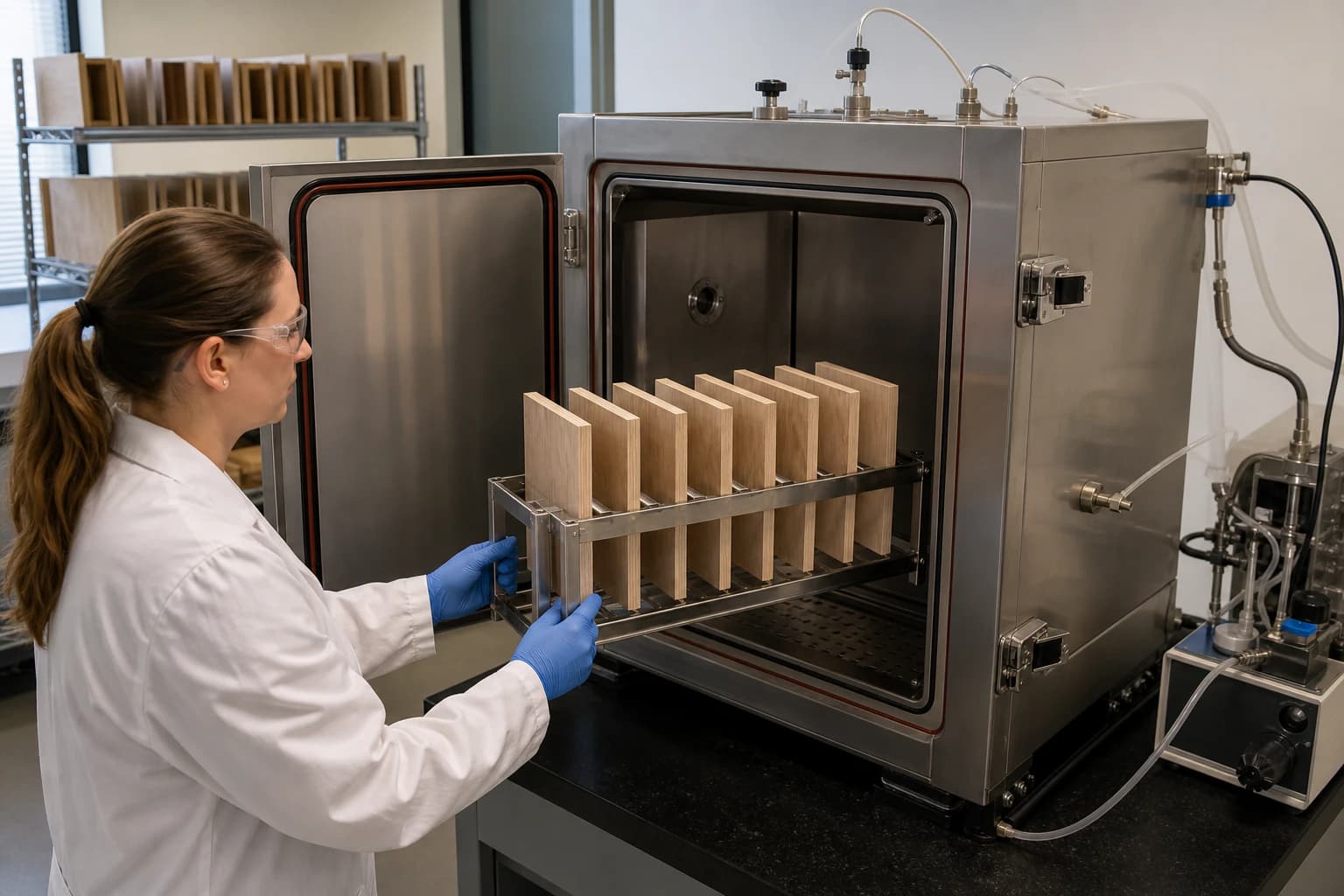
EMISSION SAMPLE + CHAMBER TEST

Conditioning, loading, method, unit and scope accompany every emission result.

Laboratory technician loading spaced plywood specimens into a sealed stainless emission test chamber
Spaced plywood specimens entering a sealed chamber

The emission-test preparation keeps specimens spaced and the chamber gasket and sampling connections visible while conditioning, loading, method, unit, required documents and test coverage remain separately identified.

ORDER DOCUMENT CHECKLIST

Request the documents that connect the ordered panel to its test results and shipment.

  1. Buyer requirement

    Provided or confirmed by
    Buyer/importer/project
    Identifies
    Destination programme and end use
    Read together with
    product documents and test results
    Update when
    Requirement or destination changes
  2. Exact product/construction identity

    Provided or confirmed by
    CUZI PLY and buyer
    Identifies
    Face, core, lay-up, thickness and overlay
    Read together with
    Bond or emission test
    Update when
    Construction changes
  3. Adhesive/resin declaration

    Provided or confirmed by
    Production/technical
    Identifies
    Primary and secondary adhesive option
    Read together with
    Durability class
    Update when
    Resin or supplier changes
  4. Glue-mix and spread control

    Provided or confirmed by
    Production QC
    Identifies
    Named order and batch
    Read together with
    Third-party report
    Update when
    Mix/spread/process changes
  5. Press/cure batch record

    Provided or confirmed by
    Production QC
    Identifies
    Assembly and press release
    Read together with
    Product certification
    Update when
    Line/process changes
  6. Internal bond/delamination QC

    Provided or confirmed by
    Factory QC
    Identifies
    Lot sampling under nominated option
    Read together with
    Regulator programme
    Update when
    Method/acceptance changes
  7. Third-party test report

    Provided or confirmed by
    Accredited lab / buyer
    Identifies
    Defined product, method and date
    Read together with
    Every construction or thickness
    Update when
    Scope, method or product changes
  8. Certification/TPC/programme record

    Provided or confirmed by
    Certifier/TPC/authority
    Identifies
    Exact programme/product/line
    Read together with
    Unlisted products or destinations
    Update when
    Approval or programme changes
  9. Lot/label/shipment traceability

    Provided or confirmed by
    CUZI PLY/exporter/importer
    Identifies
    Released lot and transaction
    Read together with
    Legal acceptance by itself
    Update when
    Lot, label or shipment changes

CUZI PLY can prepare the test, certification and shipment document package required for the ordered product and destination. The quotation states which documents are included, which require third-party testing and which depend on importer or project approval.

PRODUCTION CONTROLS

Keep the approved adhesive system consistent from veneer preparation to lot release.

Veneer moisture

Target range and sampling point for the selected construction

Recorded check
Recorded checks by veneer lot
Why it matters
Supports consistent glue spread, pressing and panel stability

Resin identity

Approved adhesive system and supplier for the order

Recorded check
Batch identity check
Why it matters
Keeps the produced panel aligned with the approved specification

Batch / mix ratio

Controlled mix for the selected adhesive system

Recorded check
Batch record
Why it matters
Supports consistent cure and glue-line performance

Pot life / time

Usable time window under the production conditions

Recorded check
Timestamped production record
Why it matters
Keeps adhesive application within our working window

Spread rate

Target spread and tolerance for the veneer and adhesive system

Recorded check
Line check
Why it matters
Supports complete, even adhesive coverage

Assembly time

Open and closed assembly time for the selected process

Recorded check
Line timestamps
Why it matters
Keeps the lay-up within the approved pressing schedule

Pre-press

Pre-press setting where required by the construction

Recorded check
Press record
Why it matters
Stabilises the lay-up before hot pressing

Hot press

Temperature, time and pressure window for the selected panel

Recorded check
Calibrated press record
Why it matters
Completes cure while controlling thickness and panel quality

Conditioning

Conditioning period and release criteria

Recorded check
Lot status record
Why it matters
Allows the panel to stabilise before finishing and inspection

Bond / delamination sampling

Method, frequency and acceptance criteria

Recorded check
Quality-control report
Why it matters
Confirms routine glue-line performance for the production lot

Emission sample traceability

Panel, line, lot and sample identification

Recorded check
Chain-of-custody record
Why it matters
Connects the tested sample to the stated product construction

Specification change control

Approval required for material or process changes

Recorded check
Change and re-approval record
Why it matters
Keeps repeat orders aligned with the agreed construction
THREE SPECIFICATION EXAMPLES

Use each example as a starting point, then confirm the ordered construction and documents.

A — Interior furniture panel

Product / use
CNC cabinet component
Construction
Named face/core/lay-up and thickness
Bond specification
Buyer-defined interior-use options
Emission requirement
Destination low-emission programme
Method / programme
Named chamber or programme method
Supporting documents
Approved sample, report and lot trace
Destination
Buyer destination
Buyer approval
Component manufacturer/importer
Details to confirm
Finish adhesive, hardware and final assembly

B — Exterior/formwork panel

Product / use
Concrete formwork or exterior component
Construction
Film/face, core, edge and thickness defined
Bond specification
PF/exterior option with nominated pre-treatment
Emission requirement
Only if destination/project requires
Method / programme
Named bond method/class
Supporting documents
Bond report, production and edge-control file
Destination
Project destination
Buyer approval
Formwork/project authority
Details to confirm
Site system, cuts, sealing and reuse expectation

C — Destination-regulated low-emission panel

Product / use
Interior hardwood plywood or laminated product
Construction
Exact substrate, overlays and adhesive systems
Bond specification
Use-selected and independently verified
Emission requirement
TSCA/CARB/CANFER/EU/JAS or buyer requirements
Method / programme
Jurisdiction-specific method/programme
Supporting documents
Scope-matched test/TPC/certification/label/records
Destination
Named country
Buyer approval
Importer/regulator/TPC/buyer
Details to confirm
Coverage, label language and shipment timing
RELATED PRODUCT + MARKET PAGES

Continue with the product construction, standard or destination that applies to your order.

OFFICIAL REFERENCES

Check the applicable standard, regulator programme and current edition.

References reviewed 2026-08-30. Final acceptance follows the current edition and the requirements stated by the buyer, importer or project.

British Standards Institution (BSI)Plywood — Bonding quality — Part 1: Test methodsEurope / United Kingdom adoption
Designation
BS EN 314-1:2004
Published status
Current; Under Review
Checked
2026-08-30
Relevant to
Test-method identity for plywood bonding quality and specimen preparation.
Open official source ↗
British Standards Institution (BSI)Plywood — Bonding quality — Part 2: RequirementsEurope / United Kingdom adoption
Designation
BS EN 314-2:1993
Published status
Current
Checked
2026-08-30
Relevant to
Bonding-class requirements according to plywood end use.
Open official source ↗
British Standards Institution (BSI)Wood-based panels — Determination of formaldehyde release — Chamber methodEurope / United Kingdom adoption
Designation
BS EN 717-1:2004
Published status
Current; Under Review
Checked
2026-08-30
Relevant to
Identity and scope of the EN chamber method for formaldehyde release.
Open official source ↗
International Organization for Standardization (ISO)Wood-based panels — Determination of formaldehyde release — Part 1: 1 m³ chamber methodInternational
Designation
ISO 12460-1:2007 + Amd 1:2023
Published status
Published; close of review
Checked
2026-08-30
Relevant to
Defined 1 m³ chamber method and method-dependent conditions.
Open official source ↗
International Organization for Standardization (ISO)Wood-based panels — Determination of formaldehyde release — Part 2: Small-scale chamber methodInternational
Designation
ISO 12460-2:2024
Published status
Published, Edition 2
Checked
2026-08-30
Relevant to
Small-scale chamber procedure and correlation scope stated by ISO.
Open official source ↗
European Union / EUR-LexCommission Regulation (EU) 2023/1464 amending REACH Annex XVII with Entry 77European Union
Designation
Regulation (EU) 2023/1464
Published status
In force
Checked
2026-08-30
Relevant to
EU Entry 77 applicability date, article scope, limits and Appendix 14 chamber conditions.
Open official source ↗
United States Environmental Protection Agency (EPA)Formaldehyde Emission Standards for Composite Wood ProductsUnited States
Designation
TSCA Title VI programme page
Published status
Current programme page; 2026 update identified as proposed
Checked
2026-08-30
Relevant to
Regulated product scope, TPC, testing, labelling and record options.
Open official source ↗
United States Environmental Protection Agency (EPA)Frequent Questions for Regulated Stakeholders about Implementing TSCA Title VIUnited States
Designation
Regulated stakeholder FAQ
Published status
Current guidance page
Checked
2026-08-30
Relevant to
Testing, TPC, records, product type and laminated-product implementation context.
Open official source ↗
United States Environmental Protection Agency (EPA)EPA Proposes Updates to Formaldehyde Emission Standards, Adding a New QC Test MethodUnited States
Designation
2026 proposed rule notice
Published status
Proposed; not final as checked
Checked
2026-08-30
Relevant to
EPA proposal to add ISO 12460-2:2024 as a QC method and update incorporated standards.
Open official source ↗
California Air Resources Board (CARB)NAF/ULEF ProvisionsCalifornia, United States
Designation
Composite Wood Products ATCM NAF/ULEF provisions
Published status
Current guidance page
Checked
2026-08-30
Relevant to
NAF and ULEF resin/programme definitions and approval process.
Open official source ↗
Environment and Climate Change Canada / Health CanadaFormaldehyde Emissions from Composite Wood Products Regulations factsheetCanada
Designation
CANFER factsheet
Published status
Current factsheet
Checked
2026-08-30
Relevant to
CANFER scope, certification, testing, records and labelling context.
Open official source ↗
Health CanadaDirective concerning testing for formaldehyde emissionsCanada
Designation
CANFER testing directive
Published status
Current directive page
Checked
2026-08-30
Relevant to
Primary and QC test methods, chamber-method equivalence and correlation scope limits.
Open official source ↗
Ministry of Agriculture, Forestry and Fisheries of Japan (MAFF)Japanese Agricultural Standard for PlywoodJapan
Designation
JAS 0233
Published status
2024 edition with amendment announced for 2026-08-31 effect
Checked
2026-08-30
Relevant to
JAS plywood option, bond categories, formaldehyde F-star categories and amendment timing.
Open official source ↗
Standards Australia / Standards New ZealandPlywood — Structural, Part 0: SpecificationsAustralia / New Zealand
Designation
AS/NZS 2269.0:2012 Amd 1:2015
Published status
Current
Checked
2026-08-30
Relevant to
Structural plywood specification option in Australia/New Zealand.
Open official source ↗
European Commission Joint Research Centre (JRC)Best Available Techniques (BAT) Reference Document for the Production of Wood-based PanelsEuropean Union
Designation
EUR 27732 EN / JRC100269
Published status
Published official reference document
Checked
2026-08-30
Relevant to
Finished wood-based panel E1 and E2 formaldehyde-emission classification semantics in EN 13986 Annex B and their relationship to EN 717-1.
Open official source ↗
British Standards Institution (BSI)Wood-based panels for use in construction — Characteristics, evaluation of conformity and markingEurope / United Kingdom adoption
Designation
BS EN 13986:2004+A1:2015
Published status
Current; Under Review
Checked
2026-08-30
Relevant to
Identity, current catalogue status, construction-product scope and characteristics/test-method framework of BS EN 13986.
Open official source ↗
BUYER QUESTIONS

Compare glue and emission quotations using the same product and test basis.

DECISION QUESTIONS

Before the purchase order

Choose the right specification.

Is MR plywood waterproof?

No. MR is commercial shorthand for a moisture-resistant option and is not a universal waterproof product or finished-assembly claim. Name the exposure, method and acceptance.

How should WBP be written in an order?

Replace WBP alone with the exact product, glue or bond specifications, pre-treatment, test method, acceptance criteria and supporting documentation required for the destination.

Is MUF glue the same as Melamine Plywood?

No. MUF is an adhesive chemistry. Melamine Plywood is a faced product whose decorative surface, substrate glue and balance must be specified separately.

Is phenolic bond the same as phenolic film?

No. PF can describe the veneer glue line; phenolic film is a surface overlay. Each interface and its supporting documentation scope are separate.

Does exterior bond make a panel marine plywood?

No. A marine option also controls veneer species/quality, core, construction, dimensions and the applicable product standard and supporting documentation.

Does exterior bond make plywood structural?

No. Structural classification requires the applicable product standard, grade, testing, certification/marking and design data, not only glue-line durability.

Are E0 and E1 global classes?

No. E1 is tied to a particular standard requirements; E0 is used differently across markets and buyers. Always name method, unit, scope and acceptance.

How do TSCA Title VI and CARB Phase 2 differ?

They are separate US federal and California programmes with closely aligned limits for covered products, but programme, TPC, labels and records must be checked for the exact option.

Can CANFER accept TSCA documents?

Canadian rules and guidance determine the option. US programme documents may support a file, but the importer must confirm Canadian product scope, certification, testing, label and records.

How does the EU 2026 option relate to E1?

EU REACH Entry 77 applies to relevant articles from 6 August 2026 under Appendix 14 conditions. It is an article placing-on-market restriction, not a renaming of E1.

Can one report cover every thickness, core and surface?

Not automatically. Coverage depends on the tested product family, construction, line, sampling, method, programme and accepting authority. Changes trigger scope review.

What belongs in a bond-and-emission RFQ?

Include use, exposure, destination, construction, current bond language, nominated bond and emission methods/programmes, supporting documentation/label needs, dimensions, quantity, packing, timing and attachments.

BOND + EMISSION RFQ

Send the intended use, service conditions, destination and document requirements.

If a test method or emission programme has not been selected, describe the application and importing country; CUZI PLY will propose suitable options for quotation.

  1. Product type or requested recommendation
  2. Intended use
  3. Destination country
  4. Indoor, damp or exterior service
  5. Expected wetting and drying
  6. Face and back species and grade
  7. Core species and construction
  8. Veneer lay-up
  9. Current bond wording
  10. Preferred adhesive system or requested recommendation
  11. Bond standard and test method
  12. Emission class or programme
  13. Emission test method
  14. Buyer, importer or project requirement
  15. Test report, certificate or TPC requirement
  16. Label and marking requirement
  17. Finished size
  18. Thickness and tolerance
  19. Surface or overlay
  20. Machining
  21. Quantity and product mix
  22. Repeat-order consistency requirements
  23. Packing and destination port
  24. Target date and attachments

Plywood enquiry

Tell us what you need.

Send end use, exposure, destination, construction, current bond language, nominated bond and emission methods, supporting documentation/label needs, dimensions, quantity, packing, target date and attachments. Our team can recommend the suitable Incoterm for the destination and order volume.

CHAT WITH CUZI PLY

By sending this request, you allow CUZI PLY to use the submitted details to respond. Read the Privacy Policy.