Hardwood vs softwood plywood: choose the panel for your part.
The right plywood starts with the part you need to make, not a hardwood or softwood label. Those names describe wood species categories. A hardwood face can cover a softwood or mixed core, while panels with similar pale faces can have different inner veneers, weight and machining characteristics.
Choose the visible grain and finish, then the core, bond and grade for the component's joints, supports and service conditions. CUZI PLY is your plywood manufacturer and direct supplier, with 10 production lines in Linyi, China. We can help bring the face you want and the construction you need into one factory quotation.
Hardwood and softwood faces do not identify the whole panel.
Order the outer veneer and inner construction separately. This gives you a meaningful comparison of appearance, cut edges, weight and performance.
Choose the visible face
Birch, poplar and okoume are hardwood choices; pine, spruce and hoop pine are softwood choices. The words do not promise a particular surface hardness or a finished panel strength. Specify the species, colour, grain, knots, patches and repairs you will accept on each side.
For clear-finished furniture, agree how the grain and colour should look across adjoining parts. For a painted or covered component, focus on preparation, acceptable repairs and the finished surface rather than paying for an appearance you will hide.
Name the core as well
A birch or other hardwood face may cover poplar, softwood, eucalyptus or a mixed core. State the inner species, veneer arrangement and core quality alongside the face. All-birch or all-okoume describes more of the construction than birch-faced or okoume-faced.
Our Core Materials & Species page helps identify the layers. Start with Hardwood Plywood or Softwood Plywood for the face and construction you want.
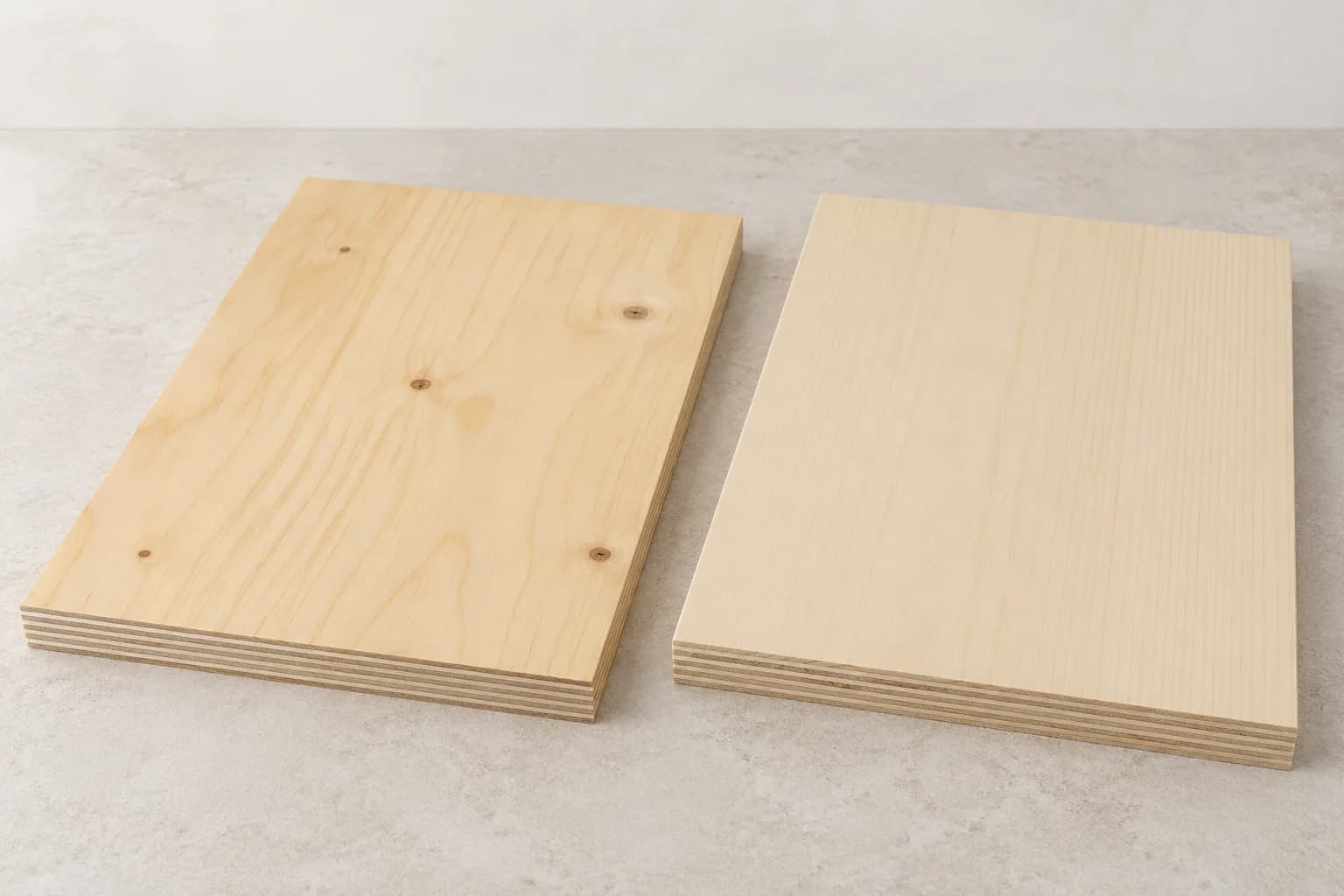
Hardwood plywood vs softwood plywood at a glance.
The useful difference is in the specified veneers and grade, not a universal ranking of the two categories.
On a phone, swipe across the table to read every column.
| Buying consideration | Hardwood plywood | Softwood plywood |
|---|---|---|
| Wood species | Specify the hardwood in the face, core or both: birch, poplar, okoume and other named species are different choices. | Specify the softwood in the face, core or both: pine, spruce, fir and other named species are different choices. |
| Inner construction | A hardwood face may cover a hardwood, softwood or mixed core. State the full veneer arrangement. | A softwood face may cover a softwood or mixed core. State the full veneer arrangement. |
| Visible appearance | Choose the species, grain, colour, repairs and grade for the finished surface; the hardwood label is not an appearance grade. | Agree grain, knots, patches, sanding and the finish; a utility face and a visible face need different requirements. |
| Weight | Compare the offered sheet mass at the same finished dimensions and moisture condition, not a category average. | Use the same comparison basis. A softwood panel is not automatically lighter than every hardwood construction. |
| Load-bearing use | Select the actual structural grade and panel properties for the loads, orientation, spans and supports. | Select the actual structural grade and panel properties for the loads, orientation, spans and supports. |
| Moisture conditions | Specify the bond, exposure, coating, edges and installation for the complete component. | Specify the bond, exposure, coating, edges and installation; softwood does not mean interior-only or waterproof. |
| Machining and fixings | Check the core continuity, cut edges, holes, joint fit and hardware in the part you will make. | Check those same details, including knots or repairs where they affect the cut, finish or fixing location. |
| Finished cost | Compare usable yield, surface preparation, edging, processing, packing and delivery alongside the board price. | Use equal specifications and quantities. The cheapest raw sheet may not give the lowest finished-component cost. |
The APA plywood guide explains how veneer selection, grading and arrangement affect the panel, and distinguishes appearance grades, structural ratings and bond classifications. Use the applicable product requirements for your project; these are separate choices, not consequences of a hardwood or softwood face.
Choose the construction by use, finish and grade.
Define what the plywood must do in the finished part. This lets our factory compare practical alternatives without losing the features your customer needs.
Cabinets and interior joinery
For a cabinet side or door, specify the visible face, reverse face, edging, hinge positions, machining and final coating. A decorative hardwood face over a selected core can keep the required look while changing weight or processing. A pine face can be selected when its grain character is part of the design.
For shelves, include the clear span, load, supports and acceptable deflection. Appearance alone does not establish shelf capacity. Use Furniture Grade Plywood to discuss the component dimensions, joints and finish.
Covered panels and reusable cases
When the face will be covered, put the budget into the core, dimensions, cut quality and fixing arrangement required by the job. For a case, include the corner joints, fastener locations, lifting method, cargo load and any repeated handling.
For building panels, give the structural role, grade, support arrangement and moisture conditions. Choose Packing Plywood for cases and protective components, or Structural Plywood for specified load-bearing panel work.
Hardwood or softwood plywood for a subfloor?
Use the structural grade and floor design to make this decision. A good-looking hardwood face is not a substitute for the capacity and installation requirements of the floor.
Specify the load-bearing panel
Give the required panel grade or rating, finished thickness, joist or support spacing, panel orientation and load conditions. Add the edge arrangement, joints, fastener layout, openings and construction moisture exposure. The project design determines the panel capacity and installation, not the hardwood or softwood category.
APA distinguishes span-rated floor and sheathing panels from appearance grades in its panel grade and span-rating guidance. For your destination, use the specified structural product requirements and project details with our Structural Plywood range.
Separate subfloor from underlayment
The structural subfloor carries the floor loads to its supports. An underlayment provides a surface beneath the floor finish; it does not automatically replace the structural panel. Identify which layer you are buying and the floor finish installed over it.
Include the finish manufacturer's substrate and installation requirements, moisture condition, flatness and joint preparation. See Structural Construction Applications for the plywood role and support details to send with an enquiry.
Hoop pine and birch, poplar and pine, okoume and meranti.
These comparisons start with species, but the buying decision still needs the actual face, core, grade and completed part.
Hoop pine vs birch plywood
Hoop pine is Araucaria cunninghamii, a softwood rather than a generic name for every pine. WoodSolutions identifies its species and uses. A hoop pine offer and a birch offer should each identify the outer veneers, inner layers, grade and bond.
For visible joinery, compare grain, colour, repairs and coating. For a machined part, compare the cut edge, joints, hardware and finished weight at equal dimensions. If the specification names hoop pine, keep that requirement explicit rather than substituting another softwood under the pine label. Explore our Birch Plywood and Pine Plywood constructions.
Poplar vs pine plywood
Poplar is a hardwood; pine is a softwood. That classification is not a weight or hardness guarantee. The US Forest Service description of balsam poplar, for instance, calls it a hardwood while describing its timber as light and soft. Use the actual poplar species and offered panel for your comparison.
Choose the face you want to show, then check the core, cut edges, fixing locations and finish in the part. If lower handling weight matters, compare measured sheet mass or the specified panel density at the same dimensions. See Poplar Plywood, Pine Plywood and our Birch vs Poplar guide for more detailed weight and component choices.
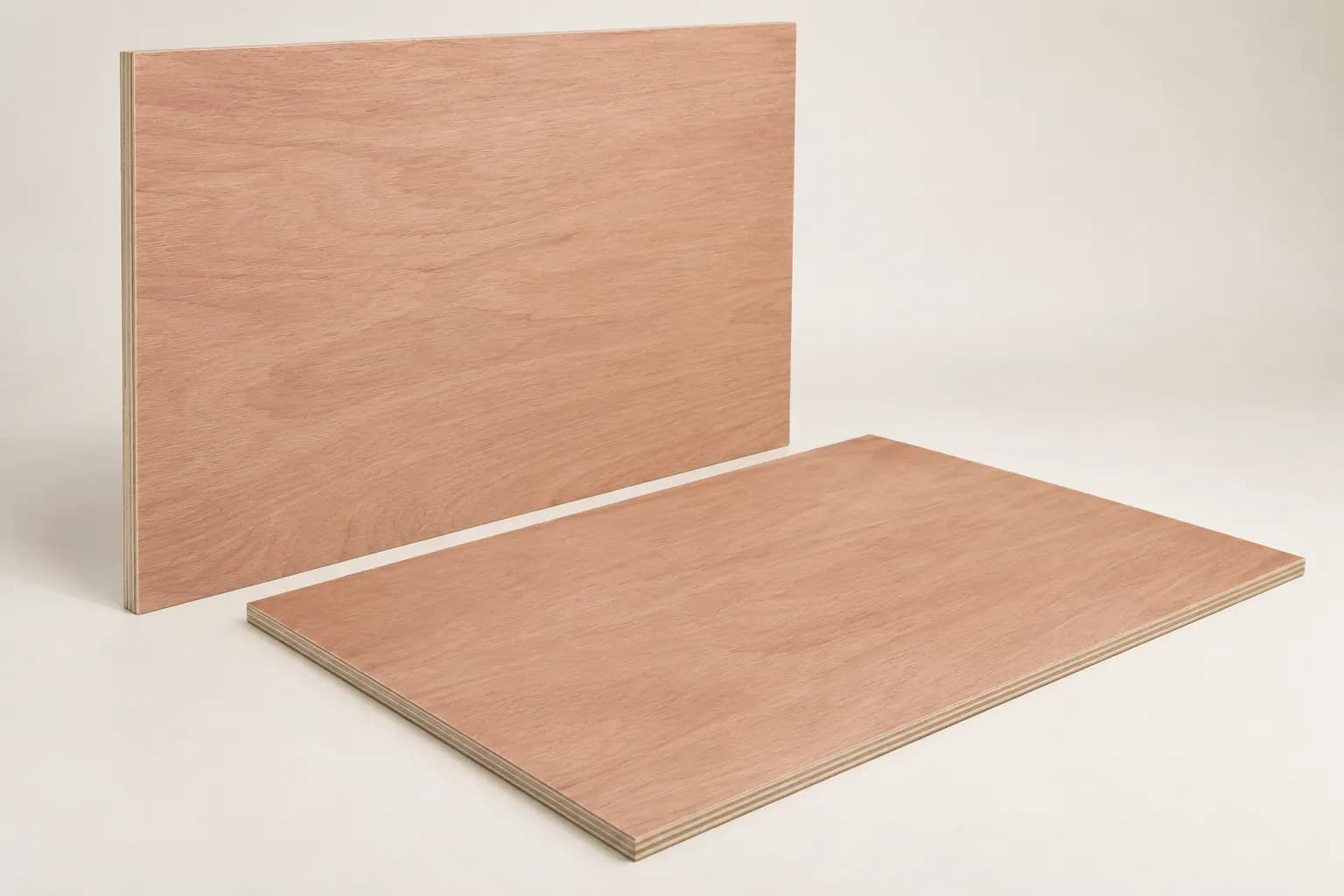
Okoume vs meranti plywood
For both names, distinguish a face veneer from the full panel construction. Our Okoume Plywood options include okoume-faced poplar core, okoume-faced eucalyptus core and all-okoume. Those are different comparisons even when the visible surface is similar.
For a meranti offer, name the supplied species or trade group and the inner veneers. The PROSEA red meranti account distinguishes light and dark red meranti groups with overlapping and varying timber properties. A trade name alone is not one panel density or performance value.
Compare equal finished thickness, face and core quality, bond, sheet mass, machining and coating. For marine or exposed components, use the complete product specification and protection details in Marine Plywood and Marine vs Exterior Plywood; neither an okoume nor a meranti face alone establishes marine grade.
Hardwood does not always mean heavier.
Compare the same sheet length, width, finished thickness and moisture condition. Use the offered construction's sheet mass or density, not a solid-timber value borrowed from the face species.
Sheet weight for handling and freight
A hardwood face over a lighter core and an all-hardwood panel can weigh differently. Mixed cores, veneer thicknesses and moisture also change the comparison. Request the mass per sheet and pack quantity for the construction you are ordering.
Use Birch vs Poplar Plywood for a same-size weight calculation with its stated density inputs. Keep calculated estimates separate from measured sheet or pack mass when planning transport.
Finished weight for the component
For a door, vehicle part or portable case, include the cut panel, edging, laminate or coating, hardware and other fitted layers. Compare that total with the target weight and handling method.
If you need a lighter construction without changing the visible face, discuss the core and supports with our factory. Our Lightweight Plywood and Combi Core Plywood pages help separate the surface choice from the inner construction.
Match machining and finish to your production process.
A species category cannot tell you how a routed edge, hinge hole or painted surface will look. Agree the output your component needs with the selected construction.
CNC work and exposed cut edges
Provide the cutting layout, reference edges, profiles, holes and finished thickness tolerance. Agree tear-out, hole exits, visible core gaps and the appearance of layered edges. Keep grain direction and face quality consistent across adjoining parts.
Hinges, screws and joints
State the hardware, fixing location, hole sizes and joint geometry. Compare the actual face and core at those locations, with the load and fastening arrangement. Do not infer screw holding from a hardwood or softwood name alone.
Clear coating, paint or laminate
For a natural finish, specify grain, colour, veneer repair allowances and sanding. For paint or laminate, agree surface preparation, adhesive or coating compatibility, edge treatment and the reverse-face build-up. Include the finished thickness after those layers are added.
Flatness and moisture condition
Agree flatness, supported storage, moisture condition and preparation before processing. Check fit and surface quality in the condition in which the component will be machined and assembled. Use Surface & Overlay Options to describe the finish.
Choose the grade and documents your project needs.
Name the product standard, grade and relevant performance requirements in the enquiry. Our factory can discuss the construction and documents with the intended component and destination.
Structural and exposed components
For load-bearing work, provide the required panel properties or rating, loads, support layout and installation conditions. For moisture exposure, specify the bond and complete protection: faces, cut edges, joints, drainage and maintenance.
Bond resistance is not the same as decay resistance. APA makes that distinction in its bond-classification explanation. Choose the product and construction around the use rather than requesting a generic waterproof hardwood or softwood panel.
Indoor furniture and fitted interiors
Tell us the destination and required emission method or limit, together with the face, core, adhesive and added surface layers. Identify which side is visible and any customer-specific finish or material requirement.
Use Bonding & Emission Options and Standards & Certifications to prepare those requirements. Sheet dimensions can be selected for cutting yield while retaining the agreed construction and applicable product specification.
Compare finished cost, not just hardwood and softwood sheet prices.
A useful factory quote keeps the face, core, dimensions, processing, quantity and delivery basis clear. This makes alternatives easier to compare and repeat orders easier to specify.
Keep the visible finish comparable
Price the face and back grades your customer will see. Include sanding, coating, applied veneer or laminate and edge finishing. A repaired utility face and a clear-finished decorative face are different purchases.
Compare usable component yield
Use the same cutting layout, grain direction and finished part dimensions. Account for trimming, kerf and any excluded defects, plus the drilling, routing and assembly work required by each construction.
Include weight and handling
Compare finished sheet or part mass, packing and unloading requirements. Add coatings, hardware and other fitted layers when working to a transport or component-weight target.
Align quantity and delivery terms
Quote the same construction mix, dimensions, quantity, currency and delivery term. Discuss production timing separately from transit, and include protective packing and stated destination charges.
CUZI PLY plywood formats: regular 1220×2440, 1250×2500, 1525×3050 mm; on request 1250×3050, 1250×3660, 2100×2800, 1830×3660, 1250×3800 mm. Choose the format around your cutting layout and give the finished thickness and quantity by construction.
Use our Plywood Price Guide for quotation units and delivery costs. Discuss these shared order conditions with our factory:
- Order quantity & mix
- Tell us the sheet size, thickness mix and quantity you need. We confirm the minimum order and available mix for your selected construction.
- Production lead time
- We confirm the production schedule with your specification, order quantity and sample requirements. Production lead times are planning estimates, not transit times.
- Price & quotation unit
- Currency and price unit stated in your quotation. Your quote is based on the agreed dimensions, construction and quantity. Processing and requested testing are stated separately where applicable.
- Samples
- Tell us the plywood, thickness, finish and delivery country. We confirm sample availability, any sample and courier costs, and dispatch arrangements before proceeding.
- Packing & delivery
- We agree export packing, labels and the loading plan for your order. Share the destination country, named port or delivery point and preferred delivery term. Freight, insurance, duties and taxes are included only when stated in the quotation.
- Payment & order confirmation
- We agree the payment method, currency and any deposit and balance schedule in the quotation or proforma invoice. Your order confirmation sets out the product, quantity, packing and delivery arrangements.
Turn your material choice into a complete plywood order.
You do not need every technical detail before contacting us. Send the component, size, quantity and destination; our factory team will help complete the construction, processing and commercial requirements.
Write the full panel construction
State face and back species and grades, core species or mix, veneer arrangement, bond and finished thickness. Mark visible edges and any repairs allowed. Keep a named hoop pine, birch or meranti requirement explicit rather than substituting a broad hardwood or softwood label.
Separate furniture fit from floor capacity
For furniture, give the cutting layout, profiles, hardware, joints, surface finish and fit tolerances. For a subfloor, give the structural grade or rating, loads, spans, supports, panel direction and installation requirements. A good-looking face does not replace the floor specification.
Compare the completed part
Assess the cut edge, hole exits, fixing locations and finished surface using the intended tooling, hardware and coating. Compare equal dimensions and moisture conditions; include edging, hardware and applied finishes in the weight. A component trial is not a structural rating or certification.
Agree the order before production
Send quantities by construction, size and thickness, with destination and target delivery date. We confirm the panel, processing, applicable product documents, price unit, packing and production schedule in the quotation. Keep that specification with repeat orders so similar-looking faces do not hide a different core.
For a construction comparison, request panels at the same thickness and process them with your planned tooling and finish. Tell us which faces and edges matter, and any project performance requirements. We confirm availability, piece sizes, costs and courier arrangements before dispatch.
Hardwood and softwood choices
Questions before you choose the face and core.
What is the difference between hardwood and softwood plywood?
The words identify wood species categories, not one finished panel grade. Hardwood and softwood veneers can be used in the outer faces, inner core or a mixed construction. Compare the specified face, core, veneer arrangement, bond and finished thickness for the component you need.
Is hardwood plywood always stronger than softwood plywood?
No. The actual species, veneer quality, layer arrangement, bond, thickness and panel direction all matter. For a load-bearing component, use the relevant grade and design properties with the loads and support layout. Do not substitute one category for another based on the word hardwood.
Should I choose hardwood or softwood plywood for furniture?
Start with the visible surface, cut edge, component dimensions, joints and finish. A hardwood decorative face can be specified over a different core; a pine or spruce face can be chosen for its own grain character. Match the inner construction, machining and hardware to the cabinet, shelf or other part, then compare complete component cost.
Is hardwood or softwood plywood better for a subfloor?
Choose the structural panel specified for the floor, not the timber category alone. Agree the grade or rating, finished thickness, support spacing, panel direction, edges, fixings, loads and moisture conditions with the project design. A decorative hardwood-faced panel is not automatically a structural subfloor, and a thin underlayment does not replace the load-bearing floor panel.
Can hardwood-faced plywood have a softwood core?
Yes. A face name identifies the outer veneer, not every inner layer. Put the face and back species and grades, core species or mix, layer arrangement and bond in the order. If all-hardwood or all-birch construction is required, state that separately from the face finish.
How do I compare hoop pine and birch plywood?
Identify the complete construction in each offer: hoop pine or birch faces, the inner veneers, grade, bond and finished dimensions. Hoop pine is a softwood, while birch is a hardwood; neither name assigns a universal panel weight or structural rating. Compare the appearance, cut edges, joints, hardware and grade properties relevant to your part.
Is poplar plywood hardwood or softwood?
Poplar is a hardwood, even though a poplar construction may be selected for a lighter component. Hardwood is not a promise of high density or surface hardness. Specify whether poplar is used in the face, core or all veneers and compare the actual offered sheet mass and component performance.
Should I choose poplar plywood or pine plywood?
Compare the complete panel at the same finished dimensions. For visible faces, agree colour, grain, knots and repairs; for the core, consider cut edges, joint fit, fixings and the component's load. Request the actual sheet mass if weight matters. Price the finished surface and processing rather than assuming pine or poplar is always cheaper.
How should I compare okoume plywood and meranti plywood?
First state whether each offer is faced plywood or uses the named wood throughout. CUZI PLY offers okoume-faced poplar core, okoume-faced eucalyptus core and all-okoume construction. For a meranti comparison, identify the supplied species or trade group and inner veneers. Compare equal thickness, face grade, bond, sheet mass, machining and intended exposure.
Does an okoume or meranti face make plywood marine grade?
A face species alone does not establish marine grade. Select the complete veneer construction, face and core quality, bond and applicable product requirements for the component. Include cut-edge protection, coating, drainage and installation conditions, with the product documents your project needs.
Is softwood plywood always lighter or cheaper?
No. Species, core mix, layer arrangement, thickness, finish and order conditions vary. Compare sheet mass at the same dimensions and moisture condition, and compare the delivered cost of equally finished parts. A light-looking face is not a reliable way to identify the inner core or weight.
What should I send CUZI PLY for a hardwood or softwood plywood quote?
Send the component and use, visible face and edge requirements, finished dimensions, machining and fixing layout. Add loads, supports, moisture conditions, weight targets and required documents where relevant, plus quantity and destination. Our factory will discuss the face, core, bond, processing and delivery terms for your plywood order.
Get the appearance and construction your part needs.
Share what you make and how it will be used. CUZI PLY can help select the face, core, bond and processing, then quote the plywood with clear order and delivery terms.
- Component dimensions, finished thickness, visible faces and cut edges.
- Machining, joints, hardware, supports, loads and moisture conditions.
- Weight target, required documents, quantity, destination and timing.
We can arrange a plywood sample for the proposed construction and discuss its costs and courier delivery before dispatch.
Prepare the purchase description with How to Specify Plywood and Plywood Types, Construction & Uses. For a specific birch-core comparison, use Birch vs Poplar Plywood.