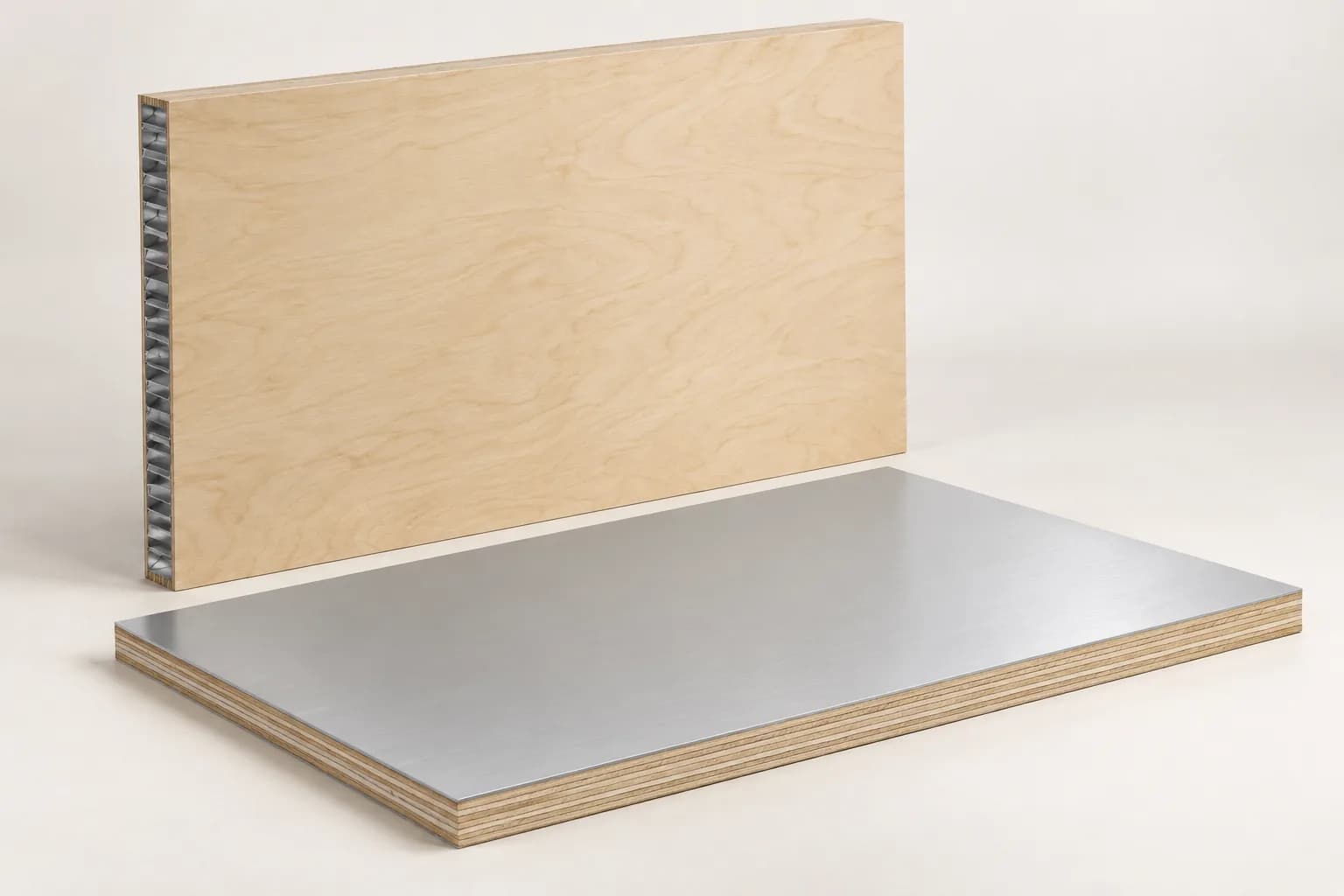
What are composite plywood panels?+
Composite plywood panels combine plywood with other materials in a defined construction. They can use plywood skins around a honeycomb or foam core, or a metal facing bonded to a plywood substrate. Describe both faces, the core, adhesives, edges and reinforcement so the name refers to the panel your component needs.
Does CUZI PLY manufacture the finished composite panels?+
Yes. CUZI PLY is the factory and direct supplier in Linyi, Shandong, China, with 10 production lines across our plywood range. We manufacture the finished composite panels using the specified plywood, cores, facings and adhesives, with agreed machining, edge details, product documents and export packing.
How do I specify honeycomb plywood panels?+
Define the plywood skins on both sides and the honeycomb material, cell arrangement, density and thickness. Add the bonding interfaces, overall thickness, target panel mass, edge closures and insert locations. Include the component loads, supports and required checks with the drawing.
What is a plywood sandwich panel with a foam core?+
It has plywood skins bonded around a specified foam core. Name the foam type and density, skin species and thicknesses, adhesives and complete-panel dimensions. The finished construction and installation need their own mechanical, insulation, moisture or fire information where your project requires it.
Is aluminium faced plywood the same as an aluminium composite sheet?+
No. Aluminium faced plywood has a wood plywood substrate with a bonded aluminium surface. An aluminium composite sheet may have metal skins around a different core. State the actual face-to-reverse construction, including the plywood and adhesive; aluminum is the US spelling of aluminium.
Can I choose one or two metal faces?+
Specify the face and reverse materials and the finish of each side, whether one or both are visible. Include flatness, moisture and temperature requirements so the substrate, facing, adhesive and balancing arrangement are selected together.
How should hinges, handles and brackets be attached?+
Provide their locations and the loads on the component drawing. Specify suitable inserts, edge members, local reinforcement or through-fixing details rather than relying on an unsupported cellular core. Keep backing, bonding, fasteners and the relevant attachment checks with the panel order.
How do I compare the weight of different composite panels?+
Compare complete constructions at the required finished size, thickness and component requirements. Use finished-panel kg/m² or measured part mass, including facings, adhesives and reinforcement. Core density alone does not give the mass of the finished panel or its attachment hardware.
How do I specify moisture and fire requirements?+
Describe the intended environment and installation, then name the required methods and documents for the finished construction. Include skins, core, adhesives, coating, cut edges and joints. A metal surface or moisture-resistant core alone does not classify the complete panel for fire or wet-service use.
Can I order custom sheet sizes and finished components?+
Yes. Use our factory formats or send a cut list with exact dimensions, thickness, quantity, tolerances and surface direction. Identify inserts, edge members, holes and exposed edges before cutting. Custom length and width are manufacturing choices; keep the product construction and applicable documents with the order.
What should I include for machining and assembly?+
Provide reference edges, profiles, holes, joints, inserts and fixing locations, with the required fit and finish. Specify the intended processing method and protective support. We confirm cutting, machining, closure, labelling and packing scope in the factory quotation.
What should stay the same when I reorder composite components?+
Keep the part codes, drawing revision and complete face-to-reverse construction with the repeat order. Record the skins, core, facings, adhesives, perimeter members and insert locations, along with surface direction, finished dimensions, mass target and tolerances. Retain the product documents and pack labels from the first delivery, then identify any changes to fixings, finish or service conditions. A similar face, thickness or weight does not make a different core or bonding arrangement interchangeable.
Should I buy full sheets or machined composite components?+
Compare the same finished part list and complete construction, including skins, reverse, core, edge members and inserts. A sheet quote needs a layout that preserves internal fixing support; a component quote also lists cuts, profiles, holes, edge closures, finish, checks, labels and protective packing. Include freight and the work your workshop still needs to do, such as hardware and final assembly. Compare the price unit and delivered part quantities, not just a sheet price or core density.
How do I get a quote or request a sample?+
Send the component use, face and core materials, finished thickness, dimensions, mass target, edge and fixing details, quantities and destination. Add required documents and delivery timing. For a sample, identify the surface, core, edge or attachment detail you want to evaluate; we confirm availability, any sample and courier costs and dispatch arrangements before proceeding.