PLYWOOD DIMENSIONSWIDTH × LENGTH × THICKNESS
Plywood Sizes and Thicknesses: Metric, Imperial and Oversize Formats
Compare common plywood sheet sizes from 1200 × 2400 to 1250 × 2500 mm, square birch sheets and larger project panels. See exact metric-to-inch conversions for nine popular thicknesses, understand why 18 mm differs from 3/4 in, and build an order with the finished size, tolerance, grain direction, quantity and packing details CUZI PLY needs.
Choose the plywood type
Write width × length × thickness
Include mm or inches
Agree finished thickness and tolerance
Mark face grain or strength axis
Give quantity for each size
Confirm packing and unloading for larger sheets
Common sheet sizes and larger formats
Start with the finished sheet width × length in millimetres. The inch column is calculated using 1 inch = 25.4 mm; confirm the size offered for your selected plywood construction.
4 ft × 8 ft converts exactly to 1219.2 × 2438.4 mm.1220 × 2440 mm is commonly called 4×8 class, not an exact mathematical equivalent. Some markets say 8×4; the written order still controls.
Swipe to compare all columns →
| Metric reference | Calculated inch reference | Usage note |
|---|---|---|
| 1200 × 2400 mm | 47.2441 × 94.4882 in | Metric sheet size for projects that specify a 1200 mm width; include the grain direction in the order. |
| 1220 × 2440 mm | 48.0315 × 96.063 in | Widely used export size, often called 4×8 class; the exact 4 ft × 8 ft conversion is 1219.2 × 2438.4 mm. |
| 1250 × 2500 mm | 49.2126 × 98.4252 in | Common metric export size for selected plywood constructions and pressing programmes. |
| 1525 × 1525 mm | 60.0394 × 60.0394 in | Square birch-family reference; specify the face grade, ply construction and finished thickness. |
| 1220 × 2800 mm | 48.0315 × 110.2362 in | Long panel for selected projects; match the pack base and handling support to the 2800 mm length. |
| 1525 × 3050 mm | 60.0394 × 120.0787 in | Wide project sheet often called 5×10 class; exact 5 ft × 10 ft is 1524 × 3048 mm. |
| 1220 × 3660 mm | 48.0315 × 144.0945 in | Long panel requiring full-length support and a transport plan matched to the packed dimensions. |
| 1220 × 3800 mm | 48.0315 × 149.6063 in | Long project panel; agree core, flatness, pack design and unloading equipment. |
| 1220 × 4200 mm | 48.0315 × 165.3543 in | Extended-length project panel; check press capacity, support, packed length and delivery access. |
SHEET SIZE COMPARISON
See how sheet footprints change.
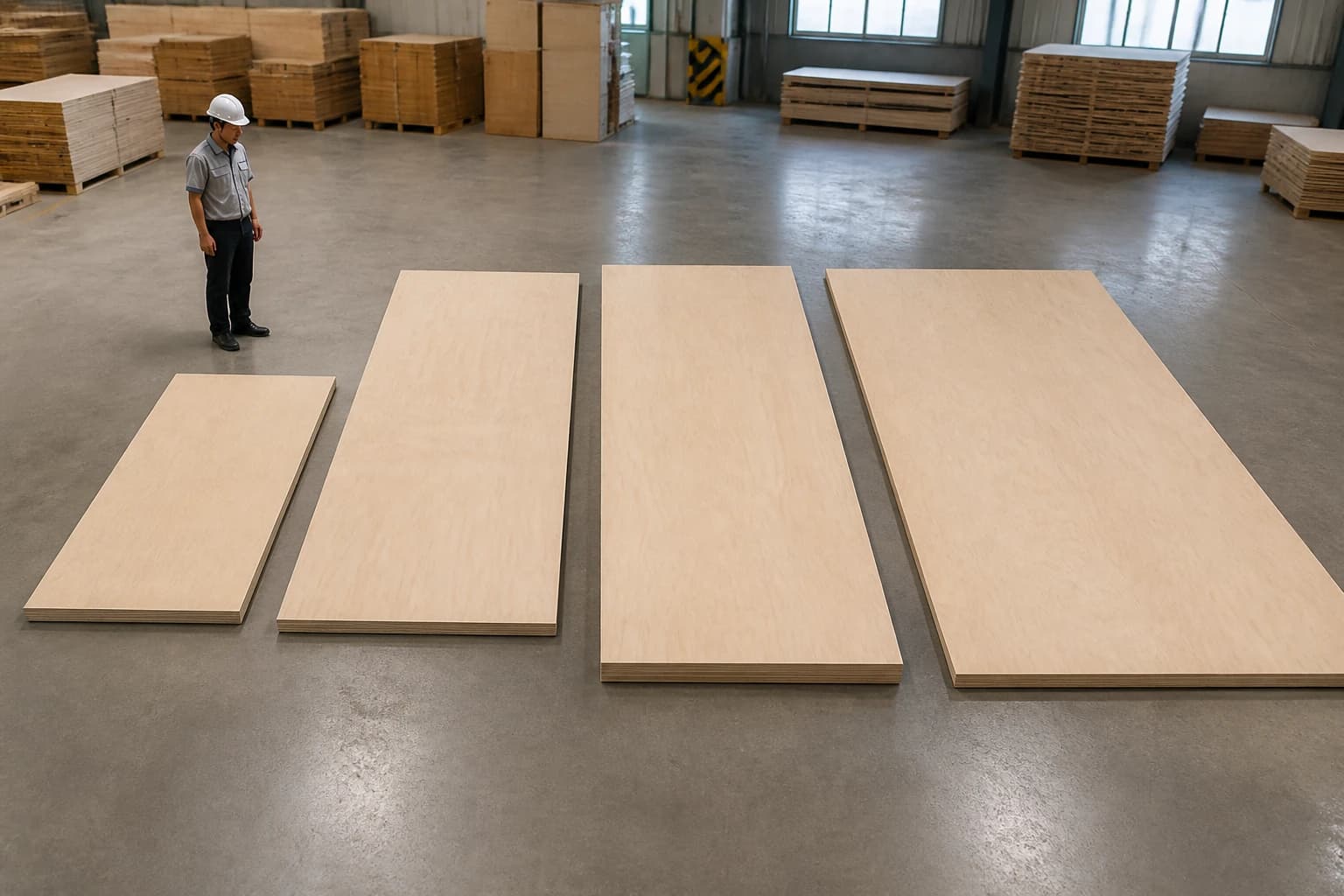
Compare sheet proportions at one scale
These outlines show how longer or wider formats change the panel footprint and the support needed in handling.
Metric thicknesses and inch equivalents
Compare the exact decimal conversion with the nearest familiar fraction. For example, 18 mm is 0.7087 in, while 3/4 in is exactly 19.05 mm; specify the required finished thickness and tolerance.
Swipe to compare all columns →
| Metric thickness | Exact conversion | Nearby fraction | Fraction in mm | Typical selection |
|---|---|---|---|---|
| 3 mm | 0.1181 in | 1/8 in | 3.175 mm | Thin backing, craft and precision-cut components; check flatness and handling. |
| 4 mm | 0.1575 in | 1/8 in | 3.175 mm | Thin furniture parts, linings and light fabricated components. |
| 6 mm | 0.2362 in | 1/4 in | 6.35 mm | Drawer parts, backing and light interior components; match stiffness to support spacing. |
| 9 mm | 0.3543 in | 3/8 in | 9.525 mm | Interior linings, cabinet parts and fabricated panels. |
| 12 mm | 0.4724 in | 1/2 in | 12.7 mm | Cabinet components and general joinery; define screw locations and support. |
| 15 mm | 0.5906 in | 5/8 in | 15.875 mm | Furniture and partitions where machining, weight and stiffness must balance. |
| 18 mm | 0.7087 in | 3/4 in | 19.05 mm | Common cabinet, flooring and formwork thickness; specify 18 mm when that is the finished target. |
| 21 mm | 0.8268 in | 7/8 in | 22.225 mm | Thicker parts and supported platforms; plan the panel weight and fastening details. |
| 25 mm | 0.9843 in | 1 in | 25.4 mm | Thick fabricated components; check machining, handling and finished-edge requirements. |
Swipe to compare all columns →
| Fraction | Exact metric value |
|---|---|
| 1/8 in | 3.175 mm |
| 1/4 in | 6.35 mm |
| 3/8 in | 9.525 mm |
| 1/2 in | 12.7 mm |
| 5/8 in | 15.875 mm |
| 3/4 in | 19.05 mm |
| 1 in | 25.4 mm |
Specify the ordered and measured thickness
State the nominal product name, the finished manufacturing target and the agreed measurement tolerance together, especially for calibrated, sanded or overlaid panels.
Order 18 mm as 18 mm; use 3/4 in when the inch-based product system is required.
- Search / market label
- A familiar phrase used to find or discuss a panel; it may combine nearby but non-identical products.
- Nominal thickness
- The order or market designation used for a product system; it does not by itself state every measured value.
- Manufacturing target
- The specified finished-panel target that production is asked to achieve.
- Measured actual
- Observed values taken on the finished panel under the agreed method and condition.
- Acceptance tolerance
- The permitted relationship between ordered target and measured values, including sampling and decision rule.
- Performance category / standard label
- A label used only inside the named product and standard system; it is not a global metric equivalent.
- Finished-panel definition
- States sanding, unsanded condition, overlay and any machining that affect what is measured.
APA Performance Categories such as 23/32 belong to the specific North American performance-rated panel system. They do not redefine 18 mm plywood worldwide, and an APA trademark applies only within the corresponding member-mill and standard context.
Measure the finished sheet consistently
For a repeatable inspection, agree the finished-panel condition, sampling points, calibrated tools and acceptance tolerance in the order. Length, width, thickness, squareness, straightness and flatness are separate checks.
- Name the applicable product standard or agreed measurement method.
- State the moisture condition of the finished panels at measurement.
- Use a calibrated thickness gauge and measuring tools suited to the sheet size.
- Measure finished thickness, length and width separately.
- Check edge straightness, squareness and flatness where the application requires them.
- Agree the number and positions of measurements and the permitted variation.
- Record results by production lot with the tool, date and measured panel identified.
Include the applicable product standard or written tolerance schedule in the quotation. Sanding and overlays affect which finished surfaces are measured.
THICKNESS MEASUREMENT
Measure between the finished faces.

Mark the face grain and strength axis
Show grain direction with an arrow relative to the stated width and length. For structural panels, use the declared strength axis; for furniture and decorative panels, specify the required visible grain orientation.
- Plywood face grain runs in a defined direction across the sheet.
- Specify face-grain direction for visible veneer, furniture panels and cut parts.
- For structural plywood, identify the product's declared strength axis and installation orientation.
- Laser cutting and patterned overlays may need a specific face or machining direction.
- Add a grain arrow to the drawing and relate it to width and length.
- Match the ordered panel and installation details to the applicable structural design when load-bearing use is intended.
Choose dimensions for the plywood type
Standard and larger formats vary by core, face, treatment, surface and press capability. Open a product page for its construction details, then send the required finished size and quantity for a quotation.
Swipe to compare all columns →
| Product | Common sheet sizes | Thickness | Dimension basis |
|---|---|---|---|
| Film Faced Plywood | 1220 × 2440; 1250 × 2500 mm | 9–25 mm by configuration | Film overlay, flatness and sealed edges for formwork sheets |
| Structural Plywood | Standard or project format within the declared system | Confirm size and thickness for the selected construction | Declared strength axis, span and structural panel grade |
| Marine Plywood | Conventional marine construction formats | Confirm size and thickness for the selected construction | Veneer construction, exterior bond and finished edge protection |
| HDO/MDO Plywood | Confirm size and thickness for the selected construction | Confirm size and thickness for the selected construction | Overlay type, face balance and press size |
| Pressure-Treated Plywood | Confirm size and thickness for the selected construction | Confirm size and thickness for the selected construction | Finished dimensions after treatment and drying |
| Fire-Retardant Plywood | Format within the exact tested construction | Confirm size and thickness for the selected construction | Thickness and construction covered by the fire-test documents |
| T1-11 Grooved Plywood Siding | Confirm size and thickness for the selected construction | Confirm size and thickness for the selected construction | Groove spacing, siding profile and edge detail |
| Commercial Plywood | 1220 × 2440; 1250 × 2500 mm | 3–30 mm by construction | Core construction, thickness tolerance and face grade |
| Furniture Grade Plywood | Conventional furniture-program formats | Confirm size and thickness for the selected construction | Calibration, machining and exposed-edge quality |
| Birch Plywood | 1220 × 2440 and birch-family formats by lot | Confirm size and thickness for the selected construction | Birch ply construction and calibrated thickness |
| Baltic Birch Plywood | 1525 × 1525 mm reference; other formats by qualified lot | Confirm thickness for the supplied lot | All-birch substrate lot and finished processing dimensions |
| Hardwood Plywood | Conventional export formats | Confirm size and thickness for the selected construction | Hardwood species, density and machining plan |
| Poplar Plywood | 1220 × 2440; 1250 × 2500 mm | Confirm size and thickness for the selected construction | Poplar core, panel flatness and long-sheet support |
| Laser-Cutting Plywood | Confirm size and thickness for the selected construction | Confirm size and thickness for the selected construction | Thin-sheet flatness, ply uniformity and cutting trial |
| Melamine Plywood | 1220 × 2440; 1250 × 2500 mm | 9, 12, 15, 18, 21 and 25 mm by programme; project 3–30 mm by construction and quantity | Melamine décor, plywood substrate and finished thickness |
| HPL Plywood | 1220×2440 and 1250×2500 mm by programme | About 6–30 mm by HPL-A / HPL-B programme; HPL-C exact tested or assessed thickness | HPL laminate, plywood substrate and finished thickness |
| Anti-Slip Plywood | 1220 × 2440; 1250 × 2500 mm | Confirm size and thickness for the selected construction | Anti-slip pattern, overlay continuity and core thickness |
| Packing Plywood | 1220×2440 and 1250×2500 mm; cut blanks after drawing confirmation | PKG-A 3–21 mm; PKG-B 4–25 mm; PKG-C 6–30 mm | Case drawing, cut-blank sizes and fastening requirements |
Plan production and handling for larger panels
Larger sheets change press and veneer requirements, flatness control, pack support and receiving equipment. The area shown is the face area of one panel.
1220 × 3800 mm
4.636 m² per sheetA long panel needs continuous support from the press through packing and unloading.
- Manufacture
- Confirm veneer supply, press opening, finished thickness and flatness for the selected plywood.
- Support
- Size the pack base to the complete 1220 × 3800 mm footprint and align the bearers.
- Protection
- Specify top and bottom sheets, corner protectors, edge guards and strap positions.
- Delivery
- Compare packed dimensions and mass with the vehicle door, lifting equipment and unloading space.
1250 × 3800 mm
4.75 m² per sheetA long panel needs continuous support from the press through packing and unloading.
- Manufacture
- Confirm veneer supply, press opening, finished thickness and flatness for the selected plywood.
- Support
- Size the pack base to the complete 1250 × 3800 mm footprint and align the bearers.
- Protection
- Specify top and bottom sheets, corner protectors, edge guards and strap positions.
- Delivery
- Compare packed dimensions and mass with the vehicle door, lifting equipment and unloading space.
1525 × 3050 mm
4.65125 m² per sheetA wide panel needs a press, pack base and lifting equipment sized for the full sheet.
- Manufacture
- Confirm veneer supply, press opening, finished thickness and flatness for the selected plywood.
- Support
- Size the pack base to the complete 1525 × 3050 mm footprint and align the bearers.
- Protection
- Specify top and bottom sheets, corner protectors, edge guards and strap positions.
- Delivery
- Compare packed dimensions and mass with the vehicle door, lifting equipment and unloading space.
2100 × 2800 mm
5.88 m² per sheetA wide panel needs a press, pack base and lifting equipment sized for the full sheet.
- Manufacture
- Confirm veneer supply, press opening, finished thickness and flatness for the selected plywood.
- Support
- Size the pack base to the complete 2100 × 2800 mm footprint and align the bearers.
- Protection
- Specify top and bottom sheets, corner protectors, edge guards and strap positions.
- Delivery
- Compare packed dimensions and mass with the vehicle door, lifting equipment and unloading space.
Calculate area, volume and estimated sheet weight
Use finished dimensions for quantity planning and your chosen construction's density for weight estimates. Add pallets and protection separately when planning transport.
Panel area
width(mm) × length(mm) ÷ 1,000,000Result unit: m²
Volume per sheet
area(m²) × thickness(mm) ÷ 1,000Result unit: m³
Estimated net panel mass
volume(m³) × agreed density(kg/m³)Result unit: kg
Worked volume example
1220 × 2440 × 18 mm → 2.9768 m² × 18 ÷ 1,000 = 0.05358 m³ per sheet.
Insert the density agreed for the selected construction; packaging mass is added separately. Mixed-thickness orders are calculated by SKU and then summed. Planning mass is not a container payload or freight quotation.
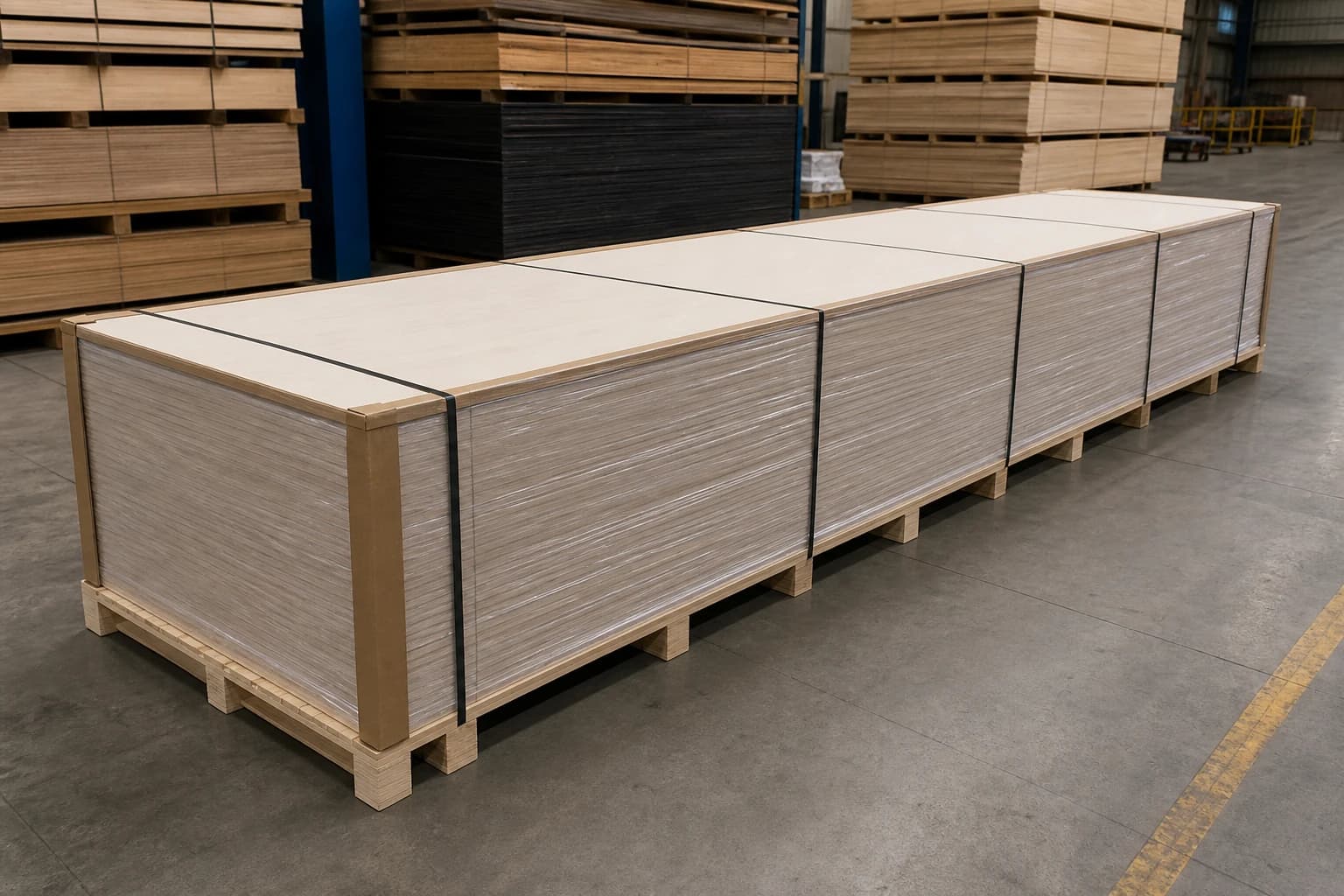
Protect and support the full sheet
Specify a pack base sized for the panels, aligned bearers, face and edge protection, lifting access and the receiving equipment at the destination.
- Support the full panel footprint.
- Set bearer number, spacing and alignment for the packed sheet size.
- Add top and bottom protection sheets.
- Choose moisture protection suited to the journey and storage conditions.
- Protect edges and corners while keeping the faces clean.
- Position straps over protectors so tension does not mark or deform the panels.
- Leave suitable fork or spreader access for the packed mass.
- Check the packed dimensions against vehicle opening, payload and receiving equipment.
LARGE-SHEET PACKING
Support the complete panel footprint.
Send a clear size and thickness schedule
List each size and thickness with its quantity, product construction, finish, tolerances and destination. Add a drawing when grain direction or cutting orientation matters.
- Plywood type
- Application
- Finished width and length
- Large format requested, if any
- Finished thickness
- Millimetres or inches
- Nominal designation and finished target
- Tolerance and measurement method
- Face grain or strength axis
- Core and ply construction
- Flatness requirement
- Quantity per size
- Face, edge and machining finish
- Support during handling
- Pack base and bearer layout
- Estimated pack mass
- Vehicle opening and loading equipment
- Destination and delivery point
- Unloading equipment and access
- Required product standard and documents
- Reference sample, if available
- Permitted substitutions
- Target delivery date
Send the schedule to [email protected].
Explore plywood products and specifications
Compare constructions, inspection requirements and packing before finalising a size schedule.
Choose the product
Product CatalogueCompare plywood types by end use, face, core and bond.Commercial PlywoodCompare general-purpose sheet sizes and core options.Film Faced PlywoodMatch long formwork panels to film, core, press and edge requirements.Structural PlywoodMatch panel size, thickness and strength axis to the structural specification.Resolve construction
Marine PlywoodSelect veneer, bond and thickness for the intended wet-service use.Fire-Retardant PlywoodMatch ordered thickness to the fire-test documentation.Furniture Grade PlywoodContinue from format into calibration, machining and appearance requirements.Birch PlywoodReview birch construction, square formats and precision requirements.Resolve material and format
Baltic Birch PlywoodCheck all-birch ply construction and available sheet dimensions.Hardwood PlywoodRelate format to density, edge quality, handling and machining.Poplar PlywoodExplore lightweight core construction and long-panel sizes.Packing PlywoodConnect sheet format to case design, fasteners, mass and handling.Close inspection and RFQ
Quality & InspectionSee how finished dimensions and surface quality are checked.Export ProcessPlan packing, documentation and delivery for your sheet mix.How to Specify PlywoodBuild a complete specification for material, bond, surface and dimensions.Request a QuoteSend your size schedule, quantity, finish and destination.DECISION QUESTIONS
Before the purchase order
Choose the right specification.
What is a standard plywood sheet size?
Common export sheet sizes include 1220 × 2440 and 1250 × 2500 mm. A 1200 × 2400 mm metric format and 1525 × 1525 mm birch-family square sheet are also used. Availability depends on the selected plywood construction and order quantity.
Is 4×8 plywood exactly 1220×2440 mm?
An exact 4 ft × 8 ft sheet is 1219.2 × 2438.4 mm. The familiar 1220 × 2440 mm sheet is slightly larger in both directions, so write the required finished dimensions in the order.
Does width or length come first in a plywood order?
This guide uses width × length × thickness, followed by the unit. For cut parts or visible veneer, add a drawing arrow showing face-grain direction; for structural panels, identify the declared strength axis.
Is 18 mm plywood the same as 3/4 inch plywood?
18 mm converts to 0.7087 in. A true 3/4 in thickness is 19.05 mm, a difference of 1.05 mm. Specify the finished target and tolerance needed by the joint, machining process or panel system.
What is nominal versus actual plywood thickness?
Nominal thickness is the product's ordering designation. The manufacturing target is the specified finished thickness, and actual thickness is measured on the completed sheet. Agree the tolerance and measurement condition for sanded or overlaid panels.
Which tolerance should be specified?
Specify separate limits for finished thickness, length, width, squareness, straightness and flatness as your use requires. Include the measurement method, sampling quantity and applicable product standard or written drawing with the order.
Can every plywood product be supplied in oversize sheets?
Large-sheet availability depends on veneer or substrate dimensions, press capacity, core construction, finished flatness and the full packing and transport plan. Send the plywood type, exact sheet dimensions, thickness and quantity for a project quotation.
How are 1220×3800, 1250×3800, 1525×3050 and 2100×2800 mm supplied?
These sizes are evaluated for the selected plywood construction. The quotation covers press and material capacity, finished thickness, flatness, pack support, calculated mass, vehicle opening and unloading equipment. State the exact format and destination so the complete shipment can be planned.
How should face grain or strength axis be stated?
Mark the direction with an arrow on the panel drawing and identify it relative to the listed width and length. The structural strength axis follows the declared product properties; a decorative panel may instead follow visible-grain or cutting requirements.
What information is needed for an oversize plywood RFQ?
Provide the plywood type and use, width × length × thickness with units, quantity by size, surface and edge finish, grain direction, finished tolerance, destination, unloading method and any required packing or testing documents.
Plywood enquiry
Tell us what you need.
Tell us the plywood type and intended use, then list each finished width × length × thickness with units and quantity. Include your tolerance and measurement method, face-grain direction, core and face construction, surface or machining requirements, destination, unloading equipment and preferred packing. Attach a drawing or sample specification if you have one; we can discuss the delivery term with your quotation.
CHAT WITH CUZI PLY↗