Standard HPL
Interior and high-use surface duty with complete panel stability and fabrication control.
CUZI PLY supplies HPL plywood for cabinet doors, worktops, tables, retail fixtures, wall panels and project joinery. Each finished panel combines a named HPL manufacturer, collection, decor, texture and performance grade with a calibrated poplar, combi, hardwood or birch-based plywood substrate, compatible adhesive and balanced reverse construction. Standard interior options use 0.5–0.7 mm HPL and an 8–12% substrate-moisture target; high-use options can use 0.8–1.0 mm HPL and an 8–10% controlled moisture window. Quotations state the complete face/back build, finished dimensions, tolerances, CNC and drilling requirements, edge treatment, surface tests, packing and destination documents.
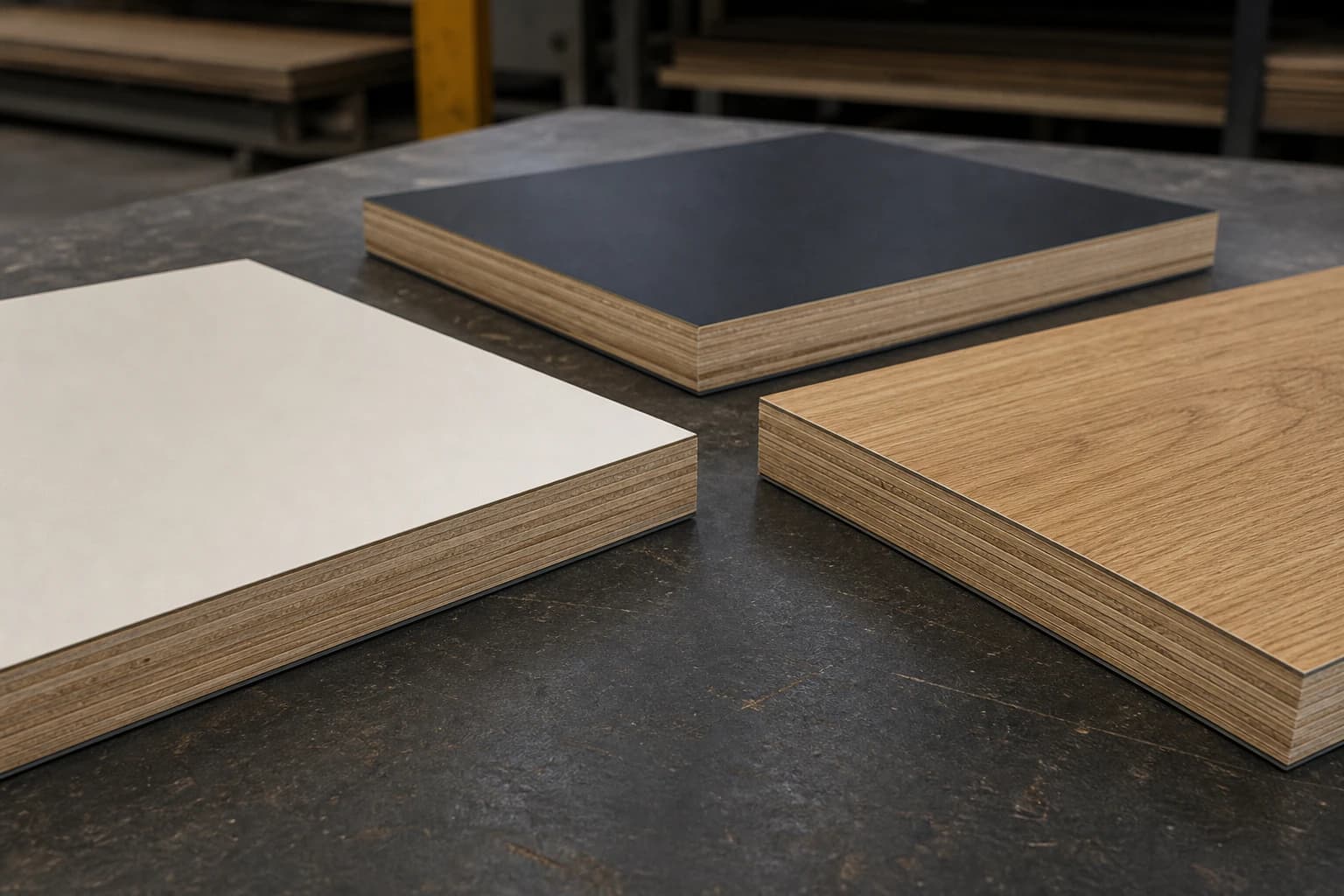
HPL-faced plywood samples show thin laminate faces, controlled bond lines, cross-laminated plywood edges and balanced reverse constructions on one comparison plane.
The HPL face, adhesive, calibrated plywood and balancing layer are specified together because each layer affects appearance, bond quality, flatness and machining.
The face is a separately manufactured high-pressure decorative laminate bonded to a calibrated plywood substrate with a compatible adhesive. A matching face or engineered balancing layer manages stress and flatness, while the chosen edge treatment prepares the panel for its finished use.
HPL plywood retains the light weight, screw holding and cross-laminated structure of plywood while adding a durable decorative surface. It is specified separately from compact laminate, loose HPL sheet and direct-faced melamine plywood so the buyer receives the intended finished panel.
Interior and high-use surface duty with complete panel stability and fabrication control.
Exact finished assembly, mounting and classification requirements matched to the project documents.
Choose this family for dry-interior furniture and cabinet parts that need a named HPL decor, a stable plywood substrate and repeatable fabrication.
Choose the high-use family when abrasion, scratch, impact, stain, heat, balance and first-article machining require measurable acceptance criteria.
Choose this project family when the HPL face, adhesive, fire-retardant plywood substrate, balancing layer, dimensions, mounting and joints are specified as one finished assembly for testing or assessment.
Abrasion, scratch, impact, stain, dry heat, wet heat and colour stability are selected by HPL grade and an agreed method. Worktops, counters, wall linings and furniture receive different combinations of wear, cleaning, impact and heat requirements.
For standard interiors, specify the named HPL supplier grade and its declared EN 438 or ISO 4586 option. For high-use worktops or commercial interiors, state the method and required abrasion class or initial/final wear-point cycles for the selected finish, together with the intended cleaning duty.
State the test method and applied load, then set the maximum visible scratch, mar or sheen change under agreed lighting. Texture and gloss affect how damage appears, so keep a physical master sample with the result.
Name the impact method, striker or object, energy or drop height and supported specimen condition. Accept only the agreed limit for indentation, cracking, chipping, bond-line opening or delamination on the finished composite panel.
List the actual household or commercial agents, concentration, dwell time and number of cleaning cycles. Accept the surface when staining, gloss change, swelling, edge attack and laminate lift remain inside the selected rating or master-sample limit.
Treat dry heat and wet heat as separate duties. State temperature, contact time, vessel or medium and edge condition, then inspect the face and bond for blistering, cracking, discolouration, imprinting or delamination against the selected method.
Record the decor code, texture, sheen and replacement master. Where light exposure matters, name the exposure method and required rating or colour-difference tolerance, and select an exterior-rated system when exterior UV duty is required.
The complete specification also states the plywood bond, edge exposure, cleaning agents, hardware and support so the surface and substrate perform together in the finished component.
The plywood face is prepared flat, clean, dry and calibrated for the selected adhesive. Adhesive spread, assembly time, platen support, pressure, temperature and cure are stated with the face and reverse construction.
Face quality, core, lay-up, bond, moisture and calibration prepare the plywood for lamination.
Chemistry, spread, assembly window, platen support, press cycle and cure define the bond line.
Face and reverse stresses are checked after conditioning, machining and the proposed panel size.
Single-faced panels use an engineered reverse construction. Double-faced panels use compatible face/back grades, thicknesses and press sequencing so the complete build remains balanced after conditioning and machining.
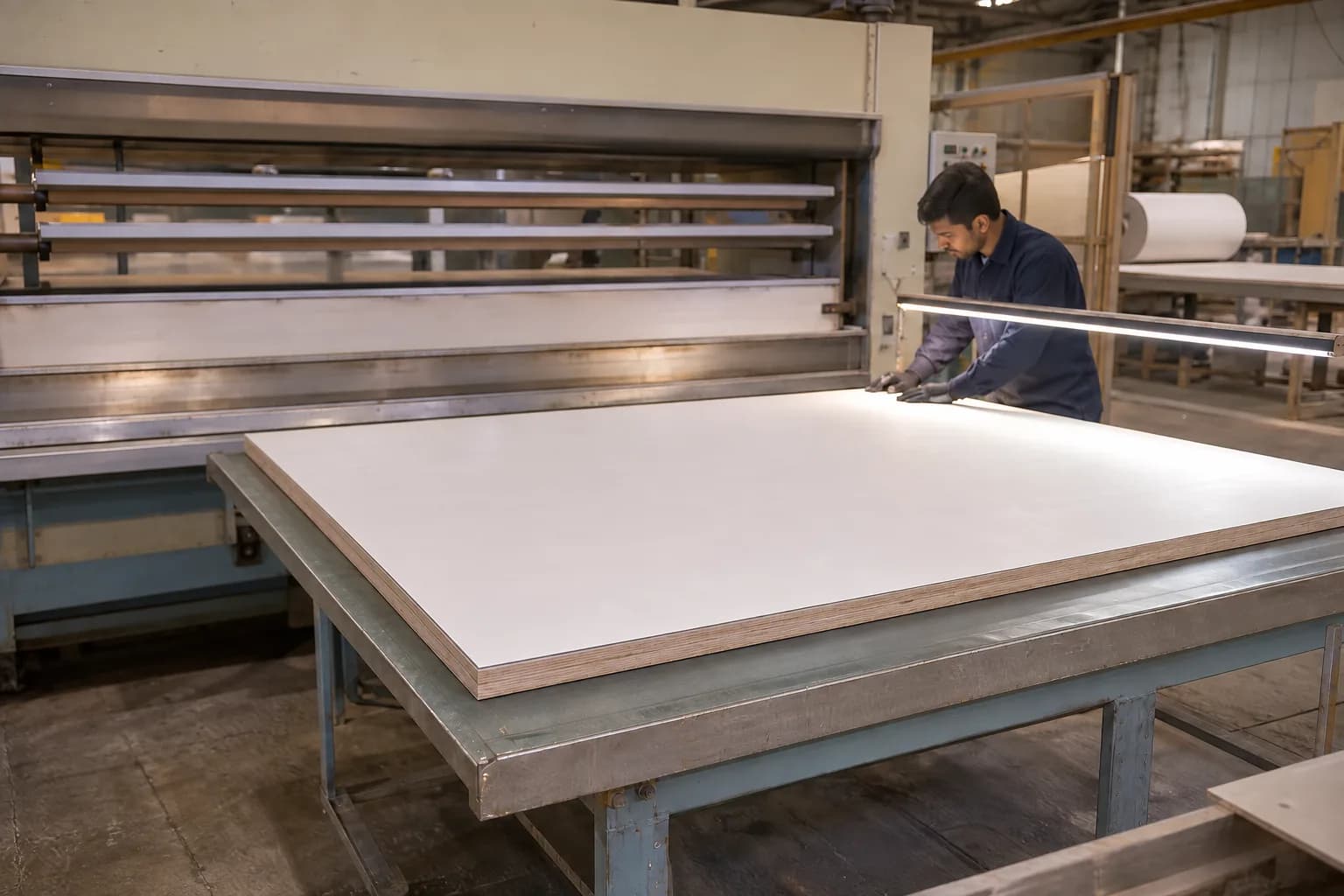
The panel stays fully supported during pressing and inspection, with adhesive application, press cycle and finished quality checked against the order specification.
Compare Standard Interior, High-Use Commercial and Fire-Retardant Project on the same basis to see what changes between the three options.
Named HPL manufacturer, collection, decor, texture, grade and laminate thickness.
Single or double face, calibrated plywood substrate, compatible adhesive and balancing layer.
Poplar, combi, eucalyptus, hardwood or birch-based cores with 8–12% moisture targets.
Abrasion, scratch, impact, stain, heat, cleaning and colour requirements stated by method.
Finished thickness, flatness, CNC, drilling, hardware and edge finish checked on the selected build.
USD 350–800/m³ planning range with SKU quantity, packing, lead time and destination documents confirmed.
| Decision field | Standard Interior | High-Use Commercial | Fire-Retardant Project |
|---|---|---|---|
| Intended use / programme | Dry-interior furniture, cabinet parts, shelves and doors | High-use worktops, tables, storage and commercial interiors | Project-defined lining, door, partition or interior assembly with a named fire-performance requirements |
| HPL manufacturer / collection / code | Named supplier collection and decor code | Named performance collection, grade and decor code | Project-nominated fire-option HPL manufacturer, product and batch identity |
| HPL class / grade | General-purpose thin HPL for bonding to a substrate | High-use grade selected by specified surface duties | HPL grade included in the exact finished-assembly test or assessment option |
| HPL nominal thickness | Typically 0.5–0.7 mm; exact supplier value recorded | Typically 0.8–1.0 mm for the stated surface duty | Exact tested or assessed face thickness retained for the project construction |
| Colour / decor reference | Standard solid or woodgrain supplier code | Signed commercial-interior colour master and replacement rule | Project schedule, sample reference and fire-option product identity |
| Texture / finish / sheen | Matt, smooth or selected wood texture | Defined texture, gloss window and cleanability expectation | Exact tested surface finish and project visual master |
| Face arrangement | Single HPL face with engineered backer, or matched double face | Matched or coordinated HPL faces with recorded grade and thickness | Exact tested face/back arrangement retained for the classified assembly |
| Reverse / balancing layer | Compatible balancing laminate or approved backer | Performance-matched reverse HPL or qualified balancing sheet | Exact balancing layer included in finished-assembly scope |
| Directional pattern and orientation | Direction marked when the decor requires it | Grain, sequence and part orientation stated in the drawings | Orientation included in the specimen and installation schedule where relevant |
| Approved master sample / colour tolerance | A4 decor sample plus panel corner | Signed full-build master with colour and sheen limit | Assembly sample linked to the project documents and production lot |
| Face/back veneer under laminate | Sanded C-grade or better face after filling and sanding | Selected calibrated face with tight repair and telegraphing limits | Fire-retardant substrate face grade retained from assessed construction |
| Core species | Poplar or approved combi core | Selected eucalyptus, hardwood, birch or stable combi option | Fire-retardant plywood species and treatment programmes fixed by project scope |
| Core construction | Balanced veneer core for interior parts | Void-controlled multi-ply construction for machining and edge quality | Exact treated lay-up, veneer option and density stated in the classified construction |
| Lay-up / ply count | Stated for the ordered base thickness | Symmetrical schedule and ply count stated by production lot | Ply schedule matched to the specified project construction |
| Core gap / overlap / repair option | Utility limits against approved edge sample | Machining-zone gap, overlap and repair limits mapped | Defect limits match the assessed substrate and final application |
| Substrate density | Declared range for the selected core | Measured lot range for weight and machining stability | Finished assembly and substrate density recorded for classification scope |
| Substrate moisture | 8–12% target before lamination | 8–10% controlled window before adhesive application | Conditioned value matched to the adhesive and classified specimen |
| Substrate calibration | Two-face sanding to lamination tolerance | Thickness map and surface quality check before lamination | Calibration fixed to assessed assembly thickness and press plan |
| Plywood bond / exposure requirements | Interior or defined humid bond selected separately | bond specifications matched to cleaning and service exposure | EN 314 / ISO 12466 substrate bond documents stated alongside the fire-performance requirements |
| Substrate emission requirements | Destination-specific substrate documents on request | Finished-panel emission requirements after HPL and adhesive selection | Applicable emission and fire documents matched to the exact finished construction |
| Adhesive chemistry / approved system | CUZI PLY-recommended PVA, PUR or other interior lamination system | Performance adhesive qualified to HPL back, plywood face and duty | Exact compatible adhesive represented in the fire test, assessment or engineering specification |
| Surface preparation | Clean, dry and uniformly sanded plywood; HPL back prepared to supplier instruction | Controlled roughness, dust removal and flatness check | Preparation method matched to the adhesive and classified assembly |
| Adhesive spread / application control | Calibrated spread and full-area visual coverage | Recorded spread mass, roller/press option and witness coupon | Exact application rate and control method retained in project file |
| Open / closed assembly time | Adhesive supplier window recorded for shop conditions | Temperature, humidity and elapsed time logged by batch | Assembly times fixed by qualified adhesive procedure |
| Press method | Level cold or heated flat press suited to the adhesive | Controlled platen press with full support and pressure mapping | Press option matched to the qualified finished assembly |
| Press temperature / pressure / time | CUZI PLY window confirmed before first production | Recorded cycle and first-panel verification | Exact cycle is a controlled fire-assembly input |
| Cure / conditioning | Flat support through minimum cure period | Conditioned stack and flatness check before machining | Defined cure, conditioning and specimen state for the classified assembly |
| Bond-line acceptance | Closed, aligned bond line free of slip, bubbles and local lift | Visual, tap and coupon checks to agreed method | Inspection plus project-nominated bond or conditioning results |
| Single-face balancing strategy | Named backer selected by stress and thickness | Trialled balance based on face grade, adhesive and panel size | Balancing construction is part of the exact assessed assembly |
| Bow / twist / flatness control | Conditioned full-support acceptance sample | Measured bow, twist and diagonal stability limit | Project limit tied to mounting and classification configuration |
| Abrasion option | HPL supplier grade and ISO 4586 / EN 438 method reference | Buyer-selected method, result class and acceptance record | Surface result paired with a separately stated assembly fire classification |
| Scratch / mar option | Selected handling sample and supplier grade | Defined method, load and visible limit for high-use duty | Exact face retained with separate fire and scratch results |
| Impact option | Furniture-part handling requirement | Specified impact method and visible damage criterion | Finished assembly impact option included when project documents require it |
| Stain / cleanability option | Named household agents and wipe method | Commercial agent, dwell time and cleaning-cycle matrix | Project cleaning schedule checked against face and installation |
| Dry heat option | CUZI PLY grade scope for normal furniture use | Defined temperature, contact time and acceptance method | Exact face and assembly matched to the specified fire or heat exposure |
| Wet heat / steam scope | Dry-interior duty with short-duration wet-heat testing by selected grade | Short-duration test where the selected grade supports it | Fire-project construction with a separately specified wet-service condition |
| Lightfastness / colour stability | CUZI PLY declaration and indoor exposure scope | Project colour-retention option and replacement master | Selected decor retained where the project documents or appearance schedule require it |
| Surface cracking / blister / delamination inspection | Full-face visual check under raking light | Conditioned panel and edge check after trial fabrication | Finished assembly inspected after conditioning and the named project test cycle |
| Cleaning chemical compatibility | Buyer lists intended cleaners in the order specification | Compatibility matrix for routine commercial maintenance | Project cleaning agents matched to HPL, edge and fire-option documents |
| Edge-water / wet-use scope | Protected cut edges for dry interiors | Defined edge band or seal plus spill-management scope | Wet-service suitability specified separately from fire classification |
| Standard formats | 1220×2440 mm | 1220×2440 and 1250×2500 mm | 1220×2440 and 1250×2500 mm reference assemblies |
| Project / oversize formats | 1250×2500 mm after HPL and balance confirmation | 1525×3050 mm after sheet, press, flatness and transport confirmation | 1525×3050; 1220×3800; 2100×2800 mm after project, equipment and handling confirmation |
| 1250×3800 mm option | Standard family uses 1220×2440 and 1250×2500 mm formats | Available after confirming the HPL sheet, substrate, adhesive, press, balance, flatness, full-length support, packing, container and loading | Available after confirming the finished assembly, press, support, packing, payload, transport and required project documents |
| Finished panel thickness | About 6–25 mm after face, adhesive, substrate and backer are defined | About 9–30 mm with calibrated finished-panel schedule | Exact tested or assessed thickness; project oversize requires separate confirmation |
| Finished thickness tolerance | Typically ±0.5 mm after approved build | Typically ±0.3–0.5 mm by finished panel | Project limit must match the tested/assessed build and fabrication drawing |
| Length / width tolerance | +0 / −2 mm reference target | +0 / −1.5 mm after trimming study | Project value fixed with mounting, joint and document scope |
| Squareness / edge straightness | ≤1 mm/m reference target | Measured to agreed EN 315 or drawing method | Project method and limit recorded for the finished assembly |
| CNC / routing / drilling | Straight cutting and basic boring after tool trial | CNC, grooves and hardware holes qualified on first article | Machining retained within tested assembly and installation field of application |
| Edge banding / exposed ply edge | ABS/PVC/veneer band or sealed visible ply edge | Specified band, radius, adhesive, primer and replacement standard | Edge finish and any fire-related interface follow project documentation |
| Cut-edge finish / sealing | Clean, dry cut and compatible seal where exposed | Machined edge inspected before banding or protective coating | Cut edges, penetrations and joints follow the project installation specification |
| Hardware / fastening / first-article trial | Basic hardware checked on one part | Drawing, edge distance, torque and first-article record | Mounting and fixing match the assessed fire assembly |
| Fire-option HPL face | Standard interior HPL face | HPL face data stated separately from whole-panel fire performance | Project-nominated HPL face represented in the exact classified assembly |
| Fire-retardant plywood substrate | General interior plywood construction | FR substrate supplied through its dedicated product options | Specified fire-retardant plywood substrate with traceable treatment and lot identity |
| Compatible adhesive and balance | Interior system matched for bond and stability | Performance system qualified for commercial duty | Adhesive and reverse layer are fixed inputs to the exact fire assembly |
| Finished assembly thickness / density | Recorded for weight and fabrication | Measured for payload and performance file | Exact specimen thickness, density and component schedule recorded |
| Mounting / fixing / joint / air-gap definition | Owned by furniture or fit-out drawing | Project interface scheduled before fabrication | Mandatory installation inputs for finished-assembly classification and field of application |
| Test / classification / field of application | Surface and substrate methods reported separately | Defined finished-panel tests when ordered | EN 13501-1, NCC/AS 5637.1 or buyer requirements only for the exact tested/assessed assembly |
| Lot inspection and sample retention | Decor and panel corner kept by production lot | Master, bond coupon and first article kept for repeat orders | Assembly specimen, project documents and reference sample kept with the production lot |
| Face protection / packing | Clean interleaf, corner protection and aligned supports | Non-marking protection, parallel straps and stable export pallet | Project-lot separation, protected faces/edges and documented handling plan |
| MOQ by decor / HPL / thickness | Typically 50–150 sheets per selected SKU | Typically 100–300 sheets or a mixed programme by quotation | Project lot after face, substrate, adhesive, specimen and document requirements are confirmed |
| Loading, lead time, documents and lot identity | Calculated payload; typically 25–40 days after sample | SKU payload plan; typically 35–50 days after first article | Oversize project requirements; typically 45–70 days after the assembly and documents are confirmed; production lot identified on shipment records |
Finished thickness includes both laminate faces or face and backer, adhesive layers and the plywood substrate. Drawings identify datum edges, direction, drilling, grooves, hardware, edge banding and exposed-ply treatment.
A selected first article establishes tool option, chip-out limit, hole quality, banding bond, visible edge and dimensional acceptance before repeat production.
The Fire-Retardant Project option combines the nominated HPL face, compatible adhesive, fire-retardant plywood substrate, balancing layer, finished thickness and density with the project mounting, fixing, joints, air gap and end-use conditions.
Reaction-to-fire classifications such as EN 13501-1 or NCC/AS 5637.1 are matched to the finished lining construction. Projects requiring a 30-, 60- or 90-minute fire-resistance rating specify a complete tested wall, door, ceiling or partition assembly, including framing, joints, fixings and installation details.
The quotation identifies the supplied panel construction and the installation variations covered by the selected report so the project team can coordinate materials, fabrication and site installation.
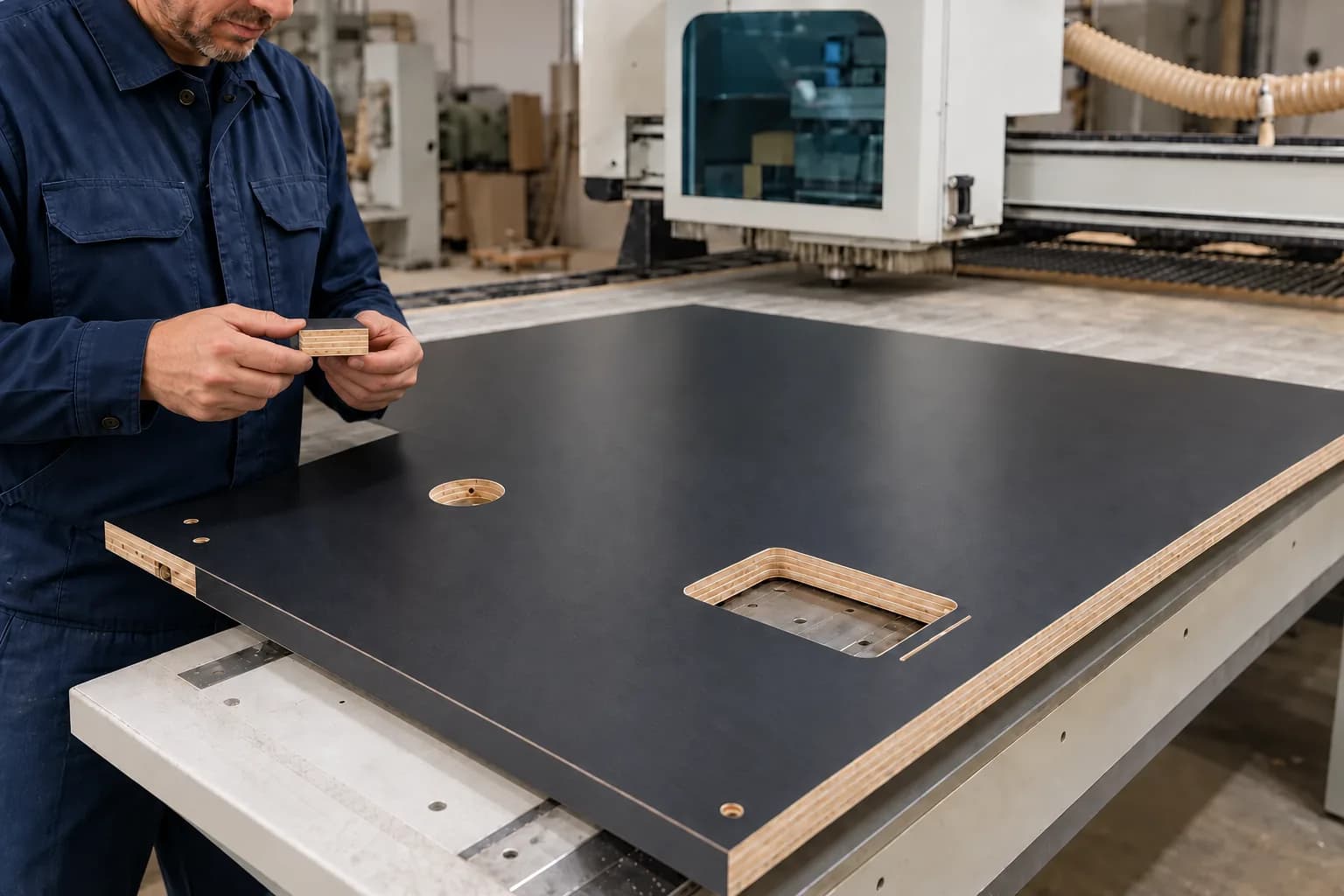
A supported HPL plywood workpiece, exposed plywood edge, CNC cutouts and sample coupon show the machining details that determine edge quality, hardware fit and repeat production.
Standard interior construction with 0.5–0.7 mm HPL option, selected plywood substrate and balanced reverse.
High-use commercial construction with selected HPL grade, tighter calibration and machining sample.
Fire-retardant project construction with FR substrate, compatible adhesive and project document requirements.
The three export ranges use the same finished-panel reference and distinguish the plywood core, HPL grade and thickness, face/reverse arrangement, adhesive, pressing, conditioning, machining, inspection and packing included in each option. The quotation then confirms quantity, destination documents and delivery terms.
Quotation variables: HPL manufacturer, collection, grade, thickness, decor, texture, face arrangement, balancing layer, plywood species/core/lay-up/bond, adhesive, finished thickness, dimensions, tolerance, surface tests, fire-performance requirements, machining, edges, first article, quantity, packing, payload, destination documents and lead time.
Reference constructionHPL-faced plywood, reference 1220×2440×18 mm finished panel
Main price variablesHPL grade, face arrangement, plywood core, adhesive, machining and order volume
Reference date2026-08-22
Methods and grade apply to the nominated HPL sheet; finished-panel requirements are stated separately.
Composite-panel methods and normal interior-use requirements for HPL bonded to wood-based substrates.
Substrate bond and finished-panel dimensional option for the selected construction.
Select the legal and test methods for the exact finished panel, destination and product scope.
Classification applies to the exact tested or assessed face, adhesive, substrate, balance, thickness and installation.
Australian lining option matches the exact finished construction with the project and building-code requirements.
Documents are matched to transaction scope, origin, importer responsibility and destination rules.
Before the purchase order
It is a composite panel made by bonding a separately manufactured high-pressure decorative laminate sheet to a calibrated plywood substrate with an approved adhesive and balancing construction.
HPL is manufactured as a separate laminate and bonded later. Melamine plywood uses resin-impregnated decorative paper pressed directly to the plywood; the material, thickness and performance requirements differ.
HPL plywood combines a decorative laminate with a cross-laminated veneer substrate, giving a lighter panel with plywood screw holding and visible-ply edge options. Compact laminate is a dense laminate product used where its solid laminate construction suits the component.
Choose by appearance, duty and part design. A single decorative face needs an engineered balancing back; a double face still requires compatible grades, thicknesses and press sequencing.
The HPL face, adhesive and plywood respond differently to moisture and temperature. A compatible reverse construction balances those stresses and helps control bow and twist after pressing and machining.
Poplar, combi, eucalyptus, hardwood or selected birch can be planned. The correct choice depends on flatness, density, core gaps, machining, visible edges, weight, bond and final duty.
State the HPL grade and test method for each relevant duty: abrasion class or initial/final wear-point cycles; scratch load and visible-mark limit; impact object, energy or drop height and permitted damage; staining agents, concentration, dwell time and cleaning cycles; dry- and wet-heat temperature, contact time and edge condition; and light exposure with the permitted colour or gloss change. Apply the acceptance limits to the selected decor, texture, finished HPL-plywood build and intended cleaning routine.
Yes. The project requirements combines a nominated HPL face, compatible adhesive, fire-retardant plywood substrate, balancing layer and installation details, with test and classification documents matched to that exact assembly.
For reaction-to-fire requirements, specify the HPL face, adhesive, fire-retardant plywood substrate, balancing layer, finished thickness and density together with joints, fixing, support and air gap, then match the relevant EN 13501-1 or NCC/AS 5637.1 option. A 30-, 60- or 90-minute fire-resistance requirement is specified through the tested complete wall, door, ceiling or partition assembly and its installation details.
HPL-B and HPL-C can include long formats after confirming HPL sheet availability, plywood substrate, adhesive, face/reverse balance, press option, flatness, full-length support, packing and container loading. State the exact width and length in the enquiry so feasibility and price can be confirmed.
Send use and destination, HPL supplier/code/grade/thickness, colour and finish, face/back arrangement, plywood build, adhesive duty, size and tolerance, machining, edges, quantity, packing, required documents and target date.
The decor sample links texture, HPL grade, plywood build, adhesive, balance, dimensions, machined component and packing to the order. Repeat orders use the same product codes, construction and finished-component requirements.
Plywood enquiry
Provide intended use and destination; HPL manufacturer, collection, code or approved sample; colour, texture, finish, grade and thickness; single/double face and balancing back; plywood species, core, lay-up, bond and emission requirements; adhesive or performance requirement; standard, project or fire-performance requirements; finished size including any 1250×3800 option, thickness, tolerance and flatness; press and full-length support constraints; CNC, drilling, drawings and hardware; edge banding or cut-edge finish; quantity by SKU; pack footprint, container, loading and unloading inputs; destination documents and target date. Our team can recommend the suitable Incoterm for the destination and order volume.
CHAT WITH CUZI PLY↗