Special plywood and composite panels for your design.
Choose the panel around the component, not just the material name. Fine veneers, bamboo grain, a cellular core or a metal face can each serve a different design. Bring the visible finish, finished mass, machining and attachment details into the specification so the panels are prepared for the way your team will use them.
CUZI PLY is your plywood manufacturer and direct supplier in Linyi, China, with 10 production lines. We manufacture aircraft and bamboo plywood and finished composite panels with the construction, processing, product documents and export packing agreed for your order. Work directly with our factory on full sheets, blanks or drawing-led parts.
Which special plywood construction fits your component?
Define the component, its supports and attachments, then choose the material arrangement. A thin veneer panel, an all-bamboo board and a sandwich with plywood skins are different products even when their finished dimensions match.
| Construction | Buying purpose | Prepare for the order |
|---|---|---|
| Aircraft and ultra-thin plywood | Fine veneer construction for drawing-specified aircraft material, models and precision or curved parts. | Component identity, required material specification, veneer quality, lay-up, grain, exact thickness, cutting fit and documents. |
| Bamboo panels | Bamboo grain and edge appearance for furniture and interior components. | All-bamboo or bamboo-faced wood core, strip style, inner-layer directions, colour, finish, joints and visible edges. |
| Plywood skins with honeycomb or foam cores | A sandwich construction selected around component mass, stiffness, supports and attachments. | Both skins, named core, density and direction, adhesives, total thickness, edge members, inserts and component requirements. |
| Aluminium-faced plywood | A specified metal surface bonded to a wood-plywood substrate. | Alloy and temper, metal thickness and finish, plywood construction, secondary bond, reverse, edges and fixing design. |
Bring the right requirements into your panel enquiry.
A furniture front, a shelf and a transport-interior part ask different things of the panel. Use your component drawing to identify the appearance, loading and installation details that matter before comparing constructions.
Cabinet fronts and interior partitions
Choose the visible bamboo or plywood face with the reverse, edge finish and required flatness. For a sandwich door, locate hinge and handle reinforcement before choosing the core. Include the installed size, hardware and cleaning conditions.
Vehicle furniture and transport interiors
Set a finished-component mass target, then specify supports, anchorage, vibration and the operating environment. Include the fire and emission requirements of the vehicle or project, with all finishes and connections in the panel description.
Shelves and work surfaces
Provide the clear span, support positions, distributed and concentrated loads, and acceptable deflection. Check the facing, core, bonds and local bearing areas together; compare the usable component rather than a bare core or an unsupported thickness claim.
Display and fixture surfaces
Specify the metal or decorative face, matching direction and appearance, routed openings and mounting points. Include the backing, joints and edge profiles so machining and installation do not leave an unfinished edge or remove a planned fixing location.
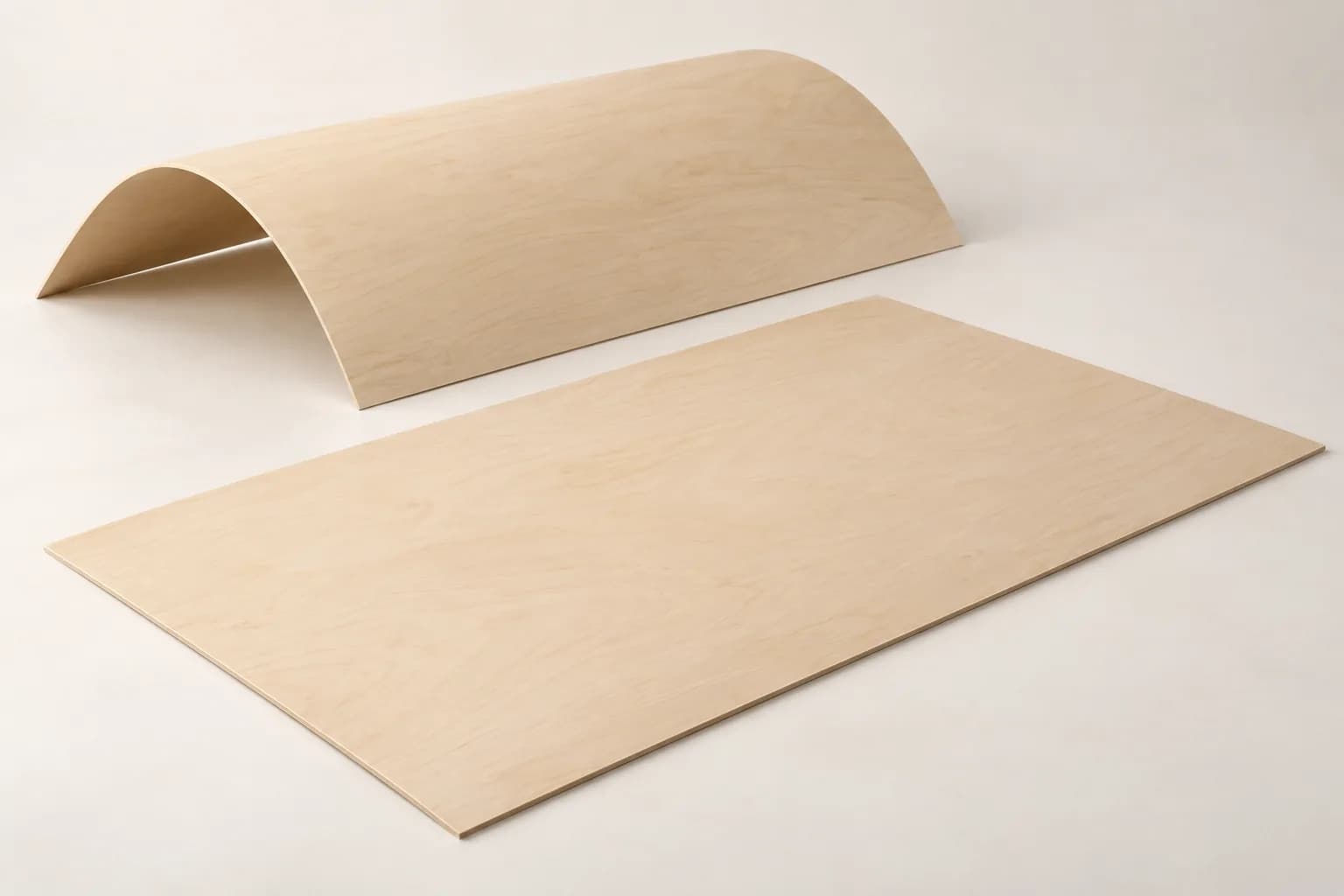
Aircraft and ultra-thin plywood need a defined veneer construction.
Identify the face, reverse and inner species, veneer quality, individual layer thicknesses, grain directions and panel bond. Keep the exact finished thickness and tolerance with slots, joints and cut profiles. Two thin panels can have different lay-ups and different machining or forming behaviour.
Aircraft components
Use the aircraft’s material specification, drawing revision and build or maintenance instructions. Name the standard and grade, required product identification and qualification documents. The responsible aircraft engineering or maintenance organisation determines suitability, installation and any substitution; the product name alone is not an aircraft approval.
Models, precision parts and curved details
Specify grain arrows, datum edges, profile and joint clearances for the selected panel. Support fine sheets through machining and protect the thin face during sanding or finishing. For a curved part, give the forming direction, radius, support and bonding method and assess the actual construction before repeat production.
For aircraft repair, follow the manufacturer’s instructions. The FAA’s AC 43.13-1B describes inspection and repair guidance for nonpressurised areas of civil aircraft where manufacturer instructions are absent, subject to its stated conditions. It is not a general material certificate for plywood supplied under an aircraft name.
Continue to Aircraft & Ultra-Thin Plywood for the veneer, cutting and ordering choices.
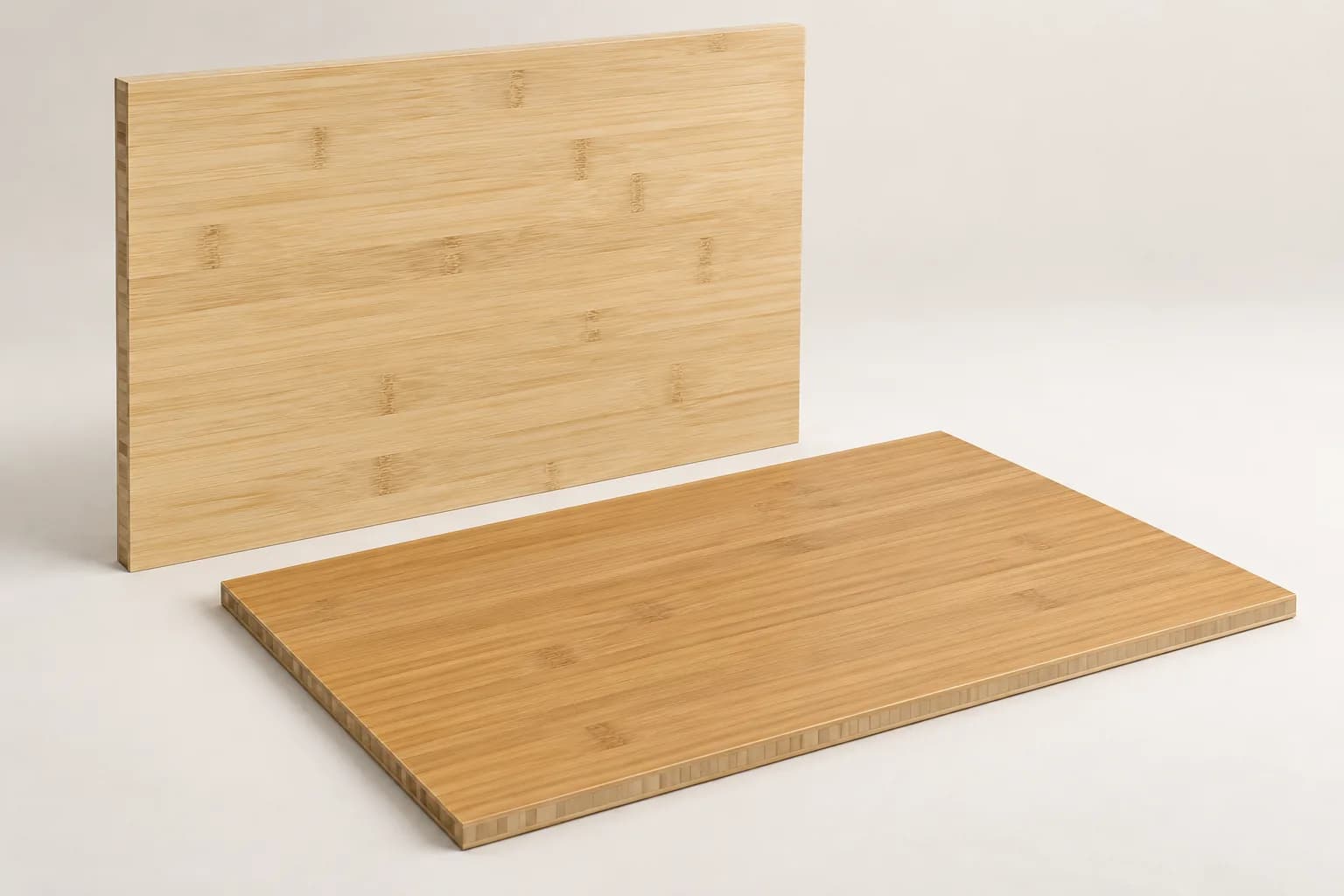
Bamboo appearance and layer directions are separate choices.
Specify all-bamboo layers, a linear laminated construction or a bamboo surface on a named wood-plywood core. Describe each layer, grain direction, thickness and the balancing reverse. Include exposed edges, hinge or joint details, supports and the conditions in which the furniture or interior part will be used.
- Flat or side grain describes the face strip appearance; state the inner-layer directions separately.
- Natural or caramel appearance belongs with colour variation, coating, sheen and matching sets.
- A bamboo-faced wood core needs its own species, veneer arrangement, bamboo face thickness and edge treatment.
- Choose cutting and routed details around the material they expose, then keep the grain and component sequence through packing.
ISO 6128 addresses laminated bamboo-strip products for indoor furniture. ISO 7567 addresses glued laminated bamboo members for structural use. Choose the applicable product and intended-use requirements rather than treating one bamboo document as a classification of every bamboo-faced panel.
Use Bamboo Plywood to specify the face, lay-up, finished parts and appearance.
Keep grain, edges and finished dimensions consistent through production.
Mark the presentation face and grain direction on the part list. Identify matching components and the surfaces that will be coated, bonded or left visible.
Plywood skins and composite cores work as a bonded construction.
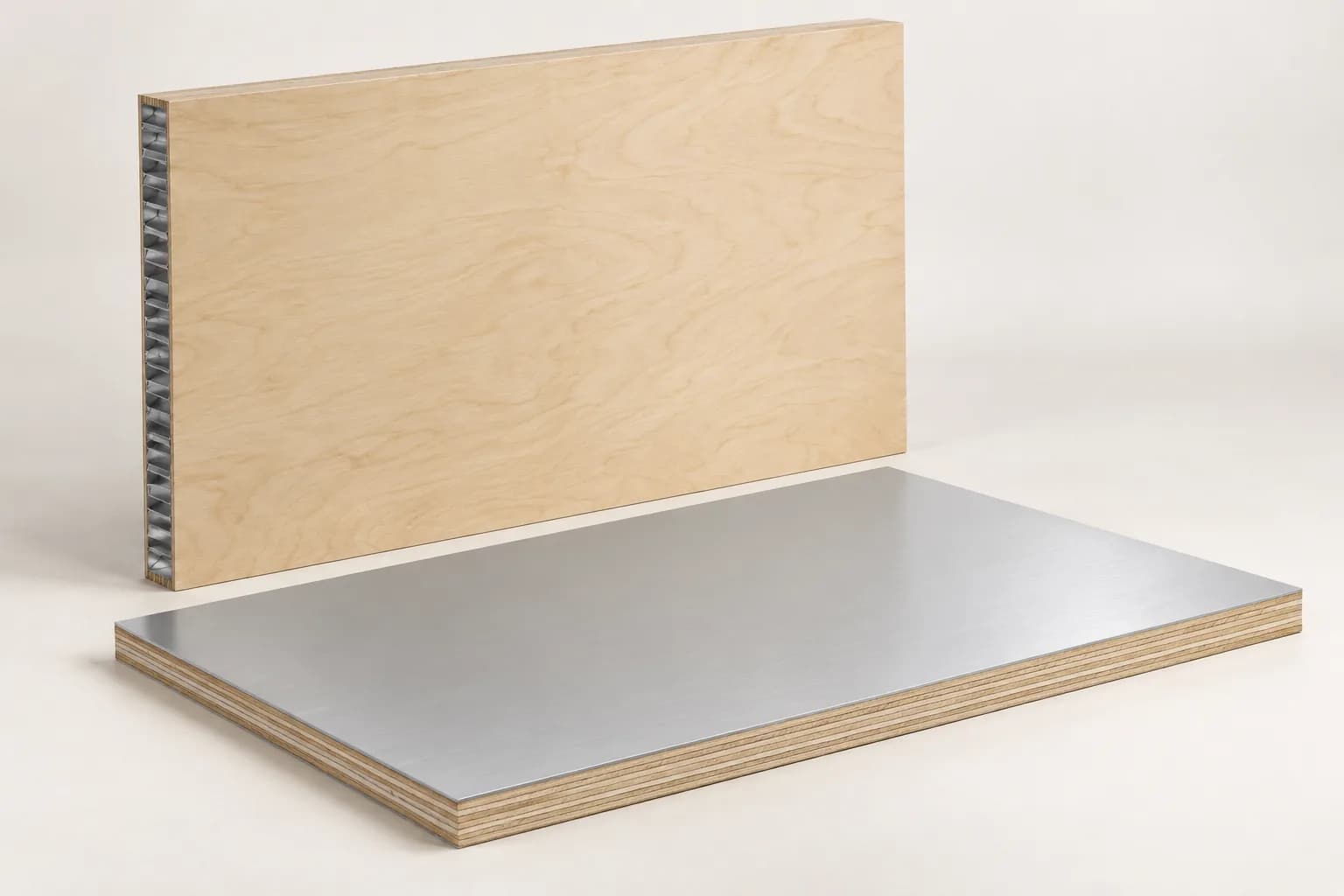
Specify plywood on both sides of a honeycomb or foam core, with every adhesive interface and any additional finish. Keep individual skin thicknesses, core thickness and overall finished thickness distinct. Include perimeter members and local reinforcement, not just the broad face-to-reverse layers.
Choose around loads, supports and assembly
The separated skins, core and bonds together influence bending and shear behaviour. The core’s material and direction and the skin-to-core attachment matter; increasing overall thickness alone does not define the panel’s useful load or fixing performance.
Give the support arrangement, loading, mass target, joints and local attachments for the actual part. Compare complete constructions at equivalent component requirements. Include adhesives, finish, closures and inserts in finished-panel mass, with hardware identified separately.
The Hexcel sandwich design guide explains general skin, core, bond and edge-closure principles. Use data for the materials and construction in your order when designing the component.
Choose the detailed construction in Composite, Honeycomb & Aluminium-Faced Plywood.
Honeycomb and foam cores need their own material specification.
A core trade description or density is not a finished-panel specification. Identify the exact material, grade, thickness and relevant data, including the bonding surfaces and service conditions.
Honeycomb
Give core material, cell geometry, thickness, density and orientation. Keep any directional shear data with the orientation in the panel and the component drawing. Include bonding-surface details, local reinforcement and the closure needed around edges and machined openings.
Foam
Name the foam type and grade rather than ordering only a foam-core panel. Specify thickness, density, bonding compatibility and required compression, shear, temperature or moisture information. Where insulation or fire performance matters, define the requirement for the finished construction and installation.
| Construction detail | Material and interface | Include with your enquiry |
|---|---|---|
| Honeycomb core | Cell walls provide discontinuous contact with the skins. Material, cell size, density and direction belong in the core description. | Name the core grade, bonding surfaces, directional data, edge closures and local attachments. Compare data for the orientation and conditions of your component. |
| Foam core | A foam core provides a continuous bonding surface, with properties that depend on its material and grade. | Name the foam, density, thickness and bonding requirements. Request the relevant shear, compression, temperature and moisture information; identify finish and installation requirements separately. |
| Perimeter members and local inserts | These are reinforcement and connection details within the panel, not a substitute name for its broad-area core. | Show their material, net dimensions, location, bond and fixing details. Include the core volume they replace and the reinforcement mass when comparing finished components. |
Keep the core material record separate from the finished panel we manufacture. A raw-core datasheet does not describe plywood skins, their bonds, perimeter members or hardware attachments.
Set a mass target for the complete component.
Calculate each material contribution from its density and net volume, then add adhesive, finish and fittings. Use actual material data and the dimensions of your part; core density alone leaves out the plywood skins and everything needed to assemble it.
Add the contributions of both skins, the core, perimeter members and inserts. Use volumes after holes, cut-outs and any core displaced by reinforcement so the same space is not counted twice.
Keep the comparison consistent
Use the same finished dimensions, face finish, support and connection requirements. Include coatings, edge closures and adhesives, with the hardware and supporting structure identified separately. Report kg/m² for a stated panel construction or kg per finished part, with the condition and calculation basis.
Confirm the delivered construction
Agree the mass target and permitted variation with the layer schedule, machining and order checks. Compare the calculated value with the finished part when that is part of the inspection requirement. Keep actual measured mass separate from a calculation and retain the component reference for repeat orders.
Edges and fixing points belong in the panel order.
A hinge, handle or bracket can put a concentrated load into a small area. Place the required inserts, solid members, backing and edge closures on the drawing before the panel is made or trimmed. An unsupported cellular core is not a solid plywood fixing base.
Hinges, handles and brackets
Mark attachment locations and required loads. Give insert, backing or local reinforcement details that carry the load into the designed panel and supporting structure.
Perimeter members
Specify material, width and position for solid edge members or profiles, including joints and the surface that receives the adhesive or fixing.
Holes, cut-outs and later trimming
Keep datum edges, grain or core direction and insert locations on the cutting drawing. Identify features that need closure or reinforcement after machining.
Fasteners and local pressure
Define fasteners, engagement, backing and any sleeves or spreading plates. Assess pull-out, shear and local compression for the connection rather than relying on the core’s name.
Exposed edges and penetrations
Agree sealing, banding, profiles or bonded closures around the actual skins and core. Include joints, hardware openings and later site cuts in the protection plan.
Repeated components
Keep drawing revision, material construction, feature positions, finish and relevant checks with each part reference. Label matching sets and packed components for assembly.
Agree who completes each cut, hole, closure and fitting step. Keep later machining within the planned reinforcement and protect newly exposed edges. Use Plywood Cutting & Forming for drawing and processing inputs.
Aluminium-faced plywood has a wood substrate and a separate facing bond.
Name the metal alloy and temper, facing thickness, surface finish, coating and protective film. Specify the plywood species, lay-up, thickness, panel bond and opposite-face arrangement separately from the adhesive joining metal to wood. Aluminium-faced plywood is not automatically interchangeable with a metal composite sheet that has a different core.
Appearance, flatness and service conditions
Mark the visible face, brushing direction and matching parts. Include the temperature and humidity conditions, required flatness and compatible surface preparation and bonding process. Select the reverse and balancing arrangement with the complete panel rather than choosing the metal face in isolation.
Machining, edges and installation
Define profiles, bores, fixing positions and any metal edge or profile details. Agree suitable tooling, support and burr removal for wood and metal together. Assess contact-material and fastener compatibility where corrosion is relevant, and protect the finished face through packing and installation.
Keep the metal facing, plywood and secondary bond connected to the required use. A metal surface alone does not establish the fire classification or moisture resistance of the entire finished panel.
Distinguish core properties, panel tests and attachment performance.
Use the appropriate property for the buying question. Compare the same construction, direction, condition and loading basis, and identify the result and failure location rather than using one strength value for every part of the component.
| Purchasing question | Information to request | How to use it |
|---|---|---|
| How much will the finished part weigh? | Finished kg/m² or part mass with skins, core, adhesive, finish, perimeter and inserts included. | Compare equivalent finished dimensions and component requirements; separate panel mass from hardware or supporting structure. |
| Which core shear data apply? | Named core, density, cell geometry and direction, condition and applicable shear test such as ASTM C273/C273M. | Keep core-property data distinct from the complete panel and its fixing capacity. |
| How does the assembled sandwich respond in bending? | Actual skins, core and bonds, panel orientation, span, supports, load and relevant beam data such as ASTM C393/C393M. | Interpret core or core-to-facing shear and beam stiffness within the method’s scope; use the appropriate facing data and component design for other questions. |
| How are the skin-to-core bonds assessed? | Actual assembled layers, adhesive, conditioning and flatwise tensile information such as ASTM C297/C297M, with the failure location. | Separate failure in the core, bond or facing; an isolated bond result is not an attachment or complete-installation load rating. |
| Will the hinge or bracket connection work? | Insert and edge-member construction, fastener, backing, load direction, local support and the designed connection checks. | Evaluate the actual attachment, including local crushing or pull-out; do not replace it with a bare-core datasheet. |
| Which fire, moisture or emission documents are needed? | Complete construction, finish, destination, service conditions, installation and the required method or classification. | Match the document to the ordered panel and project use, including the wood, core, adhesives and surfaces. |
ASTM C273/C273M addresses core shear properties, C393/C393M addresses core shear behaviour through sandwich beam flexure, and C297/C297M addresses flatwise tensile strength. State the property, method and edition with the panel construction and conditioning. Include the result, units, failure location and relevant geometry so your project team can interpret the report for the intended use.
Continue with Plywood Tests & Reports and Density, Weight & Strength for interpreting panel and component information.
Choose finishes and protection for the complete panel.
Identify temperature, humidity, wetting, cleaning, wear, vibration and the way the component is supported. Keep skins, core, bonds, coatings, cut edges, joints and attachments in the requirement. Different combinations need different processing, protection and project documents.
Moisture, handling and preparation
Protect faces and edges, maintain suitable support and follow the product and process instructions before bonding or installation. Metal or moisture-resistant core material does not remove exposed wood, joints or adhesive interfaces from the protection plan. Use Moisture & Water Resistance and Storage & Handling.
Fire and interior requirements
State the destination, intended use, required classification and installation arrangement. Include all layers and finishes in the product description. Use Fire Performance and Emissions: US & EU to specify the documents relevant to the complete supplied construction.
Keep construction and qualification documents with the order.
Prepare the product and component requirements together so dimensions, material identity, processing and reports refer to the same construction. For aircraft or other specially qualified use, include the applicable material and project documentation from the start.
The material being ordered
Keep the product description, manufacturer, drawing revision and material specification with the order and package identity. For aircraft work, include the specified grade and required material or qualification documents.
Every layer and bond
Record both skins or faces, substrate, core, layer thicknesses, grain or cell directions and adhesive interfaces. Identify core material data separately from the finished-panel description.
Dimensions, condition and mass
Use finished dimensions and tolerances, flatness, relevant moisture condition and the stated basis for panel or part mass. Include coatings, closures and reinforcement in the mass description.
Mechanical and connection information
Match the report method, tested construction, orientation, condition, span or loading to the required property. Keep inserts, fasteners and supporting details with any attachment assessment.
Project and destination requirements
Name the required fire, emission, moisture, sourcing or other documents for the actual component and installation. Check the product range, finish and relevant use covered by each document.
Production and repeat orders
Agree material identification, drawing revision, checks, part labels, packing and replacement-order details. Keep any change in skin, core, adhesive, machining or attachment with the updated specification.
Normal custom length and width do not require a new certificate for every millimetre. Keep the supplied construction within the applicable product range. Relevant changes to skins, cores, adhesives, openings, attachments or installation need the appropriate document scope and component design checked.
See Standards & Certifications and Quality & Inspection for the product and order checks.
Bring the panel construction and part schedule into one quotation.
Regular factory formats: 1220×2440, 1250×2500, 1525×3050 mm. On-request formats: 1250×3050, 1250×3660, 2100×2800, 1830×3660, 1250×3800 mm. State the actual finished sheet or part dimensions, construction, grain direction and tolerances rather than relying on a nominal size description.
- Component use, drawing revision, supports, loading, attachments and service conditions.
- Face-to-reverse layers, veneer or bamboo arrangement, core, metal facings and adhesives.
- Finished thickness, dimensions, mass target, flatness, grain or core direction and tolerances.
- Cutting, bores, joints, inserts, edge members, closures, finish and matching sets.
- Required material specification, project documents, test properties and inspection requirements.
- Quantity by sheet or part, labels, protective packing, destination, delivery term and target date.
Our factory quotation identifies the plywood or finished composite panel, agreed processing, product documents, packing and export terms. Keep repeat parts and any construction changes with the same order specification.
- Order quantity & mix
- Tell us the sheet size, thickness mix and quantity you need. We confirm the minimum order and available mix for your selected construction.
- Production lead time
- We confirm the production schedule with your specification, order quantity and sample requirements. Production lead times are planning estimates, not transit times.
- Price & quotation unit
- Currency and price unit stated in your quotation. Your quote is based on the agreed dimensions, construction and quantity. Processing and requested testing are stated separately where applicable.
- Samples
- Tell us the plywood, thickness, finish and delivery country. We confirm sample availability, any sample and courier costs, and dispatch arrangements before proceeding.
- Packing & delivery
- We agree export packing, labels and the loading plan for your order. Share the destination country, named port or delivery point and preferred delivery term. Freight, insurance, duties and taxes are included only when stated in the quotation.
- Payment & order confirmation
- We agree the payment method, currency and any deposit and balance schedule in the quotation or proforma invoice. Your order confirmation sets out the product, quantity, packing and delivery arrangements.
Construction, component fit and project requirements
Questions about special plywood and composite panels.
What should I include when ordering special plywood?
Identify the finished component and describe the construction from face to reverse. Include dimensions, tolerances, grain or core direction, mass target, supports, fixings, service conditions and project documents. CUZI PLY manufactures the selected plywood or composite construction with the machining, identification and export packing agreed in your factory quotation.
Is aircraft plywood the same as thin modelling plywood?
Not automatically. A thin modelling panel is chosen for its model, joints, appearance and cutting process. Material for an aircraft component must meet the applicable aircraft material specification and project documentation. Keep the component identity, grade, veneers, bond and grain with the drawing; suitability and any substitution belong with the responsible aircraft engineering or maintenance organisation.
Does the aircraft plywood name mean a finished part is airworthy?
No. Ordering the material and approving the aircraft part are different steps. Use the required material specification and documents, then follow the aircraft design or maintenance instructions for the component, fabrication and installation. A product name or a visual check does not establish an aircraft approval.
What is the difference between all-bamboo and bamboo-faced plywood?
An all-bamboo construction uses bamboo through its specified layers; bamboo-faced plywood has a bamboo surface over a separately specified wood-plywood core. Linear and cross-laminated bamboo also have different layer directions. Specify the complete lay-up, visible edge, grain, finish and component requirements instead of choosing only by surface colour.
Does horizontal or vertical bamboo grain describe the inner layers?
Those terms often describe how the face strips present their grain. Define the directions of the inner layers separately and mark the face grain relative to the finished part. Include matching sets, node appearance, colour variation and the coating where adjoining furniture or interior parts must look consistent.
How do plywood skins work with a honeycomb or foam core?
The skins, core and adhesive interfaces work together in the specified sandwich construction. Name the plywood on both sides and the actual core, with layer thicknesses, density, direction and bonding requirements. Select the panel around the part’s loads, supports, mass and attachments rather than treating the core as a lighter solid plywood substitute.
Does a core density tell me the finished-panel weight or strength?
No. The finished mass includes skins, core, adhesive, finish, closures and reinforcement. Mechanical behaviour also depends on the layer arrangement, direction, bonds, dimensions, loading and supports. Compare a named complete construction using relevant product data and the required component checks.
Where should hinges and handles attach on sandwich plywood?
Show the locations and required loads on the drawing. Specify suitable inserts, edge members, backing or through-fixing details that carry the load into the designed support. An unsupported cellular core is not the same fixing base as solid plywood. Coordinate reinforcement and final cutting before production.
Is aluminium-faced plywood the same as an aluminium composite sheet?
No. Aluminium-faced plywood uses a wood-plywood substrate with a bonded metal face. Other aluminium composite sheets can have a different core and no plywood. Specify the actual metal, wood, adhesives and reverse arrangement; aluminum is the US spelling of aluminium.
Does an aluminium face make the whole plywood panel waterproof or non-combustible?
No. Specify the exposure and project requirements for the complete construction, including wood, adhesives, reverse, joints, cut edges and holes. A metal surface does not remove the need for moisture protection or determine the fire classification of the finished panel and installation.
Do custom dimensions require a separate certificate for every size?
Normal length and width choices are manufacturing dimensions, not a new certificate for every millimetre. Keep the ordered construction and applicable product range with the documents. Changes affecting performance, such as different skins, cores, adhesives, openings, connections or installation, need the relevant report scope and component design checked.
Can I request a panel before placing a production order?
Yes. Specify the construction, thickness, face, core, cut edge or fixing detail you want to assess, with the destination. We confirm availability, any sample and courier costs and dispatch arrangements. Visual appearance and workshop fit checks support selection; required project tests or qualifications remain part of the material and component requirements.
Can I compare two panels using only their total thickness?
Compare the full construction instead. Panels with the same thickness can have different skins, cores, adhesive interfaces, mass, stiffness and attachment details. Keep the finished dimensions, direction, supports and service conditions the same when reviewing the product information. A change of core or skin belongs with an updated component specification.
Can I drill or trim a sandwich panel after delivery?
Identify the final machining and hardware positions before ordering. Cutting can remove a perimeter member or expose the core, and a new hole may miss a planned insert. Keep later work within the specified reinforcement and arrange the closure or sealing needed for newly exposed edges. Contact our factory with the part reference and proposed change before repeating the component.
What should accompany a composite-panel test report?
Request the tested construction, skin and core materials, adhesives, thicknesses, direction, conditioning, method and edition. The report should identify the measured property, units and failure location, with test geometry, supports or loading as relevant. Use that information with the component and connection requirements; material data, an assembled-panel test and an installed-system assessment answer different questions.
How do I compare a material trial with a repeat factory order?
Keep a component reference and drawing revision with the agreed layers, dimensions, finish and machining. Check the appearance, fit, closures and hardware interfaces against the intended part, then identify any required performance tests separately. Confirm quantity, production schedule, packing and destination with the same construction so repeat parts are not quoted from the surface name alone.
Discuss the panel your component needs.
Send the intended part, layer construction, dimensions, quantity and destination. Add the finish, core or facing, fixing details and required documents so our factory team can quote the complete supply scope.
For a physical assessment, identify the face, lay-up, core, cut edge or attachment detail you need. We confirm availability, sample and courier costs and dispatch arrangements before proceeding.