Softwood face and core
Specify the softwood species in the outer and inner veneers, plus the layer arrangement. Select each side’s appearance for whether it remains visible, painted or covered.
Compare face and core choicesSource softwood plywood directly from our factory in Linyi, Shandong, China. Choose pine, spruce or another softwood construction for furniture parts, packaging and specified building work. We bring your face grade, core, finished sizes and processing into one clear quotation—with packing and delivery arranged for your destination.
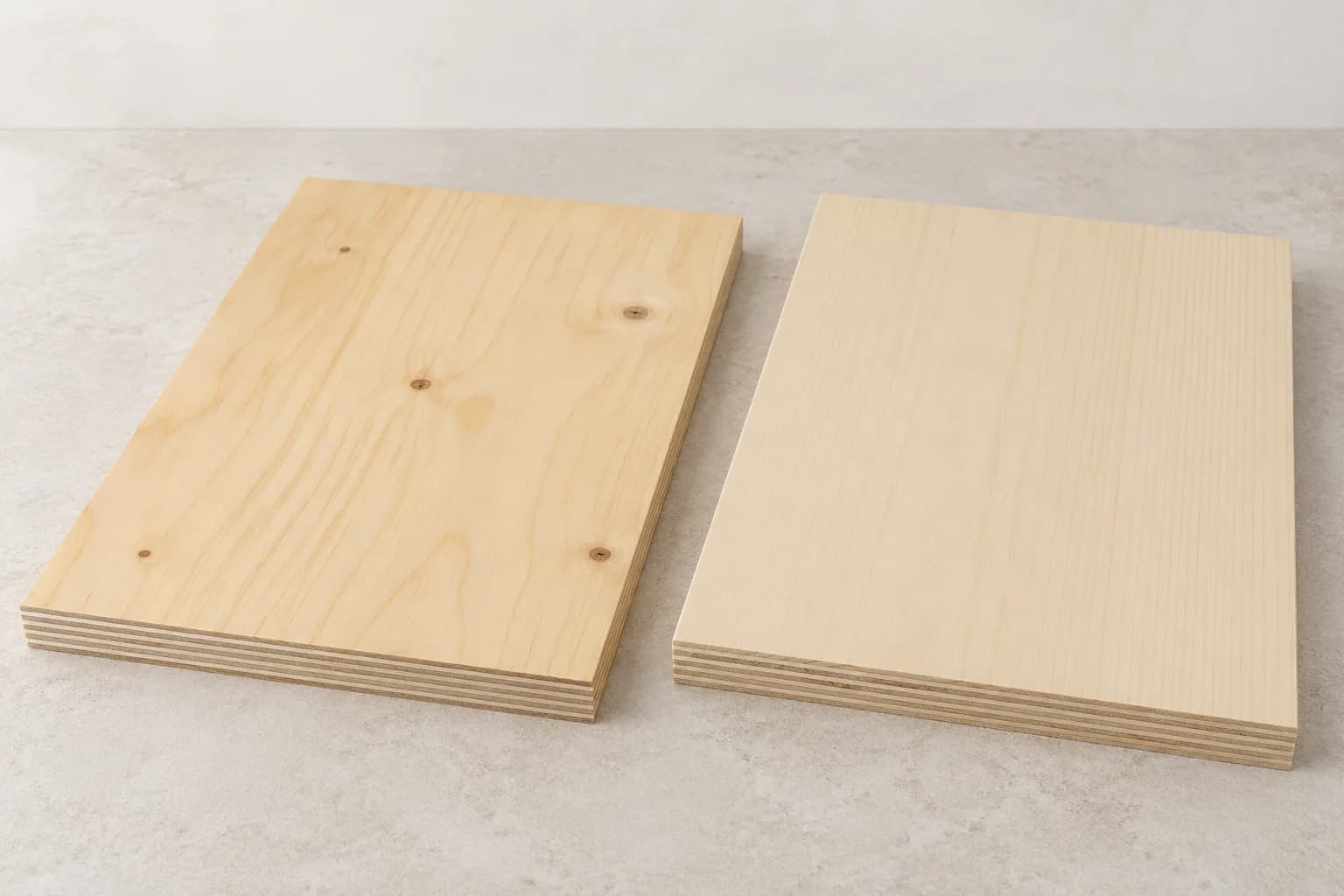
Choose pine or spruce face appearance around the finish and parts you make. Specify the inner veneers separately, with cut-edge quality, thickness and machining matched to your use.
Pine, spruce and other conifer veneers can be used in the outer layers, the core or both. Choose the face for the finished appearance, then specify the inner construction, bond and properties for your part. A hardwood face over a softwood core is a different description from softwood throughout.
Specify the softwood species in the outer and inner veneers, plus the layer arrangement. Select each side’s appearance for whether it remains visible, painted or covered.
Compare face and core choicesKeep the softwood face you want while specifying the inner species mix, layer thicknesses and permitted core repairs. Compare the complete panel for cut edges, weight, fixings and finishing.
Prepare a complete specificationA hardwood outer veneer can cover a softwood core. Order this as a faced construction, not as all-softwood or all-hardwood plywood; agree the decorative face and inner layers separately.
Explore hardwood-faced panelsStart with Pine or Spruce for a closer look at face grades, inner construction and finishing. For fir, Douglas fir, larch or cedar, tell us which layers need that species and how the panel will be used. Our factory quotes the face and core combination you need.
Choose pine for the face, inner veneers or both. For visible parts, agree grain, knots, repairs and the finish; for covered parts, compare core construction, cutting and fixing needs.
For your enquiry: Name the pine species, face/back appearance, inner veneers, finished thickness and intended use.
Specify spruce-faced or spruce-core construction rather than relying on a light-coloured face. Match the surface and layer arrangement to machining, supported parts and the finish you will apply.
For your enquiry: Name the spruce species, face and core arrangement, visible edges, surface preparation and required panel properties.
State the exact species: Douglas fir and true fir are different timber names. A Douglas fir face does not identify every inner veneer or establish marine grade.
For your enquiry: Specify face/back, core species, grade, bond, service conditions and any named marine or structural product requirements.
Choose larch for the specified face or panel construction. Agree colour, grain and repair allowances for visible work, with the coating and edge protection suited to the component.
For your enquiry: State which layers must be larch, the visible finish, acceptable repairs, exposure and machining.
Select cedar veneer for the appearance your project needs and identify the inner construction separately. Do not use the face name as a substitute for the complete panel specification.
For your enquiry: Name the cedar species, visible sides, core, finish, thickness and service environment.
Interior parts, crates and sheathing have different priorities. Describe the component and environment so we can help select the board, rather than adding cost for features your covered part will not use.
Put the finish first for cabinet parts, linings and interior fittings. Select the visible face, back, sanding and core around edges, routed profiles and hardware.
For your enquiry: Visible sides, paint or facing, part list, supported spans, joint and hardware details, finished thickness and indoor environment.
Choose panels for interior componentsCompare usable cut parts, handling weight and fixing positions for the container you make. A utility surface can be suitable where appearance is secondary, with repairs and edges agreed for the contents and journey.
For your enquiry: Cargo, case design, cut layout, lifting and stacking, fastening, moisture exposure, quantity and destination.
Plan a packaging panel orderFor roof, wall and floor work, select the structural product and declared properties your designer requires. Species, face appearance and thickness are part of that specification, not substitutes for it.
For your enquiry: Roof, wall or floor position, named product standard, required properties, support spacing, panel direction, fixings and exposure.
Select a structural plywood productFor a concrete finish, compare our film-faced and HDO/MDO panels. For an outdoor component, specify the bond, finish, cut-edge protection, drainage and service conditions with the complete construction.
For your enquiry: Concrete contact or component use, surface result, wetting and drying, support, joints, cuts, coating and quantity.
Compare film-faced formwork panelsStart with the requirements you know. We help complete the face, core, dimensions, processing and delivery details so your purchasing and production teams can compare the same board.
| Field | Options and order requirements |
|---|---|
| Face and back species | Name pine, spruce, fir, Douglas fir, larch, cedar or the agreed combination. Identify both outer veneers; timber trade names and manufacturing location are separate details. |
| Inner veneers | Specify softwood throughout, a mixed core, or a softwood core beneath a different face. State species in the inner layers, veneer arrangement and any required origin information. |
| Layer arrangement | Agree the ply count, veneer thicknesses, grain directions and core gaps or repairs for the selected board. A five-ply description alone does not specify the whole construction. |
| Face and back grade | State the grading system and what is acceptable on each side: knots, patches, open defects, repairs, colour and grain. If you request BC or another grade, include the standard and visible-side requirement. |
| Finished thickness | Send the nominal size, required finished thickness and tolerance. For requests such as 6, 9, 12, 15, 18 or 25 mm, our offer identifies the actual construction, sanding and finished thickness basis. |
| Sheet or cut-part format | Use the formats in Sheet sizes or send your finished dimensions. Include trimming allowance, grain direction, part references, quantities and handling requirements. |
| Flatness and dimensions | Agree length, width, squareness, flatness and measurement conditions around the cutting, assembly or installation process. |
| Surface preparation | Choose the sanding and preparation for a visible wood face, paint, applied veneer, laminate or a covered utility part. Agree the appearance of the finished surface, not only the word smooth. |
| Bond and exposure | Specify indoor, occasional wetting or exterior service, with the relevant bond requirements. Include coatings, cut-edge protection and installation details for the finished component. |
| Structural or marine use | State the named product standard, required properties, exposure and application. We identify the applicable panel construction and documents; use the Structural or Marine range for those specific purchasing requirements. |
| Indoor emissions | State the destination, use and required emission test method or limit. Match the report to the ordered construction and consider any adhesive, coating or facing added to the finished component. |
| Moisture and conditioning | Agree moisture and measurement conditions, supported storage and preparation before machining or finishing. Avoid comparing sheets conditioned in different environments as if they were the same. |
| Density and sheet mass | Request density or sheet mass for the selected construction. Compare the same dimensions, finished thickness and moisture condition; include hardware and finish when assessing a complete part. |
| Cutting and machining | Provide the cutting layout, profiles, reference edges, holes and fixing arrangement. Agree cut-edge quality, hole exits, part fit and protection during processing. |
| Packing and labels | Agree face and edge protection, pack dimensions, flat support and unloading. Identify the species construction, dimensions, thickness, quantity and part references on labels and the packing list. |
| Quantity and delivery | Send quantity by construction, size and thickness, plus the destination and target date. The quotation states the order mix, price basis, production schedule, payment, packing and delivery terms. |
For a smooth softwood plywood board, agree face quality, sanding and permitted repairs with the paint, clear finish or applied facing. Compare the finished appearance on visible parts and specify a different back-face requirement where it will be covered.
Send the grain direction, cutting layout, reference edges, holes and hardware for repeat parts. Check routed edges, screw positions and hole exits with the actual plywood and finish, not a face label alone.
Compare surfaces and finishingFor structural work, use the named panel’s design information. For ordinary furniture or case parts, send your assembly and machining requirements so we can quote the board and processing together.
Request a SampleSend the dimensions, thickness and quantity by construction. Compare yield after trimming, face-grain direction, cut-part layout, handling and export packing—not just the nominal sheet area.
For a 4 × 12 ft requirement, specify whether you mean exact imperial dimensions or a nominal metric sheet. Exactly 4 × 12 ft is 1219.2 × 3657.6 mm; agree the finished dimensions and tolerances before production.
Review sheet sizes and thickness choicesTell us the application, destination and named requirements. We identify the applicable certificates, declarations, test reports and product information with the offered construction. Custom length or width is a manufacturing choice, not by itself a new product category; reports describe the construction, properties, use and conditions they cover.
For a project specifying PS 1, CSA O151, EN 13986 or AVCP system 2+ documentation, send the requirement with the intended roof, wall or floor use. We help identify the appropriate construction and provide the applicable product information with our offer.
Tell us about indoor conditions, construction wetting or long-term exterior use. We match the bond and available emissions documents to your requirements, with coating and edge protection considered for the finished component.
Our panels are manufactured in Linyi, Shandong, China. Specify the face and core species, any required timber origin and sourcing documents so the quotation and delivery paperwork describe the material you are buying.
Agree thickness, dimensions, face repairs, cut edges, panel identification and packing. The inspection and packing list should describe the same product and quantities as your order.
CUZI PLY manufactures your plywood. Softwood plywood prices depend on face and back quality, inner veneers, finished thickness, sheet format, bond, processing and quantity. Compare the cost of usable parts, including trimming waste, finishing, packing and the agreed delivery point.
Send your construction, size/thickness mix, quantity and destination. We quote the required board and agreed processing, confirm sample arrangements, and set out the production schedule and delivery terms for your order.
For a sample, name the construction and finish you want to evaluate. We agree sample pieces, any sample and courier costs, and dispatch arrangements before sending it.
Your quotation states currency and price unit, quantities, processing, payment, packing, delivery terms and validity. Production timing is separate from shipping transit; freight and destination charges are included only when stated.
Softwood faces, cores and orders
Softwood plywood is a panel made with veneers from conifer species, such as pine, spruce or fir. Specify the face, back and inner veneers: some boards use one species throughout, while others combine species. CUZI PLY manufactures the construction you order, with the surface and bond selected for its use.
Plywood is an engineered panel, not one timber species. It can contain hardwood veneers, softwood veneers or a mixture. Ask what is used in the outer and inner layers. Softwood and hardwood are timber classifications, not a guarantee of how soft, hard or strong a finished plywood panel will be.
Birch is a hardwood species. Birch-faced plywood identifies the outside veneer, not necessarily the core. Specify all-birch, birch-faced softwood core or another named construction when comparing products, weight, machining and visible edges.
For visible joinery, choose the grain, knots and repair allowances you want to see after finishing. For painted or covered parts, focus on surface preparation, cut edges, hardware and usable parts per sheet. Tell us whether the named species is required in the face, core or both. Our Pine and Spruce product pages cover those constructions in more detail; we can also quote fir, Douglas fir, larch and cedar options.
Yes. Agree the face grade, permitted knots and repairs, sanding and intended finish. A smooth surface does not by itself set the core, bond or structural properties. For paint or laminate, evaluate the prepared face, exposed edges and joints with the finish you will apply.
State the required finished thickness and tolerance, not only a nominal trade size. Include the layer arrangement, face/back grade, core, bond, sheet format and quantity. We set out the offered specification in your quotation; thickness alone does not select a support spacing or load capacity.
Name the grading system and appearance required on the face and back. For a five-ply, 12 mm board with a hardwood face over softwood inner veneers, specify those layers explicitly, together with repairs, bond, finished thickness and tolerance. The grade letters and ply count are not a complete performance specification.
Yes. State the required finished dimensions: exactly 4 × 12 ft converts to 1219.2 × 3657.6 mm. Nominal metric formats are not automatically identical. Include grain direction, tolerances, trimming and quantity so our factory can quote the cutting and packing plan. See Sheet sizes for regular and made-to-order formats.
For roof, wall or floor sheathing, specify the structural product and documents required by the project, along with support spacing, panel direction, exposure and fixings. Start with our Structural Plywood range. General softwood, a smooth face or a selected thickness does not by itself supply structural design values.
It can refer to a Canadian product and standards context, not just a softwood species. If your project specifies CSA O151, PS 1 or another standard, include it in the enquiry. CUZI PLY manufactures in Linyi, China; our factory location and the origin of the timber are stated separately from product-standard requirements.
No. The species name does not establish a marine grade. State the applicable marine standard, veneers, core quality, bond and product documents, and use our Marine Plywood range for that enquiry. Coating, sealed cuts and holes, fixings and service conditions belong to the finished component as well.
Compare the same face/back grade, inner construction, finished thickness, dimensions, bond, processing and quantity. Ask for the currency, price unit, sample and courier arrangements, payment, packing and named delivery term. Production lead time and shipping transit are separate; freight, insurance, duties and taxes are included only when listed in the quotation.
Yes. Use Request a Sample to name the construction, thickness and finish you want to evaluate; we confirm costs and courier arrangements before sending it. For cut parts, send the layout, dimensions, reference edges, grain direction, holes, tolerances and quantities. We agree processing and inspection with your panel specification.
Compare the actual boards you are considering. Sheet weight depends on the veneers, construction, dimensions, finished thickness and moisture; price also depends on grades, bond, processing and order quantity. Send the same part requirements for both options and we can quote suitable constructions on a comparable basis. Include cutting yield, finishing and freight when comparing the cost of usable parts.
Tell us what you make, which sides will be visible, the finish, dimensions, quantity and destination. Include wetting, support, fixings and machining details relevant to the component. Our factory team can propose a face and core combination and set out the finished panel, processing and delivery terms in the quotation.
Select panels for the required structural grade and project properties.
Choose hardwood faces and specify the inner construction separately.
Compare panels for crates, cases and industrial packaging.
Compare overlays for concrete contact or painted signs.
Plan face protection, flat support, pack dimensions and unloading.
Compare all products made and supplied by our factory.
Start with the component, surface, size and quantity. Our factory team will help complete the construction and prepare your offer.