Plywood density, weight and strength: choose the right panel for the job.
Choose a panel that works for your component—and your shipment. Plywood density helps calculate sheet mass; strength and stiffness data help select the construction for a loaded part. Use the finished dimensions, complete core and service conditions to compare suitable panels.
CUZI PLY is your plywood manufacturer and direct supplier in Linyi, China, with 10 production lines. Tell our factory team your weight target, application and quantity. We help you specify the face, core, thickness, machining and product data needed for a comparable quotation.
Plywood density, specific gravity and weight use different units.
Density is panel mass divided by panel volume. Record the finished construction, dimensions, moisture condition and whether the result includes surface layers. The same face species can be bonded to different cores, so the name alone cannot supply the density.
Density and sheet mass
Density is usually stated in kg/m³; sheet mass in kg per sheet or lb per sheet. Areal mass, in kg/m², is useful when comparing liners and finished parts. For a uniform panel, areal mass equals density multiplied by thickness in metres.
For a measured density, divide the weighed panel mass by its measured volume at the stated condition. Keep the scale reading, dimensions and moisture basis together.
Specific gravity and specific weight
Specific gravity is dimensionless. Wood reports may use oven-dry mass and a defined green or conditioned volume; this is different from the wet mass used for shipping. Check the mass and volume basis before converting it to density.
In engineering, specific weight is force per volume, in N/m³, and equals density × gravitational acceleration. In enquiries, “specific weight in kg/m³” usually means density. State the unit so the intended value is clear.
The ASTM D2395 overview explains density and relative-density measurements for wood and wood-based materials. Agree the applicable method and condition for the panel you are ordering.
Compare the density ranges in our product specifications.
| Construction | Density range | For your order |
|---|---|---|
| Birch-faced furniture panels | 520–650 kg/m³ | Confirm the complete core, finished thickness, surface and moisture condition with the quotation. |
| Calibrated birch-faced panels | 600–720 kg/m³ | Confirm the complete core, finished thickness, surface and moisture condition with the quotation. |
| All-birch / precision panels | 680–760 kg/m³ | Confirm the complete core, finished thickness, surface and moisture condition with the quotation. |
| Utility all-poplar panels | 400–520 kg/m³ | Confirm the complete core, finished thickness, surface and moisture condition with the quotation. |
| Calibrated all-poplar panels | 430–550 kg/m³ | Confirm the complete core, finished thickness, surface and moisture condition with the quotation. |
| Selected high-ply poplar panels | 450–580 kg/m³ | Confirm the complete core, finished thickness, surface and moisture condition with the quotation. |
These published ranges are planning guidance for the listed constructions. Use the selected panel’s agreed density or measured mass for handling and loading calculations.
Calculate plywood weight from dimensions and density.
Enter the density for your selected finished panel. Calculate each construction and thickness separately when an order contains a mix.
Using millimetres: length × width × thickness × density ÷ 1,000,000,000. One kilogram is approximately 2.205 pounds.
Calculated net panel mass from your inputs. Use density for the finished panel, including its surfaces, at the stated moisture condition. Packaging, fittings and freight limits are separate.
A 6 mm birch plywood calculation
For 1220 mm length and 2440 mm width, a 6 mm panel has a volume of 0.0178608 m³. If the planning density is 650 kg/m³, the calculated mass is 11.61 kg, or 3.90 kg/m². With the same area and density, 12 mm gives 23.22 kg and 18 mm gives 34.83 kg.
The 650 kg/m³ input is a calculation assumption. Use the density or weighed mass of the chosen birch-faced or all-birch panel for your order.
From sheet mass to shipment mass
Multiply net sheet mass by the sheet count, then add actual pallets, protection, straps and other packing materials. Confirm gross pack mass, loading equipment and transport payload with the shipment arrangement.
For cut parts, use the finished geometry or weigh the component. Include fittings and finish in an assembly total; offcuts affect purchased sheet usage and cutting yield.
Marine, birch and film-faced names do not define one density.
Compare the face and back, inner veneers, layer arrangement, finished thickness, moisture and applied surfaces. Ask for the mass or density of the construction in your quotation.
Birch and lightweight components
Birch-faced plywood can use different cores. Compare the complete construction with Poplar Plywood or Lightweight Plywood around component mass, machining, finish and connections. Keep the required mechanical performance in that comparison.
Marine plywood density and mass
Choose the face and core for the intended marine part. Marine Plywood covers a product specification rather than one density; dimensions and finish also affect sheet mass. Match its bond and product documents to the service environment and the part’s design requirements.
Film weight in g/m²
For Film Faced Plywood, confirm the specified film mass per square metre, whether it applies to each face, and what the supplied-film value includes. Film weight describes the surface layer, not the core density or installed load capacity.
Include surfaces once
If estimating from an unfinished substrate, add the appropriate finished surface mass separately. If the measured panel mass or density already includes those surfaces, use it directly. Keep the quoted film specification distinct from the actual mass retained after pressing.
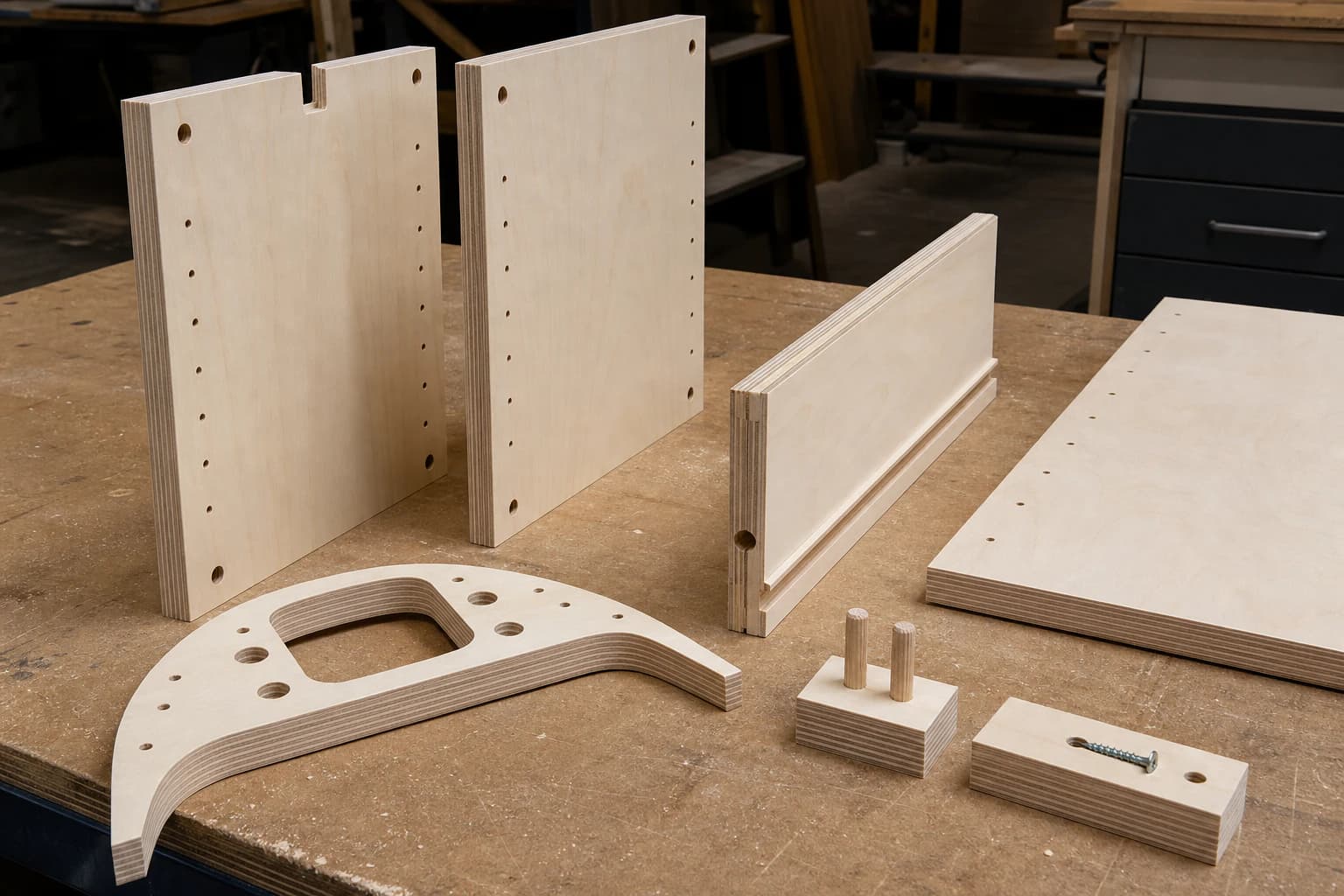
Birch plywood components: weight and fixing details
Plan component weight with the complete core, finished thickness and hardware. Match drilled holes, edge distances and joint details to the way the part will be assembled and loaded.
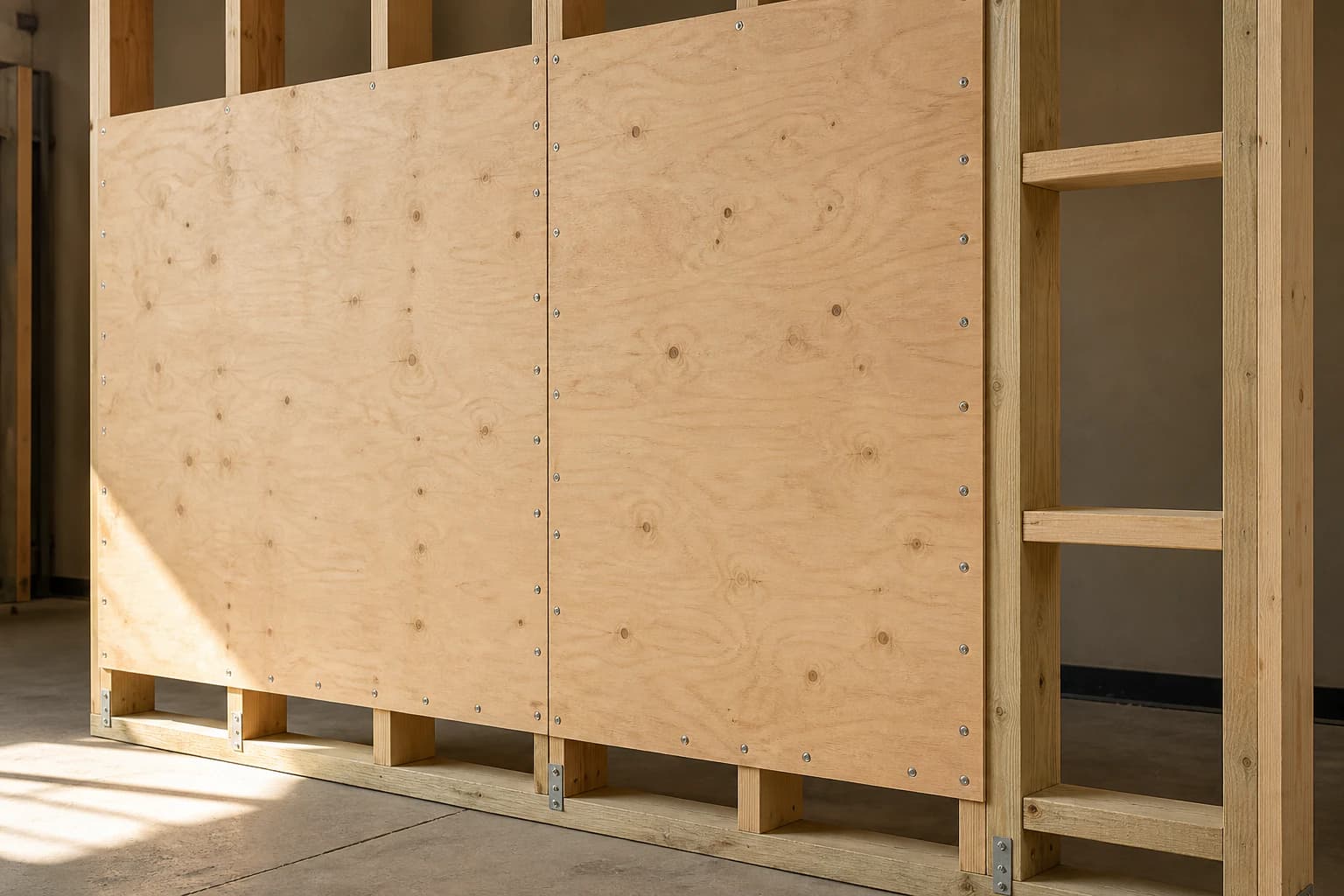
Structural plywood: supports and panel joints
Specify support spacing, panel orientation, supported joints and fasteners together. Select the structural grade and design data for the complete installation, including its service conditions.
Bending strength, modulus, shear and compression answer different questions.
Keep each value with its unit, direction, test method and panel condition. A test result, a characteristic value and a permitted design value serve different purposes.
On a phone, swipe across the table to read every column.
| Property | Meaning & unit | What to request |
|---|---|---|
| Bending strength / MOR | Stress calculated at failure in a specified bending test. MPa or N/mm² | Thickness, lay-up, direction, conditioning and test method. Keep the result separate from a design stress or installed load rating. |
| Bending stiffness / MOE | Resistance to bending deformation in the stated test. MPa or GPa | Both panel directions and the reported method. A higher MOE helps limit deflection; it does not give the failure load on its own. |
| In-plane shear | Resistance to shear acting within the panel plane. MPa or N/mm² | Loading arrangement, panel direction and product identification for bracing, webs or other shear-loaded parts. |
| Planar / rolling shear | Shear through the thickness that can involve cross-grain veneers as the panel bends. MPa or N/mm² | The relevant shear plane, core lay-up and method. Do not substitute a glue-bond quality result for structural rolling-shear data. |
| Compression and bearing | Resistance to compression in a stated direction or local bearing at a contact. MPa or N/mm² | Parallel-to-surface or through-thickness loading, contact area and support. Also check buckling when a slender part carries compression. |
| Connection resistance | Withdrawal, lateral resistance or head pull-through for the tested connection. N or kN; sometimes per fixing | Exact fastener, penetration, face or edge insertion, hole preparation, spacing, conditioning and failure mode. |
One MPa equals one N/mm²; one GPa equals 1,000 MPa. The USDA Wood Handbook chapter on composites explains these material properties. Use the matching product report for the panels and application you select. See Plywood Testing Methods for identifying the tested construction, direction, conditioning and report.
Specify plywood strength direction before cutting and installing.
Crossed veneers give plywood properties in both directions, but layer thicknesses and orientation affect the balance. Identify the strength axis from the product data; face grain is a useful visual reference, not a substitute for that identification.
For bending across supports
Match the relevant directional data to the span and support layout. If you rotate a panel or cut a narrow part in the other direction, review that direction’s properties. Thickness and grade remain part of the specification.
For repeat cutting and machining
Put the required orientation on the drawing and cutting plan. Identify it on parts that need a consistent direction after cutting. Tell us how the parts will be supported, connected and used when requesting machining.
Compare Core Materials & Species for the lay-up choices and Structural Plywood for load-bearing applications.
How to read a birch plywood stress graph or yield-strength claim.
First check the axes: load–deflection and stress–strain graphs are different. Keep the curve with the tested construction, dimensions, orientation, support arrangement, conditioning and method.
Slope and maximum result
The initial linear response helps determine stiffness using the test method’s calculation. The peak load or reported failure stress describes that test’s strength result. A bending curve needs its geometry and method before it can be interpreted as MOE or MOR.
Yield and proportional limit
Plywood does not necessarily show a metal-like yield plateau. If a report gives “yield strength,” ask how the point was defined. The proportional limit, maximum stress and serviceability limit are not interchangeable.
For a birch part, request the relevant report and curve for the supplied lay-up and direction. Keep individual and summary results identified. An average test result is not automatically a characteristic strength or a design value for your assembly.
Plywood screw holding, withdrawal tests and fixing requirements.
Describe the actual joint: panel construction and thickness, screw type and diameter, thread penetration, insertion into the face or edge, pilot hole, edge distance, spacing and moisture condition.
Compare the relevant test
Withdrawal pulls the fastener along its axis; lateral resistance concerns load across it; head pull-through concerns the head passing through the panel. Request the test method, force units, installation details and failure mode. ASTM D1761 provides methods for mechanical fasteners in wood-based materials.
Check the finished joint
Use an approved connection design or test the intended assembly. A maximum single-screw force cannot simply be multiplied by the number of screws: panel splitting, spacing, unequal load sharing and other connection modes may control.
Send the drawing for hinges, inserts, dowels or brackets. Identify any fittings you want included in the quotation, separately from the plywood and machining.
The USDA fastening chapter covers connection behaviour. Discuss edge machining, hole preparation and finish with our factory team so the supplied part matches the joint you intend to use.
Plywood load capacity needs a span, a load and an installation.
Give the designer the product grade, thickness, direction, clear span, supports, joints, loading and service environment. Check bending, shear, deflection and connections, including sustained-load effects where relevant.
Floors, shelves and platforms
Provide the clear span, supports, panel orientation, joint layout and load distribution. Include point loads, wheel contact, impact and sustained loading where relevant. Check deflection and connections as well as panel strength.
Concrete formwork
State whether the panel forms a wall or slab, the backing and support spacing, and the pressure or loading supplied by the formwork designer. Wall pressure depends on the placement conditions; a film face and sheet thickness alone cannot set the permitted pour.
Crates and transport cases
Describe the cargo mass, centre of gravity, bearing points, stacking, lifting and transport conditions. Base panels, bearers, joints and fixings share the load. Specify a complete crate design or agreed assembly test when a rated capacity is needed.
Furniture and machined parts
Show the finished part dimensions, cut-outs, unsupported lengths, hinges and fixing positions. Ask for the properties that control that part, then check the assembled component with the intended fittings and finish.
Read characteristic values correctly
A characteristic strength is a statistically established value under a stated framework. A design value applies that framework’s factors and service conditions. Ask whether a table reports test averages, characteristic values or allowable/design capacities, then use the matching design procedure.
Read span and load tables correctly
Check the covered panel grade, orientation, support conditions, load type, moisture and deflection limit. A span rating does not establish every point-load or crate capacity. Use only tables that cover the actual offered product.
APA’s plywood guidance links to its panel design and load-span publications for the products they cover. For formwork, see Concrete Formwork & Shuttering; for transport cases, see Industrial Packaging.
Specific heat and thermal conductivity describe different behaviour.
Specific heat capacity describes energy needed to raise a unit mass by one degree, usually in J/(kg·K). Thermal conductivity describes heat flow through a material, in W/(m·K). Neither is a structural strength value.
Match the measured conditions
Request the panel construction, density, moisture, test temperature, direction, thickness and method with the result. Coatings and a composite core may change the finished panel response. Wood’s moisture and temperature relationships are described in the USDA physical-properties chapter.
Assess the complete building or component
For a homogeneous layer, thermal resistance is thickness in metres divided by the applicable conductivity. A wall, roof or sandwich panel also includes other layers, joints and thermal bridges. Evaluate the actual assembly before specifying an insulation or heat-transfer target.
Request product data that matches the job.
Send the required property and intended use with the order enquiry. Our factory team helps confirm the construction and the documents or testing to include.
- Face/back, core lay-up, finished size and thickness, surface treatment and product grade.
- Density or weighed sheet mass with moisture and measurement basis.
- Required mechanical or thermal properties with units, direction and test conditions.
- Supports, loads, component drawing, fixing details and service environment where applicable.
- The applicable report, declared characteristic values or design data, with covered construction and use.
- Quantity mix, destination, requested processing, documents and delivery date.
Tell us which limit drives your purchase: maximum component mass, permitted deflection, specified grade, fixing resistance or a thermal target. We confirm which construction and product information the quotation covers. Agree any additional laboratory or assembly testing, its scope, costs and timing before the order proceeds.
An ordinary custom sheet size does not automatically require a separate certificate for every millimetre. Check the document’s product and thickness scope, and review changes to construction or use that could affect the relevant performance. Standards & Certifications explains how to match documents to the project; Quality & Inspection helps plan the checks.
Weight, performance and connections
Questions about plywood density and strength.
What is the density of plywood?
Density is mass divided by volume, usually in kg/m³. The result depends on the complete panel construction, moisture condition and finish. Specify the core and finished thickness, then ask for the density range or measured sheet mass for that construction. A face species or product name alone does not establish one value.
How do I calculate plywood sheet weight?
Multiply length × width × thickness in metres by density in kg/m³ to obtain kg per sheet. Alternatively, use all three dimensions in millimetres and divide their product by 1,000,000,000 before multiplying by density. The calculator uses this formula. Add packaging separately for gross shipment mass.
What is the specific weight of 6 mm birch plywood per m³?
In a buying enquiry, kg/m³ normally means density. Six millimetres defines thickness, not a different density unit. For a 1220×2440×6 mm panel, volume is 0.0178608 m³; multiply this by the density of the selected birch-faced or all-birch construction. With an assumed planning density of 650 kg/m³, the calculated sheet mass is 11.61 kg. This assumption is not a product specification.
Are marine plywood density and marine plywood weight fixed?
No. Marine plywood describes a product specification, not one species or density. Ask for the face and core construction and its mass or density at a stated condition. Calculate weight from the actual dimensions and finish. Marine bond or durability requirements also do not supply a structural design value by themselves.
What does film-faced plywood film weight mean?
It usually identifies the specified film’s mass per unit area in g/m². Confirm whether the quoted value is for one face or the combined surfaces, and what material the value includes. It is separate from the plywood density and complete sheet weight. Do not add it again if the density or weighed mass already includes the finished film.
Is plywood equally strong in both directions?
Crossed veneers give properties in both panel directions, but the lay-up need not give equal values. Identify the strength axis and use the relevant direction in the product data. A rotated machined part or a different support layout may require the other directional value.
Does denser plywood always carry more load?
Density is useful for weight planning, but load capacity also depends on lay-up, grade, thickness, span, orientation, service conditions and connections. Compare the actual strength and stiffness data for the intended assembly rather than using density as a load rating.
What is the difference between MOR and MOE?
MOR describes bending strength calculated from a test’s maximum load. MOE describes stiffness and helps predict deformation. They answer different questions, and neither can be used alone to assign a safe load to every floor, shelf or formwork panel.
Can I use a birch plywood stress graph or yield strength from another product?
Use the test curve and results for the relevant lay-up, thickness, direction and conditioning. Check whether the graph plots load against deflection or stress against strain. Plywood may not show the clear yield plateau associated with some metals; any reported yield or proportional-limit value needs its definition and method. Ask for the matching report rather than transferring a generic birch curve.
How much load can a plywood sheet or crate carry?
A capacity needs a defined installation. Provide support spacing, orientation, joints, concentrated or distributed loads, duration and moisture conditions. Crates also need the base supports, connections, lifting and stacking arrangements. Applicable design data and calculations or an agreed assembly test establish the capacity.
How should I compare plywood screw holding strength?
Compare the same screw, penetration, insertion location, pilot hole and conditioning. Withdrawal, lateral resistance and head pull-through are different checks. A maximum laboratory withdrawal force is not automatically the allowable load of a multi-screw joint.
Can CUZI PLY help specify the panel data for my order?
Yes. Send the use, construction or weight target, size, finished thickness, quantity and destination. Add the supports, loading, machining and fixing arrangement when relevant. Our factory team helps select the panel and confirm the product documents or requested testing with the quotation.
Can the calculator result be used as the gross shipment weight?
The calculator gives net panel mass from the density and dimensions you enter. For a mixed order, sum each construction and thickness, then add actual packing. Use the agreed weighing records for gross pack or shipment mass; confirm lifting equipment and transport limits separately.
Order plywood for your weight and performance requirements.
Regular sizes: 1220×2440, 1250×2500, 1525×3050 mm. On-request sizes: 1250×3050, 1250×3660, 2100×2800, 1830×3660, 1250×3800 mm. Add the finished thickness, construction, quantity and destination. For machined parts, give the finished geometry and required orientation.
- Order quantity & mix
- Tell us the sheet size, thickness mix and quantity you need. We confirm the minimum order and available mix for your selected construction.
- Production lead time
- We confirm the production schedule with your specification, order quantity and sample requirements. Production lead times are planning estimates, not transit times.
- Price & quotation unit
- Currency and price unit stated in your quotation. Your quote is based on the agreed dimensions, construction and quantity. Processing and requested testing are stated separately where applicable.
- Samples
- Tell us the plywood, thickness, finish and delivery country. We confirm sample availability, any sample and courier costs, and dispatch arrangements before proceeding.
- Packing & delivery
- We agree export packing, labels and the loading plan for your order. Share the destination country, named port or delivery point and preferred delivery term. Freight, insurance, duties and taxes are included only when stated in the quotation.
- Payment & order confirmation
- We agree the payment method, currency and any deposit and balance schedule in the quotation or proforma invoice. Your order confirmation sets out the product, quantity, packing and delivery arrangements.
Choose the construction your part needs.
Tell us what you are making, its weight target and how it will be used. Our factory team helps you compare the panel, processing, required data and delivered-order cost.
Name the construction, thickness, finish or machining you want to assess. We confirm availability, sample and courier costs, and dispatch arrangements before proceeding.