Plywood that fits your cutting and forming work.
Order the panel around the part you want to make. The face, core, thickness and condition affect cut edges, hole quality, joint fit and curved surfaces. Plan the material, machining and finish together to reduce rework and make repeat orders easier.
CUZI PLY is your plywood manufacturer and direct supplier in Linyi, China, with 10 production lines. Tell our factory team which operations you need before shipment and which you will complete in your workshop. We set out the supplied construction, dimensions, agreed processing and packing in your quotation.
Choose the construction for cutting, joints and visible surfaces.
Furniture and CNC components
Compare Birch, Hardwood and Furniture Grade Plywood for the required face, core, actual thickness and exposed edges. A pale face does not identify the inner veneers, and a good flat face does not establish the quality inside a deep pocket or screw joint.
Laser and curved work
Use Laser-Cutting Plywood for a construction assessed on your laser and Flexible Plywood for the selected bend direction and curve. An ordinary cross-laminated panel, a bending sheet and a finished moulded component are different purchasing choices.
Tell us whether you need full sheets, rectangular blanks, routed parts or a complete formed component. Agree the machining, finishing, packing and assembly scope with your order, so the supplied plywood fits your production plan and delivery schedule.
Specify cut-to-size plywood and marine strips clearly.
Drawing and cutting layout
List final length, width, thickness and quantity. Mark the visible face, grain or bend direction, reference edge, square ends and trimming allowance. Include the saw kerf between parts in the cutting plan; sheet area alone does not show the usable yield.
For marine plywood strips, keep direction and part identity after cutting. Specify the straightness, joints and finishing requirements, then protect newly cut edges and holes with the compatible system for the marine component.
Support and cut-edge quality
Use a sharp blade suitable for the material, with the work holding and feed method specified by the machine manufacturer. Support the sheet and the separated pieces so narrow strips do not move or break out as the cut finishes.
Inspect both faces, corners and the cut core. Identify acceptable veneer breakout separately from core gaps, an opened glue line or a damaged decorative layer. Specify the visible-edge quality needed after trimming, banding or finishing.
Define CNC routing, drilling, profiles and nesting.
| Operation | What to specify | What to check |
|---|---|---|
| Cut-to-size panels and marine strips | Finished length and width, quantity, grain or bend direction, reference edge, square ends and any trimming allowance. | Allow for the cutting kerf in the layout. Keep direction on each strip; narrow parts need suitable support, handling and protection of newly exposed edges. |
| CNC outlines, pockets and slots | Drawing units, revision, outside profile, pocket depth, slot width, corner radius and the faces used for measurement. | A round cutter leaves an internal radius. Agree joint clearances, any corner relief, hold-down marks and the permitted visible-edge appearance. |
| Drilling and countersinking | Hole diameter and position, through or blind holes, depth, face of entry, countersink geometry and matching hardware. | Assess breakout at the exit face, depth control and material around fixings. A screw clearance hole, pilot hole and dowel fit are different requirements. |
| Tongue-and-groove or other edge profiles | Profile section, orientation, reference face, engagement, clearance and the finished assembly dimensions. | Check paired parts after machining and conditioning. Profile accuracy alone does not establish the load capacity or weather-tightness of the assembled joint. |
| Calibration, sanding and face preparation | Final panel thickness, thickness variation, flatness, visible veneer and the intended paint, veneer or laminate. | Agree the material removed and the remaining face. Avoid specifying a sanding operation without its effect on thickness, appearance and the next finishing process. |
| Nesting, identification and packing | Part quantities, grain direction, mirrored or handed parts, face orientation, labels and whether sets must stay together. | Balance usable yield with edge quality, hold-down and safe handling. State whether the quote is for mother sheets, blanks or finished parts; compare waste and processing on the same basis. |
For chip-out control, match tooling, cut direction, depth and work holding to the top and bottom faces. Upcut, downcut and compression geometries have different cutting and chip-removal behaviour. Follow the selected tool’s instructions rather than copying a speed or feed from another construction; LMT Onsrud’s compression-tool information is one manufacturer-specific reference for double-sided veneered materials.
Toolpath position is not the whole quality check. Measure the finished geometry and inspect visible faces, corners, pocket floors, hold-down marks and joint fit on the actual part.
Keep machine accuracy, panel variation and finished fit separate.
Part dimensions and measurement references
Mark important lengths, hole centres, pocket depths, corner profiles and permitted variation from the drawing’s reference faces or edges. State the units, revision and measurement stage. Include squareness and straightness where the assembly depends on them.
A slot sized only from nominal sheet thickness may not fit every panel. Match its clearance to the measured thickness, finish, adhesive and required joint function.
Panel condition and finishing allowance
Agree thickness variation, flatness and conditioning alongside machining tolerances. Moisture movement and applied surfaces can change the finished fit. Edge banding, a veneer, laminate or coating adds dimensions that the cutting drawing must allow for.
Read Moisture & Water Resistance for conditioning and movement. We confirm the dimensions and inspection for the quoted construction and processing, not one universal tolerance for every machine and part.
Select birch, basswood or thin plywood by the complete laser construction.
Birch and basswood plywood names identify a material choice, not every inner veneer or glue line. Specify face and core, adhesive, actual thickness, flatness and any finish. For our current laser options, compare poplar, birch-faced balanced-core and all-birch constructions on the Laser-Cutting Plywood page.
Part details and cut appearance
Check straight cuts in both grain directions, holes, slots, narrow bridges, corners and engraving. Compare cut-through, edge colour, glue spots, residue and back marking. A thinner sheet can still need different settings and support; species and nominal thickness alone do not set the kerf or joint fit.
Machine, material and extraction
Keep the material construction and actual thickness with the machine, lens, focus, support, air assist, extraction and cutting settings. Repeat the trial after a material or important setup change. Follow the equipment’s material and fire-control requirements; do not assume a coating, adhesive or masking film is suitable for laser processing.
Trotec’s wood-processing guidance explains why wood characteristics, glue, optics and exhaust matter. Select settings for your equipment and the exact panel construction, then check the finished cut and fit.
Distinguish edge sealing from decorative edge banding.
Sealing cut edges and holes
Specify exposure, edge coating and preparation with the finished geometry. Treat new cuts, routed openings, drilled holes and corners using the compatible system, including preparation, coverage and cure. For film-faced plywood, renew protection after cutting, wear or handling damage; an intact working face does not cover a freshly sawn edge.
Do not coat over an unresolved loose layer or a substrate outside the coating’s moisture requirements. Include joints, fixings, drainage and maintenance in the component plan.
Banding and finished dimensions
Choose the visible edge material, colour, thickness, corner profile and adhesive for the service conditions. Veneer, solid timber and plastic edging have different preparation and finishing needs. Define which edges are banded, any exposed plywood layers and the finished outside dimensions.
A decorative band is not automatically a structural connection or a watertight assembly. Match its bond, trimming and joint details to the part. Do not send a plastic-banded or coated panel to a laser without material-specific equipment guidance.
Agree face preparation, finishing and the final appearance.
State the visible face and back, repairs, sanding and the intended veneer, laminate, paint or clear finish. Keep the face thickness needed after preparation. Check the adhesive or coating instructions for substrate condition, preparation, application and cure; a clean routed profile is not the full finishing specification.
Balance and assembled fit
Plan both surfaces, edge build-up and any balancing layer with the construction. Measure close-fitting parts at the agreed stage after processing and conditioning. For curves, assess joints, surface smoothness and the final finish on the formed geometry, not only the flat sheet.
Processing and finishing in the quotation
Identify which cuts, profiles, sanding, edge treatment and applied finishes are included before shipment. Agree the part labels, protective packing and any remaining workshop operations. Compare these separately from panel-only pricing so the delivered scope is clear.
Our factory quotation brings the plywood and agreed processing together. Explore cut-to-size supply, CNC plywood components and edge-banded panels for the order details. Your workshop or installer completes the operations not included before shipment, including compatible protection for any new cuts and holes.
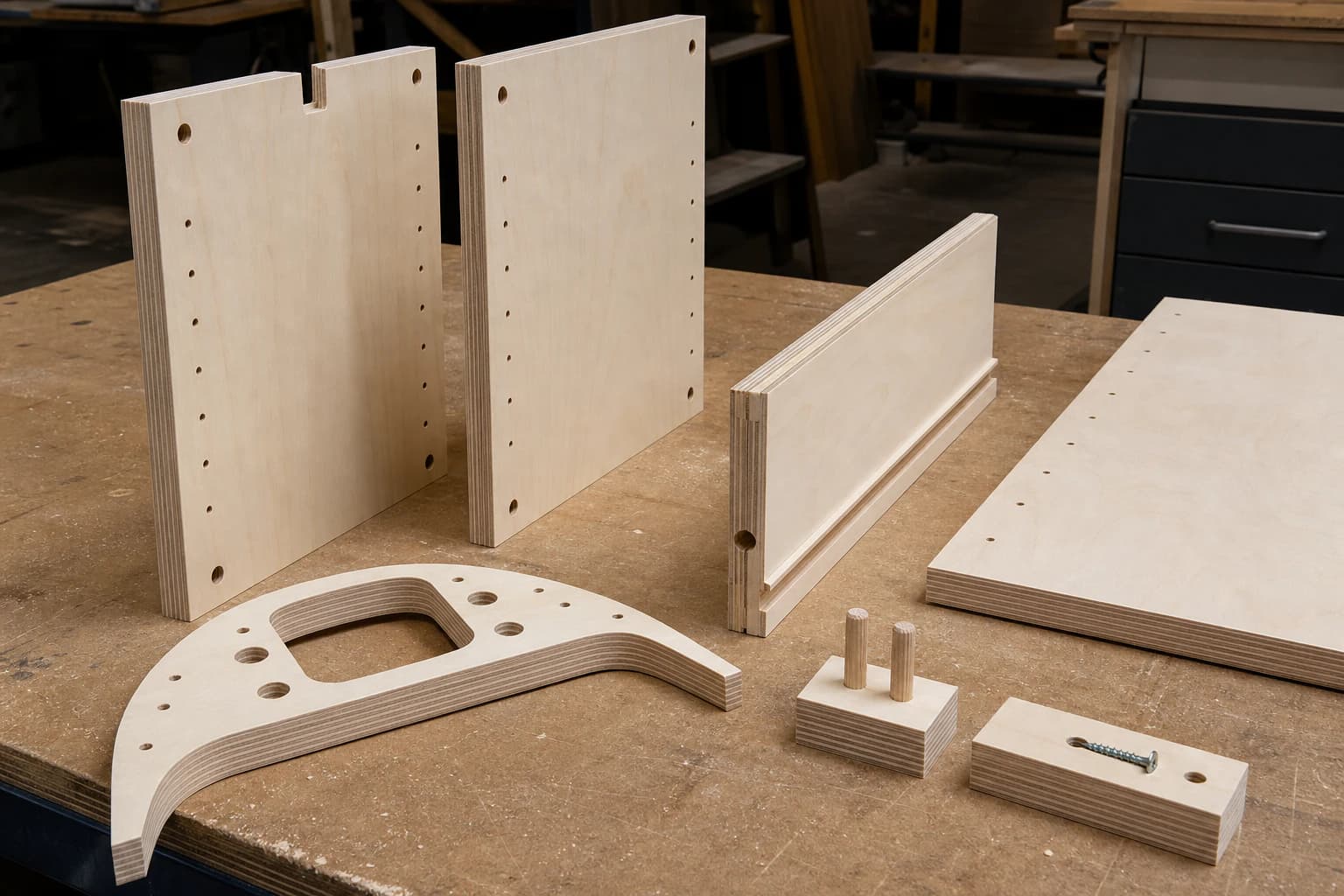
Birch plywood machining and joint details
Specify hole positions, grooves, corner profiles and visible cut edges on the same drawing. Match the panel thickness and core to the joint fit, hardware and final finish.
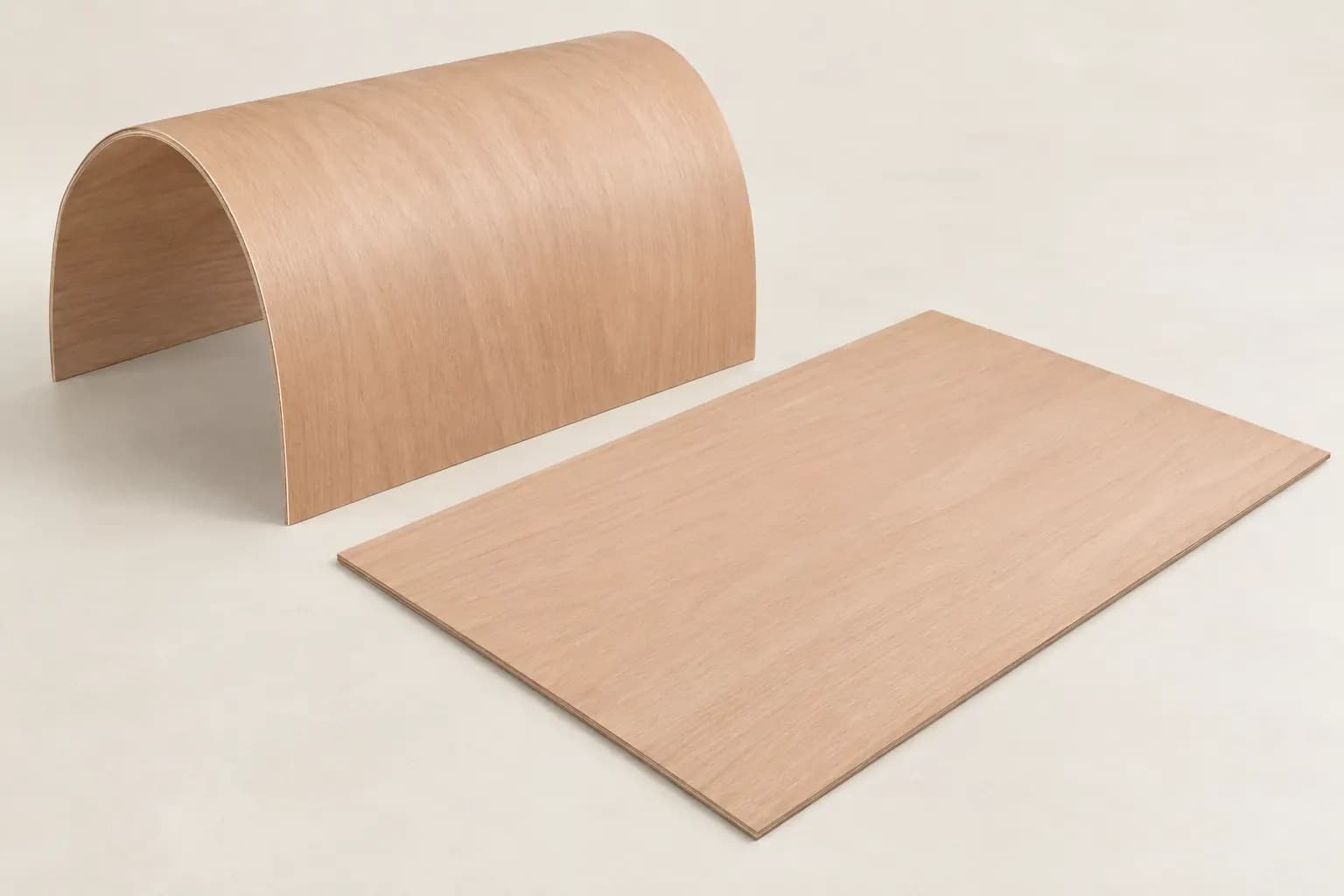
Flexible plywood for curved furniture
Select the bending direction and thickness for the required curve. Plan trimming, supporting frames, joints and the final surface around the finished component.
Plan bending plywood for furniture, circles and marine parts.
Our Flexible Plywood range uses okoume or eucalyptus options in 5–30 mm, with longitudinal or transverse configurations. Mark the curve against sheet length and width, and show the axis that stays straight. Choose the thickness and direction with the actual radius, frame, joints and finish.
Flexible plywood over a supporting form
Select the construction and bending direction for a smooth, continuous curve. Define the support, joints and finish; the sheet’s flexibility does not supply the frame or an installed load rating.
Several thin sheets bonded around a form
Specify each layer, adhesive, grain arrangement and final thickness. The forming process, bond and finished profile must be assessed together, including movement after release from the form.
Kerf-cut or patterned bending
Cuts can let a panel flex by interrupting its continuous section. The remaining webs, cut direction and pattern change the part’s strength, appearance and moisture paths. Do not treat the cut pattern as an unchanged structural sheet.
Moulded plywood components
Veneers or layers are bonded and shaped with tooling to make the specified part. Define geometry, layer arrangement, adhesive, forming process, trimming and finishing rather than specifying a flat sheet and a bend angle alone.
For a 90-degree bend, provide the radius as well as the angle. For a circle or cylinder, provide the inside or outside diameter, straight height, seam and final thickness. Check the selected construction on the forming setup and measure the profile after release; no single minimum radius applies to the entire range.
Water or steam is not a universal shortcut. Follow the selected construction and bonding process, assess any moisture or heat exposure, and reach the required condition before bonding or finishing. Ordinary marine plywood also needs a thickness, lay-up and curve suitable for its forming method; a marine bond description does not supply bending performance.
Columbia’s bending-plywood description explains direction and application choices. Trotec’s patterned-bending guidance explains how cut geometry affects flexibility. Choose the forming method for your panel, required curve and supporting structure.
Specify moulded plywood and chair components separately from bending sheets.
Moulded plywood combines shaped layers, adhesive and tooling to achieve a finished geometry. For a chair shell, curved furniture part or other formed component, provide the profile or drawing, layer arrangement, final thickness, visible surface, joints and fixing positions. Include the forming and bonding process, shape after release, trimming, finishing and the required durability or assembly tests.
Buying the plywood for your forming work
CUZI PLY manufactures and supplies the selected plywood sheets. Tell us the curve, part layout, forming method and finish so the offered material and agreed preparation fit your production. A bending-panel order does not include a complete furniture assembly.
Requesting a finished bent or moulded part
Identify that complete-part scope in your enquiry, including tooling ownership, critical geometry, finish, quantity and testing. We review the requested item and processing before confirming the supplied scope. Do not substitute a generic flexible-sheet quotation for a formed-part production specification.
Chair strength, fatigue and connections belong to the complete furniture design and applicable tests. Neither a curved appearance nor a plywood material description proves that finished furniture meets those requirements.
Support the material and control dust, fumes and fire risks.
Use trained operation, guarding, suitable work holding and the machine manufacturer’s safe procedure for sheets, strips and small parts. Capture dust at the source, maintain extraction and use appropriate protective measures for the work. HSE and OSHA describe source extraction for woodworking; follow the requirements for your workplace.
Laser work also needs suitable exhaust, material compatibility and the equipment’s fire controls. Do not leave cutting work unattended contrary to its operating procedure. Store and condition panels flat with appropriate support, and protect finished parts from wetting, surface damage and distortion through to assembly.
Send the material and part requirements for one clear quotation.
- Component, application, destination, quantity and whether you need sheets, blanks or finished parts.
- Face and core, thickness, bond and emission requirements, visible surfaces and intended finish.
- Drawing revision and units, final dimensions, reference edges, holes, slots, profiles and tolerances.
- Grain or bending direction, radius or diameter, support, joints and forming method where applicable.
- Machining, edge treatment and finishing before shipment, inspection stage and any required product or component tests.
- Part labels, handed or mirrored sets, protective packing, delivery point and target timing.
Regular sheet sizes: 1220×2440, 1250×2500, 1525×3050 mm. On-request sheet sizes: 1250×3050, 1250×3660, 2100×2800, 1830×3660, 1250×3800 mm. Plan finished-part layout, direction, cutting waste and packing around the supplied format. Product documents apply to the stated construction, properties and use. Include any required dimensional, bond or component tests with the drawing, so our quotation identifies the inspection, costs and timing.
- Order quantity & mix
- Tell us the sheet size, thickness mix and quantity you need. We confirm the minimum order and available mix for your selected construction.
- Production lead time
- We confirm the production schedule with your specification, order quantity and sample requirements. Production lead times are planning estimates, not transit times.
- Price & quotation unit
- Currency and price unit stated in your quotation. Your quote is based on the agreed dimensions, construction and quantity. Processing and requested testing are stated separately where applicable.
- Samples
- Tell us the plywood, thickness, finish and delivery country. We confirm sample availability, any sample and courier costs, and dispatch arrangements before proceeding.
- Packing & delivery
- We agree export packing, labels and the loading plan for your order. Share the destination country, named port or delivery point and preferred delivery term. Freight, insurance, duties and taxes are included only when stated in the quotation.
- Payment & order confirmation
- We agree the payment method, currency and any deposit and balance schedule in the quotation or proforma invoice. Your order confirmation sets out the product, quantity, packing and delivery arrangements.
BUYER QUESTIONS
Questions about plywood cutting, edges and curved parts.
How do I specify plywood cut to size?
Start with the final part dimensions, quantity, panel construction and thickness. Identify the reference edges, square or shaped corners, visible face, grain or bending direction, and tolerances. State whether sizes are before or after edge banding and finishing. Our quotation identifies the supplied panels or parts and the processing included.
How can I reduce chip-out when cutting or routing plywood?
Match the sharp blade or cutter, cutting direction, support and work holding to the panel and the finished faces. Check both entry and exit surfaces and any unsupported corner. Use the tool and machine manufacturer’s operating guidance, then assess a representative part for edge appearance, fit and core condition. Masking or sanding does not repair a damaged veneer bond.
Does CNC machining give every plywood part the same tolerance?
No. Machine positioning, finished-part dimensions, hole locations, actual panel thickness, flatness and moisture movement are separate matters. State the important dimensions, measurement references and condition on the drawing. We agree the required processing and inspection for the order; no single CNC accuracy number is offered for every construction or geometry.
What should I include for routed panels, holes and tongue-and-groove edges?
Include profiles and depths, internal radii, hole diameters and locations, entry faces and joint clearances. Identify the paired component or fitting and the assembly’s reference face. Check the assembled fit after conditioning and finishing. Machining a joint does not by itself qualify its structural load or water performance.
How do I cut marine plywood into strips?
Lay out the finished widths and lengths with the saw kerf, trimming and grain direction. Support both the sheet and the separated narrow pieces using the machine’s safe work-holding procedure. Check edges, straightness and the intended joint, then protect the new cuts and holes with the compatible marine finishing system. Keep the original construction and part identification.
How do birch, basswood and thin plywood choices affect laser cutting?
The face species alone does not identify the core, adhesive, actual thickness or finish. For birch or basswood plywood, specify the complete construction and check the cut edge and engraving on your equipment. Thin sheets also need adequate flatness and support. Compare cut-through, residue, edge colour and the smallest feature before selecting repeat-order material.
Is factory edge sealing the same as a waterproof finished part?
No. Factory treatment covers the edges supplied under the order. Cutting, drilling or routing can expose new wood, and joints, fixings, surfaces and drainage still affect the component. Specify the compatible edge treatment and renew protection after processing or damage. Film-faced plywood still needs care at cut edges and worn areas.
How do I bend plywood sheets for curved furniture?
Choose a bending construction and mark the curve against sheet length and width. State the inside or outside radius, support, joints, final thickness and surface finish. Check the selected panel with the intended form and assembly. Flexible plywood, laminated thin layers, kerf-cut sheets and moulded components use different processes and should not be ordered as interchangeable materials.
Can plywood bend through 90 degrees?
A 90-degree change describes an angle, not the tightness of the curve. Specify the radius as well as the angle, thickness, material, direction and support. A broad quarter-circle and a sharply folded corner are different parts. Do not force a sheet around a sharp corner on the basis of a bending-plywood name.
How should I plan plywood bent into a circle or cylinder?
State the inside or outside diameter, straight height, final thickness, seam or overlap and supporting form. Mark the bend direction and allow for trimming and the joint. Assess the profile after forming and release, then check the support and final finish. A continuous cylinder and a curved front fixed to a frame can need different constructions.
Can I bend plywood with water or steam?
Do not assume wetting makes an ordinary sheet suitable for a tight curve. Moisture or heat can change dimensions, appearance and bond behaviour. Follow the selected construction and adhesive’s forming requirements, and confirm the drying and finishing condition. We do not prescribe a universal soaking or steaming recipe for the product range.
Can marine plywood be used for bent parts?
A marine specification addresses the selected panel, not a universal bending radius. Consider thickness, veneer arrangement, direction, required curve and the complete marine component. Where thin layers are formed and bonded, specify that assembly and its protection separately. Do not substitute ordinary marine plywood for flexible plywood without checking the intended forming method.
What is different about moulded plywood and chair components?
A moulded part combines its shaped layers, tooling and adhesive with the required finished geometry. A chair shell also needs the connections, supporting structure, durability and applicable furniture tests. Buying bending sheets is not the same scope as buying a tested chair or finished moulded component. Describe which item you need so the material and complete-part requirements are reviewed separately.
Does CUZI PLY manufacture flexible plywood for curved work?
Yes. CUZI PLY is the manufacturer and direct supplier of our flexible plywood panels. The product page lists our material, thickness and bending-direction options. For a finished bent or moulded component, specify the component geometry, tooling, processing, finish and tests as a separate enquiry; the quotation must identify exactly what is supplied.
Can CUZI PLY provide plywood for an order delivered to London?
Our factory is in Linyi, China. Send your sheet or part quantities, required processing and delivery point so we can prepare a factory-order quotation with the delivery terms. Export production and freight are different from local walk-in cutting or same-day collection. Choose the purchasing route that fits your quantity and timing.
What information helps compare panel and processed-part quotations?
Use the same construction, finished dimensions, thickness, drawing revision, visible faces, tolerances, edge treatment, finish, quantities and packing. Separate tooling, processing, testing and freight where applicable. Agree which operations happen before shipment and which belong to your fabrication or installation process.
How should I check machined plywood parts when they arrive?
Match package labels and quantities to the part list and drawing revision. Check the visible faces, cut edges, holes and profiles, then measure the important dimensions from the agreed reference face or edge at the specified condition. Assess paired parts with the intended hardware and finishing allowance. Keep part references and photographs with any concern so our factory team can compare it with the order.
Who completes machining and edge protection after delivery?
Our quotation lists the cutting, drilling, profiles, sanding, edge treatment and finish included before shipment. Your workshop or installer completes the remaining operations using the appropriate equipment and finishing instructions. New cuts and holes need compatible protection, even when the delivered edges were sealed. Agree the finished dimensions and inspection stage so factory processing and later assembly follow the same drawing.
Choose the plywood for a cleaner cut and a better-fitting part.
Send the dimensions, construction, quantity and intended processing. We help complete the material and order details, then confirm the supplied scope, price, schedule and export packing.
Name the panel and the cut, joint or curve you want to assess. We confirm availability, any sample and courier costs, and dispatch arrangements before proceeding.