Plywood emissions and documents for your market.
Choose the panel and its documents together. For furniture, cabinetry and interior joinery, the destination matters as much as the face, core and finish. A clear emission specification helps you compare quotations, prepare import documents and keep repeat orders consistent.
CUZI PLY is your plywood manufacturer and direct supplier in Linyi, China, with 10 production lines. Work directly with our factory team to select the construction, identify the required product documents and include any agreed testing and labelling in your order.
Specify where the plywood will be sold and used.
Tell us whether you are buying sheets, machined components or a finished item, and how it will be used. Include the destination country, US state where relevant, indoor or outdoor location, and any buyer or project specification.
| Purchasing situation | What to specify | What to prepare |
|---|---|---|
| Interior panels for US buyers | Product category, core, adhesive, thickness range and whether the shipment contains panels, parts or finished goods. | The applicable TSCA Title VI certification, emission records, identification, labels and shipment documentation. |
| Goods sold or supplied in California | California destination as well as the US import requirement; identify the panel and finished-product roles. | The relevant CARB Phase 2 and federal documents for the quoted construction, not a general CARB badge. |
| EU furniture and indoor joinery | Destination, indoor application, construction and final surface or coating. | A report assessment against REACH entry 77 with the test conditions and product configuration identified. |
| Structural or exclusively outdoor work | The exact product standard, construction, location and foreseeable use. | The basis for the applicable classification or exclusion, plus any separate project requirements. |
State the named requirement in the enquiry rather than asking only for “low formaldehyde plywood.” Compare the same construction, test basis and destination requirements. Agree the documents before the purchase order, not after the panels are packed.
TSCA Title VI plywood combines emissions and product certification.
US TSCA Title VI covers defined hardwood/decorative plywood, MDF and particleboard. Covered hardwood plywood with veneer or composite cores has a 0.05 ppm formaldehyde limit, with certification, testing, identification and records under the programme. See EPA’s panel-producer guide.
Classify the actual product, not just its face species or marketing name. For your order, specify the core, adhesive, thickness range, surface and destination. Compare the corresponding documents with Hardwood Plywood or Birch Plywood and ask our factory team to identify the suitable construction.
A structural plywood TSCA exemption needs the right product basis.
EPA identifies exclusions for structural plywood and panels specified under the incorporated US PS 1 and PS 2 standards. A European or Australian structural classification alone is not that US exclusion. EPA’s stakeholder FAQ explains the distinction.
Ask which product standard, grade and identification establish the classification of the supplied panel. Describe the loaded component, supports, fixings and exposure separately; emission classification does not answer those design questions. See Structural Plywood and US Plywood Grades for the purchasing fields.
Buying CARB compliant plywood for California.
CARB Phase 2 is the California composite-wood programme. Its emission limits align with TSCA Title VI, but a CARB-only label is not today’s federal import documentation. Covered goods need the applicable TSCA Title VI certification and labels; see EPA’s current rule overview.
For California sales, specify both destination requirements and ask for the relevant manufacturer, product, certifier and shipment records. CARB’s labelling FAQ distinguishes product labels from invoice statements. Put the agreed requirements into the order, including who will retain identification when bundles are opened.
Product documents to request before ordering.
Use the following purchasing checklist to compare quotations and keep the selected material identifiable through machining and delivery. Ask for the documents relevant to the product and destination rather than an unspecified certificate package.
The product being purchased
Use one clear specification for face and back, core, adhesive, thickness, treatment, overlay and finish. Include the product category and destination; identify the manufacturer and production site.
Certification and its scope
Request the applicable certificate for the selected construction, with the issuing body, manufacturer, product coverage and status. Ask how the quoted product is identified within that scope.
The complete emission report
Keep the issuer, report number, test date, material identity, method and edition, preparation, conditions, results and units. Check how the tested construction relates to the order.
Panel and finished-goods labels
For regulated US panels or bundles, the label identifies the producer, lot, EPA-recognized TPC number and TSCA Title VI compliance. Finished-goods labels instead identify the fabricator, production month/year and compliance statement, subject to applicable exceptions.
Documents for the shipment
Connect the purchase, invoice or comparable compliance statement and product identification with the delivered goods. The US importer’s TSCA section 13 certification is a separate import step, not the panel’s TPC certificate.
Changes and repeat orders
Keep the agreed construction in repeat purchase orders. Before substituting adhesive, core, thickness range, treatment or finish, confirm which product documents and project assessments remain applicable.
Check the issuing certifier against EPA’s recognized and suspended/revoked TPC information. EPA recognizes third-party certifiers; it does not issue plywood product certificates. Verify the particular manufacturer and product coverage with the issuer, not simply a familiar logo.
The EPA importer guide explains the import role. For product-specific discussions, use Standards & Certifications and include the destination in your enquiry.
For the plywood you intend to order, our factory team identifies relevant available product documents and confirms the construction with your quotation. If an additional report assessment or test is needed, agree the issuer or laboratory, material selection, method, final surface and edge preparation, required report, costs and timing before commissioning the work. Confirm who will provide panel identification, finished-goods labels and import records before dispatch.
EU plywood formaldehyde requirements under REACH entry 77.
REACH entry 77 applies after 6 August 2026. Furniture and wood-based articles must not exceed 0.062 mg/m³ under the specified assessment. An E1 name or business-to-business sale alone does not establish compliance. Outdoor and professional-use exclusions have conditions, including foreseeable public exposure. See Regulation (EU) 2023/1464, entry 77 and Appendix 14.
Tell us the intended article and indoor use before choosing a panel. Include any coating, overlay, back face, exposed edge and project requirement. Agree how the selected construction and supporting report will be assessed with the buyer and relevant specialist; do not choose a looser category merely because the shipment is unfinished plywood.
Match the EU report to the reference test conditions.
Appendix 14 specifies reference conditions of 23 ± 0.5°C, 45 ± 3% relative humidity, wood-panel loading 1 ± 0.02 m²/m³ and air exchange 1 ± 0.05 h⁻¹. The result is determined at steady state within 28 days, not necessarily after a fixed 28-day run. Other conditions can be used with a scientifically valid correlation to the reference conditions.
When requesting a report assessment, include the complete results and chamber setup, exposed surfaces, edge preparation and final construction. Ask the issuer to identify any correlation and explain whether an existing report can be used. This helps avoid both unnecessary duplicate work and comparisons made on incompatible test bases.
Different formaldehyde methods answer different questions.
Chamber concentration, desiccator measurements and extracted formaldehyde content are not interchangeable results. Keep ppm, mg/m³ and mg/100 g with their method and conditions. A numerical unit conversion alone does not demonstrate equivalent testing or compliance with another programme.
For TSCA Title VI, EPA describes ASTM E1333 and the permitted equivalent ASTM D6007 approach. Use the edition accepted by the programme, not automatically a standard publisher’s newest edition. For a project class or another destination, name its method and assessment basis. See Plywood Tests & Reports for choosing checks and reading product reports.
NAF and ULEF are not zero-emission guarantees.
No-added-formaldehyde resin (NAF) and ultra-low-emitting-formaldehyde resin (ULEF) descriptions do not replace a finished-panel requirement. Under TSCA Title VI, limited testing or certification exemptions and reduced testing depend on the applicable approval and eligibility; labelling and record obligations still apply.
Specify the intended measurable requirement, construction and finish. Ask for the corresponding report and any programme approval being claimed, rather than selecting by a resin abbreviation alone. Our Bonding & Emission Options page helps you combine exposure, adhesive and indoor-use requirements in one panel specification.
Keep the finish and processed parts in the specification.
For the US programme, “laminated product” has a specific wood- or woody-grass-veneer construction definition; not every coating or HPL overlay is automatically that product. Since March 2024, non-exempt laminated-product producers have hardwood-plywood obligations. Conditional exemptions still require compliant platforms and records. See EPA’s fabricator and laminated-product guide.
Keep the underlying panel identity with cut, drilled and routed parts. Describe the final facing, back and edges when discussing the intended indoor component. Distinguish the sheet’s product documentation from any assessment of the finished furniture or complete interior assembly.
For US orders, identify whether components go to a fabricator for further assembly or directly to an end user. Ordinary parts supplied for further fabrication have different labelling treatment from finished goods; non-exempt laminated products are a separate case. Finished goods do not themselves require TSCA emission testing and third-party certification, but their regulated panels, labels and records must meet the applicable requirements. See EPA’s component-part and finished-goods guidance and include any California requirement with the order.
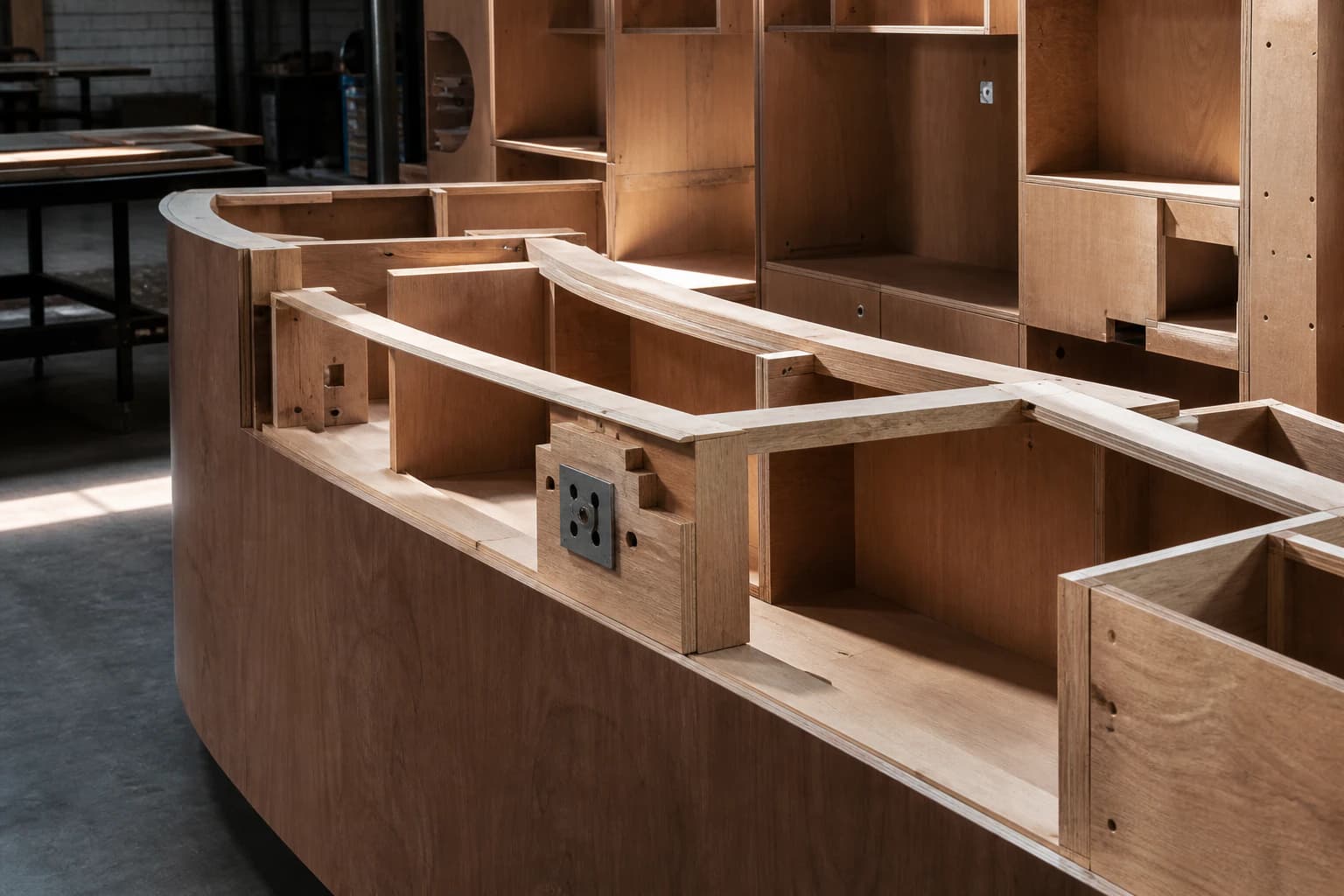
Hardwood plywood for interior cabinetry
For interior joinery, specify the face veneer, core, adhesive and final finish with your intended market. Keep the panel construction and required emission documents together in the order.
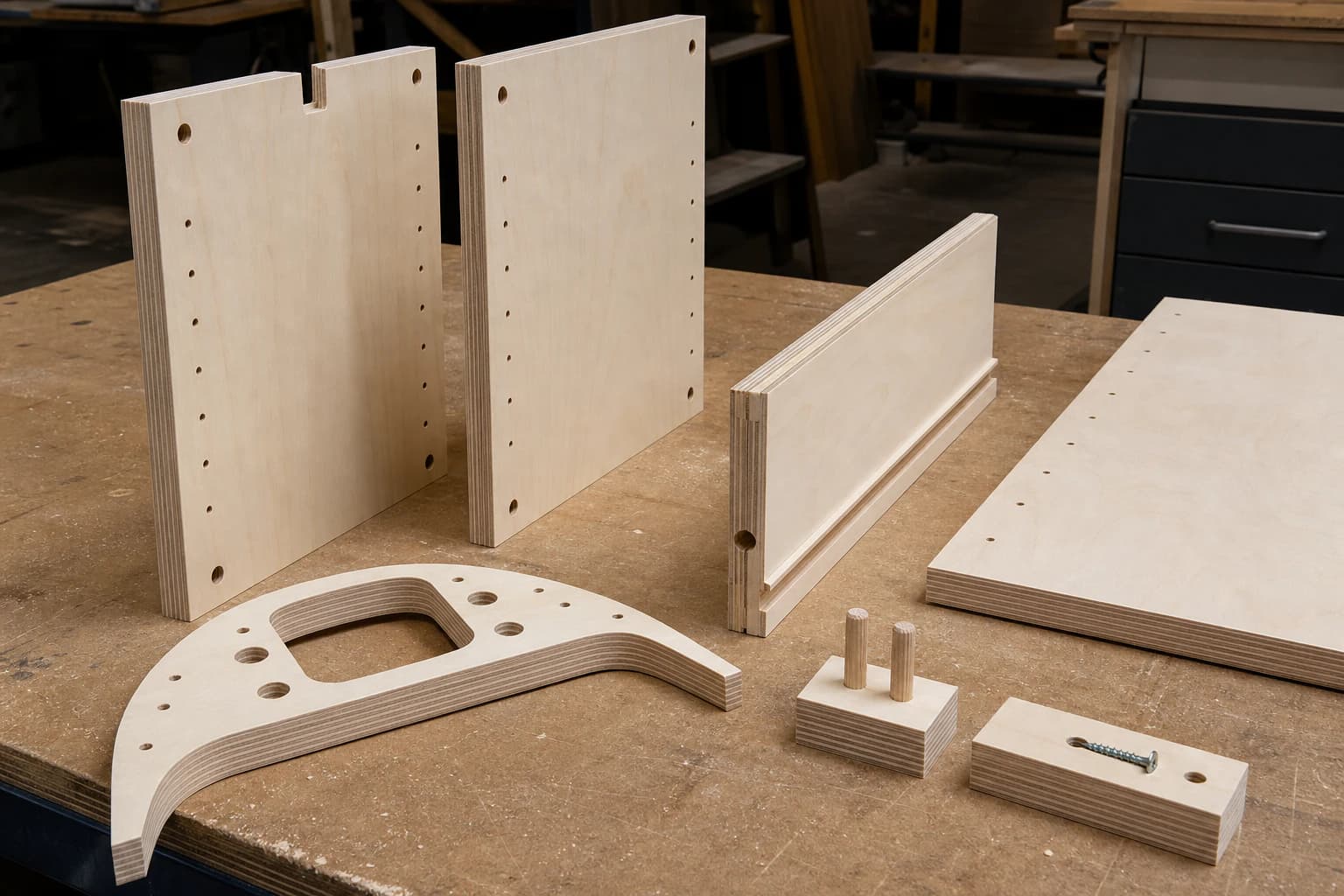
Birch plywood for machined furniture parts
Include routed openings, exposed edges, the back face and final coating when planning furniture parts. Keep the panel identity with processed components so the documents remain connected to the material used.
Get a quote for the panel and documents you need.
Regular sizes: 1220×2440, 1250×2500, 1525×3050 mm. On-request sizes: 1250×3050, 1250×3660, 2100×2800, 1830×3660, 1250×3800 mm. Add the construction, finished thickness, quantity and destination.
- Destination country and US state where relevant, buyer programme and intended market.
- Interior or outdoor application, finished article, foreseeable use and installation details.
- Face and back, core, adhesive, thickness, dimensions, overlay, treatment and final coating.
- Named emission requirement, method or class, relevant product documents and requested report format.
- Sheets, machined parts or finished goods, identification, labels and import documentation responsibilities.
- Quantity, packing, delivery point, target date and any additional assessment or testing to quote.
Custom length and width are manufacturing choices. Order the dimensions you need with the product category, construction, covered thickness range and finish. Confirm the relevant product documents and any additional assessment with its issuer, cost and delivery date; state separately any requirement for the finished article.
- Order quantity & mix
- Tell us the sheet size, thickness mix and quantity you need. We confirm the minimum order and available mix for your selected construction.
- Production lead time
- We confirm the production schedule with your specification, order quantity and sample requirements. Production lead times are planning estimates, not transit times.
- Price & quotation unit
- Currency and price unit stated in your quotation. Your quote is based on the agreed dimensions, construction and quantity. Processing and requested testing are stated separately where applicable.
- Samples
- Tell us the plywood, thickness, finish and delivery country. We confirm sample availability, any sample and courier costs, and dispatch arrangements before proceeding.
- Packing & delivery
- We agree export packing, labels and the loading plan for your order. Share the destination country, named port or delivery point and preferred delivery term. Freight, insurance, duties and taxes are included only when stated in the quotation.
- Payment & order confirmation
- We agree the payment method, currency and any deposit and balance schedule in the quotation or proforma invoice. Your order confirmation sets out the product, quantity, packing and delivery arrangements.
Indoor panels and destination requirements
Questions about plywood formaldehyde and product documents.
What should I specify when buying TSCA Title VI plywood?
Name the US destination, product category, construction, thickness and shipment form. Ask for the applicable certification, product identification and shipment documents described above. Put those requirements in the quotation and purchase order so a repeat order keeps the same agreed material.
Are CARB compliant plywood and CARB Phase 2 plywood the same purchasing request?
CARB Phase 2 names the California emission programme. State whether your order will be sold or supplied in California and whether it will be imported into the US. Ask for the corresponding product documentation rather than relying on an unspecified CARB description.
What are hardwood plywood TSCA Title VI requirements?
For a covered interior or decorative product, use the US panel requirements above and identify the actual construction. The regulatory category is not determined simply by a hardwood face species. Keep certification and labels separate from a single low emission result.
Does every structural plywood product have a TSCA exemption?
No. Match the actual structural product and its documentation to the exclusion described above. A sales name, load-bearing application or non-US structural standard alone does not establish that classification.
What should an EU plywood formaldehyde report show?
Identify the product, method, conditions and result, then document how it meets the applicable REACH entry 77 assessment. Request the full report and any correlation used rather than only an E1 label or a cropped result.
Does a REACH plywood declaration answer every project requirement?
Name the restriction, intended use and supporting product documents. Then add any project-specific indoor-air, fire, structural or sourcing requirements separately. A formaldehyde assessment answers that property; it is not a general approval for every building or furniture project.
Can an existing E1 report support the EU requirement?
It may contribute where its data and conditions support the required assessment, including a scientifically valid correlation where applicable. The class name alone is not the assessment. Ask the report issuer to explain the basis before commissioning duplicate testing.
Do NAF and ULEF mean zero-emission plywood?
No. These resin and programme descriptions are not a zero-emission promise for the finished panel or room. Specify the measurable product requirement and request the relevant documents, including approval of any claimed testing or certification exemption.
Does each custom sheet size need a new emissions certificate?
Custom length and width are manufacturing choices. Use documents for the stated product category, construction and covered thickness range. Confirm changes to adhesive, materials, treatments, finish or use against the applicable scope and report assessment, and state any requirement for the final article separately.
How can CUZI PLY help with my order?
Send your destination, application, construction, thickness, quantity and required documents. You work directly with our factory team to compare suitable panels, agree the documentation and include any additional testing, labelling, packing and delivery terms in the quotation.
Can I use the same plywood documents for US and EU orders?
Product identification and construction information can help with both orders, but the regulatory assessments are different. For a covered US panel, identify the applicable certification, labels and shipment records. For an EU wood-based article, assess the report against REACH entry 77 and its test conditions. Ask the issuer whether existing data can support the second assessment before arranging additional work; a unit conversion or class name alone is not enough. Our factory quotation identifies relevant available documents and any agreed assessment or testing, with its issuer, costs and timing.
Do machined plywood parts need the same TSCA label as a finished cabinet?
Identify who receives the parts and what they will do with them. Under EPA guidance, ordinary component parts supplied to a fabricator for further assembly do not require the finished-good label, but compliant underlying panels and supply records are still needed. Parts sold separately to end users are treated as finished goods for labelling, subject to applicable exceptions. Non-exempt laminated products have their own panel-producer obligations. State California sales separately and agree the identification, labels and shipment records before dispatch.
Choose your plywood with the destination in mind.
Send the application, construction and market requirements. Our factory team helps you compare suitable panels, agree the relevant documents and prepare a quotation with testing, labelling and delivery terms clearly stated.
For a physical panel assessment, specify the construction, thickness and finish. We confirm availability, sample and courier costs, and dispatch arrangements. Request laboratory work and regulatory documents separately.