Lightweight models & component blanks
SelectPoplar Light-Cut for pale, lightweight parts and sampling.
ConfirmCompare the actual thickness, cut edge, core joints and smallest detail on your machine.
Available to order — made to order
Make detailed models, engraved displays and repeat-cut parts with plywood selected for your machine. CUZI PLY manufactures poplar, birch-faced and all-birch laser-cutting plywood in our own factory, with thin-panel calibration and flat export packing. Choose the face, thickness and core for your component, then compare a cutting sample before ordering a production batch. Talk directly to our factory team about samples, cut sizes and a quote for your destination.
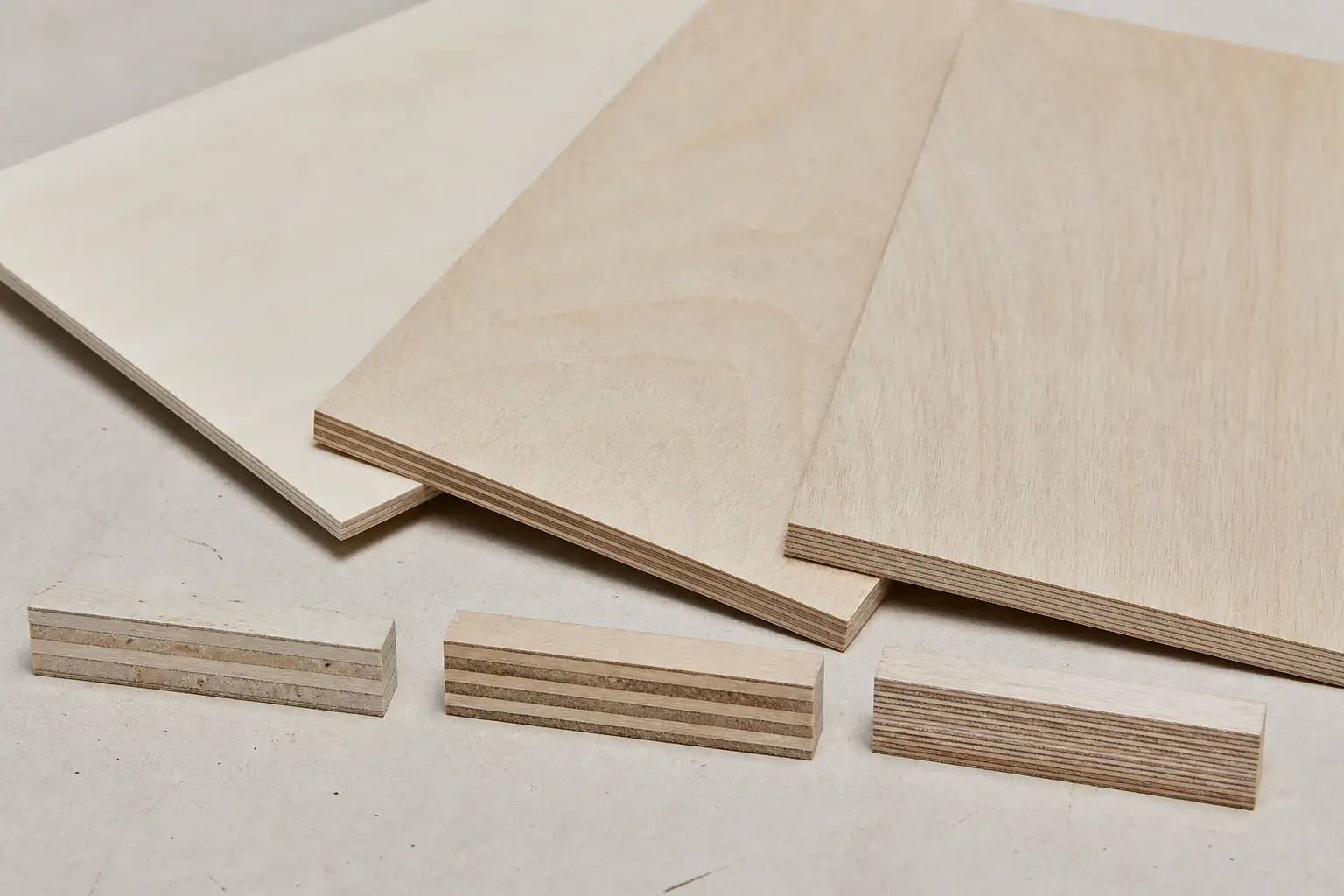
For lightweight models, educational parts and packaging inserts, start with Poplar Light-Cut. For display pieces and engraved surfaces, compare Birch-Faced Balanced Core. For nested assemblies, detailed models and visible layered edges, compare All-Birch Precision. CUZI PLY manufactures the selected face, core and thickness in our factory, with the supplied surface and packing agreed for your order.
Start with what you are making, the finished-part or blank size, target thickness, quantity and destination. Add visible-face, fine-detail and finish requirements if you have them. Our factory team helps select the construction; compare a representative cutting sample on your machine before ordering the production batch.
For a laser-grade plywood order, agree the veneer lay-up, adhesive, actual thickness, conditioned flatness and finished-part requirements together. Laser plywood core quality includes the veneer joints, gaps or overlaps, repairs and glue-line uniformity inside the panel. Compare cut edges and details from different positions in the sheet, including cuts along and across the grain. Look for incomplete cuts, local edge darkening, glue residue and fragile bridges, then check kerf and slot fit against your drawing.
SelectPoplar Light-Cut for pale, lightweight parts and sampling.
ConfirmCompare the actual thickness, cut edge, core joints and smallest detail on your machine.
SelectBirch-Faced Balanced Core for a visible birch face with a selected poplar or combi core.
ConfirmCompare face grade, engraving contrast, core construction and finished appearance.
SelectAll-Birch Precision for stiffness, detailed parts and all-birch edges.
ConfirmCompare ply construction, slot fit, minimum features and cut-part repeatability.
Compare the actual face, core, bond and cutting precision. The 2026-08-19 FOB China prices apply to the listed specifications; our factory quotes the selected construction, thickness and quantity for your order.
Start here for lightweight models, educational parts and packaging inserts. Compare pale poplar faces, cut-through and small details on your machine, then choose the thickness and packing around your component and budget.
Choose a birch face for engraved displays and visible components, with a selected poplar or combi core beneath it. Compare the face, engraving contrast and assembled part so appearance, panel weight and cost work together.
Choose all-birch veneers for detailed models, nested assemblies and exposed layered edges. Compare cut-edge appearance, stiffness, slot fit and the smallest features in your drawing before agreeing repeat production.
For slots, joints and nested assemblies, the actual thickness matters as much as the nominal thickness. Initial order targets are ±0.20 mm at 3 and 4 mm, ±0.25 mm at 6 mm, ±0.30 mm at 9 mm and ±0.40 mm at 12 mm. Agree the conditioning, measurement method and sampling with the selected construction, then check the fit on a representative part.
Initial flatness targets after agreed conditioning are ≤4 mm/1000 mm for Poplar Light-Cut, ≤3 mm/1000 mm for Birch-Faced Balanced Core and ≤2 mm/1000 mm for All-Birch Precision. Keep thin sheets fully supported through inspection, transport and unpacking; allow them to condition to the processing environment before cutting.
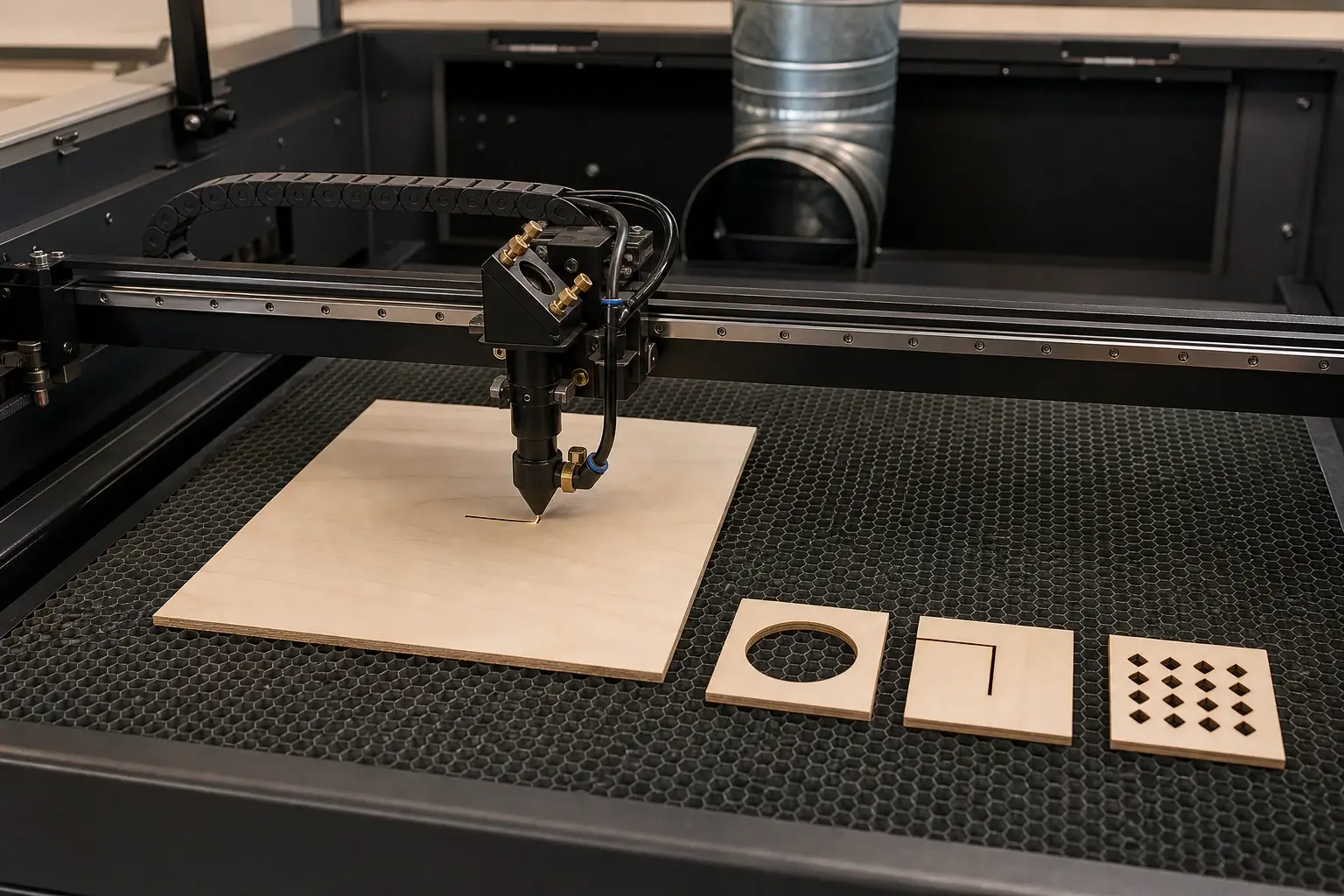
Describe the appearance and finish you want, and include any edge-colour, engraving-contrast or residue requirements you already have. If you need low visible smoke or a one-pass cut, include those goals in the sample trial. The result depends on the construction, thickness, machine, optics, air assist and extraction; keep the successful settings and selected panel together as your repeat-order reference.
Use extraction, filtration, fire monitoring and operating procedures matched to the laser equipment and material. Follow the equipment instructions and workplace controls when running the sample and production work.
Include straight cuts with and across the grain, nested shapes, holes, a narrow bridge, a sharp corner and engraving. Check the complete cut edge and both surfaces for residue, glue spots and back marking. Measure the small details, assembled fit and part flatness against your drawing, then compare the actual result on your machine.
Keep the plywood construction, actual thickness and batch identity with the machine model, laser source, rated output, lens, focus, support, air assist, extraction, speed, power and pass count. When a material, machine or important drawing detail changes, repeat the sample before continuing the production run.
Lightweight poplar, birch-faced balanced core or all-birch precision construction.
3–12 mm by construction. Choose a full sheet or blank around your machine bed, nesting layout and handling. View sheet formats.
6–10%, with the delivery condition and measurement method stated.
Cut-through, kerf, edge colour, residue, fine detail and engraving checked together.
A representative coupon records the panel, machine, optics, air, extraction and result.
USD 580–1,150/m³ FOB China price, dated 2026-08-19. Compare the construction, quantity, packing and delivery term with a current factory quote.
| Order field | Poplar Light-Cut | Birch-Faced Balanced Core | All-Birch Precision |
|---|---|---|---|
| Material option | Poplar Light-Cut | Birch-Faced Balanced Core | All-Birch Precision |
| Face / back | Selected pale poplar or buyer-agreed pale face | Birch B/BB, BB/BB or agreed visible-face range | Birch B/BB or BB/BB with patches, mineral lines and colour range agreed |
| Core species | All-poplar | Selected poplar or birch/poplar balanced combi | All-birch cross-banded veneers |
| Core construction / lay-up | Balanced lightweight cross-lay; natural density and core joints remain visible variables | Balanced lay-up selected for face consistency, weight and cost | Higher-ply all-birch lay-up selected for stiffness and edge consistency |
| Ply and glue-line control | Thin continuous glue line; overlaps, gaps and local density checked by the reference cut coupon | Uniform pale glue line and selected core joints verified on the nominated machine | Fine alternating plies, selected core and clean-cut glue line verified for each agreed construction |
| Bond & adhesive | Pale interior bond matched to the trial; exact chemistry confirmed by order | Pale interior bond with glue-line uniformity tied to machine trial | Pale interior bond selected for the target trial and exact all-birch construction |
| Panel emission requirements | Order-specific EN 717-1 / E1 or buyer-nominated option available on request | Order-specific EN 717-1 / E1 or buyer-nominated option available on request | Order-specific EN 717-1 / E1 or buyer-nominated option available on request |
| Face grade / colour range | Pale poplar; natural fibre density and colour variation matched to the reference sample | Birch visible-face grade and engraving contrast agreed | Birch face grade, patches, mineral lines and colour range agreed with the selected sample |
| Surface preparation | Calibrated and fine sanded for the reference trial | Calibrated, fine sanded and protected from face contamination | Precision-calibrated and fine sanded with batch reference retained |
| Regular sheet sizes | See sheet formats and machine-bed blanks below. | See sheet formats and machine-bed blanks below. | See sheet formats and machine-bed blanks below. |
| Made-to-order sheet sizes | See sheet formats and machine-bed blanks below. | See sheet formats and machine-bed blanks below. | See sheet formats and machine-bed blanks below. |
| Machine-bed blanks | See sheet formats and machine-bed blanks below. | See sheet formats and machine-bed blanks below. | See sheet formats and machine-bed blanks below. |
| Nominal thickness | 3, 4, 6 mm | 3, 4, 6, 9 mm | 3, 4, 6, 9, 12 mm |
| Agreed actual thickness range | 3/4 mm: ±0.20 mm; 6 mm: ±0.25 mm initial order targets | 3/4 mm: ±0.20 mm; 6 mm: ±0.25 mm; 9 mm: ±0.30 mm initial targets | 3/4 mm: ±0.20 mm; 6 mm: ±0.25 mm; 9 mm: ±0.30 mm; 12 mm: ±0.40 mm initial targets |
| Thickness measurement plan | Condition, instrument, points and sample count stated before production | Condition, instrument, points and sample count stated before production | batch distribution measured across the agreed point pattern |
| Length / width target | Initial order target +0 / −2 mm; final method by order | Initial order target +0 / −2 mm; final method by order | Initial order target +0 / −2 mm; project drawing may narrow after the part trial |
| Squareness target | Initial order target ≤1 mm/m | Initial order target ≤1 mm/m | Initial order target ≤1 mm/m or project target after the part trial |
| Edge-straightness target | Initial order target ≤1 mm/m | Initial order target ≤1 mm/m | Initial order target ≤1 mm/m or project target after the part trial |
| Flatness target after conditioning | Initial order target ≤4 mm/1000 mm | Initial order target ≤3 mm/1000 mm | Initial order target ≤2 mm/1000 mm |
| Moisture range | 6–10%, method and delivery state agreed | 6–10%, method and delivery state agreed | 6–10%, batch condition and precision use agreed |
| Laser trial coupon | Lines, three hole sizes, nested shapes, bridge, sharp corner, engraving and dimensional datum | Same full coupon across face, core joints and multiple glue-line positions | Same full coupon plus minimum-feature and precision-part repeatability review |
| Machine & optics | Brand/model, source, rated output, lens/focus, bed and support | Brand/model, source, rated output, lens/focus, bed and support | Fixed machine/optics record for the reference sample and production comparison |
| Air assist & extraction | Air assist, extraction and filtration condition recorded | Air assist, extraction and filtration condition recorded | Agreed air/extraction arrangement retained with the process record |
| Cut-through and pass decision | One-pass cutting target where the agreed 3/4/6 mm construction passes the nominated trial | Complete cut-through and pass count confirmed for each thickness | Repeatable cut-through and pass decision confirmed for each precision construction |
| Kerf & edge-colour requirements | Consistent kerf and clean light-brown edge; visible-smoke target checked during the machine trial with extraction maintained | Consistent kerf, agreed cut-edge appearance and engraving contrast by reference trial | Consistent kerf, agreed cut-edge appearance and precision-part fit by reference trial |
| Residue & glue-spot requirements | Top/bottom residue, rub-off, local glue spots and back marking recorded | Top/bottom residue, rub-off, glue spots, local flare and back marking recorded | batch-linked residue, glue-spot and local-flare limits retained with the inspection results |
| Fine-detail & engraving requirements | Buyer drawing and trial define minimum bridge, hole and engraving result | Buyer drawing and trial define minimum feature and visible-face contrast | Precision drawing, nested parts, datum change and engraving result agreed |
| When to repeat the cutting trial | Species/selected core, lay-up, glue, thickness, face, machine or drawing change requires a new coupon | Species/selected core, lay-up, glue, thickness, face, machine or drawing change requires a new coupon | Construction, batch result, machine, optics, extraction or critical drawing change requires a new coupon |
| Quality checks & batch identification | Selected coupon, material identity, thickness/flatness checks and packing details | Selected coupon, face/core/glue-line identity, geometry checks and batch results | Construction, sample, process record, geometry, result and repeat-order reference |
| Packing | Dry full support, top/bottom protection, aligned bearers, corners, parallel straps and moisture barrier | Full-area flat support and face protection with pack-unit traceability | Precision flat pack; 1525×3050 only with agreed full-support cradle, handling and machine-bed plan |
| Minimum order quantity | Confirmed by thickness mix, coupon plan and pack | Confirmed by face grade, lay-up, thickness mix and trial | Confirmed by all-birch construction, precision targets and project quantity |
| Production timing depends on | 7–15 days | 7–15 days | 7–15 days |
| Quotation unit | USD/m³ export reference range | USD/m³ export reference range | USD/m³ export reference range; testing/cut service stated separately if requested |
Use machine-matched extraction, filtration, air assist, fire monitoring and operating procedures.
Do not laser-cut PVC-faced panels, PVC masking films or materials containing halogens, epoxy or phenolic resins. Check the exact adhesive, coating and treatment ingredients with the material and machine manufacturers before processing any modified panel.
The operator sets workplace extraction, filtration and exposure controls for the selected material and process.
Low visible smoke is not proof of safe emissions. Keep extraction, filtration and fire controls operating during the selected construction and machine trial.
Dimensions, thickness, squareness and edge straightness for the nominated plywood construction
Request the dimensional specification and measurement method for the ordered construction. Agree the actual thickness, conditioning and slot-fit targets separately with your part drawing.
Formaldehyde chamber-emission requirement for the exact panel construction
Request the panel emission report required for your destination. Its chamber result describes the panel; laser-cutting fumes still need the machine's extraction and workplace controls.
Bond testing and bonding-quality requirements for the ordered panel construction
Specify the bond required for the component's use and request the relevant panel test information. Compare the selected adhesive and glue lines in your cutting trial as well.
Construction, sample, machine settings, measured result, change history and lot identity
Keep the selected face, core, adhesive, actual thickness, geometry measurements and machine-trial result together. Use this reference when placing the next batch order.
Covered transaction and matching material records
State any FSC or PEFC transaction claim with the enquiry. Request the applicable certificate scope and matching sales documents for the material you are ordering.
Current destination, operator/importer and shipment inputs
Give the destination and shipment information your importer needs. Coordinate the origin and transaction documents before shipment with the operator or importer.
These 2026-08-19 prices vary with the selected thickness, sheet size and quantity. We confirm the selected panel price, sample or processing costs, packing, delivery terms and quotation validity for your order.
Poplar Light-Cut export reference range; exact construction, trial and order variables apply.
Birch-Faced Balanced Core export reference range; face grade, core and trial option apply.
All-Birch Precision export reference range; ply count, geometry and sample option apply.
Compare quotations on the same face species, core construction, glue-line option, actual thickness tolerance, coupon requirement, pack unit and delivery term. Optional cutting trials, cut-to-size work and additional documents are stated separately.
For unit conversion, a 1220×2440×3 mm full sheet contains approximately 0.00893 m³. Multiply the agreed USD/m³ price by the volume of your selected sheet, then compare cutting yield, rejected parts, finishing, packing and delivery to the workshop. Use your quoted unit price and actual blank dimensions for order totals.
FOB China price USD 580–1,150/m³
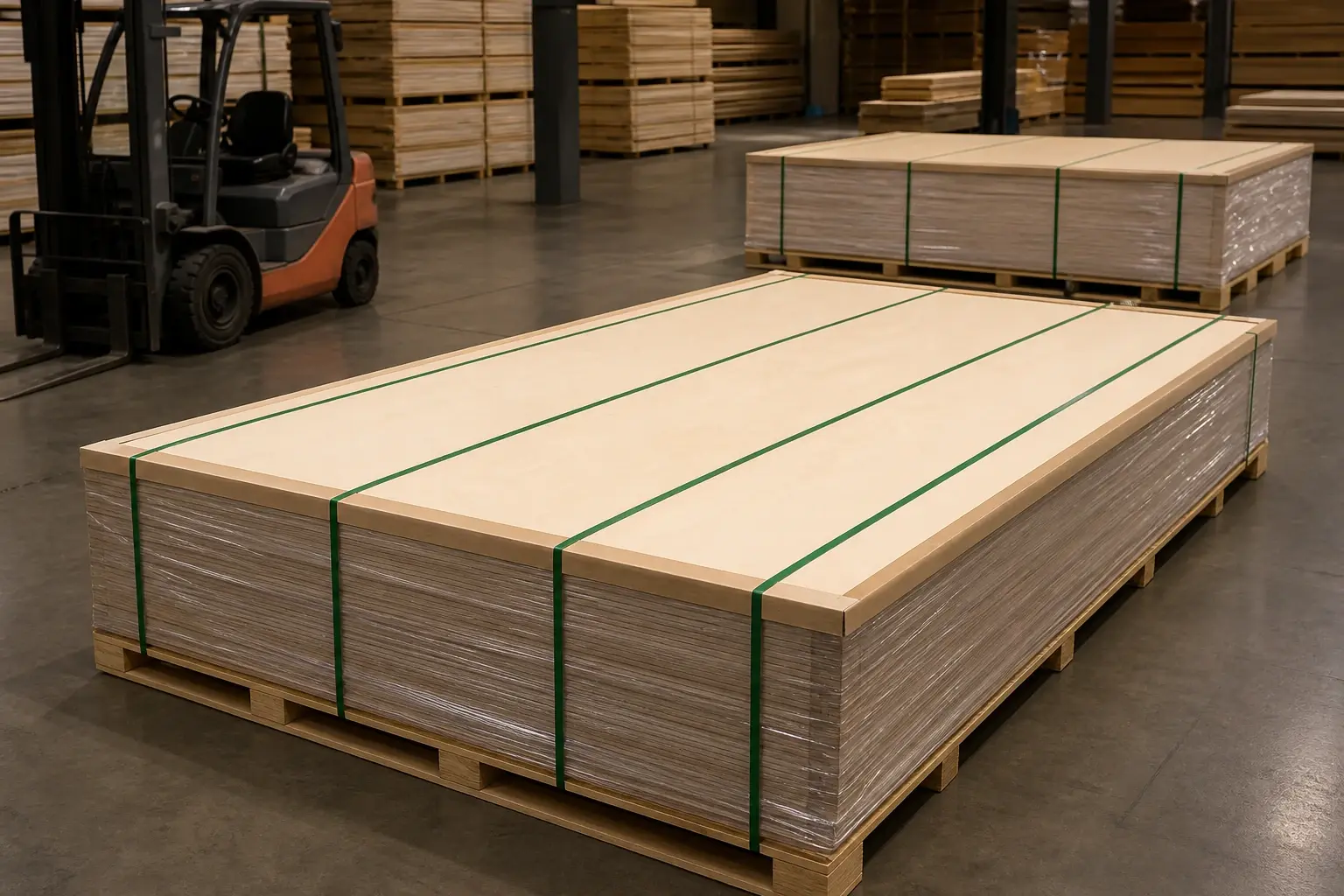
Start with the blank dimensions and quantities. Add grain direction, reference edges and nesting allowance if available. Before cutting, we agree finished-size tolerances and squareness so the blanks fit the bed and stay fully supported.
Tell us the target thickness and any drilling or edge work you need. Before preparation, we agree the actual thickness range for slots and joints. Our quotation identifies the supplied operations and tolerances. Compare a prepared blank and an assembled part before ordering repeat quantities.
Agree visible-face quality and any sanding or coating supplied with the panel. Check adhesives, finishes and masking materials with the equipment manufacturer before laser processing. Include cleaning, sealing or painting after cutting in the finished-part plan.
Our panel supply and your laser processing are specified separately. For additional component work, start with the part, dimensions and quantity; share a drawing and inspection requirements if available. We confirm those details before quoting the machining method and supplied finish.
Plan machining and edge finishingBuy direct from CUZI PLY, the plywood manufacturer and supplier in Linyi, Shandong, China. Our factory operates 10 plywood production lines. We manufacture the agreed veneer construction and prepare the specified sheet or blank size, inspection and export packing for your order.
Start with the part use, finished-part or blank size, target thickness, quantity and destination. Add your material preference, drawing and machine details when known; our factory team helps complete the panel specification. Tell us whether you need full sheets or factory-cut blanks for your own laser processing.
Tell us the model or prototype you are making and its finished dimensions. Add the smallest bridge and hole, stiffness and visible-face requirements if known. Compare pale poplar or birch-faced construction using cuts along and across the grain, and include the fragile details in your trial.
Send the sheet or blank quantities and any known bed or nesting layout. We agree blank dimensions, orientation marks and pack sizes before production so thin parts remain supported during handling.
Describe the appearance and finish you want for the display. Add any face-grade, colour, visible-patch or engraving-contrast requirements you already have. Compare the actual face, residue, back marking and cut edge with your artwork and cleaning method before ordering.
Choose only laser-compatible masking or finishing materials. Keep the selected face and artwork reference with the order so repeat displays can be compared consistently.
Start with the kit or assembly, its dimensions and target thickness. Share a slot and joint drawing, kerf allowance and small-feature requirements if available. Before the repeat order, agree the actual thickness range and assembled fit using the selected lay-up, conditioned flatness and measured cut-part dimensions.
Keep material, batch identification and machine settings with the successful part. Repeat the trial when the construction, adhesive, machine or critical geometry changes.
Regular sizes: 1220×2440, 1250×2500, 1525×3050 mm. Made to order: 1250×3050, 1250×3660, 2100×2800, 1830×3660, 1250×3800 mm.
Start with the cut-blank sizes you need and share the machine-bed size or nesting layout if known. Before cutting, we agree tolerances, grain direction and reference edges. Plan full-sheet support, cutting yield, flat pack dimensions and unloading for the ordered format. Custom size is a manufacturing choice; documents follow the selected construction and use.
Request a sample for the part and thickness you need; add the drawing and machine details if available. We confirm the selected sample, preparation, sample and courier costs before dispatch. The quotation states minimum quantity, manufacturing time, payment, packing, delivery terms and repeat-order references; production time is separate from shipping transit.
Plan your cutting trial and part assemblyCompare the actual panel, cutting yield, finishing and delivery costs.
View detailsBuying Plywood from Our China FactoryPlan samples, repeat production and export packing directly with our factory.
View detailsExplore our plywood productsCompare materials and constructions for what you want to make.
View detailsCompare Birch PlywoodCompare birch faces and core choices for visible parts and machining.
View detailsCompare Baltic Birch constructionCompare all-birch veneers, layered edges and available product documents.
View detailsCompare Poplar PlywoodCompare all-poplar panels for lightweight components and interiors.
View detailsFurniture Grade PlywoodPlan surface preparation, CNC work and hardware for furniture components.
View detailsChoose sheet sizes and thicknessesPlan sheet sizes and cut blanks around your laser bed, drawing and material yield.
View detailsStandards and certification documentsMatch bond, emission, dimensional and sourcing documents to your project.
View detailsUse the plywood specification guideTurn your part requirements into a clear panel and processing specification.
View detailsCompare grades, cores and bondsUnderstand face grades, core materials and adhesives before selecting a sample.
View detailsSee our quality checksReview panel measurements, cutting samples and pre-shipment inspection.
View detailsPlan export packingPlan full-sheet support, face protection and dry export packing.
View detailsLaser Cutting & Precision ComponentsPlan part geometry, sample cutting and repeat production around your machine.
View detailsGet a Laser-Cutting Plywood QuoteStart with the part, thickness, quantity and destination. Our factory team helps complete the specification.
View detailsCompare core materials for laser cuttingCompare veneer species, layered edges and core construction for your part.
View detailsChoose adhesive and emission requirementsDiscuss the glue line, panel emissions and representative machine trial.
View detailsLaser-Cutting Plywood
Start with the finished part. Poplar Light-Cut suits pale, lightweight models, educational parts and packaging inserts. Birch-Faced Balanced Core combines a visible birch face with selected poplar or combi veneers for engraved displays and decorated components. All-Birch Precision uses birch veneers throughout for detailed models, nested assemblies and visible layered edges. Compare a representative cut sample for the face, edge, smallest features and assembled fit on your machine.
Our Poplar Light-Cut option uses an all-poplar core for pale, lightweight parts. Birch-Faced Balanced Core has a birch face with selected poplar or birch/poplar balanced combi beneath it. All-Birch Precision uses cross-banded birch veneers throughout. Compare actual thickness, stiffness, weight, engraving appearance and cut-edge quality at the same dimensions. Our factory team helps match the construction to your component and budget.
Choose thickness around part stiffness, slot fit, the smallest detail and your machine capability. Three millimetres suits fine lightweight parts; four millimetres adds stiffness; six millimetres needs more cutting energy and makes core and glue-line variation more influential. Our poplar option lists 3, 4 and 6 mm; birch-faced adds 9 mm; all-birch adds 9 and 12 mm. Check the actual thickness and assembled fit with your own drawing before placing the production order.
Choose from the three regular formats or five made-to-order formats shown on this page, or discuss cut blanks sized to your laser bed. Start with the blank or finished-part dimensions, target thickness, quantity and destination. Add the laser-bed size and cutting layout if available. Before preparing the blanks, we agree the construction, actual thickness and finished dimensions; your quotation states the cutting work, handling and export packing. Custom size is a manufacturing choice; product documents follow the applicable construction and use.
Yes. Send the intended part, target thickness and delivery country. Add your preferred material, laser-bed size, machine model and any edge, engraving or assembly requirements if known. Our factory team helps choose the sample for your trial. We confirm sample availability, any sample and courier costs, and dispatch arrangements. Test the sample on your machine and compare the complete cut, residue, fine features and assembled fit before agreeing repeat production.
Follow the equipment instructions and run a representative sample on your machine. Laser source, rated output, optics, focus, support, air assist, extraction, panel density, adhesive, actual thickness and drawing geometry all influence the result. Record speed, power and pass count with the selected material and compare cut-through, edge appearance and engraving. One setting should not be assumed to work for every machine, thickness or construction.
Tell us the result your finished part needs, including edge colour, residue, engraving contrast and pass count. Compare these requirements during a representative machine trial of the selected construction and thickness. A light edge, low visible smoke or one-pass result is a trial target, not a universal guarantee. Use suitable extraction, filtration and fire monitoring even when visible smoke is low, and repeat the sample when important material or machine inputs change.
Slots and joints need the actual panel thickness to match the drawing, while flat support helps keep the sheet positioned during cutting. Initial thickness targets are ±0.20 mm at 3 and 4 mm, ±0.25 mm at 6 mm, ±0.30 mm at 9 mm and ±0.40 mm at 12 mm. Initial flatness targets after conditioning are ≤4, ≤3 and ≤2 mm per 1000 mm for poplar, birch-faced and all-birch respectively. Agree measurement and conditioning requirements, then compare a cut and assembled sample.
Keep sheets flat on full-area support, with faces and edges protected from damage and moisture. Our export packing uses aligned support and suitable restraint for the ordered format. When unpacking, maintain level support and allow the panels to condition to the processing environment before checking flatness and cutting. Share your handling equipment and destination so we can plan pack dimensions, protection and unloading with your order.
Repeat the representative sample when the veneer species, core selection, ply construction, adhesive, thickness, face finish, machine, optics, extraction or an important drawing feature changes. Also check again when cut quality drifts during production. Compare cut-through, kerf, edge colour, residue, engraving, small features and part fit with the reference selected for your order.
Tell us the application and destination, plus any standard or document your project specifies. Product documents available on request include EN 315 dimensions, EN 717-1/E1 panel emissions and EN 314-1/EN 314-2 bond requirements for the selected construction. Discuss any FSC or PEFC transaction claim and destination import requirements with the enquiry. Panel emission reports and laser-process safety address different questions: follow the machine instructions and workplace extraction controls for cutting. We confirm the applicable documents with your quotation.
FOB China prices are USD 580–720/m³ for Poplar Light-Cut, USD 720–920/m³ for Birch-Faced Balanced Core and USD 920–1,150/m³ for All-Birch Precision, on the construction and nominal-thickness basis stated in the price section. Minimum quantities and production timing are confirmed around the material, thickness mix, sample trial, inspection and packing; this page does not state a fixed delivery time. Start with the part, thickness, quantity and destination. Our factory quote confirms current price, any cut-to-size or testing costs, payment, packing and delivery terms; shipping transit time is separate.
Compare the veneer lay-up, joints, gaps or overlaps, repairs and adhesive uniformity as well as the surface. Run the important details at different positions in the sheet and along and across the grain. Check complete cut-through, local edge darkening, glue residue, fragile bridges and the actual kerf. Use the measured panel thickness and assembled part to agree slot allowances. Keep the selected construction and machine settings with the order so repeat batches can be compared on the same basis.
CUZI PLY supplies the agreed plywood construction as full sheets or factory-cut blanks for your processing. Specify any additional drilling, edge work or surface preparation in your enquiry; our quotation states the supplied operations, dimensions and tolerances. Your own laser trial establishes the settings, cut-edge appearance, engraving and part fit for your equipment. For additional component work, start with the part, dimensions and quantity; add a drawing and inspection requirements if available. We confirm the drawing, supplied operations and inspection requirements before quoting that work separately from panel supply.
Tell us what you’re making, the finished-part or blank size, target thickness, quantity and destination. Add the machine and bed size, smallest details, engraving or edge requirements where available. You don’t need a complete technical specification to start the conversation.
Talk directly to our factory
Tell us what you’re making, the quantity and destination. Our team will help you choose a panel and prepare a quote.