Plywood tests that answer your project questions.
Choose the test that answers the purchasing question. A well-matched report helps you compare panels, plan fabrication and avoid paying for checks that do not address the job. Start with the use, then connect the test method, result and requirement to the construction you intend to order.
CUZI PLY is your plywood manufacturer and direct supplier in Linyi, China, with 10 production lines. Our factory team helps you specify the panel, compare relevant product documents and include any agreed testing in your quotation.
Turn the intended use into a test request.
Describe the part, destination, loads, support, wetting, finish, machining and expected maintenance. Identify what a result must answer: a close joint fit, repeated moisture exposure, a worn working surface or a specified purchasing requirement.
A test method
Describes how to obtain a result under defined conditions. Choose a procedure applicable to the product, interface and property; a familiar standard number is not always the right method for your construction.
A performance requirement
Defines the result the product or assembly must achieve. Get the criterion from the applicable product specification, project or purchasing programme, including its conditions and decision rule where needed.
A test report
Records the identified material, preparation, method and results. It answers the tested question under those conditions. Match it to the quoted construction and use rather than treating the title as a general guarantee.
A product certification
Applies under a defined certification scheme and scope, which may include production controls and ongoing checks. Keep the required certificate, identification and report together; a laboratory report alone is not the same document.
Agree the construction and required documents before ordering repeat material. Where a new test is needed, include the method, preparation, cost, lead time and required report in the quotation. Ask for the checks relevant to the job, not an undefined “all tests” package.
Plywood test methods, units and the decisions they support.
Read the exact method and edition with the result. The same number can mean different things when thickness, direction, conditioning, test arrangement or units change.
| Test family | Method and result | Purchasing use |
|---|---|---|
| Dimensions and thickness | EN 324-1 covers board thickness, width and length. Record millimetres, measurement positions, actual thickness and the agreed tolerance. | Check machining, sheet yield and assembly fit. Keep squareness, flatness and finished-part tolerances as separately specified checks. |
| Moisture content | Record the applicable direct measurement or meter procedure, mass basis, calibration, locations and panel condition; moisture content is usually reported as a percentage. | Compare dispatch, machining or finishing requirements at the same stage. Film, adhesives and treatments can affect measurement. |
| Veneer-bond quality | EN 314-1 provides plywood bond test methods; EN 314-2 sets bonding-class requirements. Keep the pre-treatment, shear result in N/mm² or MPa and wood-failure assessment together. | Compare the specified bond for the intended exposure. A visual soak check or adhesive trade name is not the complete assessment. |
| Bending stiffness and strength | EN 310 determines bending modulus of elasticity and bending strength. Record the units, usually N/mm² or MPa, direction, thickness, conditioning and test arrangement. | Compare the same construction and direction. A laboratory mean is not an installed floor’s allowable load or a structural design value. |
| Water absorption and swelling | Use a method applicable to the panel and requirement. Report mass gain and thickness change separately, with initial condition, exposure, edge protection and measurement points. | Assess moisture uptake and dimensional fit. These results do not also establish bond quality, decay protection or a watertight assembly. |
| Indentation, scratch and abrasion | Specify which surface property is required. Keep the indenter or wear procedure, load, duration, support, finish and result units with the report. | An indentation result, scratch-resistance result and wear result answer different questions. A species hardness value does not qualify a complete coated panel. |
| Slip resistance | EN 16165 provides evaluation methods for pedestrian surfaces. Name the selected method, result scale, direction, surface condition and contamination used. | Compare the supplied texture and relevant wet or dry use. Do not convert between different result scales without a justified method. |
| Formaldehyde emissions | Record the method and edition, panel configuration, conditioning, result units and applicable limit. For US TSCA Title VI, check the accepted chamber methods and certification requirements. | Match the report to the product and destination. An emission measurement alone is not a product certification or a conversion between every emission class. |
BSI’s EN 324-1 overview identifies the dimensional method. The EN 310 overview identifies bending stiffness and strength. For structural use, connect the specified test data with the applicable design standard, grade, supports and connections; see Plywood Density, Weight & Strength.
A plywood boil test is not the whole glue-bond test.
Use the prescribed conditioning and pre-treatment for the intended bond assessment. Boiling or soaking followed only by a visual check is different from a complete method and its required results. There is no single boiling recipe that qualifies every panel or exposure.
Read the shear and failure assessment
Keep the tested glue line, preparation, shear value and wood-failure assessment together. Identify whether separation occurred at an adhesive interface or within the wood, according to the selected procedure.
Apply the correct requirement
EN 314-1 concerns test methods; EN 314-2 sets plywood bonding-class requirements for end uses. Read both roles with the specified product. A bond result is not also a surface-wear, decay or complete-assembly water test.
For the order, state the bond requirement with the Film Faced Plywood or Marine Plywood construction. See Bonding & Emission Options for the material choices.
Measure absorption, swelling and bond change separately.
A plywood moisture resistance test must state what was measured. Mass gained during exposure, thickness change and veneer separation are different results; one does not automatically establish the others.
Record the exposure and geometry
Keep the initial condition, temperature, duration, face finish and exposed or protected edges. Use the applicable procedure’s measurement points and surface-water removal. Compare like constructions and protection, not a sealed component against an open-edge sheet.
Distinguish results taken wet from those after drying or reconditioning. State whether the concern is temporary movement, residual change, flatness, fit or the bond.
Choose a method applicable to plywood
Do not assign every wood-panel swelling method to every product. For example, ISO 16983’s published scope identifies particleboards, fibreboards, OSB and cement-bonded particleboards; it is not a universal veneer-plywood method.
Agree the relevant plywood or project procedure and limit with the test laboratory. See Plywood Moisture & Water Resistance for exposure, cut edges and storage.
Film-faced plywood hardness, scratching and wear are different properties.
For a local dent, specify indentation behaviour. For dragged tools or handling marks, specify scratching. For repeated rubbing or traffic, specify abrasion. Choose the method for the actual overlay and supported panel; there is no universal “film hardness” number that answers all three.
Compare the complete panel
Record the film or finish, core, bond, thickness, backing and support. For indentation, keep the contact geometry, load, duration and measurement with the result. A harder wood species does not automatically mean a more wear-resistant film.
Connect the result to service
State the working face, contact, frequency, cleaning and likely damage. For formwork, compare the concrete-contact finish, handling, release-agent compatibility and maintained edges alongside any surface test. Do not infer a fixed number of pours from a hardness result.
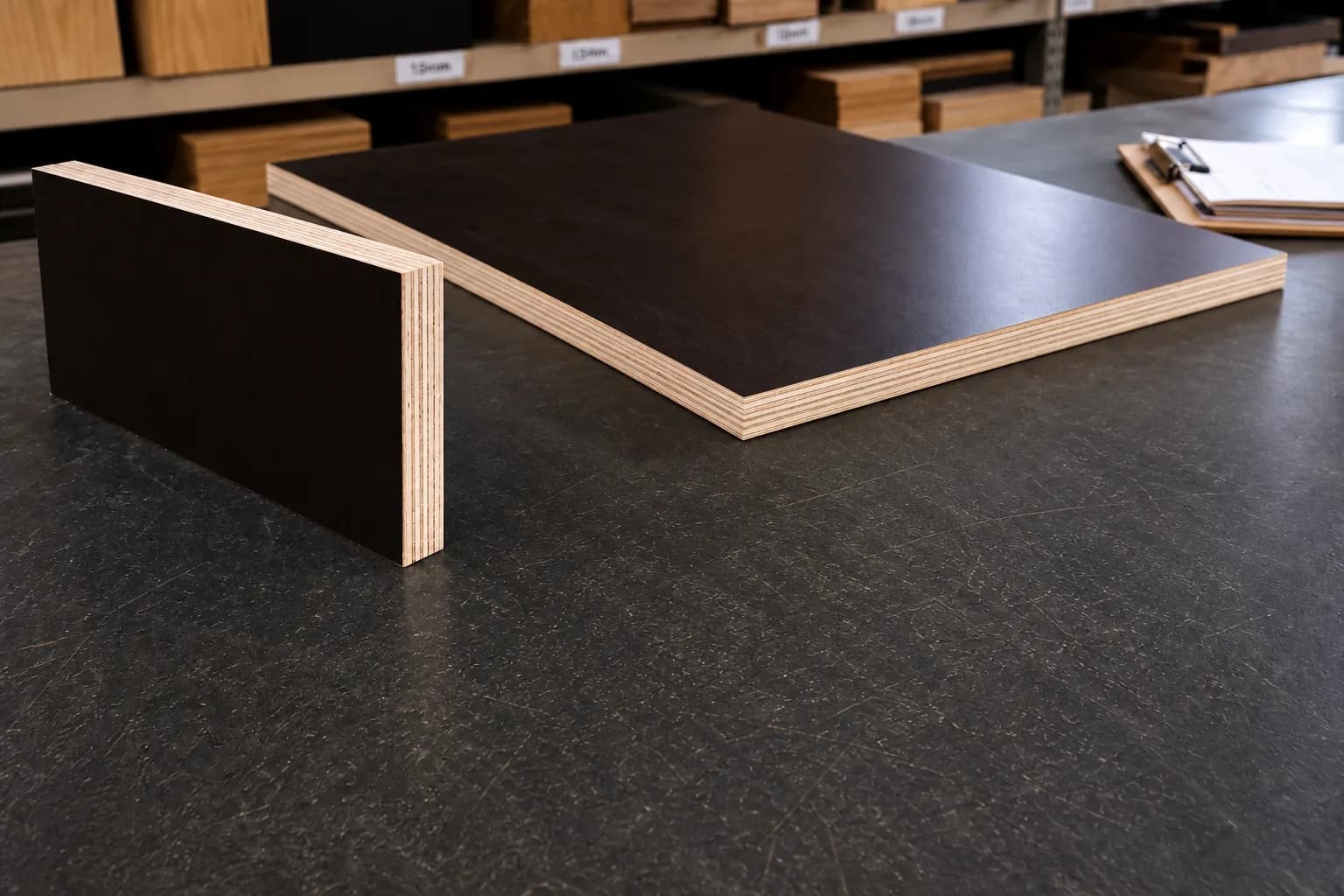
Film faced plywood working face and cut edges
Specify the working face, core, bond and edge condition with the test request. Surface wear, indentation, veneer-bond quality and moisture exposure answer different questions.
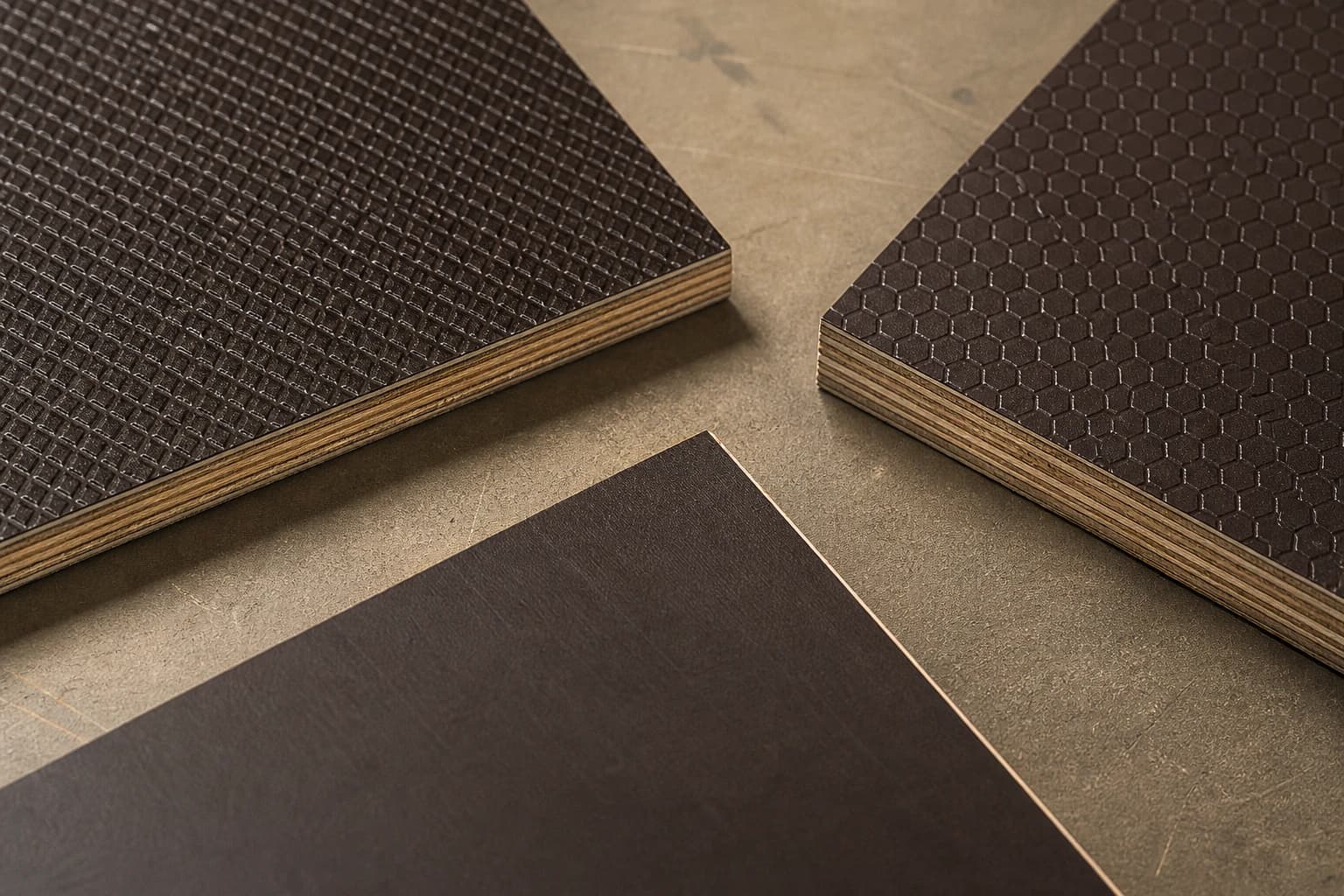
Anti-slip plywood surface patterns
Choose the exact surface pattern for the traffic, footwear and contamination expected. Keep the tested direction, condition, cleaning and wear state with the slip-resistance result.
Compare anti-slip plywood under the conditions that matter.
EN 16165 provides slip-resistance evaluation methods for pedestrian surfaces. Specify the selected method, result scale, direction and dry, wet or contaminated condition. Keep the exact surface pattern, preparation and wear state with the report.
Texture is only part of the floor
Consider footwear, traffic, water, oil or other contamination, cleaning and maintenance. The HSE flooring guidance connects floor selection with activity and contamination. A dry result or visible texture alone does not answer every operating condition.
Keep load and installation separate
A slip result does not establish bending capacity, fixings, joint support or waterproofing. Match the Anti-Slip Plywood texture and construction to the complete floor and its structural, edge and maintenance requirements.
A formaldehyde test report must match the purchasing requirement.
Identify the construction, preparation, conditioning and result units. Chamber, desiccator and extraction procedures measure under different conditions; ppm, mg/m³ and mg/100 g are not interchangeable labels or a universal conversion between classes.
For US TSCA Title VI, EPA’s stakeholder guidance discusses ASTM E1333 and ASTM D6007 with the required equivalence. Check the accepted edition and product configuration. Keep the required certification and identification documents with the emission report; a low test number alone is not the whole programme.
For another destination or indoor-use requirement, identify its applicable method, class and programme. Review the construction and documents with Standards & Certifications; do not compare incompatible units to select a supposedly lower-emitting panel.
ASTM D6251 concerns the complete wood-cleated shipping box.
The current ASTM D6251/D6251M-23 specification is titled “Wood-Cleated Panelboard Shipping Boxes.” Its scope includes fabrication, closure, components and assembly. It is not a standalone plywood product certificate.
Specify the box design, contents, weight distribution, cleats, fasteners, closure, handling and transport conditions alongside the panel material. Where performance testing is required, agree the complete packing and test programme. Do not turn a specification’s scope into a load rating for your own box.
Use Packing Plywood to select the panel and Industrial Packaging to describe the case, crate or transport requirement. Our quotation identifies the plywood and any agreed processing, separately from the complete packaging design and assessment.
PNS 196:2000 and film-faced plywood testing.
PNS 196:2000 appears in historical BPS plywood certification guidance. The BPS current product listing identifies PNS ISO 12465:2017 with the plywood certification issuances. Confirm the applicable standard and programme for the order rather than relying on an older reference alone.
For a film-faced construction, distinguish requirements for the plywood substrate from additional tests for the film surface and intended use. Give the laboratory or certification body the full construction, thickness range and destination requirement. An appropriate test report and the destination’s product certification are separate parts of purchasing.
Choose a qualified laboratory and match its report to the order.
ISO/IEC 17025 addresses laboratory competence, impartiality and consistent operation. Check competence for the exact procedure and the accreditation scope where the project requires it. Accreditation of a laboratory is not certification of every product it tests.
Product and construction
Identify the manufacturer, product, face and back, core or veneer arrangement, adhesive, treatment or overlay, thickness and relevant dimensions. Keep a report for a different construction separate.
Batch and test-piece selection
Record the batch or production identity, who selected the test pieces, selection date and the number tested. Identify the tested orientation, faces and any machining or edge protection.
Method, edition and condition
Keep the complete method reference, preparation, conditioning, test date and any deviations. Check the edition accepted by the project or destination programme, not only the newest catalogue edition.
Results and units
Read individual results and summary values where reported. Keep directions, thicknesses and conditioning groups distinct. Ask how variability or measurement uncertainty affects a close decision.
Requirement and conclusion
Compare the result with the applicable product or project criterion. Where a conformity statement is needed, agree the criterion and decision rule. A test-method number by itself is not a pass limit.
Issuer and supplied product
Check the original report number, issuer and complete pages. Match its construction and scope to the quotation and delivery documents. A laboratory’s accreditation and a product’s certification serve different purposes.
Before commissioning a test, agree who selects the material, the construction and batch, preparation, method, criterion and required report. Obtain the complete report and confirm its identity with the issuer when needed. A cropped result, marketing badge or report for another construction leaves important purchasing questions unanswered.
A test date records when work was done; it is not automatically a universal report expiry date. Review construction changes, programme rules and the project’s recency requirements. See Quality & Inspection and Shipment & Receiving Inspection for order identification and delivery checks.
Use the method overview to choose the checks your project needs. For your order, our factory team identifies relevant available product documents and confirms the supplied construction with you. If additional testing is required, agree the laboratory or issuer, material selection, preparation, method, criterion, report, costs and timing before commissioning the work.
Include the required tests and documents in your plywood enquiry.
Regular sizes: 1220×2440, 1250×2500, 1525×3050 mm. On-request sizes: 1250×3050, 1250×3660, 2100×2800, 1830×3660, 1250×3800 mm. Add the construction, finished thickness, quantity and destination.
- Component, intended use, support, loads, wetting, traffic, finish and machining.
- Face and back, core or veneer arrangement, bond, treatment, overlay, thickness and dimensions.
- Applicable product or project standard, test method and edition, criteria and destination programme.
- Required directions, conditioning, surface or edge condition and test-piece selection.
- Available product reports, certificate requirements and any new testing to include in the quotation.
- Quantity, packing, labels, delivery point, target date and the required document format.
Custom length and width are manufacturing choices. Match documents to the stated product category, construction, thickness coverage and use. Identify any additional report required for the order, with the method, acceptance criterion and delivery date. Complete-box, floor or component tests remain separate from the sheet specification.
- Order quantity & mix
- Tell us the sheet size, thickness mix and quantity you need. We confirm the minimum order and available mix for your selected construction.
- Production lead time
- We confirm the production schedule with your specification, order quantity and sample requirements. Production lead times are planning estimates, not transit times.
- Price & quotation unit
- Currency and price unit stated in your quotation. Your quote is based on the agreed dimensions, construction and quantity. Processing and requested testing are stated separately where applicable.
- Samples
- Tell us the plywood, thickness, finish and delivery country. We confirm sample availability, any sample and courier costs, and dispatch arrangements before proceeding.
- Packing & delivery
- We agree export packing, labels and the loading plan for your order. Share the destination country, named port or delivery point and preferred delivery term. Freight, insurance, duties and taxes are included only when stated in the quotation.
- Payment & order confirmation
- We agree the payment method, currency and any deposit and balance schedule in the quotation or proforma invoice. Your order confirmation sets out the product, quantity, packing and delivery arrangements.
Methods, results and purchasing
Questions about plywood testing and product reports.
Which plywood test methods should I request?
Start with the finished component and its risks: dimensions and fit, loads, wetting, working-surface wear, slipping or indoor emissions. Select applicable methods and acceptance criteria for those requirements. Specify the construction, thickness, direction and destination with the test request; more tests are not automatically a better purchasing specification.
What is a plywood boil test?
Boiling may form part of a specified bond-test pre-treatment. It is not one universal recipe or a complete plywood performance test. Keep the actual method, treatment and subsequent bond assessment with the result. A video showing no visible separation does not establish every bond class or the installed component’s water performance.
What does a plywood glue shear test show?
It assesses the selected veneer bond under the stated preparation and test conditions. Read the shear result with the required wood-failure assessment and applicable bonding requirement. Do not use that result alone as bending strength, surface hardness, decay resistance or an immersion guarantee.
How do I test hardness of film faced plywood?
First decide whether the concern is indentation, scratching or wear. Specify a suitable procedure for the film and complete panel, with surface condition, load or indenter, duration and support. Compare the same finish, core and thickness. A hardness value for the wood species cannot replace this surface and panel assessment.
Is plywood hardness the same as abrasion resistance?
No. Indentation concerns a local permanent mark under the defined contact. Abrasion concerns surface wear under the chosen wear procedure. Scratch behaviour is another property. Select the measurement that corresponds to your concrete-contact, flooring, furniture or transport use rather than requesting an unspecified hardness number.
Which testing method is right for film faced plywood?
Choose tests for the required function: dimensions and moisture for fit, veneer-bond testing for exposure, bending for loaded use, and surface tests for the working face. Record the film, core, bond, thickness and cut-edge condition. Brown or black colour alone does not describe these properties.
Can film faced plywood be tested with PNS 196:2000?
PNS 196:2000 appears in historical Philippine plywood certification guidance. The BPS current product listing identifies PNS ISO 12465:2017. Confirm the applicable standard, construction and certification programme for the order. Separate the plywood substrate’s requirements from any additional film-surface performance tests.
Does ASTM D6251 certify plywood for shipping boxes?
ASTM D6251/D6251M specifies wood-cleated panelboard shipping boxes, including components and assembly. It is not a standalone plywood certificate or a load rating for every box. Identify the complete box, packing and transport requirements alongside the panel specification.
What should a plywood moisture resistance test report include?
Include the construction, initial condition, water exposure and temperature, protected or open edges, measurement points and results. Keep mass uptake, thickness swelling and bond separation distinct. State whether results were taken wet or after reconditioning; comparisons need the same basis.
How should I compare plywood slip resistance tests?
Use the same method and result scale, surface texture, direction, contamination and wear condition. Ask whether the tested condition matches the footwear, traffic and cleaning expected. A dry result does not automatically answer a wet or oily-floor question, and the panel result does not qualify the whole installed floor.
What should I look for in a plywood formaldehyde test report?
Check the method, accepted edition, construction, conditioning, units and applicable limit. Different methods and units are not interchangeable. For a regulated purchasing requirement, match the report with the required certification and identification documents.
How do I choose a laboratory and use the plywood test report?
Check competence for the exact method and, where required, its accreditation scope. Agree preparation, selection, criteria and reporting before the work starts. Obtain the complete report from its issuer and compare it with the supplied construction. A general laboratory credential does not certify every plywood product.
Does each custom sheet size need a separate certificate?
Custom length and width are manufacturing choices; product documents apply to the stated category, construction and certification scope. Confirm the covered thicknesses, materials, adhesive, treatment, overlay and use with the order. Finished-part dimensions and tests for a complete box, floor or other assembly remain separate requirements.
How do I request product reports or additional testing from CUZI PLY?
Send the product, construction, thickness, use, destination and required standard or project criterion. Our factory team identifies the relevant available documents for the selected plywood and confirms their scope with your quotation. If additional testing is needed, agree the laboratory or issuer, material selection, method, preparation, report, costs and timing before commissioning the work. A physical product assessment and a laboratory report are separate requests.
What should I do when two plywood test reports show different results?
First compare the construction, thickness, direction, conditioning, test method and edition, units and reported measurement. Check whether one number is an individual result, a mean or a design value. Surface finish, contamination, protection and wear also matter for surface or exposure tests. Ask the issuer to explain any difference before comparing both reports with the same purchasing criterion; do not average incompatible results.
Get the plywood and documents your project needs.
Tell us the application and purchasing requirement. Our factory team helps compare the construction, relevant documents, any agreed testing and the delivered-order terms before you place the order.
For physical assessment, name the construction, thickness and finish. We confirm availability, sample and courier costs, and dispatch arrangements. State separately any laboratory work or reports required.