What does plywood grade describe?
The named grading system sets visible face and back requirements, such as knots, repairs, joints and sanding. Specify the core and glue bond separately for the intended use.
Choose plywood by the parts that affect your finished product: the appearance of each face, the veneers inside the panel, and the bond required for its working environment. This guide explains common grade names, what to inspect at a cut edge, and which details make quotations comparable.
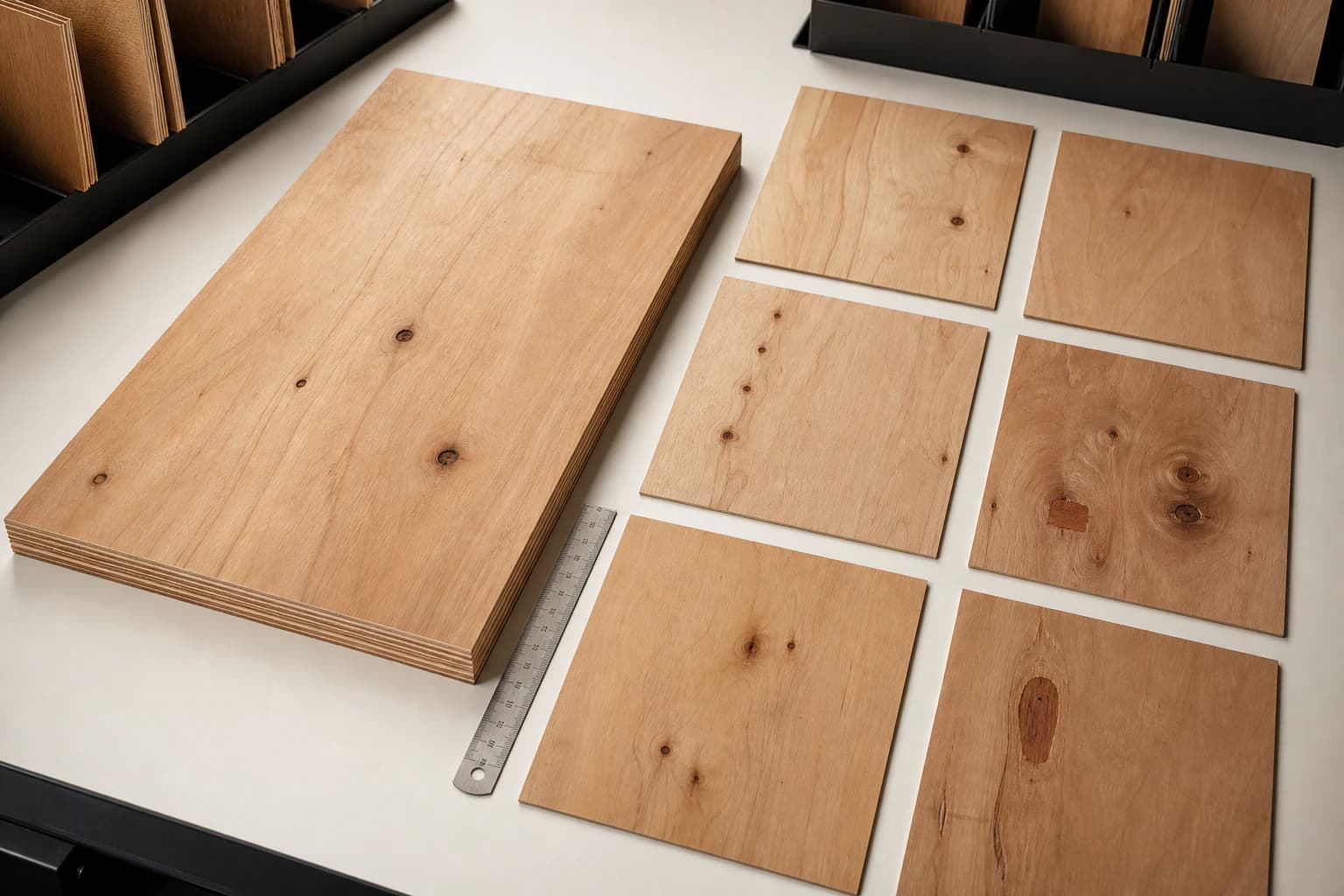
The named grading system sets visible face and back requirements, such as knots, repairs, joints and sanding. Specify the core and glue bond separately for the intended use.
B/BB and BB/CC describe different face/back combinations under a stated grading convention. Compare the written defect limits and our full-panel samples before choosing a finish.
Match the core to the component: poplar helps reduce weight; hardwood and eucalyptus offer denser constructions; birch is useful where a clean machined edge matters. Confirm the veneer sequence and trial the component.
A birch face can be paired with poplar, combi, hardwood or birch inner plies. State whether the order requires birch-faced, birch-core or all-birch plywood.
WBP is a commercial bond description. For wet service, state the adhesive family, exposure conditions, relevant bonding test and acceptance requirement in the quotation.
Use the standard named for the destination and application. ISO and EN appearance classes, structural product standards and commercial grades cover different requirements; compare their stated criteria.
Keep a full-panel face/back reference, a cut-edge sample and a machined component where those features matter. Record the accepted colour, repairs, core gaps, thickness and finish.
Send the application, face/back requirements, core species and lay-up, bond and exposure, size, thickness tolerance, moisture target, machining, quantity and destination.
A face grade, core description and bond requirement answer different purchasing questions.
Name the face and back separately. Agree the species, colour, knots, repairs, sanding and decorative finish using full-size samples where appearance matters.
Review face grades ↗State the core species sequence, ply count, gaps, overlaps, density or panel mass, and quality expected at a cut or machined edge.
Compare core options ↗Describe interior or exterior exposure, adhesive family, intended finish and any project-specific test method or acceptance class.
Compare bond terms ↗A painted cabinet front and a concealed back can have different appearance requirements.
Paint, clear veneer and overlay finishes each reveal different defects. Set the acceptable colour, joints, knots and repairs for the face that customers will see.
A concealed cabinet back may allow a wider appearance range while retaining the required construction, flatness and bond.
Compare a representative sheet under agreed lighting. Keep a face-and-back sample and a written defect schedule with the order.
Grade letters are meaningful when the named standard or our written grade schedule and defect limits are supplied together.
| System | What it covers | What to specify |
|---|---|---|
| ISO 2426 | ISO surface-appearance classification | Part, species scope, face/back class and declared defects |
| EN 635 | European surface-appearance family | General, hardwood or softwood part and face/back class |
| DOC PS 1-22 | United States structural plywood standard | Grade, construction, workmanship, dimensions, certification/marking scope |
| AS/NZS 2269.0 | Australia/New Zealand structural plywood specification | Product grade, nominated structural option and project acceptance |
| JAS 0233 | Japanese plywood standard | Applicable category, grade, quality, test and marking option |
| CUZI PLY shorthand | Order-specific commercial vocabulary | Defect schedule, face/back sample, repairs and limits |
For appearance grading, check the relevant ISO 2426 or EN 635 part. For structural applications, specify the applicable product standard and project requirements. Explore standards and certifications ↗
| Feature | State in the order | How to check |
|---|---|---|
| Face/back pairing | Record both sides independently; a better face does not define the reverse. | Full-panel visual review |
| Species and cut | Name the visible species and whether the appearance option is rotary, sliced or otherwise specified. | Species declaration and face review |
| Colour range | Set an acceptable range through samples or a controlled written scope. | Controlled-light comparison |
| Sound knots | State number, size, distribution and whether they are accepted on each face. | Defect count and size check |
| Open defects | State whether open knots, splits, checks or voids are permitted and how they are repaired. | Defect and repair inspection |
| Patches and plugs | Define shape, number, colour contrast, adhesion and permitted locations. | Patch/plug inspection |
| Veneer joints | Record joint visibility, overlap/open-joint limits and surface telegraphing expectations. | Joint and telegraphing inspection |
| Sanding | Specify calibrated, sanded, unsanded or finish-ready option and the acceptance reference. | Surface and calibration check |
| Grain and figure | Use only where the visible component requires direction or repeatability. | Directional comparison |
| Printing and marks | State whether mill marks, stamps or repairs may appear on the visible or reverse face. | Marking inspection |
| Finish compatibility | Tie paint, veneer, melamine, HPL or clear-finish trials to the selected face. | Finish trial and adhesion review |
| Approved reference | Agree a representative full-panel appearance range alongside the written defect limits. | Side-by-side approved-range comparison |
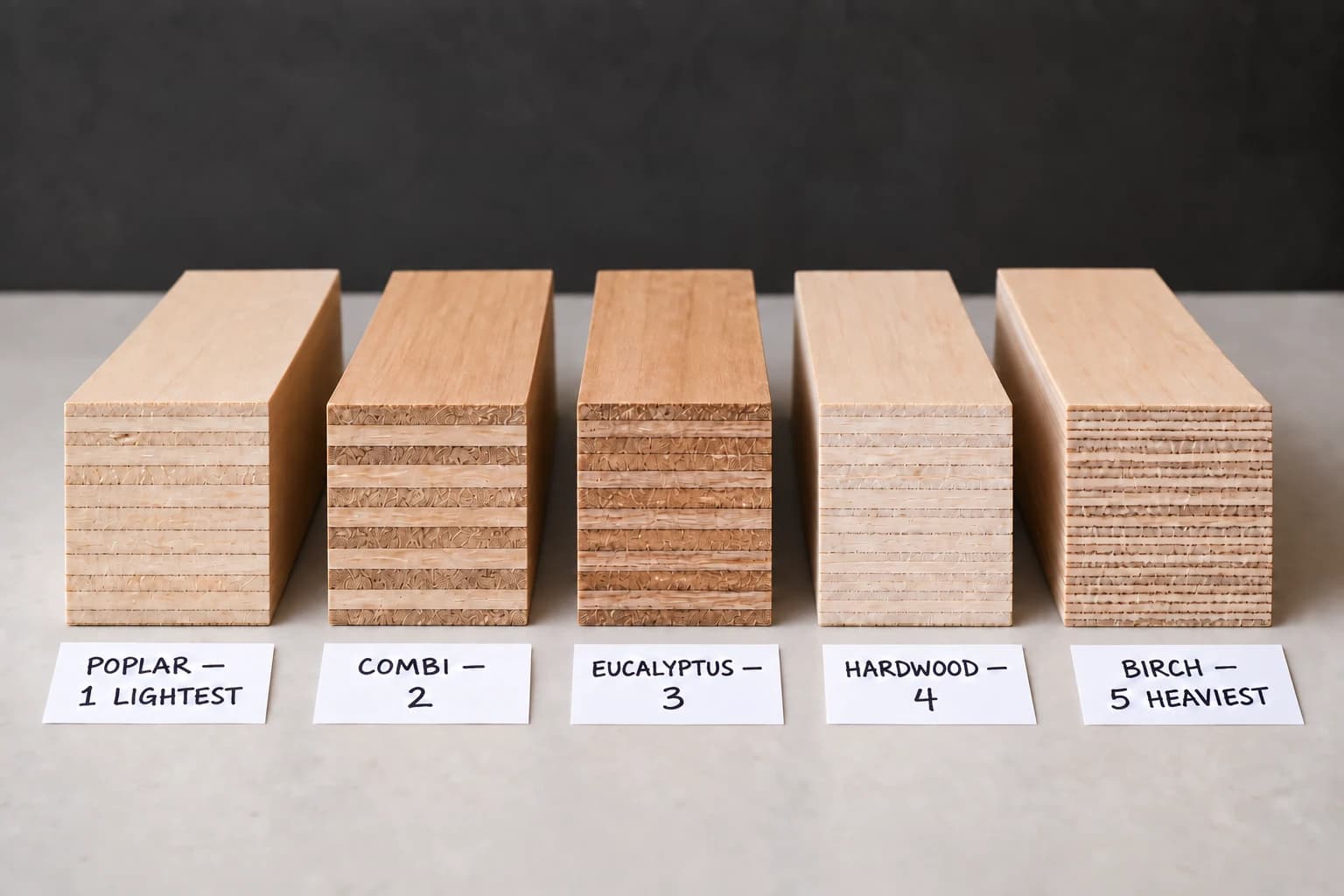
The pictured samples run from a light poplar core to an all-birch core, the heaviest of these five constructions. For an order, state the selected panel's density or mass at the specified moisture condition.
Final density, dimensions and machining results depend on the specified lay-up and finished panel.
Lower-mass construction using poplar inner veneers
Mixed-species construction balancing panel mass and cost
Higher-density hardwood veneer construction
Dense hardwood construction suited to heavier-duty panels
Birch veneer used in a declared core construction
All-birch veneer construction with substrate origin and processing stated for the order
These details help compare two panels sold under the same core name.
| Detail | Specify | Check |
|---|---|---|
| Species sequence | Name every veneer family from face to back | Review construction sheet and a cut edge |
| Ply count | State the permitted finished-panel ply count | Count plies on representative cut edges |
| Veneer thickness plan | State nominal veneer plan or permitted range | Compare edge sequence with construction sheet |
| Cross-band orientation | Record the direction of face, cross-bands and core plies | Check edge and machining reveal for directional sequence |
| Core gaps | Set permitted width, length, frequency and distribution | Inspect and measure representative edge gaps |
| Core overlaps | Set permitted overlap width, frequency and distribution | Inspect and measure representative overlaps |
| End joints | Define permitted end-joint form, location and spacing | Inspect locations visible on approved edges or records |
| Scarf or repair option | Define permitted repairs, scarf geometry and locations | Inspect repaired veneers and representative cut edges |
| Open defects and plugs | Define permitted open features, plugs and fills | Inspect edge and any approved core review records |
| Moisture before lay-up | Set the pre-lay-up moisture control and method | Review measured veneer/moisture records |
| Panel density or mass | Set accepted panel mass or density range at the stated condition | Measure panel mass or density by the agreed method |
| Symmetry and balance | Require a balanced sequence around the centre line | Compare opposing veneer sequence and panel flatness |
| Edge reveal | Freeze an accepted cut-edge reference and defect limits | Compare full edge with retained reference |
| Machining trial | Define cutter, feed, drilling or fastening trial conditions | Run the approved machining or fastener trial |
| Batch-change approval | Name the material/process changes that require approval | Review CUZI PLY change notice and retained comparison file |
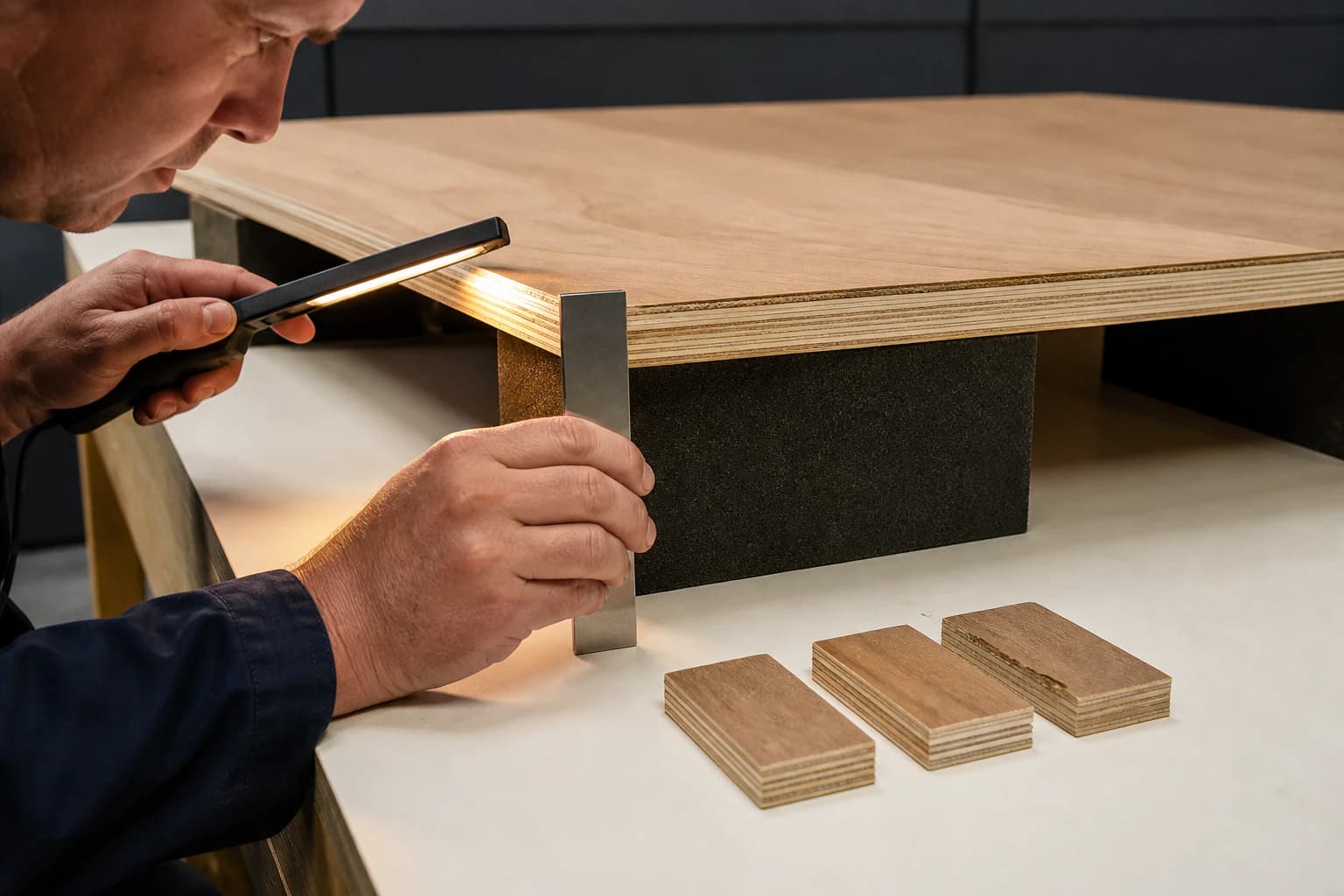
Look for the declared veneer sequence, open gaps, overlaps and repairs; a machining sample also shows how the edge finishes in the intended component.
MR and WBP are commercial descriptions; MUF and PF identify adhesive families. State the exposure condition, relevant test and acceptance class.
| Term | Category | Meaning |
|---|---|---|
| MR | Commercial shorthand | Commercial moisture-resistance wording |
| MUF | Adhesive family | Melamine-urea-formaldehyde adhesive family |
| PF / phenolic | Adhesive family | Phenol-formaldehyde adhesive family |
| WBP | Commercial shorthand | Commercial water-boil-proof language |
| Interior / exterior | Use/exposure language | Intended exposure or product-use language |
| A-bond | Market-specific classification | Market-specific bond classification terminology |
| EN 314 | Bonding standard | European bonding test and requirement standards |
For bonding methods, acceptance requirements and emissions, see Bonding & Emission Options ↗.
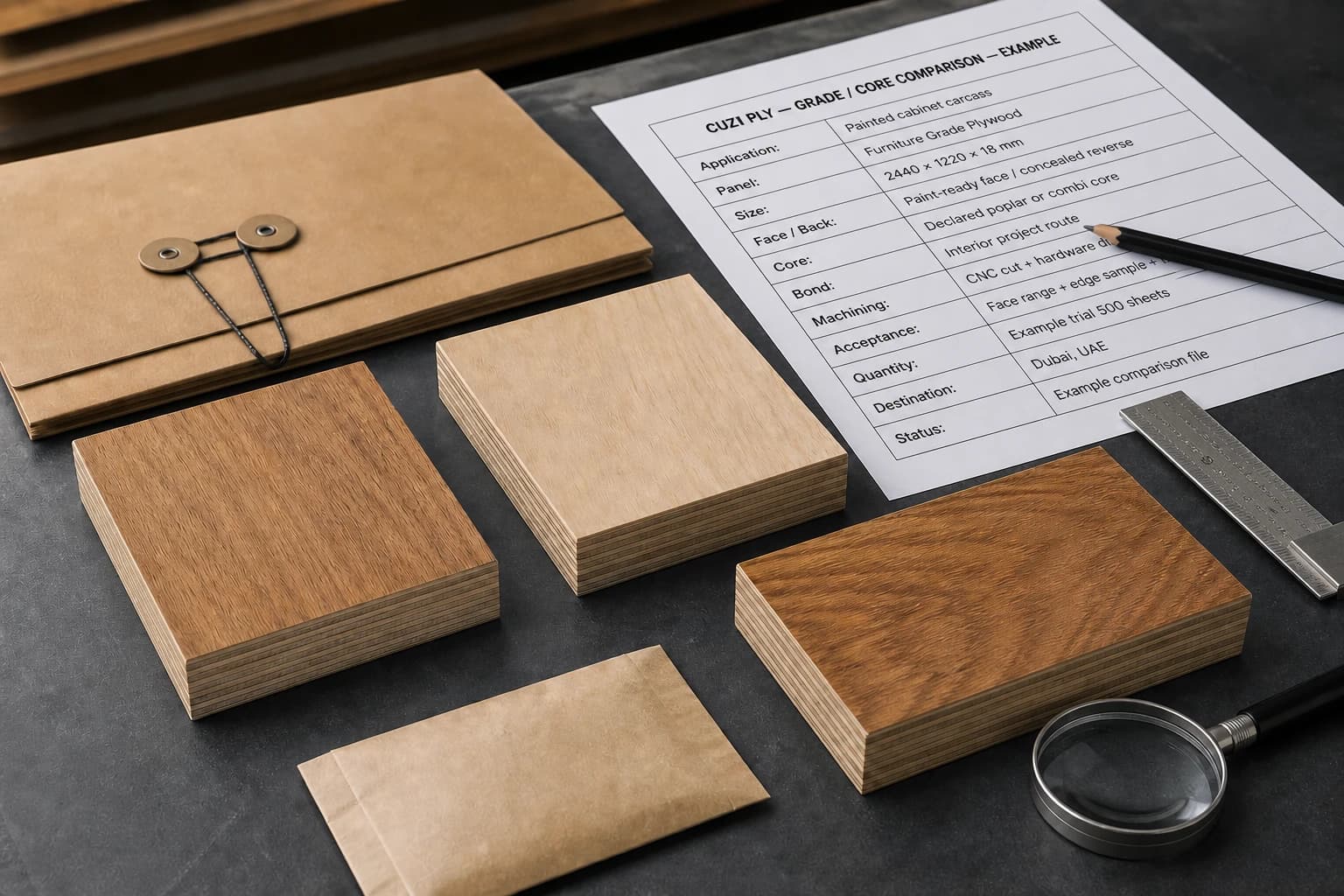
A useful comparison includes the face and back, a cut-edge sample, bond requirements, dimensions and intended finish.
For a painted cabinet, these details often explain a price difference more clearly than the face-grade letters alone.
| Compare | Required | Offer A | Offer B |
|---|---|---|---|
| Visible face and reverse-face requirement | Paint-ready face; concealed reverse | B/BB birch face/back | BB/CC poplar face/back |
| Named grade system or seller defect schedule | Written buyer defect schedule | CUZI PLY birch grade table Rev C | CUZI PLY poplar grade table Rev B |
| Species and veneer option | Declared species at face, back and core | Birch face/back; poplar/combi core | Poplar face/back; poplar core |
| Core family and exact species sequence | Poplar/combi; sequence declared | Poplar-eucalyptus-poplar sequence declared | Poplar core; sequence not declared |
| Ply count and veneer-thickness plan | Odd balanced lay-up; plan recorded | 13 plies; nominal plan attached | 11 plies; plan not attached |
| Core gap, overlap and repair limits | Buyer-approved edge reference and written limits | Limits stated; edge coupon supplied | Seller standard; no edge coupon |
| Density or panel-mass target | Panel mass recorded for hardware trial | Declared 590 kg/m³ nominal | Declared 520 kg/m³ nominal |
| Adhesive family | Interior project adhesive option declared | MUF option declared | UF option declared |
| Dimensions and orientation | 2440 × 1220 mm; long grain parallel to length | 2440 × 1220 mm confirmed | 2440 × 1220 mm confirmed |
| Thickness and tolerance | 18 mm nominal; finished tolerance per drawing | 18 mm; ±0.4 mm declared | 18 mm; ±0.5 mm declared |
| Moisture condition | Conditioned panel record before machining | 8–12% supplier target | Not stated |
| Machining, drilling and fasteners | CNC nesting plus hinge and screw trial | Machining coupon and hardware trial offered | CNC sample offered; hardware trial open |
| Surface or finishing option | Primer and paint system trial | Sanded face; paint trial accepted | Sanded face; paint trial pending |
| supporting documentation and inspection pack | Construction, dimensions, appearance and first-article records | Complete proposed pack | Appearance photo and dimensions only |
| Quantity and thickness mix | 500 sheets at 18 mm after one trial pallet | 500 sheets plus trial pallet | MOQ 800 sheets; no trial quantity |
| Packing and labels | Protected export pallet; label file by revision | Specified pallet and label file included | Standard pallet; face protection open |
Compare final price after appearance, core, bond, thickness, moisture, finishing trial, quantity and packing have been aligned. Read the price guide ↗
Use the relevant appearance, structural or bonding standard when specifying a tested requirement.
Before the purchase order
The named grade sets the face and back appearance or product classification under a particular standard or supplier schedule. Add core construction, bond and intended use to describe the complete panel.
B/BB usually calls for a different visible-face selection from BB/CC. Compare our defect schedule and full-panel samples against the finish you need.
A birch face can cover poplar, combi, hardwood or birch inner veneers. Specify birch-faced, birch-core or all-birch construction explicitly.
Choose by cut-edge visibility, tool path, weight and fastener duty. A representative CNC component shows chipping, void exposure, edge finish and fit.
WBP describes a commercial bonding expectation. Specify the adhesive family, service exposure, test method and acceptance requirement for the order.
EN 635 classifies surface appearance; PS 1 covers structural plywood in the United States. Use the standard required by the destination and compare its relevant clauses.
The core is the veneer construction inside the panel. The bond is the adhesive connection between plies; both should be stated in the order.
Keep the accepted face, edge and machined samples with the written construction. Review replacement samples if veneer source, lay-up, adhesive or finish changes.
Ply count works with veneer quality, thickness, cross-grain balance, repairs and bonding. Compare the finished panel against the component's machining and load requirements.
Check species sequence, ply count, gaps, overlaps, repairs, glue lines and the finished edge after machining.
Request the relevant lot document showing the test method, acceptance requirement, sampling and result when project approval requires tested performance.
Send the application, visible and reverse faces, core construction, bond and exposure, dimensions, moisture target, machining, quantity, packing and destination.
Share the details you know; we can confirm available face, core, bond and size options against your application.
Plywood enquiry
Send the application, face/back grade context, core construction, bond and exposure requirements, dimensions, machining, supporting documentation, quantity, destination and target date.
CHAT WITH CUZI PLY↗