Keep your plywood ready for production and installation.
Plan storage and handling before the shipment arrives. Protecting the panels’ faces, edges and flatness helps keep furniture production, machining and installation moving. Prepare the receiving area, supports and handling equipment, then follow the requirements for the construction and finish you are buying.
CUZI PLY is your plywood manufacturer and direct supplier in Linyi, China, with 10 production lines. Tell our factory team how you will unload, store and process the panels. We agree export packing, package identification and relevant product instructions with the plywood order.
Plywood storage changes when a pack is opened.
An intact delivery package, a loose sheet and a panel ready for finishing need different attention. Match the storage plan to its current condition and the next operation.
| Stage | Priority | Check before use |
|---|---|---|
| Unopened delivery packs | Keep protection intact where dry and suitable for the planned storage. | Package condition, labels, level support, moisture exposure and the product’s storage instructions. |
| Open packs and loose sheets | Protect exposed faces and edges, support flat panels and retain identification. | Indoor conditions, clean contact surfaces, the next operation and safe retrieval or lifting. |
| Temporary site holding | Arrange shelter and a dry, supported location before delivery. | Rain, standing water, sun, condensation, cover condition and the duration until use. Transit wrapping is not a long-term outdoor storage plan. |
| Before machining or installation | Bring the panel into the conditions required by the process and finished component. | Actual moisture condition, flatness, coating or adhesive requirements, and the installation environment. |
Plan plywood warehouse storage around the actual packs.
Choose a covered location away from leaks, standing water, direct sun and unsuitable heat. Provide level support, safe access and capacity for the actual load. Keep labels readable and constructions, thicknesses and finishes identifiable when issuing material.
Before unloading
Confirm package dimensions and mass, the access route and available supports. Agree any unloading or storage limits with our factory team before dispatch, rather than discovering that a pack cannot be safely received.
While stock is held
Check the store and protection after changes in weather or building conditions. Keep open packs protected and identifiable. Do not assume that an export wrapper controls the warehouse environment or remains effective after damage.
Plywood warping prevention starts with support and even exposure.
Store flat panels horizontally on a level base with adequate support. Avoid unsupported spans, uneven bearing and concentrated contact that can mark a face. Where packages are stacked, align support positions and use an arrangement suitable for the package and storage system.
There is no universal stack height or support spacing for every thickness, format and package load. Confirm stability, floor or rack capacity and safe access through the responsible site team. For a pre-shaped component, use supports suited to its geometry rather than forcing it flat.
Do not lean an unsecured stack of sheets against a wall. The HSE board-storage safety alert explains the falling-board risk and the need for suitable storage and handling arrangements. Use purpose-designed support and restraint if upright storage is needed.
Keep rain, condensation and uneven drying out of the storage plan.
A durable adhesive, marine description or film surface does not make the whole sheet impermeable. Cuts, holes, edges, worn faces and damaged packaging still need attention. Plan covered storage and inspect any temporary protection for the actual conditions.
Dry packs and temporary protection
Retain suitable protection according to the product instructions. For temporary site holding, provide shelter, drainage and supports clear of water. Follow a covering and ventilation arrangement that protects the panels without assuming wet wrapping is harmless.
Wetting or condensation
Keep affected packs identifiable, record what was observed and assess the panels before processing. Check the source of moisture and the required condition for the next operation. Drying does not automatically restore appearance, bond or structural performance.
APA’s moisture guidance explains the role of storage and moisture control in wood construction. For panel properties and protection, use Plywood Moisture & Water Resistance; for excessive wetting, arrange an assessment suited to the intended component.
Plywood acclimatisation needs a condition target, not just a clock.
Agree the conditions needed before machining, bonding, coating or installation. The panel’s starting moisture, thickness, construction, finish and surroundings affect readiness. Follow the product and process instructions, with relevant condition checks before work begins.
- Prepare the intended working or installation environment, including wet trades and moisture sources that may affect it.
- Keep panels suitably supported and protected while conditioning; do not adopt one unpacking or spacer method for every finish.
- Use the moisture and surface requirements of the selected adhesive, coating or flooring system.
- Record relevant temperature, humidity and panel moisture measurements with the method and locations.
- Check flatness, dimensions and the final surface before precision processing or installation.
Check readiness against the selected process and installation requirements, not elapsed time alone. A dispatch moisture value can change during transport or storage. Inspect wet or damaged material first, then agree any drying or conditioning needed before use.
APA’s wood-moisture overview highlights the importance of drying before moisture is enclosed by an impermeable construction.
Plywood handling must suit the format, weight and package condition.
Plan lifting aids, personnel and the transfer route for the actual sheet or pack. Use suitable rated equipment and trained operators under the site’s safe system of work. Keep faces, corners and machined edges clear of impact and abrasion; do not drag panels across a floor or dirty contact surface.
Complete packs
Check the supports, restraint and access required by the packing and equipment instructions. Package mass includes the plywood and packing. Do not treat straps or outer covering as lifting attachments unless specifically designed and authorised for that purpose.
Opened packs and individual sheets
Removing restraint changes the load. Slippery overlaid sheets and thin or large-format panels need a suitable individual-sheet method. Do not move an unsecured stack with mechanical equipment as though it were an intact delivery pack.
HSE’s woodworking handling guidance supports assessing the task and using appropriate lifting aids. The selected equipment’s instructions and site assessment govern the operation.
Adapt storage and handling to the panel construction.
Thin sheets, large panels, furniture faces and coated working surfaces are not interchangeable handling loads. Include their critical features in the storage and transfer plan.
| Panel type | What to protect | Information to prepare |
|---|---|---|
| Thin and flexible flat sheets | Use suitable flat support and protect the whole sheet during retrieval and transfer. | Thickness, dimensions and the next forming or cutting operation. Do not force an unsupported sheet into a stack or assume it is a rigid lifting platform. |
| Large-format plywood | Plan supports, package access and lifting equipment for the actual length, width and mass. | Maximum working dimensions, receiving space, access route and machine feed arrangements. |
| Wood veneer and furniture faces | Keep contact surfaces clean and avoid dragging, grit, local pressure and uneven exposure. | Visible faces, veneer direction, finish, protective interleaving and required surface condition. |
| Film, laminate and other overlaid panels | Protect the working face, corners and cut edges, and account for slippery surfaces after opening. | Overlay, edge profile, protective layers and the safe method for moving individual sheets. |
| Machined edges or through-openings | Keep tongues, grooves, slots and routed corners from impact or unsupported loading. | Drawing, edge geometry, solid fixing zones and the sequence of storage and assembly. |
| Treated or specially finished plywood | Follow the treatment and finishing instructions for storage, conditioning and later processing. | Treatment, final surface, service conditions and compatible adhesive, coating or fastening requirements. |
Manufacturer instructions can differ by product. Metsä Wood’s birch handling leaflet and WISA’s overlaid formwork site guidance address their own panels and packing. Use the instructions agreed for your CUZI PLY order rather than transferring another product’s conditioning time, environment or unpacking procedure.
Agree protection, supports and package identification before dispatch.
Tell us the receiving equipment, available storage area and when the plywood will be used. We agree packing for the selected product and route, including face and edge protection, supports, restraint and labels. Keep these arrangements connected to unloading and later processing.
Factory packing
CUZI PLY agrees the plywood specification, protective layers, package supports, restraint and labels with your order. Include the packing list and relevant product instructions in the shipment arrangements, and tell our factory team about receiving limits before dispatch.
Transport arrangements
Agree the delivery term and named point, and who arranges freight, insurance and unloading. The appointed carrier or forwarder plans route protection and load restraint for the journey. Factory packing and storage instructions do not replace those transport arrangements.
Receiving at your destination
Your receiving team prepares access, suitable rated equipment, trained operators and a dry supported location. Check delivery identity and visible package condition before opening where practical, and keep photographs and observations with the pack labels.
Storage and preparation for use
Your site team maintains protection, supports and identification after unloading and opening. Follow the selected panel and process instructions, and check moisture, flatness and surface condition where relevant before machining, finishing or installation.
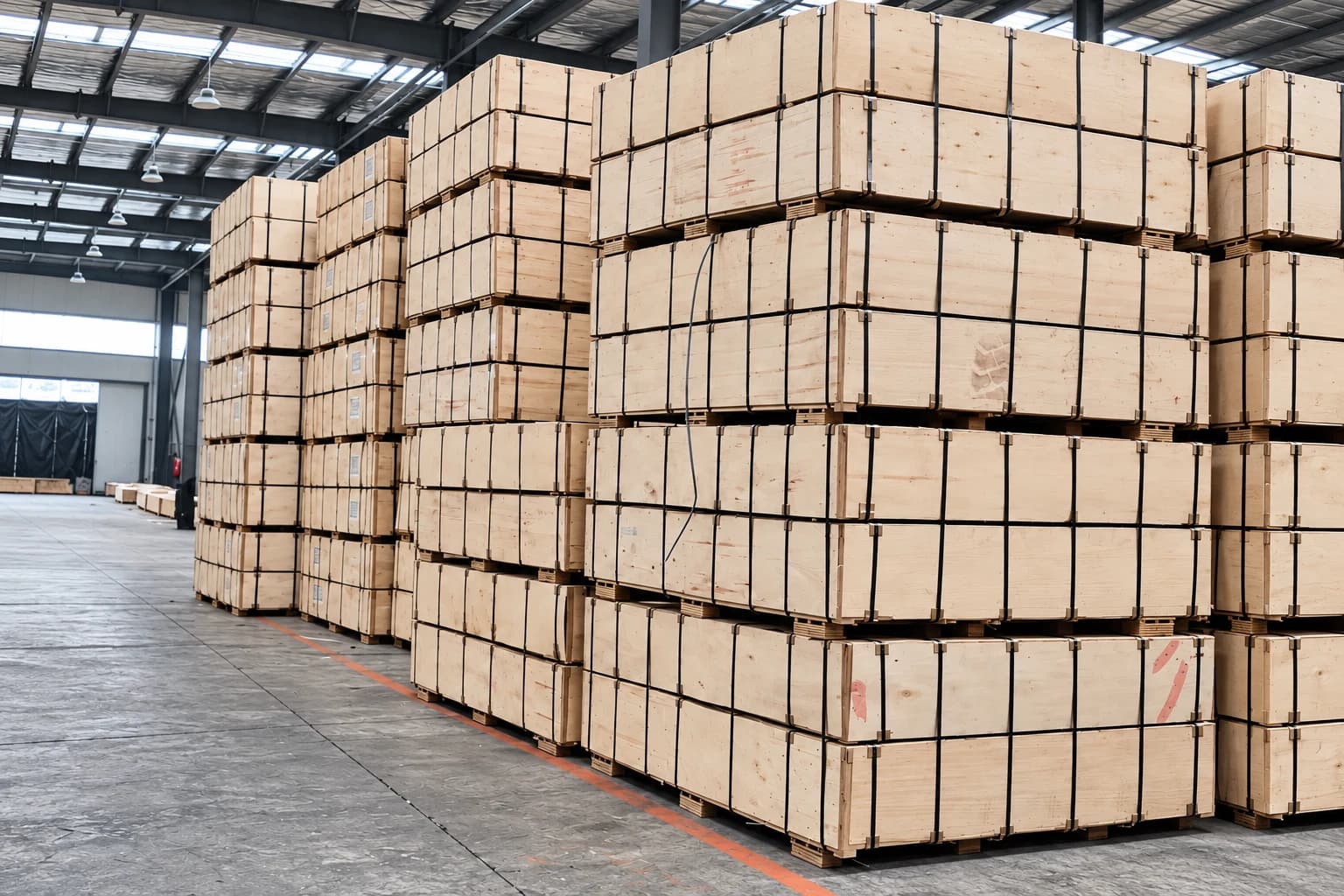
Packed plywood in covered warehouse storage
Keep packs on suitable level supports in a dry, covered area, with access to their labels. Separate constructions and thicknesses when issuing stock, and check the package, floor and storage system before stacking.
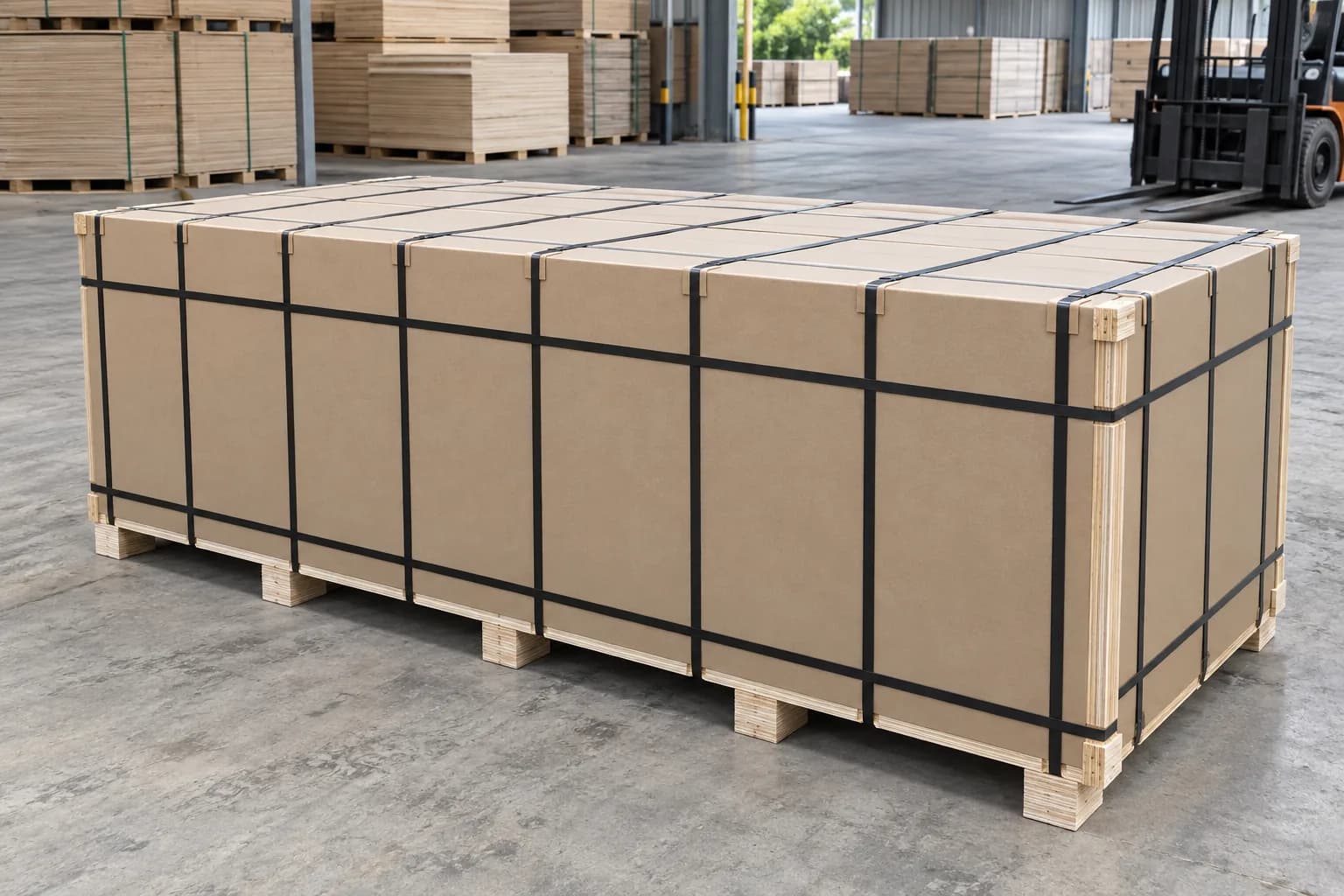
Flat pallet packing for plywood delivery
Agree package dimensions, mass, support positions and face and edge protection before dispatch. Prepare suitable unloading equipment and a supported storage position; once the pack is opened, use the appropriate method for individual panels rather than moving an unsecured stack.
Confirm stack height and support with your site’s load capacity and storage system before stacking packages. Continue with Packing & Container Loading for the order’s export arrangements.
Check arriving plywood before issuing it to production.
Use the packing list, agreed specification and product instructions to check the delivery. Keep package identification and observations with any material that needs review, so our factory team can respond to the actual shipment and condition.
Delivery and package identity
Record the delivery date, shipment or order reference and package labels. Keep the pack identifier with the panels when dividing a shipment for production.
Quantity and specification
Compare package and sheet counts, product construction, thickness and dimensions with the packing list and purchase order. Identify mixed thicknesses or constructions before issuing material.
Protection and supports
Check wrapping, outer boards, straps, corners, timber bases and visible impact marks. Record damage before opening where practical, then arrange safe handling and suitable storage.
Panel condition
Check representative faces, edges and flatness for the agreed quality. Record stains, raised grain, chipped edges, lifted overlays or veneer separation as distinct observations, not one assumed cause.
Moisture and exposure
Record visible wetting, condensation and relevant storage conditions. Where moisture readings are needed, keep the method, locations, construction and meter settings with the results.
Any issue needing review
Keep affected packs identifiable and share the order reference, pack labels, photographs and observations with our factory team. Record what was seen on arrival and any later unpacking, storage or processing.
Visible moisture, swelling, surface marks, overlay lifting and veneer separation need different checks. Keep affected material out of the next process until the relevant condition has been assessed. Follow your site’s safety arrangements for unstable packs or suspected mould; do not improvise a lifting or cleaning procedure.
Use Plywood Pre-Shipment & Receiving Inspection and Quality & Inspection to connect the delivery check with the agreed purchase specification.
Include storage and unloading requirements in your plywood enquiry.
Regular sizes: 1220×2440, 1250×2500, 1525×3050 mm. On-request sizes: 1250×3050, 1250×3660, 2100×2800, 1830×3660, 1250×3800 mm. Confirm the largest sheet and package dimensions your receiving and production arrangements can handle.
- Product construction, finish, thickness and size mix, sheet quantity and intended use.
- Destination, delivery point, route and expected time from arrival to processing.
- Receiving access, unloading equipment and any package dimensions or mass limits.
- Storage space, supports and the site’s environmental conditions.
- Face and edge protection, mixed-pack identification and label requirements.
- Required dispatch condition, measurement method and processing or installation instructions.
Our factory team confirms the plywood, agreed packing, relevant instructions, production schedule and export terms with the quotation. Share practical receiving limits early so they can be included in the order.
- Order quantity & mix
- Tell us the sheet size, thickness mix and quantity you need. We confirm the minimum order and available mix for your selected construction.
- Production lead time
- We confirm the production schedule with your specification, order quantity and sample requirements. Production lead times are planning estimates, not transit times.
- Price & quotation unit
- Currency and price unit stated in your quotation. Your quote is based on the agreed dimensions, construction and quantity. Processing and requested testing are stated separately where applicable.
- Samples
- Tell us the plywood, thickness, finish and delivery country. We confirm sample availability, any sample and courier costs, and dispatch arrangements before proceeding.
- Packing & delivery
- We agree export packing, labels and the loading plan for your order. Share the destination country, named port or delivery point and preferred delivery term. Freight, insurance, duties and taxes are included only when stated in the quotation.
- Payment & order confirmation
- We agree the payment method, currency and any deposit and balance schedule in the quotation or proforma invoice. Your order confirmation sets out the product, quantity, packing and delivery arrangements.
Delivery, storage and readiness for use
Questions about plywood storage and handling.
What is the best way to arrange plywood storage?
Plan a dry, covered area with level support suitable for the panels and package loads. Keep flat panels supported horizontally, protect faces and edges, retain package identification and follow the selected product’s instructions. Storage conditions and the next operation matter as well as the adhesive or product name.
Can marine or exterior plywood be stored outdoors indefinitely?
No. A durable bond or marine description does not make exposed wood, damaged wrapping or cut edges immune to wetting and dimensional change. Arrange covered storage. If temporary outside holding is unavoidable, agree suitable protection and inspection for the actual product and conditions rather than treating transit packaging as a permanent store.
Can I lean loose plywood sheets against a wall?
Do not use an unsecured leaning stack as a storage or retrieval method. Boards can fall during removal. Use suitable supported storage and handling aids under the site’s safe system of work. Flat storage is the normal choice for flat sheets; any upright storage needs purpose-designed support and restraint.
Should I leave the wrapping and straps on during storage?
Follow the product and packing instructions, taking account of whether the package is dry, exposed or already opened. Protection can help dry panels during storage, but wet wrapping must not be assumed harmless. Removing restraint changes handling safety, particularly with slippery overlaid panels. Do not move an unsecured stack as though it were a complete delivery pack.
How long does plywood acclimatisation take?
There is no single time for every construction, thickness, finish and destination. Agree the conditions and readiness criteria for your adhesive, coating, machining or installation process. Record the panel’s actual moisture and dimensional condition where relevant; a fixed number of hours alone does not establish that it is ready.
Is plywood acclimatisation the same as drying a wet shipment?
No. Acclimatisation prepares suitable material for the intended processing or service conditions. Wetting or visible damage needs inspection and an appropriate drying or assessment plan first. Do not cover, laminate or install wet panels just because a conditioning period has passed.
What helps with plywood warping prevention?
Reduce uneven moisture and heat exposure, maintain suitable flat support and protect the panels during storage and handling. Confirm the required flatness and condition before precision machining or assembly. Cross-laminated construction improves stability but does not guarantee that every sheet stays flat in any environment.
How should I handle large-format or thin plywood?
Plan the actual sheet dimensions and mass, receiving space, lifting aids and transfer route. Support the panel through the move and protect its faces, corners and machined edges. Use trained personnel and suitable equipment under your site’s assessed handling method; do not assume one method suits every format.
What should I do if arriving plywood is wet or damaged?
Record package labels, arrival condition and photographs, keep affected packs identifiable and contact CUZI PLY with the order details. Distinguish packaging damage, swelling, surface marks, loose overlays and veneer separation. Review the intended use and condition before processing; drying alone does not establish restored appearance, bond or structural performance.
What should I tell CUZI PLY about my receiving and storage arrangements?
Tell our factory team the product, thickness and size mix, quantity, destination, unloading equipment, available storage space and time before use. Add face protection, package dimensions or mass limits, labels and moisture or process requirements. We agree the plywood specification and export packing with your quotation.
Who should arrange transport, unloading and storage protection?
Agree factory packing and product instructions with CUZI PLY before dispatch. Confirm the delivery term and named point, who arranges freight and insurance, and the unloading arrangements with the appointed carrier or forwarder. Your receiving and site teams prepare safe unloading, suitable supports and ongoing protection, including after packs are opened. Tell us about changed delivery or storage plans before the shipment leaves.
What should I send if damage is found after a pack is opened?
Send CUZI PLY the order reference, pack label, dated photographs, affected sheet count and the condition of the wrapping, faces and edges. Include when the pack was opened, where it was stored, any wetting or later processing, and relevant moisture readings with their method. Keep affected panels identifiable and hold them out of the next operation while the condition and intended use are assessed. Follow the agreed carrier or insurer reporting procedure where relevant; do not assume the cause from one surface mark.
Plan the plywood order around your receiving needs.
Send the product, dimensions, quantity, destination and receiving or storage requirements. We help agree the construction, packing, identification, relevant product instructions and export arrangements.
For a physical panel assessment, specify construction, thickness and finish. We confirm availability, sample and courier costs, and dispatch arrangements before proceeding.