Choose plywood for moisture and water exposure.
Make moisture performance part of the order, not an afterthought. Choose the plywood construction for the way your component gets wet, dries and is maintained. The bond, wood layers, surface, edges and installation each play a part in dependable service.
CUZI PLY is your plywood manufacturer and direct supplier in Linyi, China, with 10 production lines. Share the application and exposure with our factory team. We help you compare the construction, edge treatment, processing and product documents before you place the order.
Specify the wetting and drying conditions first.
Describe what you are making, where it will be used and which surfaces are exposed. Include water contact, humidity, temperature, drying access, loads and expected maintenance. This makes panel and finishing quotations easier to compare.
| Exposure | Panel selection | What to provide |
|---|---|---|
| Dry interiors | Select the face, core and bond for furniture, cabinetry or lining in the intended room. | Room humidity, finish, visible faces and dimensional fit. Bathrooms and unheated spaces may need a different moisture specification. |
| Occasional wetting with drying | Specify the appropriate bond and protect the complete part, including cuts, joints and fixings. | How often it gets wet, for how long, and whether both faces and edges can dry. |
| Repeated exterior weather | Select an exterior-service construction with compatible finishing and installation details. | Rain, sun, drainage, ventilation, exposed edges, maintenance and any structural requirements. |
| Immersion, ground contact or persistent damp | Define the complete application and any required treatment or assembly qualification before selecting the panel. | Fresh or salt water, duration, temperature, biological risks, load and the applicable project requirements. A marine name or film face is not the complete specification. |
For boat joinery and external components, compare Marine Plywood and Marine & Exterior Applications. For concrete-contact work, start with Film Faced Plywood. Add structural or treatment requirements separately where the job needs them.
Is plywood waterproof, or water resistant?
Water resistance describes performance under defined exposure. A waterproof or watertight requirement must identify the complete component, conditions and acceptance test. Bond durability, moisture uptake, decay resistance and a sealed assembly are different requirements.
Marine plywood
Select the marine product specification and construction for the intended part. A durable adhesive bond does not stop exposed veneers absorbing moisture or protect every cut and penetration. Plan the finishing and installation as well.
Film-faced plywood
The working face can help protect the panel where it remains intact. Cut edges, holes, joints and worn areas still expose the wood. Choose the core and bond, then maintain the surface and edge protection for the application.
MR and WBP descriptions
Ask for the actual bond requirement and applicable test or product standard. These trade descriptions do not define every service condition, a coating system or an immersion guarantee. See Bonding & Emission Options.
Exterior use and complete assemblies
Specify the exterior-service panel and its finish, joints, drainage and maintenance. A bond classification does not replace the water-management details of a wall, cabinet, hatch or transport floor. Review moisture exposure with the assembly designer.
Tell us the water exposure and required result in your enquiry: occasional splash, repeated rain, damp storage, immersion, dimensional fit or a watertight assembly. Our factory team can then compare the appropriate panel construction and processing.
Plywood moisture content changes with storage and service conditions.
Moisture content is generally expressed on an oven-dry mass basis. The dispatch target, the condition before bonding or machining, and the moisture level in service need not be the same.
Use the selected method’s drying endpoint and material requirements. Do not substitute the original wet mass as the denominator.
Our product targets
Our current Film Faced Plywood specification targets 8–12% moisture content, with the method and batch checks agreed. The selected construction in Marine Plywood targets 6–12%, according to species and finishing.
Confirm the selected construction’s dispatch target and measurement method in your order. These product targets are not a promise that the panel remains at the same value after shipment or installation.
Meter checks and direct measurement
Record the instrument, calibration or correction, measurement locations and panel condition. Veneers, adhesive layers, film and treatments can affect the reading or method. Use a suitable direct measurement when needed to verify the agreed target.
The ASTM D4442 overview describes direct measurement for wood and wood-based materials and identifies limitations for certain treatments. Agree the applicable method rather than treating all meter readings as interchangeable.
Compare dispatch and receiving readings using the agreed method and locations. Record the packing and panel condition on arrival, and allow for the different temperature, humidity and storage conditions. Send unexpected readings with the product and measurement details to our factory team; a changed moisture value alone does not identify the cause or establish a bond failure.
Temperature and relative humidity influence moisture exchange with wood, as explained in the USDA moisture-relations chapter. Condition panels for the intended fabrication or installation process; follow the finish or assembly supplier’s requirements instead of assigning one acclimatisation period to every job.
Water absorption, thickness swelling and dimensional stability are different checks.
Record the initial condition and use the same measurement locations before and after the defined exposure. Keep wet results distinct from results after drying or reconditioning.
Water absorption
Measure mass gained after the stated exposure, following the method’s surface-water removal procedure. A common expression is mass gain divided by initial conditioned mass, multiplied by 100. Confirm the initial mass basis with the method.
Immersion time, temperature, thickness, surfaces and sealed or exposed edges all affect comparison. Do not compare a fully sealed part with an unsealed panel test as though they were the same construction.
Thickness swelling
Calculate the thickness increase divided by initial thickness, multiplied by 100, at the specified points. Report local edge changes separately when the measurement plan requires them.
Some movement can reduce after drying, while residual swelling, checking or distortion may remain. Assess length, width and flatness as well when the part has a close dimensional fit. A small thickness change alone does not establish bond durability.
For repeat furniture or CNC parts, state the finished-fit and flatness requirements with the expected humidity range. Balanced construction and finishing, conditioning, supports and allowance for movement work together; crossed veneers do not make plywood dimensionally motionless.
Distinguish plywood delamination from HPL separation and surface damage.
A lifted edge, blister or split needs a description of its location and interface. Different causes call for different checks; appearance alone does not establish the cause.
Separation between plywood veneers
Inspect which glue line has opened and whether separation is between veneers or within the wood. Retain the construction, batch identity and exposure history, and review the relevant bond report or testing.
HPL-to-plywood delamination
A laminate can lift at its adhesive interface even when the internal plywood bond is intact. Check the HPL Plywood construction, substrate condition, laminate and backing, adhesive compatibility, preparation, pressing or cure, and moisture or heat exposure.
Surface checking, film wear or swelling
Raised grain, a cracked face, damaged film and a swollen edge are not automatically the same as glue-line separation. Record the extent, location and change after conditioning, then assess the intended function.
What to do with a suspect panel
Set affected panels aside and prevent further wetting. Keep photos, pack and batch identification, measurements and the use history. Do not install or load a panel with unresolved bond damage; agree the assessment and corrective action before reuse.
For HPL work, agree compatible materials, conditioning and bonding with the selected laminate and adhesive instructions. Review the finished interface separately from the plywood bond. Sealing over a wet or detached layer is not a substitute for restoring the required assembly performance.
Compare moisture, swelling and delamination reports on the same basis.
Ask for the product construction, initial condition, method, exposure time and temperature, number of test pieces and individual or summary results. Agree the required limit with the applicable product or project specification.
| Check | What the result records | What to request |
|---|---|---|
| Moisture content | Water mass relative to oven-dry wood-based material mass, reported as % under the selected method. | Method, conditioning, measurement locations, construction and treatment. Identify meter readings separately from direct laboratory measurements. |
| Water absorption | Mass gained during a defined exposure, using the method’s specified initial mass and surface-water removal procedure. | Initial conditioning, immersion or other exposure, time, temperature, edge condition and mass basis. Compare like-for-like tests. |
| Thickness swelling | Change in thickness relative to the initial measured thickness, usually reported as %. | Measurement points, exposure and conditioning; results while wet and after reconditioning where required. Record thickness changes separately from mass gain. |
| Plywood veneer bond | Bond behaviour after the specified conditioning or pre-treatment, with the required shear or other evaluation. | Applicable plywood method, bond requirement, tested construction, individual results and acceptance criteria. A visual soak check is not the same as a complete standard test. |
| HPL-to-plywood bond | Performance of the decorative laminate, adhesive and plywood interface under the intended conditions. | Laminate and backing, substrate, adhesive, preparation, cure, temperature and moisture exposure. Keep this result separate from the plywood veneer-bond test. |
| Fungal durability or treatment | Resistance to the specified biological exposure or the declared preservative-treatment requirements. | Organisms or use category, species, preservative, retention and penetration where relevant, conditioning and method. A water-absorption result does not establish decay resistance. |
The BSI EN 314-1 overview identifies plywood bonding-quality test methods, including shear testing. Agree the required pre-treatment and bond class with the applicable specification. A visual boil or soak check is not the complete test, and a bond result does not also measure water uptake, HPL bonding, decay resistance or the watertightness of an installed assembly.
Include any requested testing and reports in the quotation. See Plywood Testing Methods for matching the method and report to the supplied construction, Quality & Inspection for order checks and Standards & Certifications for matching product documents to the use.
Plan coatings, cut edges and penetrations before fabrication.
For marine joinery and other exposed components, choose a compatible coating or encapsulation system for the actual environment. Follow its preparation, application, curing and maintenance instructions. Include the agreed factory edge treatment and machining in the plywood quotation; specify the coating system and application work separately.
Prepare and condition
Use a sound, clean substrate at the moisture condition required by the finishing system. Confirm any sanding, corner profile and coating compatibility, including the back face and fittings.
Protect every exposed cut
Include sawn edges, routed slots, handle openings, drilled and countersunk holes, corners and repaired damage. Factory edge treatment covers the geometry supplied; new machining can expose untreated wood.
Detail water paths
Design joints, seals, flashing or drainage for the component. Allow water to leave and the part to dry, rather than relying on a flat face coating while water collects behind it or at fixings.
Inspect and maintain
Define inspection and renewal around the actual coating and service conditions. Repair wear and newly exposed edges using the compatible system. For formwork, include cleaning, handling and storage between pours.
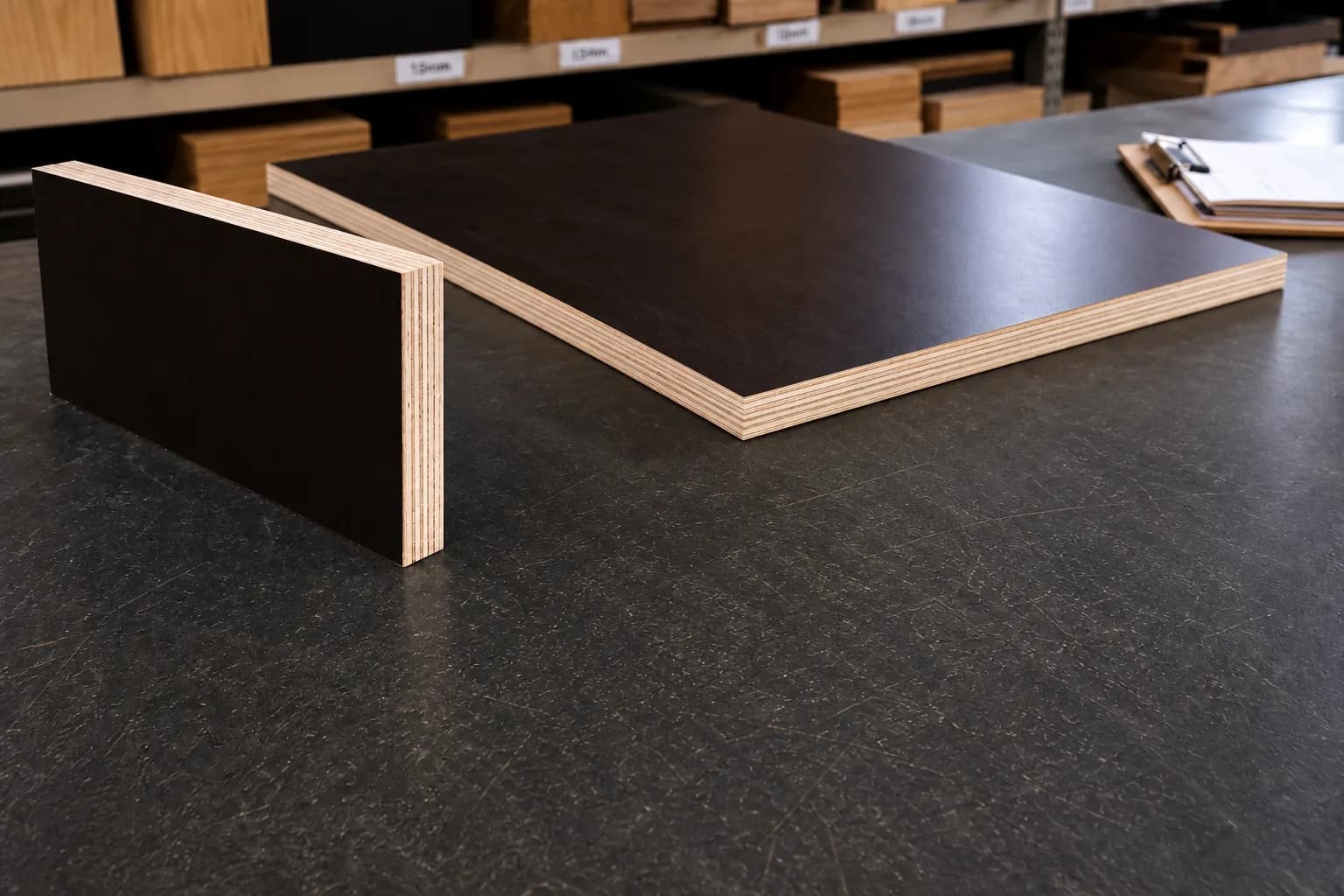
Film-faced plywood: protect the working face and cut edges
Specify the film surface, core and bond for the intended use. Protect newly cut edges, drilled holes and damaged corners; an intact film face does not cover these entry points.
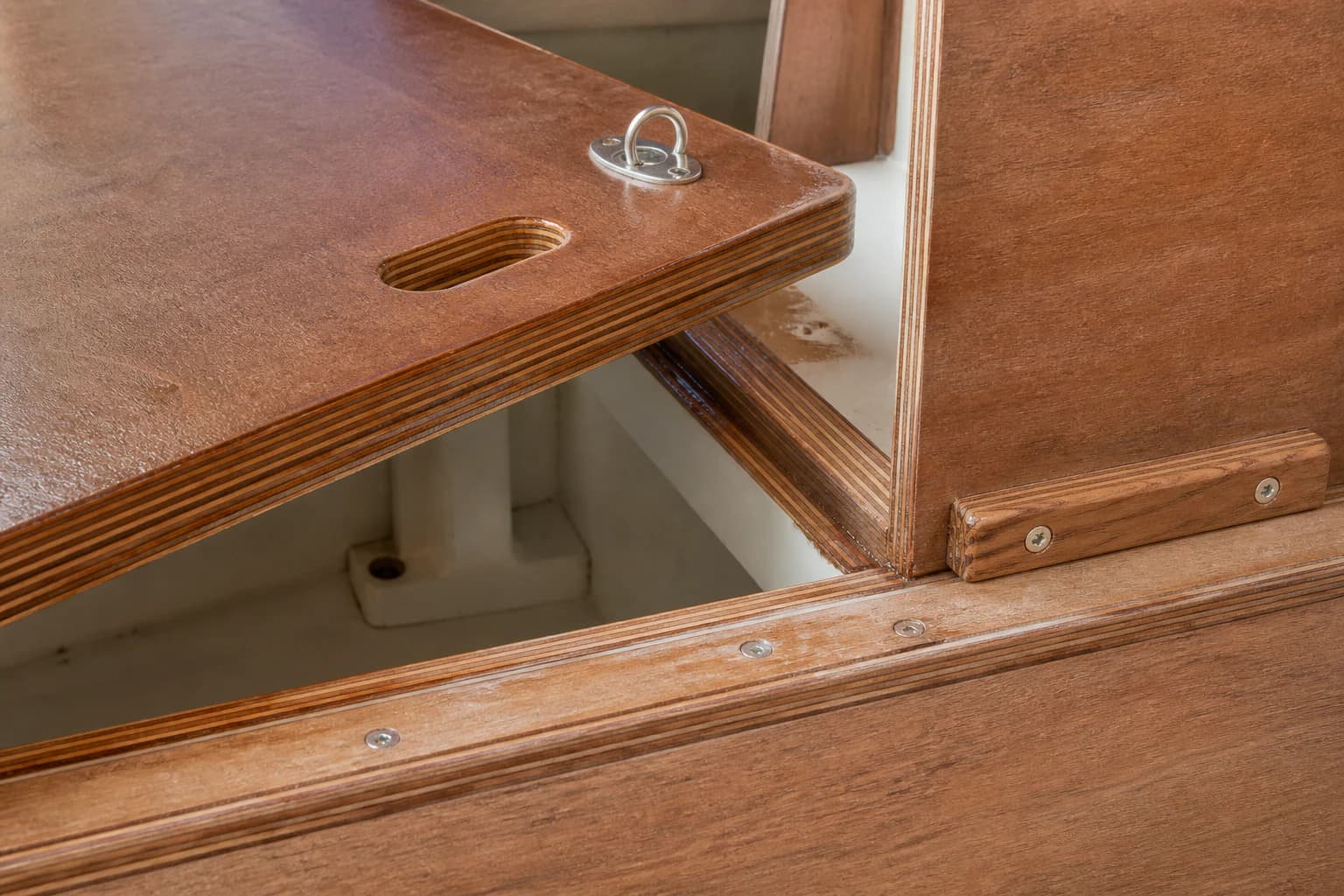
Marine plywood joinery: openings, joints and fittings
Plan edge coating, openings, joints and fittings as one finished component. Use compatible protection and provide drainage, drying access and maintenance suited to the exposure.
For building applications, APA’s moisture-mitigation guidance discusses the building envelope and drying. Select details for the complete assembly and local conditions, not just the panel face.
Fungal durability needs its own exposure and treatment specification.
Moisture, temperature and suitable biological conditions affect decay risk. A durable adhesive, MR description or marine product name does not by itself provide preservative protection.
Reduce persistent damp
Prevent water entry and accumulation, provide drying and maintain the finish. Surface mould or staining and wood decay are different conditions. Investigate persistent damp, soft or deteriorated wood and affected bonds; review fitness for the intended use rather than relying on colour alone.
The USDA biodeterioration chapter identifies fungi and other wood-degrading organisms and the conditions that permit their growth.
Specify treatment where needed
For Pressure-Treated Plywood, state the intended use category and required preservative, retention and penetration documents. Check finishing, machining after treatment, fastener compatibility and applicable structural data.
APA’s preservative-treated plywood overview separates treatment type and use conditions. A surface sealer and preservative treatment perform different jobs.
If movement or water damage changes the part’s fit or load-bearing function, assess the complete component. See Plywood Density, Weight & Strength for the direction, loading and connection data to keep with the panel specification.
Protect plywood during storage, conditioning and receiving.
Store flat on suitable aligned supports, clear of ground moisture and water collection. Keep faces and edges protected; arrange weather protection and ventilation so a cover does not trap condensation.
Before fabrication or installation
Follow the agreed storage and conditioning plan for the product, finish and assembly. Check moisture and dimensions at the appropriate stage. Do not close wet panels into an assembly or apply a finish before its substrate requirements are met.
Export packing protects the shipment under the agreed handling conditions; it is not a permanent outdoor-storage enclosure. Inspect damaged wrapping, pallets and corners on arrival.
After accidental wetting
Stop further water entry and allow appropriate drying. Record the area, duration and condition; inspect edges, dimensions, flatness, veneers and any laminate interface. Avoid assuming that drying restores every original property or bond.
For structural or safety-critical work, keep suspect panels out of service until assessed. Review the Shipment & Receiving Inspection checklist for identification and reporting.
Include moisture and water-exposure requirements in the order.
You do not need a finished technical brief to contact us. Start with the use and exposure; our factory team helps complete the construction, processing and document requirements.
- Component, destination, humidity, wetting duration, drying, water type, temperature and maintenance.
- Face and back, core, bond requirement, thickness, size, quantity and any load-bearing use.
- Moisture target, measurement method and stage: dispatch, fabrication or installation.
- Surface finish, edge coating, machining, holes, joints, fittings and who completes site protection.
- Applicable product, bond, absorption, swelling, interface or treatment tests and required results.
- Packing, labels, storage instructions, requested documents and target delivery date.
Ask us to quote the panel, machining and factory edge treatment together. Identify any coating, site sealing or assembly work arranged separately, so each offer covers the same finished-part requirements. Agree additional tests, their acceptance limits, costs and timing before ordering; include the checks for receiving and repeat orders.
Ordinary custom sheet sizes do not require a separate certificate for every millimetre. Match the product documents to the construction, thickness range and intended use; review material, bond, treatment or finishing changes that affect the relevant performance. Any installed watertightness requirement belongs with the complete assembly specification.
Wetting, drying and durable use
Questions about plywood moisture and water resistance.
Is plywood waterproof or water resistant?
Specify the panel and the exposure rather than relying on either word alone. A suitable bond can withstand its specified wet conditions, while the wood may still absorb moisture, change dimensions or need protection against decay. A watertight component also needs appropriate coatings, cut edges, holes, joints and installation details.
Is marine plywood waterproof?
Marine plywood is made to a selected construction and product specification. Its durable bond is important, but it does not make exposed wood, site cuts or joints impermeable. Choose the marine specification for your component and plan compatible coating, sealing, drainage and maintenance. Specify preservative treatment separately when the exposure requires it.
How should I waterproof marine plywood for a finished component?
Use a coating or encapsulation system specified for the actual marine use. Prepare and condition the panel as that system requires, then protect faces, back, edges, routed openings and fastener penetrations. Follow the coating manufacturer’s application and cure instructions. Design joints and drainage, and renew protection after cutting or damage. CUZI PLY supplies the plywood and agreed processing; coating products are specified separately.
Is film-faced plywood waterproof?
The film provides a working surface; the core, bond, edges and finished assembly still need the right specification. Water can reach wood at cuts, holes, joints and worn or damaged areas. For formwork, protect these areas and follow the cleaning, storage and edge-treatment plan between uses. An intact face does not establish unlimited immersion or outdoor service life.
Do MR and WBP identify the full water-performance specification?
No. MR and WBP are commonly used bond descriptions, not a complete specification for the installed component. Request the applicable bond standard or test requirement and choose the face, core and protection for the exposure. Neither description replaces the intended-use details or any required product documents.
What plywood moisture content should I specify?
Agree the dispatch target and measurement method for the selected construction and finishing process. Also consider the destination’s storage and service conditions. A dispatch value is not a permanent in-service value; conditioning before machining, bonding or installation may be needed. Use the coating or flooring system’s requirements where those apply.
Are water absorption and thickness swelling the same?
No. Water absorption records mass gained during the defined exposure; thickness swelling records a dimension change. Keep both results with the initial condition, exposure duration and temperature, edge treatment and measurement method. Low swelling does not by itself prove a watertight assembly or a durable veneer bond.
Can plywood swell without delaminating?
Yes. Wood layers can take up moisture and change dimensions without a veneer bond separating. Raised grain, checking, local edge swelling, veneer separation and a lifted decorative surface are different observations. Inspect the affected area and review its construction, exposure and required function before deciding on reuse.
What does a plywood delamination test tell me?
It evaluates the bonded construction under the method’s stated conditioning, exposure and acceptance criteria. Ask which bond or interface is assessed and request the complete report. Under EN 314-1, veneer-plywood bonding quality is evaluated by shear testing with specified pre-treatments. A simple boil or soak demonstration does not provide every required result.
How should I investigate HPL plywood delamination?
Identify whether the HPL has lifted from its adhesive, plywood veneers have separated, or the surface itself is damaged. Record the location, construction, adhesive and backing, preparation and cure, and the heat or moisture exposure. Review the HPL bonding system separately from the plywood’s internal bond. Do not cover a loose or wet interface and assume its performance is restored.
Does marine or exterior bonding prevent fungal decay?
Bond durability and biological durability are different. Persistent damp can create conditions for wood-decay organisms even when a bond remains intact. Control water entry and provide drying. Where the application needs treated plywood, specify the treatment and intended use category, including compatible coatings and fasteners.
Can CUZI PLY help select the panel for my wet-service project?
Yes. Tell our factory team the component, wetting and drying conditions, finish, size, thickness, quantity and destination. Add any bond standard, treatment or test requirements. We help compare the construction and agreed processing, confirm the documents and packing, and prepare a factory quotation.
Can I compare dispatch and receiving moisture readings directly?
Keep the product, measurement method, instrument corrections, locations and conditions with each reading. Moisture can change during transit or storage, and readings taken by different methods may not be directly comparable. Record the packing and panel condition on arrival, repeat checks on the agreed basis and contact our factory with the results. A changed moisture reading alone does not establish a bond failure.
Who protects plywood edges after cutting or drilling on site?
Our quotation identifies the factory edge treatment and machining supplied. Further site cuts, routed openings, drilled holes and damage expose new areas that need compatible protection. Agree who will complete and inspect this work before the component gets wet. Follow the coating system’s substrate, application and curing requirements; factory edge treatment does not cover later cuts automatically.
Order the panel, processing and protection your project needs.
Regular sizes: 1220×2440, 1250×2500, 1525×3050 mm. On-request sizes: 1250×3050, 1250×3660, 2100×2800, 1830×3660, 1250×3800 mm. Add the finished thickness, construction, quantity and destination. State the edge treatment and machining with the final part dimensions.
- Order quantity & mix
- Tell us the sheet size, thickness mix and quantity you need. We confirm the minimum order and available mix for your selected construction.
- Production lead time
- We confirm the production schedule with your specification, order quantity and sample requirements. Production lead times are planning estimates, not transit times.
- Price & quotation unit
- Currency and price unit stated in your quotation. Your quote is based on the agreed dimensions, construction and quantity. Processing and requested testing are stated separately where applicable.
- Samples
- Tell us the plywood, thickness, finish and delivery country. We confirm sample availability, any sample and courier costs, and dispatch arrangements before proceeding.
- Packing & delivery
- We agree export packing, labels and the loading plan for your order. Share the destination country, named port or delivery point and preferred delivery term. Freight, insurance, duties and taxes are included only when stated in the quotation.
- Payment & order confirmation
- We agree the payment method, currency and any deposit and balance schedule in the quotation or proforma invoice. Your order confirmation sets out the product, quantity, packing and delivery arrangements.
Choose plywood with the exposure in mind.
Tell us what you are making and how it gets wet and dries. We help compare the construction, finish, agreed processing, product documents and delivered-order cost.
Name the construction, thickness, finish and edge treatment you want to assess. We confirm availability, sample and courier costs, and dispatch arrangements before proceeding.