CUZIPLYFactory-direct plywood
Get a quote
PLYWOOD TECHNICAL GUIDELAMINATED PLYWOODNINE SURFACE FAMILIESREVIEWED 2026-08-30

Plywood Surface, Laminate and Overlay Options

Laminated plywood performs as a complete panel: the visible face, supporting veneer, core construction, plywood bond, secondary adhesive, balancing back and edge treatment work together. This guide compares raw and sanded faces, decorative veneer, melamine, HPL, phenolic film, HDO/MDO, anti-slip overlays and coated or grooved finishes. It also explains how to specify moisture, flatness, abrasion, scratch, impact, stain resistance, heat contact, colour stability, machining and cleaning. Start with the finished component and service conditions, select the surface family and substrate, then approve a representative sample using the required test method. Quotations can then be compared on the same construction, dimensions, performance checks, packing and destination requirements.

  1. 01Define the componentAppearance, contact, cleaning and environment
  2. 02Select the faceVeneer, melamine, HPL, film, HDO/MDO or anti-slip
  3. 03Build the panelSubstrate, bonding, balancing back, moisture and edges
  4. 04Approve performancePhysical sample, named method and acceptance value
Interior moisture target
8–12%, confirmed by construction
Face + substrate
Specified as one finished panel
Balance + flatness
Checked on a representative first article
Order documents
Sample, test method and inspection requirements
Build a surface specification
BUYER ANSWERS

Choose the complete laminated plywood construction.

What does laminated plywood mean?

Laminated plywood combines a plywood substrate with a decorative or functional face such as melamine paper, HPL, phenolic film, HDO/MDO overlay or selected veneer.

Specify: Its purchase specification includes the face material, plywood construction, bonding method, balancing back, finished thickness and edge treatment.Send the intended use, surface reference and finished-panel construction with the enquiry.

How are melamine plywood and HPL plywood different?

Melamine plywood uses resin-impregnated decorative paper pressed directly to the panel, while HPL plywood uses a separately manufactured laminate bonded to a calibrated plywood substrate.

Specify: HPL is normally thicker and selected by a named laminate grade; melamine is commonly selected by decor, texture and direct-facing quality.Confirm the finished component, wear duty, machining, backer and approved sample.

How do film faced plywood and HDO/MDO plywood differ?

Film faced plywood uses a phenolic or resin film for formwork and industrial protection. HDO/MDO use resin-impregnated fibre overlays selected for smoothness, paintability, signage or specialised formwork.

Specify: The overlay, core construction, exterior bond, reverse face and edge sealing are specified together.Choose the required concrete finish, paint system or industrial surface before comparing products.

What moisture level suits decorative lamination?

For interior furniture and decorative panels, 8–12% is a practical quotation target for the plywood substrate, with the final range confirmed for the species, panel thickness, press process and destination climate.

Specify: Moisture is checked before lamination and again when finished panels are conditioned for packing.State the required moisture range and the measurement method in the order.

How should abrasion and scratch resistance be specified?

Name the applicable laminate or overlay grade, test method, load or wheel type, cycle or endpoint, and the acceptable visual change. ISO 4586-2 is a common method source for HPL sheet properties.

Specify: The finished plywood sample should use the same face material, substrate and bonding process as the order.Provide the traffic, cleaning and contact duty so we can propose a suitable surface.

When is a balancing back required?

A balancing back is normally evaluated for single-sided HPL, veneer or other asymmetric laminations to control bow and twist after pressing and conditioning.

Specify: Backer material, thickness and pressing history are matched to panel size, substrate and flatness tolerance.Approve a full-size or representative first article before volume production.

How are stain, heat and colour performance confirmed?

List the actual agents, dwell times, cleaning cycles, dry or wet heat temperature, contact time, light exposure and acceptable colour or gloss change. The named surface supplier method can then be applied to the finished construction.

Specify: Edges, holes and machined areas are included whenever they will be exposed in service.Attach the cleaning schedule, heat source and decor reference to the enquiry.

What belongs in a surface and overlay RFQ?

Include the application, destination, surface family, decor and texture, face/back arrangement, substrate, primary and secondary bonding, dimensions, moisture, machining, edge treatment, performance tests, approved sample, quantity and packing.

Specify: This information allows offers to be compared on the same finished-panel construction.Attach drawings, decor references and any destination or project document list.
PERFORMANCE CHECKS

Turn surface requirements into measurable quotation fields.

Performance checkDefine the dutyState in the specificationVerify withSelection resultQuotation record
AbrasionHow much traffic, handling or cleaning wear will the face receive?Method, abrasive wheel or medium, load, cycles and wear endpointTest coupon made with the ordered surface constructionSelect a surface grade matched to the dutyRecord the method and pass criterion in the quotation
Scratch / marWhat contact load and visible mark limit are acceptable?Stylus or contact method, load, finish, viewing angle and visual limitApproved sample before and after the nominated checkMatch texture and gloss to the end useKeep the approved reference with the production order
ImpactWhat object or service impact can reach the panel?Impactor type, mass, drop height, support and acceptable dent or fractureRepresentative finished-panel test pieceSelect substrate and face as one constructionInclude edge and supported-span conditions
Stain / cleaningWhich liquids, cleaners and cleaning frequency apply?Agent concentration, dwell time, temperature, cycles and recovery periodCleaning trial on the finished face and exposed edgesConfirm cleaner compatibility and maintenanceList the actual agents used by the customer
Dry / wet heatWill hot cookware, steam or heated equipment contact the surface?Dry or wet method, temperature, contact time, fixture and visual limitTest the finished surface over the selected plywood substrateSelect laminate grade, adhesive and backer togetherInclude edge and joint exposure where relevant
Colour stabilityHow closely must repeat orders match the approved decor?Light source or exposure, reference sample, colour-difference limit and replacement toleranceRetained master sample and controlled viewing conditionConfirm batch matching before productionRecord acceptable natural or printed variation
Moisture / exterior exposureIs service dry interior, humid, exterior or intermittently wet?Panel moisture, primary bond, secondary adhesive, edge system, drainage and maintenanceConditioned first article plus applicable exposure checkMatch the complete panel to the service environmentState installation and maintenance conditions
SURFACE LIBRARY

Compare substantial panel samples—not isolated colour chips.

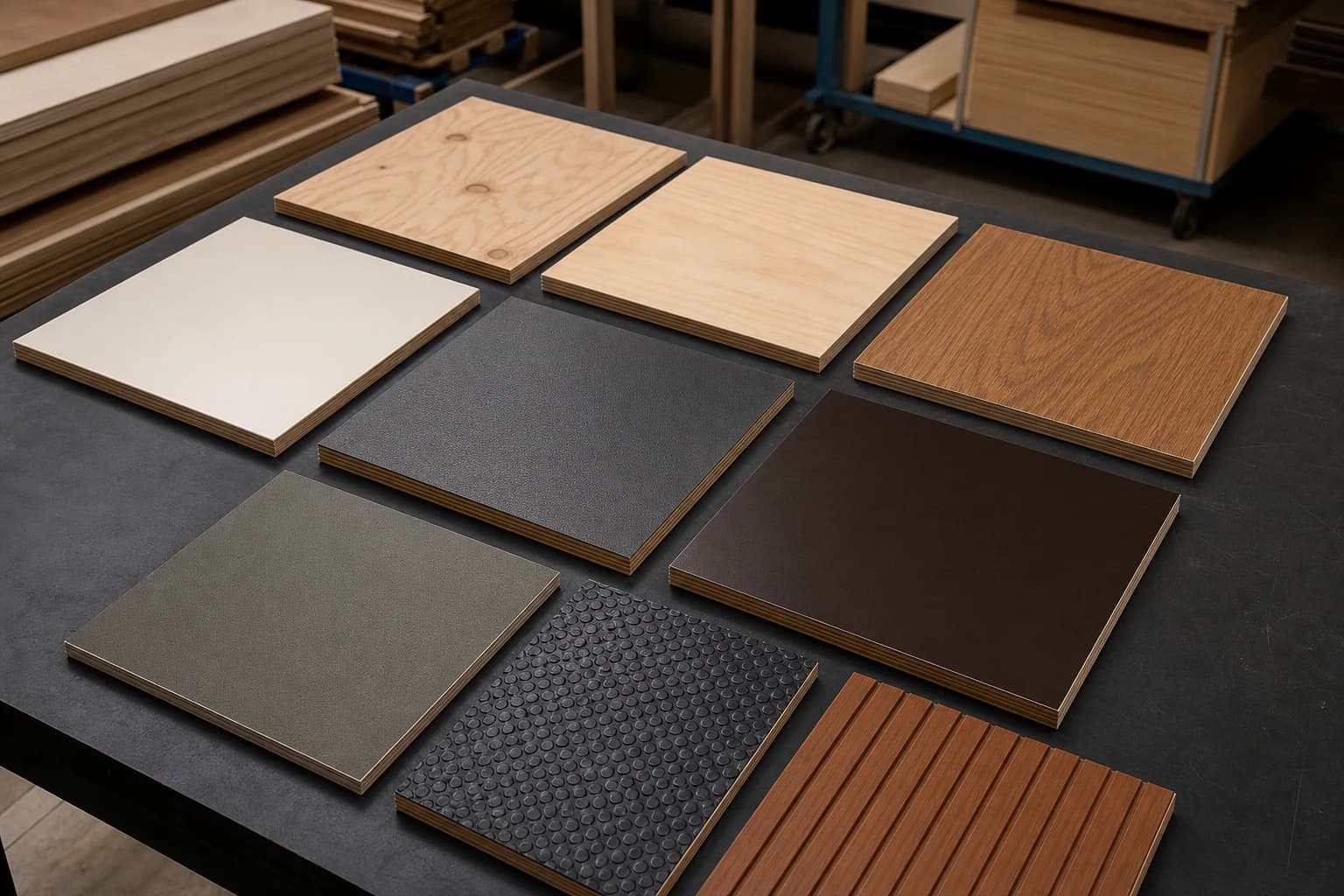
Nine substantial plywood samples showing raw sanded veneer decorative laminate film resin-fibre patterned and grooved surface options on an inspection table
Material construction on one inspection table

Bare, decorative and functional surface families remain on one inspection table so the face, substrate edge and reverse construction can be compared together.

SURFACE FAMILIES

Compare the face, substrate, bonding, balance and edges together.

Surface familySurface constructionTypical usePlywood substrateFace and backBondingEdge treatmentSample and checksProduct page
Raw / unsanded veneer faceMill veneer surface with natural variation and production textureUtility base or later preparationStable face/back veneer and repair limitsUsually symmetric bare facesPrimary plywood bond onlyProtect exposed edges for intended useFace sample and repair range/products/commercial-plywood/
Sanded / calibrated veneer faceMachined bare veneer face with controlled surface and thicknessPaint, veneer or component preparationMachining allowance and thickness consistencyBalanced sanding and face/back definitionPrimary plywood bond onlySpecify cut-edge and coating preparationCalibration record and sample/products/furniture-grade-plywood/
Decorative veneer-faced plywoodSelected natural wood veneer on a qualified substrateNatural visible wood appearanceSmooth support veneer, telegraphing and colour rangeUsually balanced face/back constructionSecondary veneer adhesive plus primary bondFinish and seal cut edges to designMatched sample and finish trial/products/hardwood-plywood/
Melamine-faced plywoodResin-impregnated decorative paper fused as a direct face optionCleanable furniture/interior decorCalibrated stable substrate and press compatibilityOne- or two-face option with balance reviewFace resin system is not the primary MUF/PF glue lineEdge banding or sealing as component requiresDecor/sample and machining trial/products/melamine-plywood/
HPL-faced plywoodIndependent high-pressure laminate bonded to a plywood substrateWear-resistant decorative work surfaceCalibrated substrate, HPL grade and adhesive compatibilityBacker selected for flatness and serviceSecondary lamination adhesive plus primary bondMachine and finish exposed composite edgesHPL sample and composite first article/products/hpl-plywood/
Phenolic/resin film-faced plywoodThin resin film hot-bonded to plywood facesConcrete-forming or protected industrial faceCore, bond, smooth support and edge controlFace/reverse film specified separatelyFilm interface and primary bond remain distinctFactory seal and prompt site-cut resealFilm/edge approved sample and use trial/products/film-faced-plywood/
HDO/MDO resin-fibre overlayResin-impregnated fibre overlay in high- or medium-density optionPaint/sign/formwork or industrial surface preparationOverlay grade, substrate and press optionBack face and balance defined by product useOverlay bond and core bond specified separatelyEdge and coating programme remains explicitOverlay sample and coating/form trial/products/hdo-mdo-plywood/
Patterned anti-slip overlayWear face with controlled embossed or mesh patternTraffic/grip surface for defined conditionStable substrate, pattern continuity and wear interfaceReverse face and balance option statedOverlay and core bond remain separateEdges, penetrations and wear zones controlledPattern sample plus nominated slip/wear supporting documentation/products/anti-slip-plywood/
Grooved / coated / project-finished optionMachined geometry or field/factory coating over a qualified panelSiding, signage or project-defined finishMachining support, coating preparation and exposure requirementsBack and balance chosen for componentCoating adhesion and primary bond are separateGrooves and cut edges need specified protectionMachined first article and coating-system approval/products/t1-11-grooved-plywood-siding/
PANEL CONSTRUCTION

Build laminated plywood from the visible face through to the backer.

  1. Top surface / finish

    Visible and contact result

    Colour, texture, gloss and use contact
  2. Overlay or laminate

    Specified face material

    Material identity, grade and thickness/basis weight when applicable
  3. Secondary adhesive

    Bonds a separate laminate/veneer

    Chemistry, spread, press and compatibility
  4. Support veneer

    Carries the surface

    Smoothness, repair and telegraphing control
  5. Plywood lay-up / core

    Structural substrate

    Species, plies, gaps, repairs, moisture and flatness
  6. Primary glue lines

    Join plywood veneers

    bond specifications and supporting documentation independent of surface
  7. Backer / balance layer

    Controls asymmetry

    Material and process selected for flatness
  8. Factory edge system

    Protects original finished edges

    Coating, colour, coverage and sample
  9. Site-cut edge treatment

    Restores protection after machining

    Compatible project system and responsibility
LAMINATION PROCESS

Support the substrate and align the face material through the controlled pressing process.

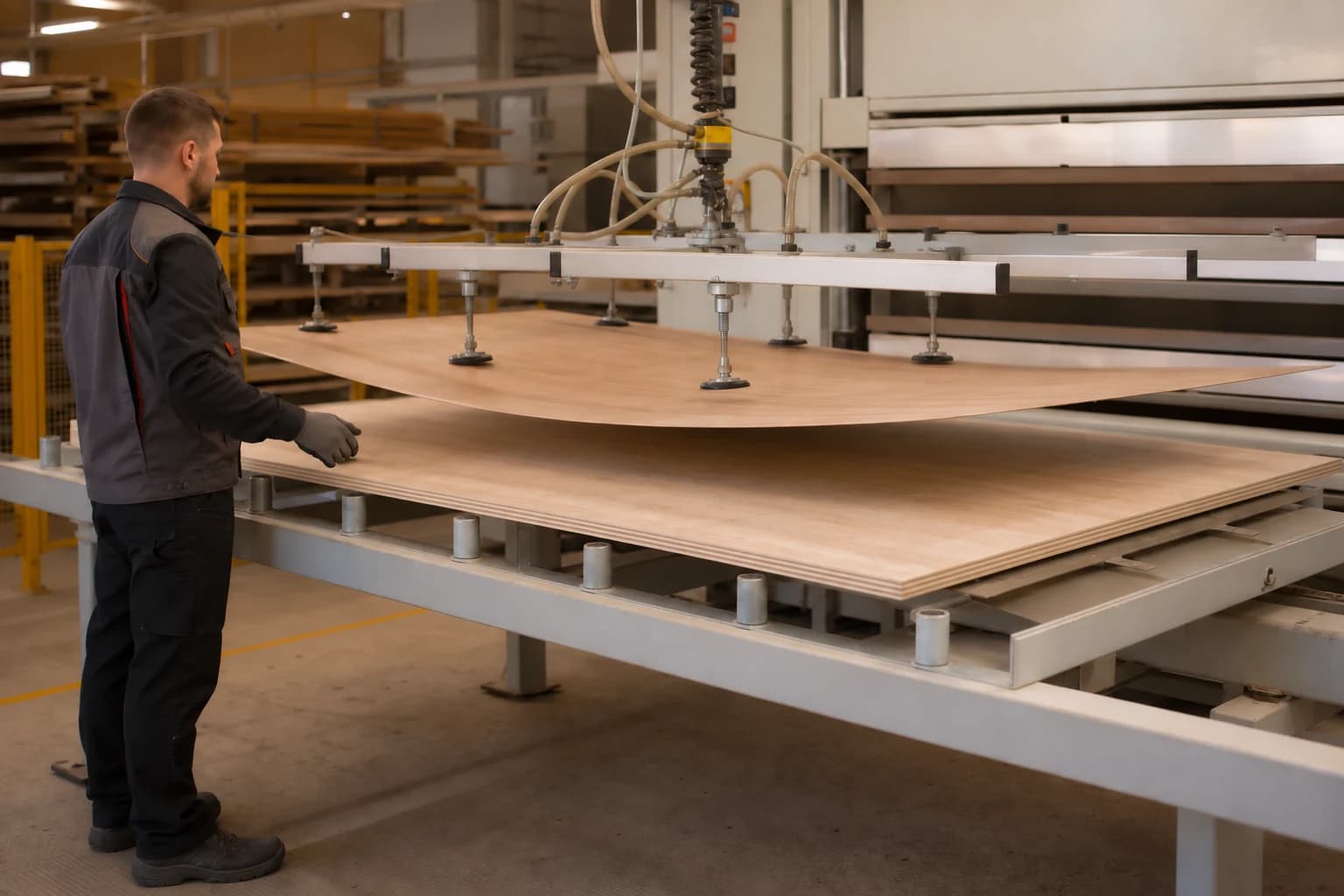
Full plywood substrate supported on a level lamination table while one thin decorative sheet is aligned by a vacuum lifting frame
Thin laminate aligned over a full plywood substrate

The full plywood substrate remains supported while the thin face material is aligned and the operator stays outside the press pinch point.

FINISH RESULT MATRIX

Choose by the buyer result, then continue to the relevant page.

Buyer resultStarting optionConfirmRelevant page
Paint-readySanded/calibrated face or MDO optionFlatness, repairs, primer and coating compatibilityOpen page ↗
Natural wood appearanceDecorative veneer-faced optionSpecies, cut, matching, finish and sampleOpen page ↗
Decorative colour / patternMelamine or HPL optionDecor, gloss, texture, balance, machiningOpen page ↗
Cleanable furniture surfaceMelamine or HPL optionCleaner, wear, edge band and hardware interfacesOpen page ↗
Wear-resistant work surfaceHPL composite optionHPL grade, substrate, adhesive, backer and edgeOpen page ↗
Concrete-forming faceFilm or qualified HDO optionRelease, edge, core, bond and site cycleOpen page ↗
Sign / print substrateMDO/HDO or project coating optionPrinting/coating system, edge and supportOpen page ↗
Patterned traffic surfaceAnti-slip product/application optionsPattern, wear, contaminants and installed testOpen page ↗
Grooved siding / panelT1-11 or project-machined coated optionGroove, siding profile, coating and installationOpen page ↗
RAW, SANDED + VENEER FACES

Specify visible appearance, preparation and finishing together.

Veneer species / cut

Natural colour and grain range

Approve species, cut and matching sample

Face / back grade

Visible repairs and defects

Name side-specific grade and use

Repair allowance

Patches, plugs and filler

Set type, count/range and visible scope

Sanding / calibration

Surface preparation and panel consistency

Set grit/process, tolerance and trial

Telegraphing

Core/support features visible through finish

Qualify substrate and first article

Paint / veneer readiness

Next finishing interface

Approve primer/adhesive/finish compatibility

ISO 2426-1 is the reference for plywood surface-appearance classification. Overlaid panels use the relevant laminate or overlay specification, while core construction and bond durability are stated in the finished-panel order.

DECORATIVE LAMINATION

Choose melamine or HPL by the component, wear duty and fabrication process.

SurfaceConstructionTypical useFace and backMachining and edgesSample and checksProduct page
MelamineDirect decorative paper/resin facing optionFurniture and interior component surfacesFace/back balance and calibrated substrateCNC, drilling and edge banding trialDecor/sample plus finished-panel scopeOpen page ↗
HPLSeparately manufactured laminate bonded to substrateWear/contact decorative work surfacesHPL grade, secondary adhesive and backerComposite edge, machining and hardware trialHPL sheet plus composite first articleOpen page ↗
INDUSTRIAL OVERLAYS

Choose film, HDO/MDO or anti-slip surfaces by the required working result.

SurfaceFace materialTypical useReverse faceSpecifySample and checksProduct page
Film FacedResin filmFormwork or protected industrial faceSpecified reverse filmRelease, cleaning, edge and wear questionsFilm/edge sample and project trialOpen page ↗
HDO/MDOResin-fibre overlayPaint, sign, formwork or industrial optionOverlay/back option by productCoating, release, smoothness and edge questionsOverlay sample and coating/form trialOpen page ↗
Anti-SlipPatterned functional overlayTraffic or equipment flooringReverse face and balance optionWear, contamination and installed slip questionPattern sample and nominated slip/wear supporting documentationOpen page ↗
SURFACE + EDGE QC

Check surface continuity, flatness and the finished composite edge.

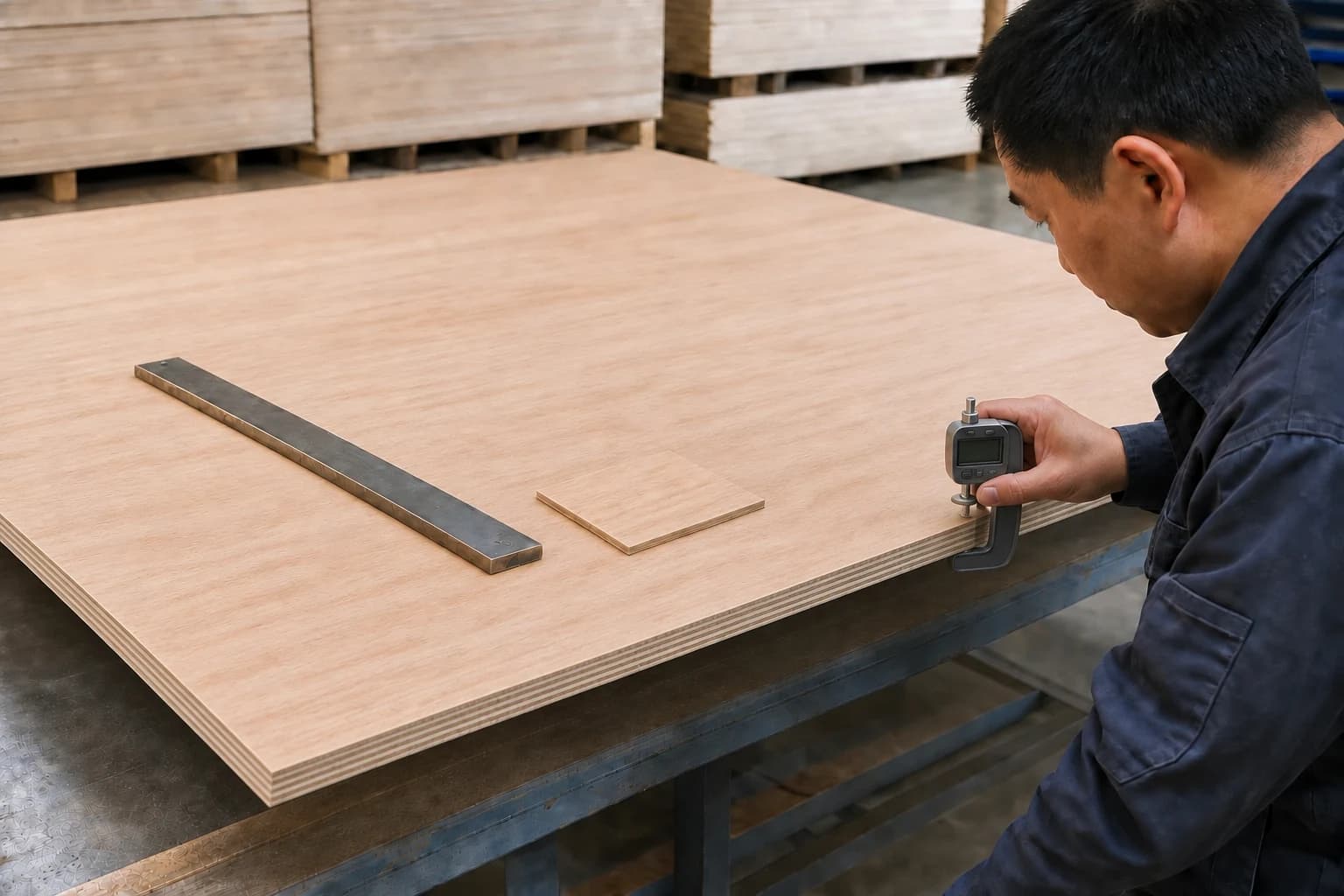
Inspector using a vertical C-frame digital thickness gauge with its upper contact on the panel top and lower anvil under the panel bottom beside a matching surface reference and straightedge
Supported finished panel under surface and thickness review

A matching unmarked surface sample, straightedge and vertical C-frame thickness gauge with upper contact and lower anvil keep colour, texture, flatness and thickness review on the supported finished panel.

PURCHASE SPECIFICATION

Put every construction and performance field into the quotation.

  1. Surface family
  2. Face/back arrangement
  3. Colour/decor reference
  4. Texture/pattern/gloss
  5. Overlay/laminate grade
  6. Nominal thickness/basis weight if applicable
  7. Support veneer
  8. Core species/construction
  9. Lay-up/ply schedule
  10. Primary bond specifications
  11. Secondary lamination adhesive
  12. Balance/backer requirement
  13. Sanding/calibration/flatness
  14. Panel dimensions/tolerance
  15. Machining/grooving/printing
  16. Factory edge sealing
  17. Site-cut edge treatment
  18. Surface sample/first article
  19. Test/document and test requirements
  20. Packing/surface protection
  21. Change control
OFFICIAL STANDARDS

Match each material and test method to the selected finished panel.

Official source pages reviewed 2026-08-30. Confirm the current edition required by the destination or project before ordering.

International Organization for Standardization (ISO)ISO 4586-1:2018International
Reference
High-pressure decorative laminates (HPL, HPDL) — Sheets based on thermosetting resins — Part 1: Introduction and general information
Status
Published; confirmed current 2023
Applies to
HPL family identity and the relationship among ISO 4586 parts.
Reviewed
2026-08-30
Open official source ↗
International Organization for Standardization (ISO)ISO 4586-2:2018International
Reference
High-pressure decorative laminates (HPL, HPDL) — Sheets based on thermosetting resins — Part 2: Determination of properties
Status
Published; confirmed current 2022
Applies to
Test-method identity for properties of HPL sheets covered by ISO 4586.
Reviewed
2026-08-30
Open official source ↗
International Organization for Standardization (ISO)ISO 4586-3:2018International
Reference
High-pressure decorative laminates (HPL, HPDL) — Sheets based on thermosetting resins — Part 3: Classification and specifications for laminates less than 2 mm thick intended for bonding to supporting substrates
Status
Published; confirmed current 2022
Applies to
Classification and specification identity for thin HPL intended for bonding to a supporting substrate.
Reviewed
2026-08-30
Open official source ↗
British Standards Institution (BSI)BS EN 438-3:2016Europe / United Kingdom adoption
Reference
High-pressure decorative laminates (HPL) — Sheets based on thermosetting resins — Classification and specifications for laminates less than 2 mm thick intended for bonding to supporting substrates
Status
Current
Applies to
European HPL sheet identity and intended bonding to supporting substrates.
Reviewed
2026-08-30
Open official source ↗
British Standards Institution (BSI)BS EN ISO 13894-2:2015Europe / United Kingdom adoption
Reference
High-pressure decorative laminates — Composite elements — Specifications for composite elements with wood-based substrates for interior use
Status
Current
Applies to
Interior HPL composite-element scope with wood-based supporting substrates.
Reviewed
2026-08-30
Open official source ↗
British Standards Institution (BSI)BS EN 14322:2021Europe / United Kingdom adoption
Reference
Wood-based panels — Melamine faced boards for interior uses — Definition, requirements and classification
Status
Current
Applies to
Melamine-faced board terminology and the stated interior substrate scope.
Reviewed
2026-08-30
Open official source ↗
International Organization for Standardization (ISO)ISO 2426-1:2020International
Reference
Plywood — Classification by surface appearance — Part 1: General
Status
Published; confirmed current 2025-12-16
Applies to
General surface-appearance classification identity for plywood and its exclusion of overlaid plywood.
Reviewed
2026-08-30
Open official source ↗
British Standards Institution (BSI)BS EN 636:2012+A1:2015Europe / United Kingdom adoption
Reference
Plywood — Specifications
Status
Current
Applies to
Plywood product/exposure specification scope, including overlaid or coated plywood.
Reviewed
2026-08-30
Open official source ↗
APA — The Engineered Wood AssociationAPA Form B360North America
Reference
HDO/MDO Plywood Product Guide
Status
Live guide page
Applies to
HDO/MDO overlay identity, use and finishing/specification guidance.
Reviewed
2026-08-30
Open official source ↗
APA — The Engineered Wood AssociationAPA product information pageNorth America
Reference
MDO and HDO Panels
Status
current products information page
Applies to
Resin-impregnated fibre-overlay identity and general MDO/HDO distinction.
Reviewed
2026-08-30
Open official source ↗
British Standards Institution (BSI)BS EN 927-1:2013Europe / United Kingdom adoption
Reference
Paints and varnishes — Coating materials and coating systems for exterior wood — Classification and selection
Status
Current
Applies to
Classification and selection framework for exterior-wood coating systems.
Reviewed
2026-08-30
Open official source ↗
British Standards Institution (BSI)BS EN 16165:2021Europe / United Kingdom adoption
Reference
Determination of slip resistance of pedestrian surfaces — Methods of evaluation
Status
Current
Applies to
Test-test methods for slip resistance of pedestrian surfaces.
Reviewed
2026-08-30
Open official source ↗
WORKED SPECIFICATIONS

See how surface, substrate, fabrication and testing combine in a real enquiry.

Furniture panel: Melamine or HPL

Use: Cabinet, shelving or work-surface component

Surface Result: Decorative, cleanable face with an agreed texture and gloss

Substrate: Calibrated plywood selected for machining, hardware and flatness

Interfaces: Direct melamine facing or HPL with a compatible secondary adhesive

Face Back: Matching two-face construction or qualified balancing back

Edge Machining: CNC, drilling and edge-banding sample

Sample Test: Decor sample, cleaning check and finished first article

Documents / tests: Product specification, sample approval and inspection record

Details to confirm: Wear duty, cleaners, hardware pattern and monthly volume

View the application guide ↗

Formwork, sign or coated industrial panel

Use: Concrete formwork, printed sign or coated industrial component

Surface Result: Release face, smooth paint base or printable overlay

Substrate: Core and exterior bond matched to span, machining and exposure

Interfaces: Phenolic film or resin-fibre overlay with the specified plywood bond

Face Back: Reverse face, balance and sealed-edge construction

Edge Machining: Factory-sealed edges with compatible treatment for site cuts

Sample Test: Surface, edge, coating or formwork trial

Documents / tests: Product data, test documents and approved application sample

Details to confirm: Exposure, concrete finish, coating system, supports and cleaning

View the application guide ↗

Traffic, grooved or project-finished panel

Use: Vehicle floor, stage, platform, siding or machined panel

Surface Result: Patterned grip, controlled groove or compatible coating

Substrate: Panel selected for machining, support spacing and service moisture

Interfaces: Functional face or coating combined with the specified plywood bond

Face Back: Balanced reverse face and protected cut edges

Edge Machining: Pattern or groove continuity, penetrations and edge protection

Sample Test: Machined first article with the nominated wear or slip check

Documents / tests: Finished-panel specification and inspection report

Details to confirm: Loads, contaminants, cleaning, maintenance and destination

View the application guide ↗
PRODUCT + APPLICATION GUIDES

Continue with the product, fabrication process or destination requirements.

BUYER QUESTIONS

Get clear answers before comparing laminated plywood quotations.

DECISION QUESTIONS

Before the purchase order

Choose the right specification.

What does laminated plywood mean?

Laminated plywood is a plywood substrate finished with a separate decorative or functional face such as melamine paper, HPL, veneer, phenolic film or resin-fibre overlay. A complete order names the face, substrate, bonding, balancing back and finished thickness.

How are Melamine Plywood and HPL Plywood different?

Melamine uses resin-impregnated paper pressed directly to the panel. HPL is a separately manufactured laminate bonded to a calibrated plywood substrate, normally with a secondary adhesive and a balancing back selected for flatness.

How do film faced and HDO/MDO plywood differ?

Film faced plywood uses a thin phenolic or resin film, commonly for formwork. HDO/MDO use resin-impregnated fibre overlays selected for smoothness, paintability, signage or specialised formwork.

What is the difference between raw and sanded plywood?

Raw plywood retains normal mill texture. Sanded or calibrated plywood adds controlled machining for smoother finishing and more consistent thickness. Face grade, repairs, sanding tolerance and the intended coating should be stated together.

When should decorative veneer be selected?

Decorative veneer suits visible furniture and joinery where natural species, cut, grain matching and finishing matter. Approve the veneer range, matching pattern, support veneer, finish system and visible-edge treatment by sample.

Can plywood be laminated on one side only?

Yes, with a balancing construction selected for the substrate, sheet size, press cycle and required flatness. A representative first article confirms bow, twist, thickness and finished appearance before volume production.

What is a balancing back?

A balancing back is the reverse-face material used to reduce unequal moisture and stress across a faced panel. Its material and thickness are matched to the front face, plywood substrate, dimensions and service conditions.

How should edges and site cuts be treated?

Specify factory sealing or edge banding for original edges, then use a compatible treatment for new cuts, holes and grooves. The finish schedule should cover exposed plies, corners, joints and maintenance.

How is a laminated panel prepared for exterior use?

Select an exterior-bond plywood substrate, compatible face and secondary adhesive, protected edges and penetrations, suitable coating or overlay, drainage, ventilation, fixing details and a maintenance schedule for the installed component.

How are fire or anti-slip requirements specified?

Name the finished panel or assembly, intended use, test method, specimen construction and required classification. For anti-slip work, also state the installed surface condition, contaminants, footwear or tyre contact and acceptance value.

How should a laminated surface be cleaned and maintained?

Approve the actual cleaners, concentration, dwell time, temperature and cycle count on a finished sample. Protect edges and damaged areas, and use the surface supplier's maintenance method for the selected decor and texture.

What belongs in a surface and overlay RFQ?

State application, exposure, face material, decor and texture, plywood substrate, bonding, face/back balance, dimensions, moisture, machining, edge treatment, performance tests, approved sample, quantity, packing and destination.

SURFACE + OVERLAY RFQ

Send the complete finished-panel requirement for a comparable quotation.

Include known details and attach drawings or surface references. CUZI PLY will confirm suitable constructions, available tests, packing and commercial terms in the quotation.

  1. Product or required surface result
  2. Intended use
  3. Destination country
  4. Dry interior / humid / exterior / contact condition
  5. Expected appearance and service duty
  6. Surface family
  7. Face/back arrangement
  8. Colour, decor or sample reference
  9. Texture, pattern and gloss
  10. Overlay or laminate grade
  11. Overlay thickness or basis weight where applicable
  12. Support veneer
  13. Core species and construction
  14. Lay-up and ply schedule
  15. Primary plywood bond
  16. Secondary lamination adhesive
  17. Balancing back requirement
  18. Finished sheet size
  19. Finished thickness and tolerance
  20. Moisture, calibration and flatness
  21. Machining, grooving or printing
  22. Factory edge sealing or edge banding
  23. Treatment for site cuts, holes and grooves
  24. Abrasion, scratch, impact, stain, heat, colour, slip or fire requirements
  25. Approved sample or first article
  26. Required standard, test method and product documents
  27. Quantity and SKU mix
  28. Packing and surface protection
  29. Delivery destination and timing
  30. Drawings, decor files and special instructions

Plywood enquiry

Tell us what you need.

Send the application, destination, surface result, face and back construction, decor, plywood substrate, bonding, balancing back, dimensions, moisture, machining, edge treatment, performance tests, approved sample, quantity, packing, timing and attachments.

CHAT WITH CUZI PLY

By sending this request, you allow CUZI PLY to use the submitted details to respond. Read the Privacy Policy.