Melamine surface
Direct decorative paper and texture option for interior panel faces.
CUZI PLY melamine plywood combines a ready-to-use white, black, solid-colour or woodgrain melamine surface with a calibrated poplar, combi, hardwood or birch-based plywood substrate. It is configured for cabinet carcasses, wardrobes, shelving, furniture, retail fixtures and interior joinery where a decorative face, lower component weight, strong plywood edges and reliable machining are required together. Choose single- or double-sided construction, smooth, matt or wood-pore texture, 9–25 mm standard thicknesses, 8–12% moisture and coordinated edge banding or visible-ply edges. Three programmes cover utility interiors, repeat cabinet production and textured precision joinery at USD 310–580/m³.
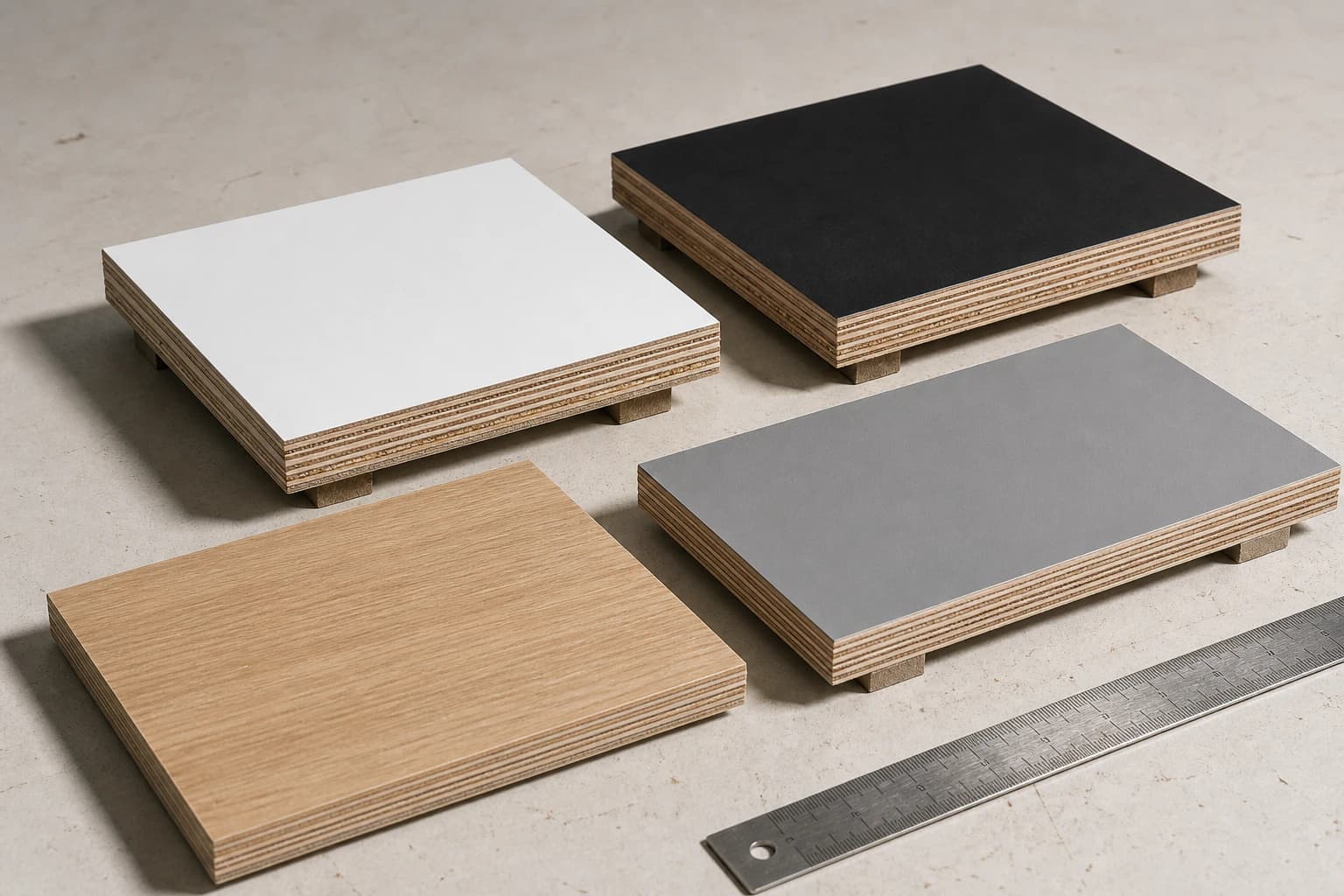
Specify the decor code, texture, sheen and face arrangement so repeat orders match the selected sample.
White, black, solid-colour and woodgrain surfaces are selected by paper supplier code or physical master, then paired with the required smooth, matt or wood-pore texture and sheen. The quotation identifies the decorative paper, texture, face arrangement and balancing back so the finished panel can be matched on repeat orders.
Melamine faced plywood uses resin-impregnated decorative paper pressed directly to a prepared plywood face under heat and pressure. The resulting thin decorative surface follows the calibration and smoothness of the plywood beneath it. HPL uses a separately manufactured laminate bonded to the substrate, while MUF refers to an adhesive chemistry used within a panel build.
Each material term describes a different part of the finished panel and helps buyers compare like-for-like constructions.
Direct decorative paper and texture option for interior panel faces.
An available adhesive chemistry within the specified panel construction.
A separately manufactured high-pressure laminate supplied through the HPL plywood option.
Specified through the matching substrate, bond, veneer and project-document requirements.
Specify the face, back, core, bond and press cycle as one cross-section.
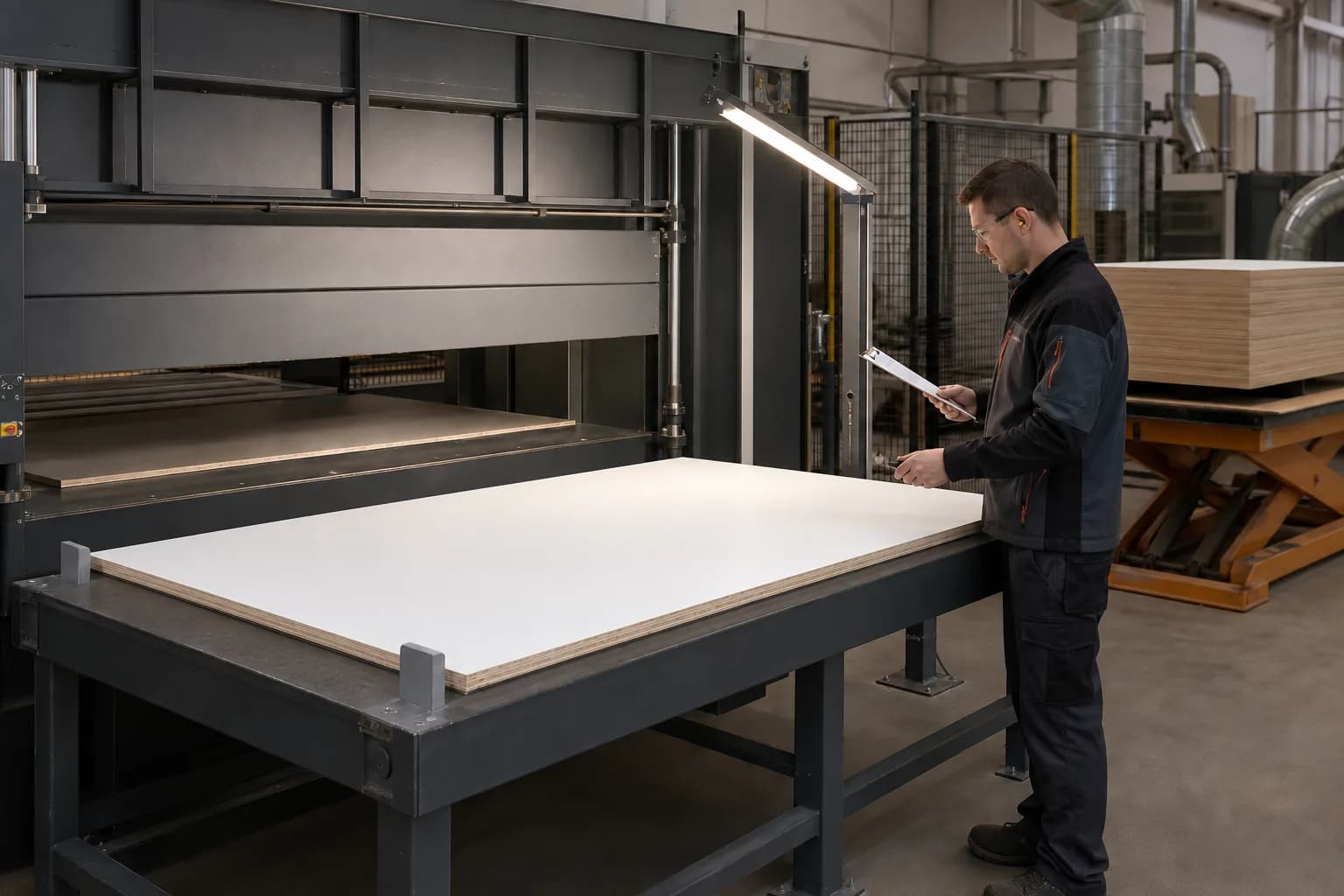
A smooth melamine face reveals the quality of the calibrated plywood beneath it. Core species, veneer lay-up, gap limits, bond, density, 8–12% moisture, sanding and press cycle are selected together for the intended cutting, drilling, hardware and edge finish.
For double-sided panels, compatible papers, resin loading, press cycle and plywood symmetry control face stress, bow and twist. Single-sided panels use a balancing back suited to the component size, humidity and support condition. Finished thickness, flatness and surface appearance are checked after conditioning.
Decor, texture, sheen and face arrangement
State the paper supplier code or sample, the texture reference and the balancing back.Substrate, bond, moisture and calibration
Specify the complete panel cross-section with the selected decor and 8–12% cabinet-grade moisture.Cutting, drilling, hardware and edge finish
Confirm these details on a machined sample made with the selected panel construction.Humidity, cleaning and finished-component duty
Match the decorative face, plywood bond, edge treatment and service condition in one order specification.Use a clean white direct melamine face when cost, repeatable basic finish and an uncomplicated interior fabrication option matter most.
Use a balanced double-sided construction when cabinet flatness, machining, edge banding and repeatable decor matching control the buying decision.
Use the precision option when texture identity, colour continuity, tight calibration and CNC or visible-edge workmanship must remain consistent across the project lot.
Start with the six buying essentials, then use the detailed schedule to align the complete order.
White, black, solid colour or woodgrain; smooth, matt or wood-pore texture.
Single-sided with a balancing back, or coordinated double-sided construction.
Poplar, combi, hardwood or birch-based plywood selected for weight, machining and visible edges.
9–25 mm standard cabinet range; project constructions from 3–30 mm.
8–12% moisture target with finished thickness, flatness and squareness stated.
Sawing, CNC, drilling, hardware and edge treatment matched to the component drawing.
| Decision field | Utility White | Balanced Cabinet | Textured Precision |
|---|---|---|---|
| Product definition | Utility white direct-faced plywood | Balanced cabinet melamine plywood | Textured precision melamine plywood |
| Intended interior use | Shelves, backs and utility fixtures | Cabinets, furniture and interior panels | Visible joinery and precision components |
| Decorative paper / surface reference | Utility white paper family | CUZI PLY paper and resin option | CUZI PLY code, batch and resin pickup |
| Melamine surface-system description | Direct paper pressed to prepared plywood | Controlled paper, plate and press cycle | Specified paper, plate and press window |
| Decor / colour code | Utility white master | Named solid or woodgrain code | Signed code and colour tolerance |
| Colour-family option | Standard solid colours | Selected solids and common woodgrains | Matched project decor by sample |
| Texture / gloss option | Smooth utility sheen | Smooth, matt or selected wood pore | Defined texture and gloss tolerance |
| Approved surface sample | A4 face sample | Colour-and-texture board sample | Signed master and retained sample |
| Single-sided / double-sided configuration | Named backer or double-side white | Matched or coordinated double faces | Matched faces; asymmetric build trialled |
| Reverse face / balancing layer | Compatible named backer | Balanced face/back paper and cycle | Reverse build selected for stability |
| Face matching / direction requirement | Direction only when ordered | Direction recorded on cutting file | Decor sequence and replacement matching confirmed |
| Plywood substrate species | Poplar or selected combi | Poplar, eucalyptus or hardwood/combi | Selected hardwood, eucalyptus or birch |
| Substrate core construction | Balanced utility lay-up | Balanced cabinet multi-ply | Veneer groups selected for machining and visible edges |
| Lay-up / ply schedule | Recorded by thickness | Stated count and symmetry | Lot-specific veneer schedule |
| Core gap / overlap / repair scope | Utility acceptance sample | Closed-core fabrication limits | Mapped machining-edge defects |
| Substrate face veneer reference | Sanded, filled plywood face | Selected calibrated face | Tight face grade and defect map |
| Substrate sanding / calibration | Utility pre-press calibration | Lot-controlled two-face calibration | First-article thickness mapping |
| Bond / exposure requirements | Interior or defined humid bond | Bond selected separately from decor | Substrate- and destination-specific test methods |
| Substrate emission requirements | Buyer-specified option on request | Destination-specific substrate documents | Documented substrate production processes |
| Finished-panel emission requirements | Order-specific option for the finished construction | Applicable EN, EPA or buyer requirements | Exact finished construction documented or tested |
| Surface abrasion evaluation option | EN 14323 wear method available with the cycle endpoint stated for utility cleaning duty | Named wear method, cycle count and visual endpoint stated with the selected decor | Exact specimen, method, cycles and endpoint matched to the required service duty |
| Scratch / mar evaluation option | Sample comparison with the contact method and visible-mark limit stated | Named stylus or load method with visual and gloss acceptance | Instrument, load, stroke, observation conditions and acceptance limit stated together |
| Stain / cleanability evaluation | Cleaning agents, dwell time and wipe procedure stated for the intended interior use | Agent, concentration, dwell time, temperature and cleaning cycles recorded | Project chemicals, exposure sequence and colour or gloss acceptance stated |
| Surface cracking / impact scope | Impact method, contact object and visible-damage limit agreed by sample | Drop height or impact energy and accepted dent, crack or delamination stated | Exact face/substrate specimen, impact method and finished-part acceptance stated |
| Heat / steam / moisture scope | Dry-heat or damp-cleaning temperature, contact time and edge condition stated | Dry and wet heat exposure, duration, support and edge condition stated | Project exposure cycle, repetition, recovery time and appearance limit stated |
| Edge-water / wet-use scope | Protected interior edges with the selected seal or band | Banding material, adhesive, exposed-edge finish and cleaning duty stated | Humidity or splash duty matched to the plywood bond, balance, sealed cuts and joint design |
| Standard formats | 1220×2440 mm | 1220×2440; 1250×2500 mm | 1220×2440; 1250×2500 mm |
| Project / oversize formats | Standard formats preferred | 1525×3050 mm available after paper, press, balance and packing confirmation | 1525×3050; 1220×3800; 2100×2800 mm available after construction, press, flatness, handling and transport confirmation |
| Thickness range | 9, 12, 15, 18 mm | 9, 12, 15, 18, 21, 25 mm | Project 3–30 mm by construction and quantity |
| Finished thickness tolerance | About ±0.5 mm | About ±0.3–0.5 mm | About ±0.2–0.3 mm for the confirmed thickness and construction |
| Length / width tolerance | +0 / −2 mm | +0 / −1.5 mm | Project tolerance stated with the cutting and measurement method |
| Squareness / edge straightness | ≤1 mm/m target | ≤1 mm/m measured | Agreed method and limit |
| Flatness / warpage acceptance | Conditioned full-support check with the permitted bow and twist stated | Double-face panel bow and twist measured after conditioning | Parent-panel and machined-component flatness limits stated for the project |
| Moisture target | 8–12% | 8–12% | 8–12%, with a narrower project range available when required |
| Density range | About 450–550 kg/m³ for the selected poplar or light-combi construction | About 520–650 kg/m³ for the selected cabinet-grade combi or hardwood construction | About 600–720 kg/m³ for the selected hardwood or birch-based precision construction |
| Actual sheet-weight confirmation | Calculated from the quoted size, thickness and density | Reference sheet weighed for handling and container planning | Parent panel and machined component weights recorded for hardware, handling and payload |
| Cutting / CNC option | Straight cutting to the confirmed drawing | CNC programme matched to the selected cutter, support and finished tolerance | First component records tool, feed, edge finish, finished dimensions and tool-life check |
| Drilling option | Pilot-hole diameter, depth and hardware stated | Confirmat, dowel and hinge boring checked on the selected panel | Hardware, hole position, edge distance, breakout and assembly fit recorded |
| Edge-banding option | PVC/ABS with compatible adhesive | ABS, PVC, veneer; EVA/PUR option | Specified edge, primer, adhesive and master |
| Exposed plywood-edge option | Sanded or sealed edge | Clear, stained, painted or banded | Visible-ply sample or matched band |
| Cut-to-size / nesting option | Straight parts after drawing | Nest, tool trial and identification | Approved nest, datum and replacement control |
| Part labelling / grain-direction option | Basic pack mark | Identity and direction recorded | Sequence and matched-set packing |
| First-article sample | Recommended before series production | Machined cabinet component matched to the drawing and edge finish | Signed first component retained as the production reference |
| Batch inspection plan | Contamination and press-mark check | Lot surface, dimension, flatness and edge | Mapped measurement and acceptance method |
| Decor-lot / colour-change control | One decor lot preferred | Master compared during inspection | Method, plate and replacement rule |
| Packaging and face protection | Interleaf and protected corners | Aligned bearers and parallel straps | Non-marking, lot-separated handling plan |
| MOQ by decor / thickness | 100–300 sheets per SKU | SKU mix or container programme | Project decor/texture/tooling lot |
| Loading quantity / payload calculation | Actual density, thickness and pack | SKU-mix payload plan | Oversize opening, payload and support model |
| Lead time | 25–35 days after order confirmation | 30–45 days after decor and construction sample confirmation | 40–60 days after decor, texture, construction and first-component confirmation |
| Target markets / documents / quotation / lot identity | Destination stated; required documents listed; USD/m³ quotation; lot identification | Destination requirements, product documents, machining scope and repeat-order reference stated | Project documents, tooling sample, decor master and replacement matching stated |
The first machined part tests the plywood edge, calibration and banding process together.
CNC routing, boring and hardware move the decision from face appearance to calibration and edge integrity. Submit drawings, holes, tooling, visible-edge needs and banding inputs for a first article.
The fabricator selects band, radius and adhesive. Plywood edge quality, thickness variation and surface cleanliness determine whether that process repeats consistently.
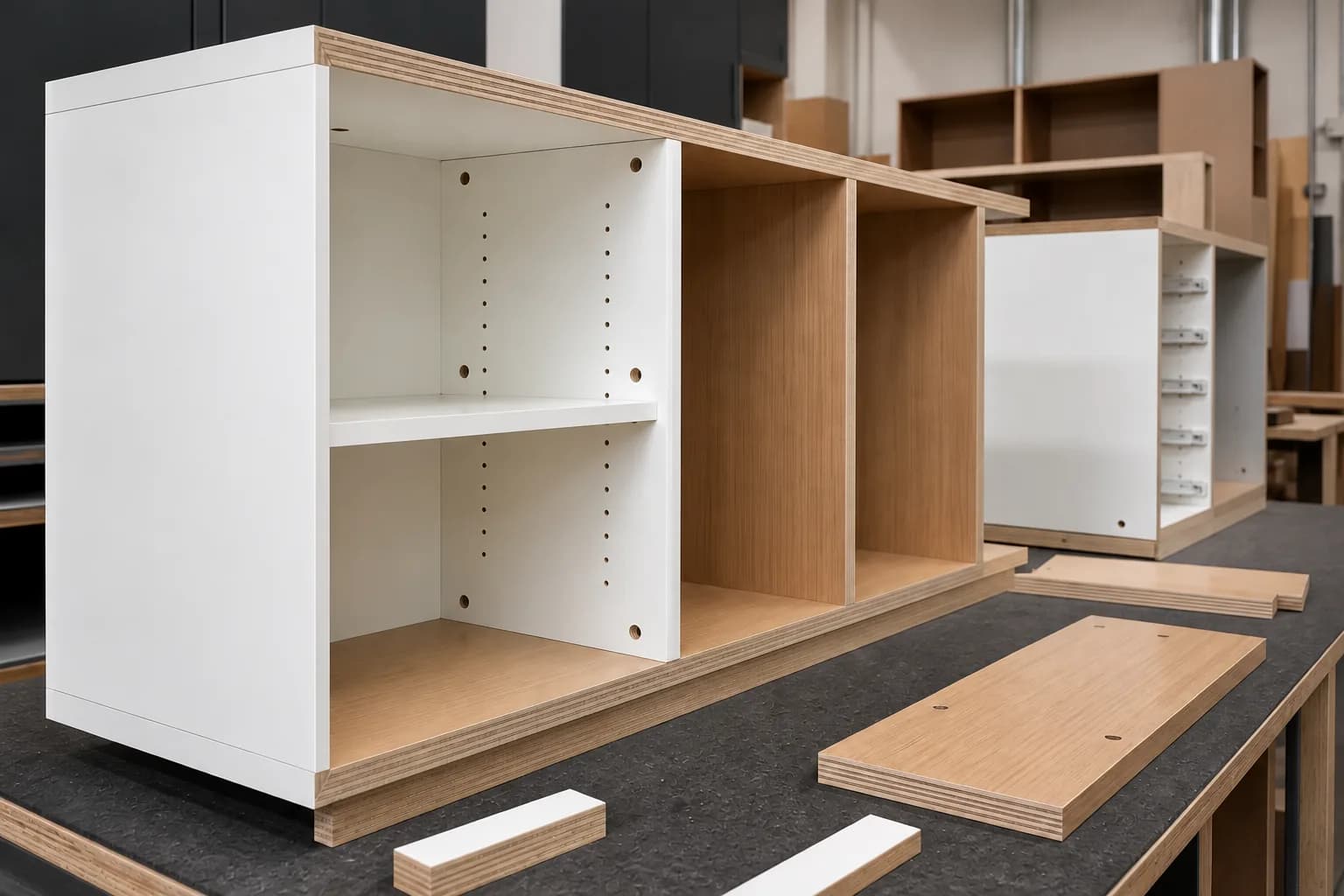
Keep the decor, texture, sheen and visual comparison sample for repeat orders.
Condition and measure the complete face/back construction.
Check saw, CNC, drilling and edge-banding results.
Reconfirm the sample after changes to paper, core, bond, calibration or press cycle.
Select the substrate, bond and edge treatment for the actual indoor humidity and service conditions.
Cabinet, furniture and interior joinery applications use a balanced plywood substrate, selected bond, direct melamine surface and compatible machining and edge-banding option.
Marine, exterior cladding and structural projects are supplied through their corresponding substrate, bond, veneer, treatment and project-document requirements.
Buyer-agreed surface test methods are applied to the exact melamine-faced plywood construction and approved specimen.
Bond testing applies to the defined plywood substrate and service requirements; decor is controlled by the approved surface master.
Dimensions and plywood-use classification are matched to the exact construction and destination.
Finished-panel emission requirements selected for the applicable EU use and legal scope.
Applicable hardwood plywood construction is supplied with the confirmed certification, labelling and recordkeeping option for US orders.
Sourcing claims are supplied when the ordered material and relevant supply-chain links are within valid scope.
Species, harvest country, legality due diligence, biosecurity and project requirements are reviewed for the shipment.
Utility white construction with a value-led plywood core, standard calibration and export packing.
Balanced cabinet construction with selected decor, calibrated core, two-face options and machining sample.
Textured precision construction with matched decor, controlled plate texture, tighter calibration and CNC preparation.
Compare the three ranges on the same 1220×2440×18 mm reference. Final pricing follows the decor paper, texture, plywood substrate, side arrangement, calibration, machining, edge system, quantity, packing and delivery terms.
Quotation variables: Decor paper, texture plate, resin option, core, lay-up, bond, calibration, side arrangement, size, thickness, machining, edge system, documents, pack, payload and order volume.
Reference constructionDirect melamine-faced plywood, reference 1220×2440×18 mm
Main price variablesDecor, plywood build, face arrangement, machining and order volume
Price reference date2026-08-21
Before the purchase order
Melamine plywood is a cross-laminated plywood panel faced directly with melamine-resin decorative paper. A complete specification includes decor code, texture, sheen, single- or double-sided construction, balancing back, plywood core, bond, moisture, calibration and fabrication method.
The surface may look similar, but this substrate uses cross-laminated plywood veneers rather than a homogeneous fibre or particle core.
Melamine paper is pressed directly to the substrate. HPL is a separately manufactured laminate with its own thickness and performance requirements.
Yes. Name the backer for a single face, or record both papers and the press cycle for a double-sided build.
A compatible reverse build helps manage face stresses, bow and twist. Confirm it on the conditioned plywood construction.
State the intended cleaning or service duty first. The quotation can then identify the test method, exact finished-panel specimen, wear cycles and endpoint, scratch load and visual limit, staining agents and dwell time, cleaning cycles, dry or wet heat temperature and contact time, edge condition, light exposure and the permitted colour or gloss change. Results apply to the selected decor, texture, plywood construction and conditioning option.
Yes, when substrate, calibration, machining, hardware, banding and edge expectations are matched to the part and first article.
It is commonly used for cabinet carcasses, wardrobes, shelving, retail fixtures, furniture and interior wall panels. Humid interiors use a suitable plywood bond, balanced construction and sealed or edge-banded cuts; roofing, structural and exterior work use the corresponding specialist plywood product.
Yes. Cabinet and precision grades are calibrated for saw or CNC cutting, confirmat or dowel drilling and ABS, PVC or veneer edge banding. Provide the drawing, grain direction, tooling, hole pattern, band thickness and EVA or PUR adhesive, then approve the first machined component before series production.
Applicable EN or buyer methods, EPA scope, transaction-specific FSC or PEFC chains and importer documents can be available for the exact construction.
State the decor or sample, complete plywood build, size and tolerance, machining and edge requirements, destination documents, quantity, packing and target date.
Plywood enquiry
Provide decor/colour reference, texture, sheen, single- or double-sided build, balancing back, plywood core and lay-up, bond/exposure requirements, emission requirements, size, thickness and tolerance, machining drawing, drilling/hardware, edge-banding system, visible-edge expectation, quantity, pack, destination, documents and target date. Our team can recommend the suitable Incoterm.
CHAT WITH CUZI PLY↗