CUZIPLYFactory-direct plywood
Get a quote
EXTERIOR PLYWOOD / APPLICATION GUIDEMARINE CRAFT · WET AREAS · EXTERIOR JOINERY · LANDSCAPE

Choose Plywood by Marine, Wet-Service and Exterior Exposure

CUZI PLY helps buyers specify plywood for marine craft interiors, wet-area cabinetry, exterior joinery, screens, soffits, planters and other weather-exposed components. Start with the water source, wetting duration, drying path and component geometry, then select the panel construction, bond specifications, thickness, dimensions, moisture target, edge protection, coating, fasteners and export packing. Marine, Structural, Pressure-Treated and T1-11 options can be coordinated with cut-to-size machining, sealed factory edges and the documents required for the destination market.

  • Marine craft, wet-area joinery, exterior components and planters
  • 3–30 mm production range
  • 1220 × 2440 mm, 1250 × 2500 mm and project sizes
  • 8–12% typical shipment moisture target
Applications
Marine craft, wet areas, exterior joinery and landscape components
Panel options
Marine, Structural, Pressure-Treated and T1-11
Specify together
Panel, water path, edges, finish, fasteners and maintenance
Quotation input
Drawing, exposure, dimensions, finish, quantity and destination
EXPOSURE ENVELOPE MAP

Match the plywood and protection system to the way each component gets wet and dries.

Compare water source, wetting duration, drying path, UV, temperature and maintenance access for each application.

Sheltered humidity / condensation

Source
Humid air, condensation and intermittent surface moisture
Wetting
Short unless a cavity traps vapour
Drying
Air circulation and inspection access
UV / temperature
Low UV; temperature cycling drives condensation
Risk
Concealed corrosion and fungal growth
Product option
Marine or exterior-condition plywood matched to the component duty
Protection
Ventilated cavity, capillary break and protected edges
Responsible party
Component designer and installer

Intermittent wetting / washdown

Source
Cleaning water, spray and spills
Wetting
Repeated short events controlled by drainage
Drying
Slopes, outlets and open drying faces
UV / temperature
Warm service and cleaners can wear coatings
Risk
Corroded fasteners, open holes and wet joints
Product option
Marine Plywood or a qualified exterior option
Protection
Compatible coating, sealed cuts and drain path
Responsible party
Specifier, fabricator and operator

Direct exterior weather above ground

Source
Rain, wind-driven rain, UV and temperature cycles
Wetting
Weather and season dependent
Drying
Shedding faces and open cavities
UV / temperature
Direct UV and thermal movement
Risk
Coating wear, edge wetting and moving interfaces
Product option
Marine, Structural or T1-11 by component duty
Protection
Drips, flashings, ventilated backing and access
Responsible party
Envelope designer and installer

Splash / spray exposure without assumed immersion

Source
Salt, wave or process spray
Wetting
Frequent wetting without permanent submersion
Drying
Salt and enclosed joints slow drying
UV / temperature
Combined UV, salt and temperature
Risk
Corrosion, coating undercut and wet fasteners
Product option
Marine Plywood; other options only when specified
Protection
Drainage, compatible fasteners and sealed penetrations
Responsible party
Marine designer, fabricator and operator

Marine craft and waterway service

Source
Fresh or salt water, spray and condensation
Wetting
Set by component location and vessel duty
Drying
Lockers need deliberate airflow
UV / temperature
Deck, hull and interior conditions differ
Risk
Moving joints, concealed decay and coating damage
Product option
Marine Plywood under vessel-specific design
Protection
Coating or laminate, supported joints, drainage and log
Responsible party
Vessel designer, builder and responsible party

Soil proximity / near-ground biological exposure

Source
Rain splash, irrigation, soil vapour and debris
Wetting
Prolonged where soil or liners retain water
Drying
Raise, drain and ventilate the component
UV / temperature
UV plus near-ground moisture cycles
Risk
Biological attack, liner damage and corrosion
Product option
Pressure-Treated or project-qualified exterior option
Protection
Soil isolation, liner, raised base and outlets
Responsible party
Landscape designer, fabricator and maintenance responsible party
MATERIAL IN SERVICE

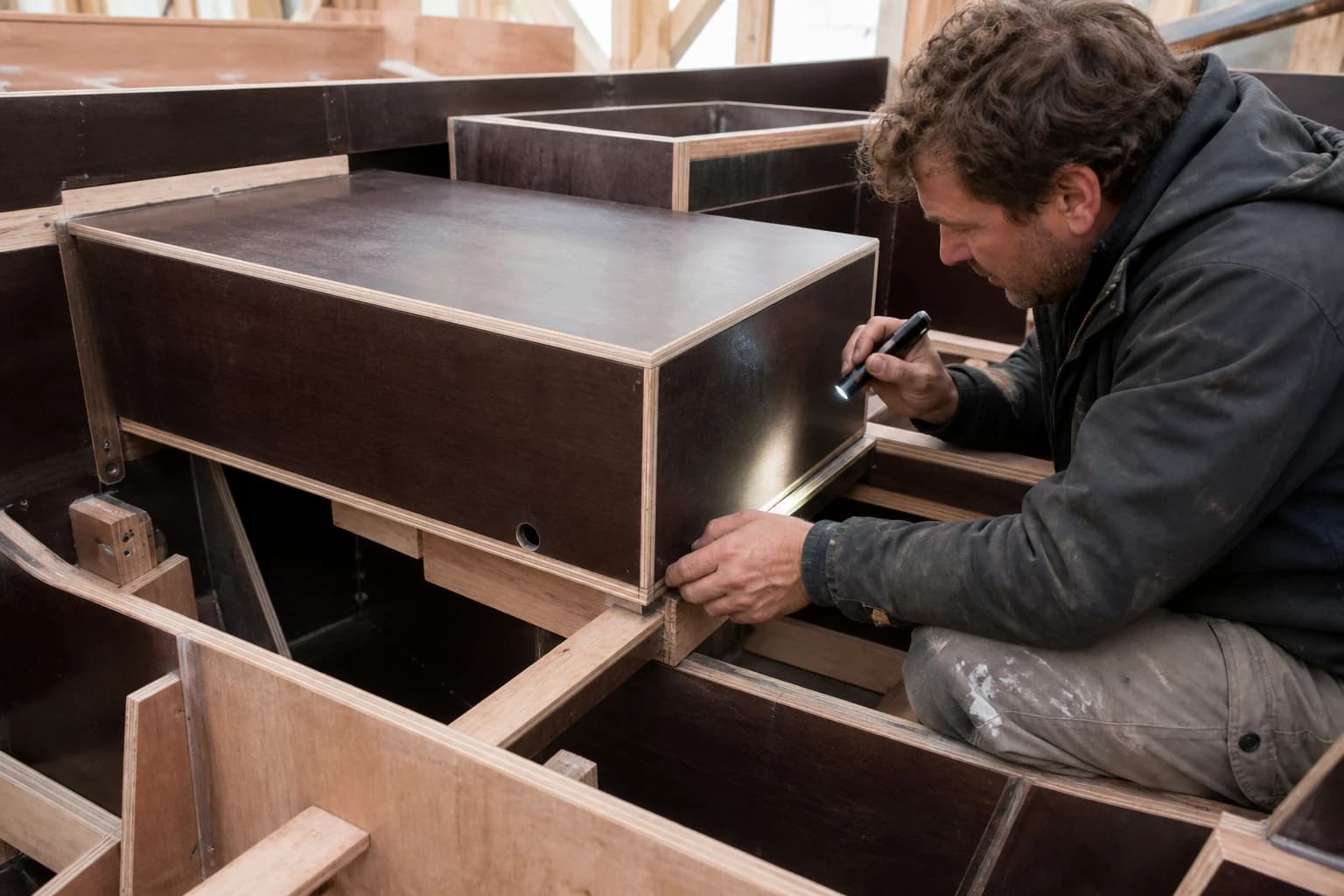
A wet-service component needs supported joints, sealed edges and a visible exit for water.

Worker inspecting a supported coated plywood locker component, sealed edges and drainage opening inside an unfinished utility workboat
Marine plywood in useThe supported locker module keeps component geometry, drainage, coatings and vessel requirements visible inside the unfinished workboat.
APPLICATION + WATER-PATH MATRIX

Compare exterior plywood applications by water path, drying conditions and component duty.

Marine and exterior application water-path matrix
ApplicationWater pathDrying opportunityPrincipal riskLikely panel constructionSystem requirementResponsible party
Marine craft hull/deck components under vessel-specific designSpray, runoff and condensation follow penetrations and bilge paths.Slopes, limber holes, ventilation and access.Standing water at unsupported joints or holes.Marine Plywood under the nominated vessel and product options.Supported seams, compatible finish, sealed cuts and drainage.Vessel designer and boatbuilder
Boat interiors, cabinetry and wet lockersWet gear, washdown and condensation collect at bases and hardware.Vent slots and removable bases allow drainage and air.Concealed wet edges, corroded hardware and trapped coatings.Marine Plywood; appearance grade specified separately.Raised bottom, drain, sealed holes and cleaning access.Interior designer, fabricator and vessel responsible party
Marina or dock components above the permanent-immersion zoneSplash, rain and runoff reach parts above normal water level.Open undersides, drips and gaps permit drying.Confusing splash with immersion or ignoring salt corrosion.Marine, Pressure-Treated or Structural matched to the component duty.Engineered support, corrosion option and replaceable wear edges.Marine civil designer and operator
Exterior joinery, screens, soffits and protected cladding componentsRain reaches faces, ends, joints and fixings.Back ventilation, flashings and drips clear moisture.Unventilated backs, wet end grain and incompatible coatings.Marine, Structural or T1-11 by assembly duty.Movement joints, cavity, protected tops and coating inspection.Envelope designer and installer
Outdoor flower boxes, planters and trellisesIrrigation, rain and soil moisture load liners and outlets.Liner, drain layer, low outlet, air gap and raised base.Bare plywood against soil, liner puncture or blocked drainage.Pressure-Treated or project-qualified exterior construction.Soil isolation, sealed cuts, ventilation and maintenance access.Landscape designer, fabricator and maintenance responsible party
Outdoor playground, climbing-wall and sports-equipment componentsRain and cleaning reach faces, cutouts and hardware.Open backs, drained bases and inspectable connections.Panel choice without structural, fall or user-safety design.Structural, Marine or Pressure-Treated under project specification.Engineered supports, protected holes and inspection regime.Qualified equipment designer and operator
Wet-area furniture, utility cabinets and washdown componentsJets, spills and floor water concentrate at bases and seams.Raised plinths, sloped shelves and open cavities.Water held against edges, feet or sealed backs.Marine or exterior-condition option matched to finish.Washable coating, sealed holes, drip clearance and replaceable bases.Facility specifier, fabricator and cleaning responsible party
Weather-exposed project components with a defined coating and maintenance fileWeather follows orientation, top edges, joints and interfaces.Slopes, ventilated gaps and accessible surfaces.Assuming a product label replaces detailing and maintenance.Structural, marine, treated or siding option by duty.Specified coating, edge system, inspection and replacement criteria.Project designer, coating specifier and asset responsible party
PRODUCT OPTIONS

Choose the panel construction that matches the finished component.

MATERIAL IN SERVICE

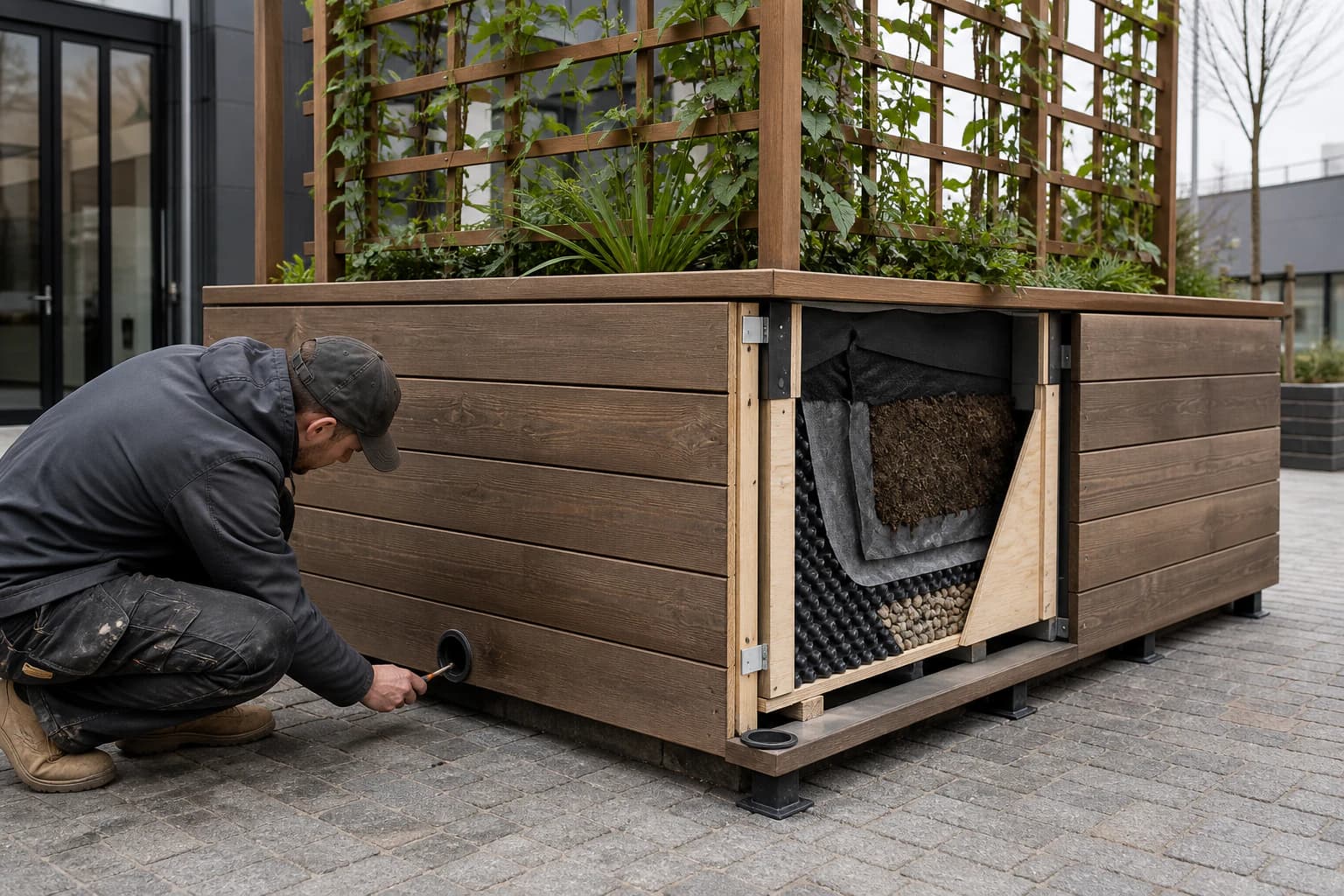
A planter keeps soil, retained water and bare plywood in separate layers.

Installer checking a raised outdoor planter with soil-isolating liner, drainage mat, gravel outlet and ventilated cladding cavity
Marine plywood in useThe raised-planter cutaway coordinates the liner, drain layer, low outlet, ventilation gap and maintenance access.
COMPONENT SYSTEM

Build the exterior component from panel selection through drainage and maintenance.

Panel product options

State construction, thickness, dimensions, moisture target and requested documents.

Panel supplier and specifier

Support, joint and movement detail

Provide bearing, joint access and movement allowance.

Designer and fabricator

Edge support and component geometry

Slope surfaces and support loaded or exposed edges.

Designer

Fastener material and corrosion option

Match metal and coating to exposure and connection.

Designer and installer

Factory edge, site cut and drilled-hole protection

Separate factory edges from new cuts, holes and damage.

CUZI PLY, fabricator and installer

Face coating, overlay, liner or fibreglass system

Confirm adhesion, cure, movement and repair compatibility.

Finish-system responsible party

Drainage, ventilation, cavity and drip path

Keep downhill water and drying-air paths open.

System designer and installer

Inspection, maintenance and replacement responsibility

Set inspection intervals, repair triggers and replacement responsibility for the finished component.

Asset responsible party
EDGE PROTECTION WORKFLOW

Protect every factory edge, site cut, drilled hole and damaged corner.

The order defines the original factory edge system; fabrication and installation use a compatible preparation, coating and cure procedure for new cuts and penetrations.

  1. 01

    Define scope

    Record sheets, machined parts and factory/site edge responsibility.

  2. 02

    Confirm compatibility

    Check panel, primer, finish, adhesive, overlay, liner or fibreglass as one build.

  3. 03

    Prepare at factory

    Complete sizing, chamfering, sanding and cleaning without loose fibres.

  4. 04

    Apply factory edge system

    Provide ordered waterproof edge-sealing paint or compatible treatment.

  5. 05

    Record application

    State the system, colour, covered edges, coverage and cure condition.

  6. 06

    Protect in transit

    Keep straps off finished edges; prevent impact, water and trapped moisture.

  7. 07

    Store dry and supported

    Keep sheets flat, off ground, continuously supported and ventilated.

  8. 08

    Prepare new site cuts

    Dry and clean exposed veneers; remove loose fibres.

  9. 09

    Reseal site work

    Coat every site-cut edge, hole and damaged corner with the compatible system.

  10. 10

    Final inspection

    Check continuity, cure, fasteners, drainage and damage before service.

MATERIAL IN SERVICE

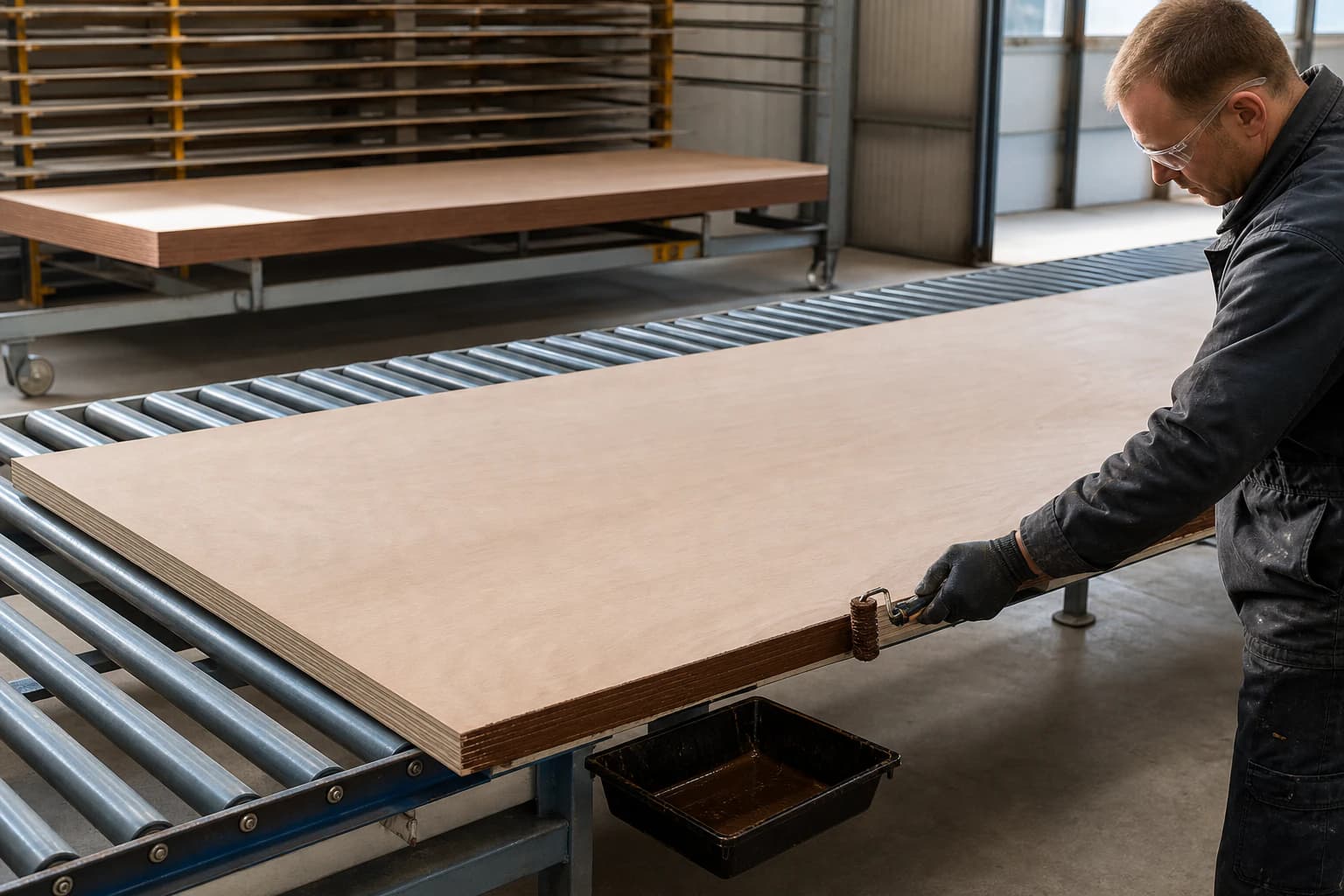
Factory edge-sealing paint belongs on the prepared edge, with the panel fully supported.

Factory operator applying a thin continuous waterproof edge-sealing coating to a plywood sheet fully supported on a level roller table
Marine plywood in useThe factory application keeps paint system, covered edges, application requirement, cure and inspection attached to the purchase order.
INSTALLATION DETAILS

Coordinate supports, movement, fasteners, coatings, drainage and ventilation.

Marine and exterior installation details
InterfaceRequired detailCommon issueProject check
Supports and jointsSupport loaded edges and keep service joints accessible.Unsupported seams, hidden end grain, inaccessible sealant.Drawing and first article
Movement gaps and interfacesAllow movement at sheets, frames, finishes and dissimilar materials.Tight joints that trap water or buckle.Fabrication and installation record
Fastener type / corrosion compatibilityMatch metal and coating to salt, treatment and moisture.Galvanic pairs, staining, pull-through or open holes.Fastener schedule and lot
Cut edges, holes and penetrationsPrepare and reseal every exposed veneer.Bare end grain, missed hole walls or dusty coating.Site-cut register and cure
Drainage and drip pathMaintain downhill options, outlets and drips.Blind cavities, blocked drains and inward slopes.Water-path check
Ventilation and drying cavityKeep an air path behind liners, cladding and lockers.Sealed voids or blocked airflow.Inspect before closure
Coating / liner / overlay compatibilityApprove adhesion, cure, balance and repair on the exact panel.Solvent attack, puncture, undercut or unbalanced faces.Approved sample and data
Soil, metal, concrete, fibreglass and dissimilar-material interfacesUse isolation, compatible sealants and maintainable transitions.Soil contact, alkaline moisture, galvanic corrosion or rigid cracks.Interface schedule and access
STANDARDS + DESTINATION REQUIREMENTS

Match the plywood standard and supporting documents to the destination and application.

Source record 01

BS 1088:2018

Marine plywood product requirements

Publisher
BSI
Status
Current · Available on request
Product scope
Defines the nominated marine-plywood product options for the specified panel.
Coordinate with
Coordinate with vessel design, service exposure, coating, joints and installation.
Official source
Source record 02

AS/NZS 2272:2006 (Reconfirmed 2016)

Marine plywood manufacture, grading and finishing

Publisher
Standards Australia / Standards New Zealand
Status
Current; reconfirmed 2016 · Available on request
Product scope
Provides the nominated Australia/New Zealand marine-plywood option.
Coordinate with
Coordinate with component design, installation, treatment and finish.
Official source
Source record 03

BS EN 636:2012+A1:2015

Plywood specifications for dry, humid and exterior conditions

Publisher
BSI
Status
Current · Project-specific
Product scope
Provides service-condition language for the selected plywood.
Coordinate with
Coordinate with wetting duration, drying, edge protection, finish and maintenance.
Official source
Source record 04

BS EN 314-1:2004

Plywood bonding-quality test methods

Publisher
BSI
Status
Current; Under Review · Available on request
Product scope
Provides test methods for the nominated bond specifications.
Coordinate with
Use with the required bond class, product construction and batch documents.
Official source
Source record 05

BS EN 314-2:1993

Plywood bonding-quality requirements

Publisher
BSI
Status
Current · Available on request
Product scope
Provides bond requirements by end-use requirements.
Coordinate with
Coordinate with coating, drainage, treatment and component design.
Official source
Source record 06

BS EN 13986:2004+A1:2015

Construction-panel characteristics, conformity and marking

Publisher
BSI
Status
Current; Under Review · Project-specific
Product scope
Supports construction characteristics, conformity and marking where the project requires them.
Coordinate with
Confirm the product, intended construction use and destination requirements together.
Official source
Source record 07

BS EN 335:2013

Use classes for biological exposure

Publisher
BSI
Status
Current; Under Review · Project-specific
Product scope
Supports durability and preservative-treatment decisions by exposure class.
Coordinate with
Use with the selected species, treatment specification and component water path.
Official source
Source record 08

Destination and project specification

Coating, treatment, component, installation and maintenance requirements

Publisher
Project authority
Status
Project-specific · Project-specific
Product scope
Connects the panel documents to the finished component and destination requirements.
Coordinate with
Coordinate product, finish, installation, inspection and maintenance requirements in one specification.
Standards guidance
INSPECTION + MAINTENANCE

Plan inspection, recoating, repair and replacement from delivery onward.

Set the inspection frequency from the exposure, coating instructions, component design, project documents and observed condition.

  1. 01

    Delivery acceptance

    Check identity, dimensions, edges, pack moisture and transit damage.

    Purchaser / site receiver
  2. 02

    Dry-storage inspection

    Check flat support, ground clearance, ventilation and condensation.

    Site logistics responsible party
  3. 03

    Pre-installation condition

    Inspect faces, edges, flatness, moisture and compatibility documents.

    Fabricator / installer
  4. 04

    Post-cut / post-drill edge protection

    Record exposed veneers, cleaning, coverage and cure.

    Machining or site-cut responsible party
  5. 05

    Coating and cure check

    Confirm build, cure, adhesion sample and repair materials.

    Coating-system responsible party
  6. 06

    Installation / close-up inspection

    Confirm supports, joints, fasteners, drainage, ventilation and holes.

    Installer and project inspector
  7. 07

    Periodic service inspection

    Inspect water paths, outlets, coating, movement and corrosion.

    Asset maintenance responsible party
  8. 08

    Damage repair, recoating or replacement decision

    Dry and repair within the system, or replace an unserviceable substrate or connection.

    Asset responsible party and responsible designer
SITE PROBLEMS + CORRECTIVE ACTIONS

Use visible warning signs to protect edges, joints, drainage and coatings.

Waterproof or WBP label used as the whole brief

Construction, bond test records and water path stay undefined.

Issue product and system requirements.

Factory-treated edge is cut on site and left open

Fresh veneers fall outside factory protection.

Dry, clean, reseal and inspect the cut.

Water enters a drilled hole or fastener position

Hole walls or damaged coating remain exposed.

Seal penetrations and use the approved fixing detail.

Horizontal surface or joint retains water

Slope, drip or outlet is missing.

Correct geometry and prove downhill drainage.

Drain or ventilation cavity becomes blocked

Debris, soil or sealant closes the path.

Keep outlets accessible and inspect them.

Coating conflicts with panel, adhesive, liner or fibreglass

Separate materials were not qualified as one build.

Approve compatibility and repair sequence.

Fastener is unsuitable for salt or humid exposure

Metal or coating conflicts with exposure or treatment.

Define corrosion protection and isolate metals.

Planter or component touches soil or ground directly

Biological exposure exceeds the selected option.

Add isolation, raised support, drainage or treatment.

Wet panels are trapped in impermeable wrapping

Packaging holds moisture and prevents drying.

Ventilate, support flat and inspect before use.

Product, species, bond, size or coating changes

The existing documents no longer describe the supply.

Reconfirm samples, documents and interfaces.

Non-immersion option is used under permanent immersion

Exposure exceeds the specified application.

Perform separate immersion and biological qualification.

No responsible party for inspection, recoating or replacement

Damage and blocked paths remain unresolved.

Name inspection triggers, records and replacement responsibilities.
MATERIAL IN SERVICE

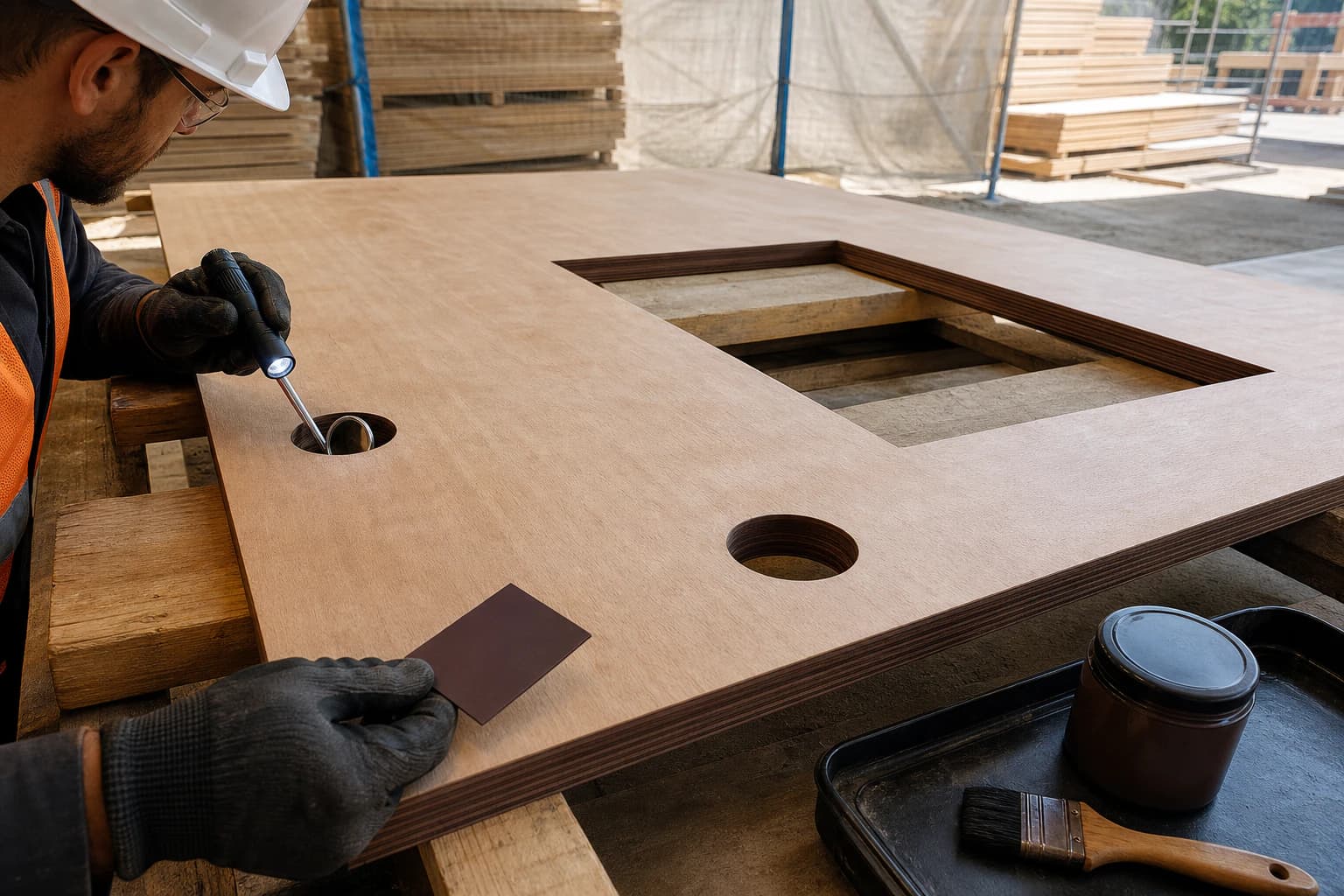
Every new cut and drilled penetration receives matching edge protection.

Site inspector using a mirror and flashlight to check sealed drilled holes and a protected service cut-out in supported exterior plywood
Marine plywood in useThe site inspection checks sealed cut-out and hole walls against the project preparation, coating compatibility, cure and acceptance requirements.
BUYER + INSTALLER QUESTIONS

Practical answers for marine, wet-service and exterior plywood applications.

DECISION QUESTIONS

Before the purchase order

Choose the right specification.

What is the difference between marine plywood and exterior plywood?

Marine plywood is a product options defined by a nominated standard, veneer/core controls, bond and supporting documentation. Exterior plywood describes application intent under rain, humidity, washdown or splash. The component may hand off to Marine, Structural, Pressure-Treated or T1-11, while support, joints, coating, edges, drainage, fasteners and maintenance remain system decisions.

How should WBP be used in an exterior plywood specification?

Treat WBP as a starting description of the bond specifications. A comparable quotation states the adhesive or bond class, panel construction, test methods and requested documents, then adds the edge, hole, joint, coating, drainage and ventilation details required by the finished component.

When should BS 1088, AS/NZS 2272 or EN 636 be specified?

Use BS 1088 or AS/NZS 2272 when the project names that marine-plywood option. EN 636 provides service-condition language for dry, humid or exterior plywood. Confirm edition, exact product, supporting documentation and any component, treatment, finish or installation requirements.

When is Pressure-Treated Plywood needed in an exterior system?

Choose a treatment programmes when biological exposure, near-ground service or a project use class requires it. Record chemistry, treatable species, penetration or retention supporting documentation, post-treatment dimensions and compatible fasteners and finishes. Structural or marine duties, drainage and coating remain part of the same component specification.

What option is suitable for permanent immersion?

Permanent immersion, marine borers and submerged joints require a separately qualified product and component system. The project authority defines the panel and treatment supporting documentation, coating or laminate, fasteners, inspection access and maintenance ownership for that submerged duty.

What is included in factory edge sealing?

The order can state preparation, compatible waterproof edge-sealing paint, colour, covered original edges, application or coverage requirement, cure and inspection. Site cuts, drilled holes, installation damage and joints use the matching repair procedure during fabrication and installation.

How should site-cut edges and drilled holes be resealed?

Dry the exposed veneers, remove dust and loose fibres, then coat the full cut edge and hole wall with the project-compatible waterproof edge-sealing system. Follow its coverage and cure procedure, and inspect continuity before fastening, concealment or service.

Can waterproof edge-sealing spray paint be specified?

Yes. State the compatible spray product, preparation, coverage, cure, PPE and inspection method. The spray protects prepared edges within the complete panel, joint, drainage and coating system, with factory and site responsibilities listed separately.

How should exterior or marine plywood be stored before installation?

Keep panels flat, off ground and continuously supported on aligned bearers. Protect faces, edges and corners from rain and impact while allowing ventilation. Avoid trapping wet panels under impermeable wrapping, and inspect delivered and opened packs before use.

What information belongs in a Marine & Exterior RFQ?

Send the component drawing, water source, wetting duration, drying path, structural or non-structural duty, preferred product and standard requirements, dimensions, machining, factory and site edge duties, finish, drainage, fasteners, treatment, requested documents, quantity, destination, packing and target date. We can then recommend the suitable shipping term and quotation basis.

MARINE + EXTERIOR RFQ

Send the component, exposure, dimensions and finish for a comparable quotation.

  1. Project / vessel / component type
  2. Intended component duty
  3. Drawing or specification reference
  4. Exposure pattern
  5. Fresh water / salt water / washdown condition
  6. Wetting duration and drying opportunity
  7. UV / temperature condition
  8. Soil, ground or permanent-immersion contact
  9. Structural or non-structural duty
  10. Responsible designer / authority
  11. Preferred product options
  12. Nominated standard / grade
  13. Face and back species / grade
  14. Core construction
  15. Adhesive / bond specifications
  16. Sheet size
  17. Thickness
  18. Tolerance / measurement method
  19. Cut-to-size / CNC / drilling requirement
  20. Factory edge-sealing option
  21. Site-cut / hole resealing responsibility
  22. Coating / liner / overlay / fibreglass system
  23. Drainage and ventilation detail
  24. Fastener / corrosion option
  25. Preservative-treatment requirement
  26. Inspection / test / document package
  27. Quantity and destination
  28. Packing, storage, delivery sequence and target date

Application: Marine & Exterior · Product option: confirmed from component duty · Shipping term: Recommended from destination and order details · Reply: [email protected]

Plywood enquiry

Tell us what you need.

Send the component, drawing, exposure and drying pattern, product and standard requirements, construction and dimensions, machining, edge responsibilities, coating or liner, drainage, fasteners, treatment, requested documents, quantity, destination, storage and target date. We will recommend a suitable quotation and shipping basis.

CHAT WITH CUZI PLY

By sending this request, you allow CUZI PLY to use the submitted details to respond. Read the Privacy Policy.