CUZIPLYFactory-direct plywood
Get a quote
ANTI-SLIP PLYWOODPATTERN · CORE · TEST CONDITION

Anti-Slip Plywood for Industrial Floors, Platforms and Vehicle Bodies

CUZI PLY manufactures anti-slip plywood for industrial floors, service platforms, vehicle bodies, staging, walkways and removable access panels. Choose a wire-mesh or hexa-pattern phenolic working face, a smooth or functional reverse, and a poplar, combi, hardwood or birch-led core with exterior bonding and sealed factory edges. Standard 1220×2440 and 1250×2500 mm formats are available in 9–27 mm, with 8–12% moisture for Standard Export and Premium constructions. Quotations state overlay weight, surface pattern, slip-test condition, abrasion endpoint, core density, dimensions, edge treatment, packing and the USD 320–900/m³ export price range.

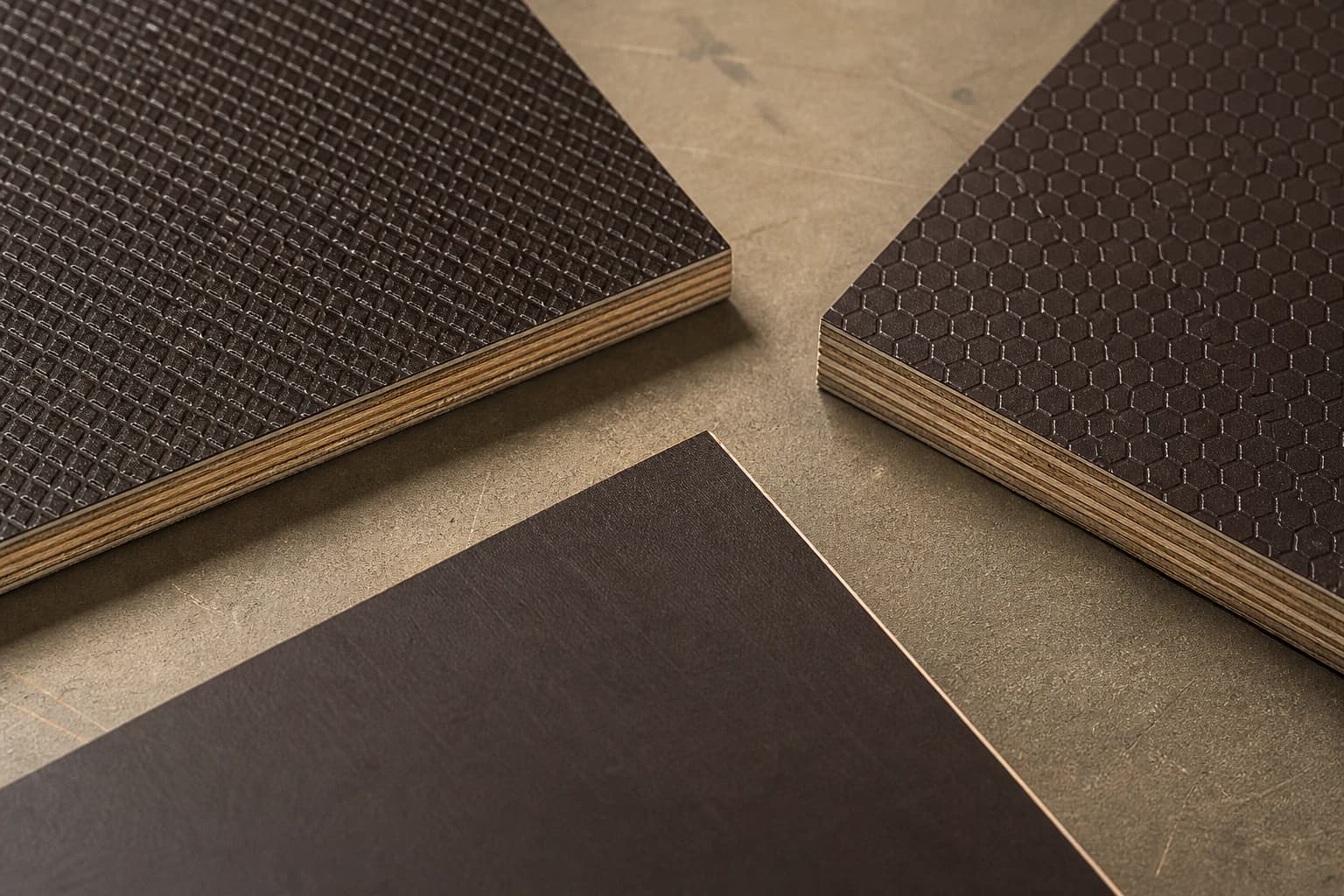
Anti-slip plywood samples with wire-mesh, hexagonal and smooth phenolic faces beside realistic cross-laminated edges
Anti-slip surface samplesThe surface and edge study shows the selected tread pattern, overlay, plywood construction and sealed edge beside the agreed product sample.
Surface
Pattern + overlay
Panel
Core + bond + edge
Duty
Support + exposure
Testing
Method + condition
Delivery
Size + pack + date
QUOTE THE COMPLETE PANEL

Match the tread surface to the panel construction and operating condition.

Surface
Wire mesh or hexa pattern
Panel
Core · bond · reverse · sealed edge
Standard range
9–27 mm · 8–12% moisture
Export price
USD 320–900/m³
DECISION QUESTIONS

Answer five decision questions before comparing anti-slip plywood.

  1. What traffic and surface conditions will the panel face?

    State pedestrian or equipment contact, footwear, dry or wet use, oil, grease, mud or dust, incline, drainage and cleaning frequency.

  2. Which working face and reverse-face construction is required?

    Select wire mesh or hexa against a physical pattern sample, then state overlay, colour and a smooth or functional reverse.

  3. Which panel construction supports the installed duty?

    Name core, lay-up, bond, thickness, size, factory edge treatment, site cuts or holes and the required resealing method.

  4. Which documents and tests must answer the buyer’s condition?

    Name the exact slip, wear or bond method, surface condition, conditioning, classification or threshold and the party responsible for the document.

  5. Which delivery inputs complete the quotation?

    State quantity, pack protection, handling, destination, required documents and target date.

A mesh or hex embossing is pressed into resin-impregnated paper over a cross-laminated plywood substrate. Core species, ply count, bond quality, overlay mass, reverse face, edge protection and dimensional control complete the specification and explain why visually similar sheets can differ in weight, machining and service performance.

Use this page to compare patterned panel constructions for fabrication. Film Faced Plywood covers smooth formwork faces, while Structural Plywood covers panels supplied with declared structural properties. Installed supports, fastening, loads, drainage and maintenance are then coordinated with the selected anti-slip panel.

Slip resistance is measured for a particular pattern, method and surface condition. Pattern geometry influences grip, drainage and cleanability, so the order identifies the proposed method, dry or contaminated condition and requested result together with the physical surface sample.

RECOMMENDED APPLICATIONS
  • A patterned phenolic surface is an explicit material requirement
  • The buyer can define support, exposure and cleaning conditions
  • Cut edges and drilled holes can be resealed after fabrication
  • Test documents can be matched to one exact construction
SPECIALIST PRODUCT OPTION
  • Smooth concrete-forming face controls the order
  • Declared structural design values control the panel
  • Marine-standard boatbuilding construction is required
  • The request is still an installed-use problem without a panel specification
SAMPLE FEATURES

Read surface, reverse and plywood edge as one material sample.

Wire mesh
Fine repeating tread reference
Hexa
Alternative contact geometry
Smooth reverse
Underside overlay option
Panel edge
Thin overlay over cross-laminated plywood
SURFACE SYSTEM SELECTOR

Select the tread pattern for the operating condition and cleaning method.

Wire mesh

Face / reverse
Patterned face / smooth reverse baseline
Overlay specification
Ordered face and reverse mass
Cleaning / contamination
Footwear, contamination, incline and cleaning
Test method
Named slip method when classification is required
Recommended use
Fine repeating tread for frequent foot contact and practical cleaning

Hexa

Face / reverse
Hexagonal face / smooth or functional reverse
Overlay specification
Pattern reference and press texture fixed
Cleaning / contamination
Contact geometry, drainage and cleaning method
Test method
Exact surface and condition tested
Recommended use
Defined contact geometry for selected industrial floor and vehicle uses

Smooth reverse

Face / reverse
Reverse-face option beneath the working surface
Overlay specification
Smooth phenolic film by ordered mass
Cleaning / contamination
Bonding, cleaning and underside exposure
Test method
Bond or emission requirement when required
Recommended use
Clean underside finish with ordered film weight and colour
THREE PRODUCT GRADES

Compare construction, surface performance and price on the same reference size.

Economy

Value-led combi or eucalyptus/poplar construction with a lighter patterned face and smooth reverse for controlled, supported industrial use.

Pattern / face / back
Brown patterned phenolic face / smooth brown film back; Wire mesh or established hex pattern
Core / lay-up
Poplar/eucalyptus or combi, destination-confirmed; Balanced cross-lay with controlled utility repairs
Bond / edge
Exterior phenolic option where ordered; Factory edge paint, colour agreed
Sizes
1220×2440 standard; 1250×2500 standard
Test documents
Bond and slip-test documents available when the buyer defines the method and requested result
Recommended use
Dry or managed-moisture supported decks where replacement interval and value are explicit
Export price range
USD 320–430/m³

Standard Export

POPULAR EXPORT CHOICE

Working baseline with selected hardwood/combi lay-up, heavier patterned phenolic face, smooth reverse, sealed edges and written lot inspection.

Pattern / face / back
Selected brown patterned phenolic face / smooth phenolic back; Wire mesh or hex pattern against approved reference
Core / lay-up
Selected combi, eucalyptus or hardwood; Balanced selected veneers; reduced overlaps and voids
Bond / edge
Exterior phenolic bond with lot identity; Moisture-resistant factory edge seal with coverage check
Sizes
1220×2440 standard; 1250×2500 standard; 1525×3050 by order
Test documents
EN 314-2 and EN 16165 options available on request for the exact construction
Recommended use
Recurring distributor, fabrication and industrial platform programs with controlled supports
Export price range
USD 450–620/m³

Professional / Premium

Selected hardwood or birch-led multi-ply construction with tight calibration, project pattern, enhanced inspection and documents matched to the installed duty.

Pattern / face / back
Project-selected patterned face / calibrated smooth or patterned reverse; Pattern, colour, texture depth and cleaning option approved together
Core / lay-up
Selected hardwood or birch-led multi-ply; Higher-ply-count balanced lay-up; tight internal continuity
Bond / edge
Project exterior bond with named test documents; Project-compatible edge system and documented coverage
Sizes
1220×2440 standard; 1250×2500 standard; 1525×3050 by order; 1220×3800 by order; 2100×2800 by order
Test documents
Project slip, wear, bond, emission and chain-of-custody documents as required
Recommended use
Demanding fabrication, access and platform programs where machining, wear and traceability are controlled
Export price range
USD 650–900/m³
COMPLETE SPECIFICATION

Compare all construction, dimension, testing and commercial fields.

Working face

Wire-mesh or hexa tread, colour, overlay mass and pattern sample.

Panel build

Poplar, combi, hardwood or birch-led core with exterior bond.

Standard range

1220×2440 or 1250×2500 mm, normally 9–27 mm.

Moisture

8–12% for Standard Export and Premium constructions.

Performance

Slip, abrasion and bond methods matched to the stated condition.

Commercial basis

USD 320–900/m³ with construction, quantity and packing stated.

Use the three schedules below to compare the same 27 fields across Economy, Standard Export and Professional / Premium options.

Complete specification comparison27 fields covering construction, dimensions, tests, packing and quotation terms.Show specificationsHide specifications

Surface & Panel Construction

FieldEconomyStandard ExportProfessional / Premium
Face / backBrown patterned phenolic face / smooth brown film backSelected brown patterned phenolic face / smooth phenolic backProject-selected patterned face / calibrated smooth or patterned reverse
Core speciesPoplar/eucalyptus or combi, destination-confirmedSelected combi, eucalyptus or hardwoodSelected hardwood or birch-led multi-ply
Core construction / lay-upBalanced cross-lay with controlled utility repairsBalanced selected veneers; reduced overlaps and voidsHigher-ply-count balanced lay-up; tight internal continuity
Glue / bondExterior phenolic option where orderedExterior phenolic bond with lot identityProject exterior bond with named test documents
Panel gradeIndustrial utility, covered defects controlledExport industrial with a selected face/edge referenceProject-controlled appearance, machining and edge reference
Overlay typeResin-impregnated paper, patterned facePhenolic resin-impregnated paper, patterned faceProject-selected phenolic overlay and press texture
Surface patternWire mesh or established hex patternWire mesh or hex pattern against approved referencePattern, colour, texture depth and cleaning option approved together
Overlay weightApprox. 120–167 g/m² face; order-confirmedApprox. 220 g/m² face / 120–130 g/m² reverse220 g/m² or project-selected system, verified by specification
Reverse faceSmooth phenolic filmSmooth phenolic film; patterned reverse optional by orderSmooth or functional patterned reverse selected by use
Edge sealingFactory edge paint, colour agreedMoisture-resistant factory edge seal with coverage checkProject-compatible edge system and documented coverage

Dimensions, Duty & Test Documents

FieldEconomyStandard ExportProfessional / Premium
Standard sizes1220×2440; 1250×2500 mm1220×2440; 1250×2500 mm standard; 1525×3050 mm after validation1220×2440; 1250×2500 mm standard; 1525×3050, 1220×3800 and 2100×2800 mm after validation
Oversize availability1220×2440 and 1250×2500 mm standard formats1525×3050 after pattern continuity, press/line, flatness, handling, packing and loading confirmation1525×3050, 1220×3800 and 2100×2800 after construction, pattern continuity, flatness, handling, packing and payload confirmation
Thickness9, 12, 15, 18, 21 mm9, 12, 15, 18, 21, 24, 27 mm6.5–30 mm reviewed by lay-up and use
Thickness toleranceAbout ±0.7 mm; order method statedAbout ±0.5 mm; measurement method statedAbout ±0.3 mm where construction and method permit
Moisture8–14% shipment target8–12% shipment target8–12% with agreed sampling and conditioning
Density / panel weightApprox. 520–650 kg/m³; calculated by lotApprox. 600–720 kg/m³; calculated by constructionApprox. 680–750 kg/m³; exact panel weight confirmed
Cut-edge ruleReseal every cut and drilled hole before exposureCompatible reseal system with fabrication detailsProject method for cuts, holes, joints and maintenance repairs
Slip-test requirementBuyer-selected project method where requiredEN 16165 method available on request for the exact surfaceEN 16165, AS 4586 or named project method for the stated condition
Wear-test requirementVisual pattern and overlay inspectionAgreed abrasion method available on requestProject wear method, conditioning and acceptance threshold defined
Bond-test requirementBuyer-named service class if requiredEN 314-2 option for the exact constructionEN 314-2 or destination method matched to the production lot
Emission requirementDestination requirement confirmed before orderE1 option available on request for the exact glue/panelProject emission method and finished-panel construction stated

Inspection, Packing & Commercial

FieldEconomyStandard ExportProfessional / Premium
Inspection planDimensions, appearance, moisture and edge coverageSelected pattern, overlay, thickness, squareness, moisture and pack checksExpanded lot sampling plus agreed slip, wear and bond checks
PackagingDry export pack, face sheet, corner and strap protectionSealed export wrap, protectors, bearers and pack identificationProject pack with surface separation, traceability and handling plan
MOQOne full-container quantity basisOne full-container quantity basis; mixed sizes by quotationProject lot sized after sample and document requirements are stated
Loading quantityCalculated from actual density, thickness mix and payloadPack and payload calculation after size/thickness mixEngineering and loading review for dense or large-format panels
Lead timeConfirmed after pattern and material availabilityConfirmed after the surface reference and order specificationConfirmed after the technical specification, required documents and material reservation
Quotation unitUSD/m³; sheets stated as a conversionUSD/m³; sheets stated as a conversionUSD/m³; testing or machining identified separately
TEST & DOCUMENT OPTIONS

Choose the documents required for surface, wear, bond and installed duty.

Slip surface

AVAILABLE BY ORDER
Purpose
Measured surface response in a named condition
Method
EN 16165, AS 4586 or buyer-named project method
Order details
Exact pattern, condition, contamination, conditioning and classification
Result supplied
Result delivered for the selected surface and condition

Overlay wear

PROJECT-SPECIFIED
Purpose
Pattern and overlay change under an agreed abrasion requirement
Method
Project-selected wear method with cycles or visual endpoint
Order details
Exact overlay mass, pattern, conditioning and cleaning regime
Result supplied
Acceptance based on the stated cycle count or endpoint

Bond / panel

AVAILABLE BY ORDER
Purpose
Bond quality and panel-construction performance
Method
EN 314-2 or destination method for the ordered construction
Order details
Core, lay-up, glue, service class, lot, required documents and test coverage
Result supplied
Documents matched to the ordered panel construction

Installed system / load

PROJECT-SPECIFIED
Purpose
Supports, loads, fixing, drainage and installed inspection
Method
Project engineering and installed-system verification
Order details
Span, support centres, load case, holes, joints and maintenance
Result supplied
Engineering inputs stated for the complete floor or platform
DOCUMENTS

Availability by order

Available tests and documents

Confirm the exact construction, destination and required method so each report, transaction document or project qualification matches the supplied product.

EN 314-2 bond-quality option

Available on request

Available on request for the exact panel construction and intended service class, with test documents matched to the ordered bond and substrate.

EN 16165 / project slip-test methods

Available on request

Available on request where the buyer defines the applicable method, surface condition and classification requirement for the installed use.

Overlay wear-test methods

Project-specific

Available for project orders using an agreed test method and the selected overlay, pattern and conditioning sequence.

FSC / PEFC chain claim

Available on request

Available on request for qualifying transactions with matching chain-of-custody and material records.

SURFACE & EDGE INSPECTION

Inspect the supported panel from surface pattern to finished edge.

  1. Pattern sample
  2. Face
  3. Dimensions
  4. Edge
  5. Lot result
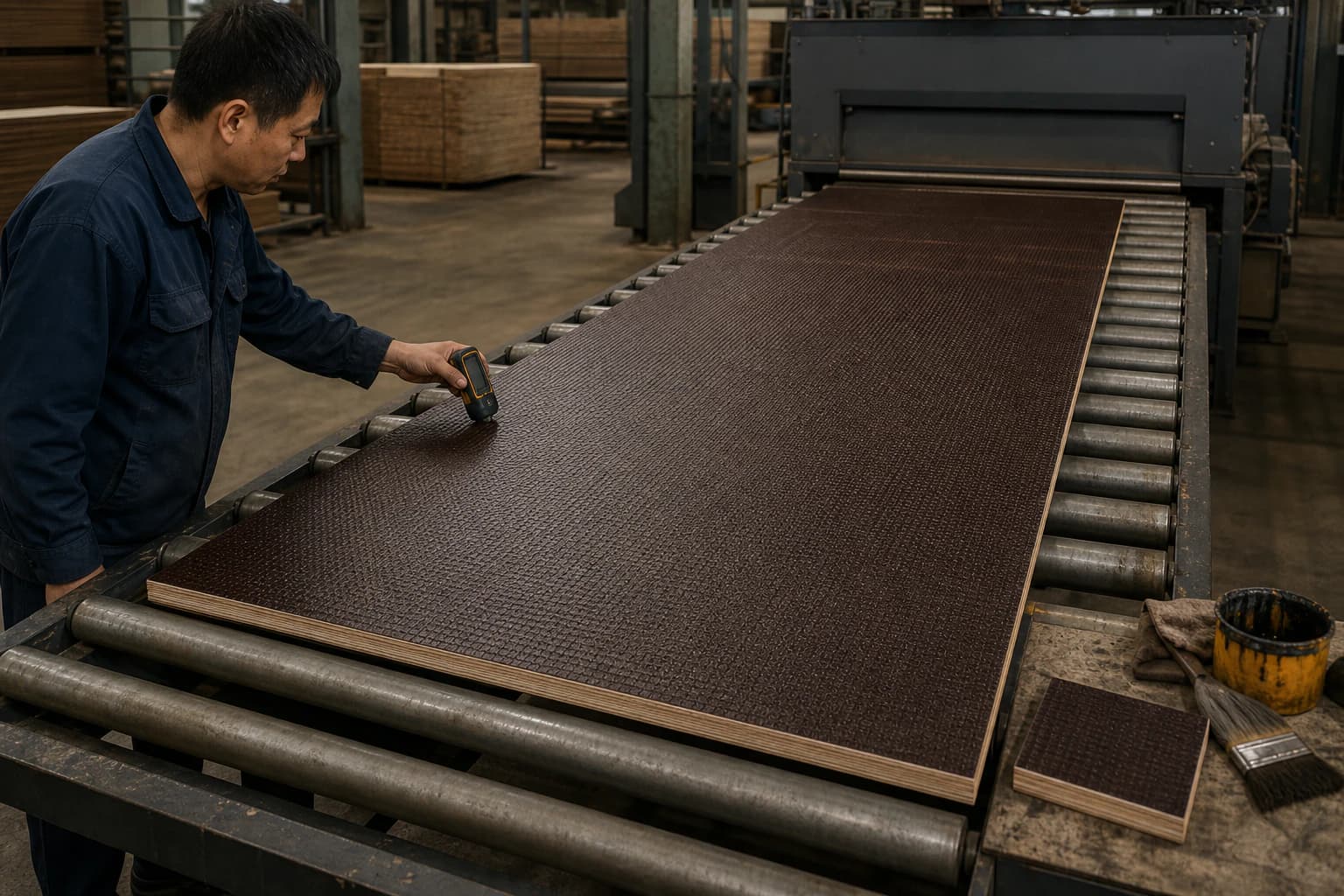
One operator inspecting a wire-mesh phenolic anti-slip plywood panel fully supported on a level roller table
Surface and edge inspectionA supported patterned panel is checked on a level inspection line for tread continuity, dimensions, edges and finished-lot condition.
PANEL & INSTALLATION INPUTS

Coordinate the supplied panel with the finished floor or platform.

SUPPLIED PANEL

Ordered panel construction

  • Pattern and face/reverse overlay
  • Core, lay-up and exterior bond
  • Size, thickness and moisture
  • Factory edge and site-cut sealing method
  • Slip, abrasion and bond documents
  • Panel inspection and export packing
FINISHED FLOOR OR PLATFORM

Installation and operating duty

  • Load case and engineering design
  • Span and support centres
  • Fixing, holes and joint support
  • Drainage and exposure details
  • Cleaning, maintenance and replacement
  • Installation inspection and project acceptance

Supported industrial access decks

Panel selection: State support centres, load case, fixing, surface contamination and cleaning.

Installation requirement: Coordinate the selected panel with engineered spans, supported joints and the project load schedule.

Service platforms and removable access panels

Panel selection: Control edge support, removable-panel tolerance, handles, holes and resealing.

Installation requirement: Combine the panel specification with access, guard, edge-support and fall-protection details.

Fabricated equipment walkways

Panel selection: Specify contact pattern, reverse face, weight, cutting plan and edge maintenance.

Installation requirement: Complete the assembly with the machine builder’s support, fixing and conformity requirements.

Temporary staging and event infrastructure

Panel selection: Name indoor/outdoor exposure, support layout, repeated handling and required slip method.

Installation requirement: Complete public-use engineering and local approvals for the assembled stage, stair or platform.

Vehicle and mobile platform fabrication

Panel selection: Record dynamic duty, fixing, sealing, drainage and weight before selecting construction.

Installation requirement: Coordinate panel weight, dynamic loads, support layout, fastening and drainage with the finished vehicle body.

PLATFORM CONSTRUCTION

Supports, joints, fixings and resealed edges remain visible decisions.

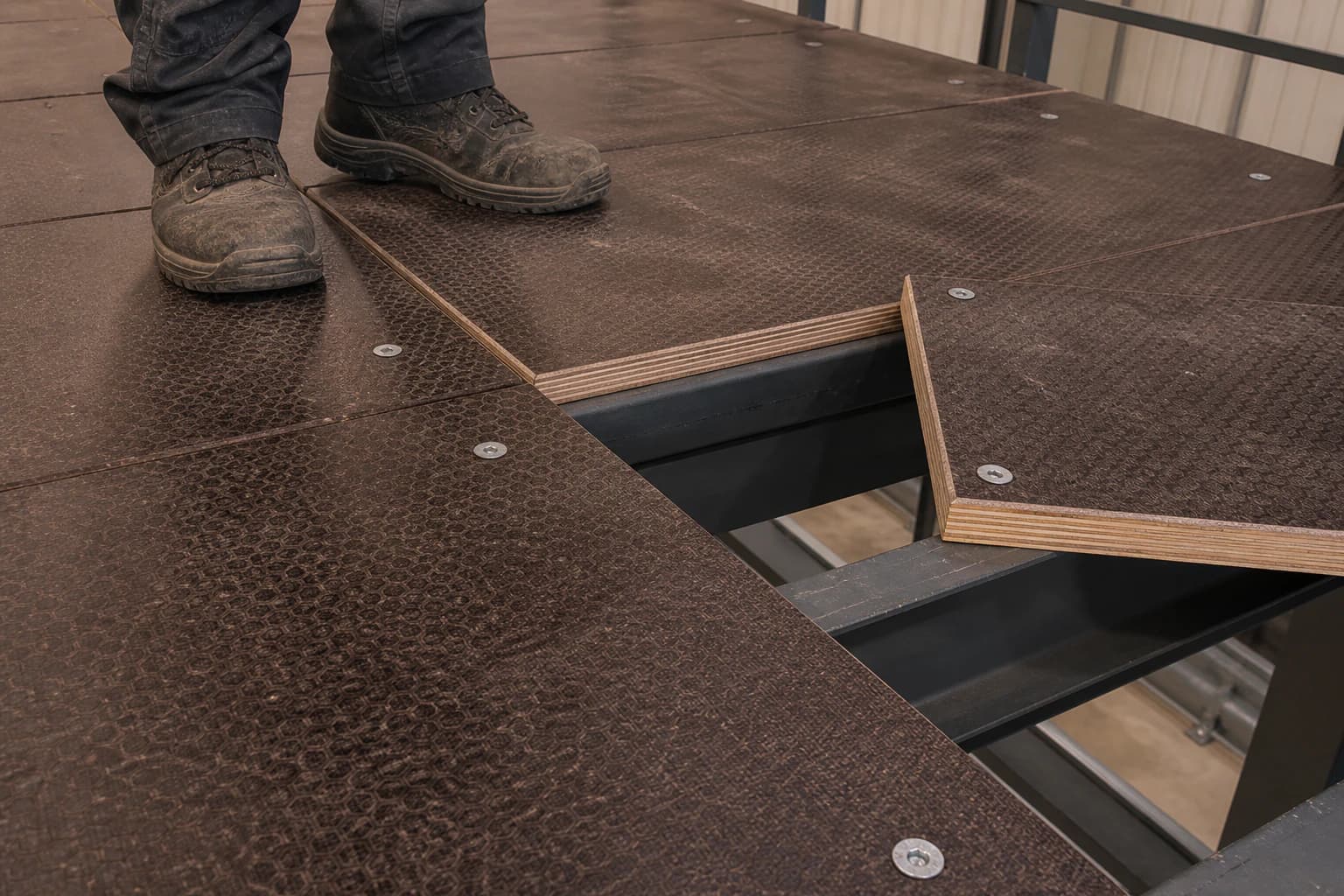
Patterned anti-slip plywood panels fixed over steel supports with one access panel lifted to show the sealed layered edge
Platform supports and fixingsPatterned panels over steel supports with fixed joints and a lifted access-panel edge; project support and fastening remain buyer-defined inputs.
SIZE & HANDLING

Choose standard or project formats with the required handling support.

Economy

STANDARD FORMATS
  • 1220×2440 mmStandard

    Primary comparison format.

  • 1250×2500 mmStandard

    Common export metric format.

Standard Export

PROJECT FORMATS AVAILABLE
  • 1220×2440 mmStandard

    Primary comparison format.

  • 1250×2500 mmStandard

    Common export metric format.

  • 1525×3050 mmBy project order

    Requires pattern continuity, press and line capability, flatness, handling, packing and loading validation.

Professional / Premium

PROJECT FORMATS AVAILABLE
  • 1220×2440 mmStandard

    Primary comparison format.

  • 1250×2500 mmStandard

    Common export metric format.

  • 1525×3050 mmBy project order

    Requires construction, embossing and pattern continuity, flatness, handling, packing and loading validation.

  • 1220×3800 mmBy project order

    Requires long-panel lay-up structure, pattern continuity and press capability, flatness, handling, packing and loading validation.

  • 2100×2800 mmBy project order

    Requires wide-panel construction and press capability, embossing continuity, flatness, handling, packing and payload validation.

Use the Plywood Sizes & Thicknesses guide to align large-format construction, pattern continuity, press capacity, flatness, full-area handling, packing and loading.

INSPECTION & EXPORT PACKING

Protect the tread pattern from production inspection through container loading.

  1. Approved surface

    Compare pattern geometry, colour and texture with the selected reference under consistent light.

  2. Overlay inspection

    Check face continuity, press marks, contamination and local overlay damage.

  3. Panel dimensions

    Measure thickness and squareness with the panel fully supported and the method recorded.

  4. Edges and separators

    Inspect edge-seal coverage, corners and any factory machining before packing. Use a clean face sheet or separator to keep straps and protectors clear of the tread pattern.

  5. Pack protection

    Protect corners and every strap contact point with secure full-width materials. Keep packs dry, level and supported by bearers aligned for handling.

  6. Lot documents

    Confirm moisture, pack identity and required documents against the order specification. Keep slip, wear and bond results tied to the tested construction and condition.

Continue to Quality & Inspection and Export Process for shared control, pack and destination-document frameworks.

MARKET, PRICE & RFQ

Choose the destination documents, product grade and delivery specification.

MarketPriorityProduct and document requirementsAvailability
AustraliaTier 1Importer confirms biosecurity documents; pedestrian surfaces may specify AS 4586 classification for the ordered panel construction.AVAILABLE BY ORDER / IMPORTER CONFIRMATION
Middle EastTier 1Pattern, bond, edge protection, heat exposure, documentation and private-label requirements are fixed per destination and buyer.AVAILABLE ON REQUEST
Central AsiaTier 1Temperature range, handling risk, transport pack, declared standard and project documents are matched to importer requirements.CONFIGURED BY ORDER
Latin AmericaTier 1Local-language documents, pattern references, customs descriptions and end-use test records are confirmed by destination.AVAILABLE ON REQUEST
AfricaTier 2Value, payload, moisture range, replacement supply and importer documents guide the selected construction.CONFIGURED BY ORDER

Use the dedicated Australia and Middle East guides to select destination documents, labelling and import information.

EconomyUSD 320–430/m³

Value-led combi/eucalyptus-poplar panel with lighter patterned face, smooth reverse and standard format.

Standard ExportUSD 450–620/m³

Selected combi/hardwood construction with 220 g/m²-class patterned face, smooth reverse, sealed edges and written inspection.

Professional / PremiumUSD 650–900/m³

Selected hardwood or birch-led construction with project pattern, calibration, traceability and named test documents.

BUYER QUESTIONS

Patterns, moisture, testing, installation and pricing

Choose the right specification.

What is anti slip plywood?

Anti-slip plywood is a cross-laminated plywood panel faced with resin-impregnated paper pressed into a wire-mesh, hexa or project-selected tread pattern. A complete order states the core, lay-up, exterior bond, face and reverse overlays, pattern reference, edge seal, dimensions, moisture and selected slip or abrasion test.

How should wire mesh, hexa and reverse faces be specified?

Wire mesh and hexa are distinct working-face geometries, while the reverse face is a separate construction choice. State the pattern sample, overlay system and mass, colour and press texture, then identify the reverse as smooth phenolic or a second functional pattern. The slip method and surface condition complete the performance specification.

How is anti-slip plywood protected from moisture?

Moisture resistance is built through the selected exterior bond, balanced plywood lay-up, resin-impregnated face and reverse overlays, continuous factory edge sealing and compatible resealing of every site cut and drilled hole. Supported joints, drainage, drying and ventilated storage complete the installed moisture-control system.

Which core, lay-up and bond specifications should be selected?

Select combi, eucalyptus, hardwood or birch-led construction from panel density, machining, fastener holding, edge quality and installed duty. The order states the ply schedule, gap and overlap limits, repairs and the applicable exterior-bond method so we can quote the same construction.

Which thicknesses and panel sizes can be supplied?

Common options are 9–27 mm in 1220×2440 and 1250×2500 mm formats. Project formats of 1525×3050, 1220×3800 and 2100×2800 mm are quoted after confirming pattern continuity, press capacity, flatness, full-area handling, packing, loading and payload.

How should slip resistance be tested?

Test the selected pattern under a named method and operating condition. State the dry, wet or contaminated surface, direction, incline where applicable, slider or footwear and required classification for EN 16165, AS 4586 or the buyer's project method. The report then identifies the tested surface and condition.

How do dry, wet, oily or contaminated conditions change the decision?

Water, oil, grease, mud and dust change contact and drainage at the tread, so each important service condition is stated separately. Include the expected contaminants, cleaning interval, footwear or wheel contact and required result in the enquiry.

How should wear and abrasion resistance be specified?

State the wear method, conditioning sequence, cycle count or visual endpoint and the exact overlay-pattern construction. Compare the tested and delivered surface with the selected sample, including pattern loss, film exposure and the point at which the tread no longer meets the agreed visual or slip requirement.

How are factory edges, site cuts, drilled holes and damaged areas protected?

Original edges receive the agreed factory coating. Every site cut, drilled hole or damaged corner exposes the core and must be cleaned, kept dry and resealed with the compatible system before exposure, then inspected under the assigned fabrication responsibility.

How should supports, joints, fixings and concentrated loads be handled?

The installed-system design states support centres, supported joints, fastener type, edge distance, penetrations and concentrated load cases. The Anti-Slip Flooring, Stages & Platforms application guide connects these values with the selected panel construction and tread surface.

How should anti-slip plywood be used outdoors, cleaned and maintained?

Outdoor service combines the selected exterior bond and sealed edges with drainage, drying, ventilation, UV and temperature inputs. Use compatible cleaners, remove contaminants without damaging the tread, inspect faces, edges and fixings, and state the replacement criteria for the project.

What should buyers confirm in an approved sample and comparable RFQ?

A comparable RFQ confirms the approved pattern and colour sample, face and reverse overlays, core, lay-up, bond, dimensions, tolerances, edge and cut treatment, slip-test methods, wear documents, quantity, packing, destination and target date. Our team can recommend suitable options for any open fields and prepare the quotation against one consistent construction.
REQUEST A QUOTATION

Price the complete anti-slip plywood specification.

Send the use, support layout, surface pattern, face and reverse overlay, core, bond, dimensions, cut-edge method, required tests, quantity, pack, destination and delivery date. Our team can recommend the remaining options.

Plywood enquiry

Tell us what you need.

Specify use, support layout, pattern, face/reverse overlay, core, bond, size, thickness, edge and cut treatment, slip or wear test methods, quantity, packing, destination and target date. Our team can recommend suitable product options and the Incoterm for the destination and order volume.

CHAT WITH CUZI PLY

By sending this request, you allow CUZI PLY to use the submitted details to respond. Read the Privacy Policy.