Plywood vs particleboard for furniture and flooring.
Plywood uses bonded wood veneers; particleboard, also called wood chipboard, uses bonded wood particles. Consider particleboard for suitably faced interior components. Consider plywood when natural veneer, visible layered edges or a selected core construction adds value to your design.
Choose the cabinet, shelf or floor panel by the job it must do. Compare the finish, joints, loads, moisture conditions and cost of the usable component. CUZI PLY is your plywood manufacturer and direct supplier, with 10 production lines in Linyi, China.
Plywood vs chipboard starts with the inner construction.
A decorative facing can hide the difference. Put the substrate, grade and finished surface on your component schedule, not just a colour or a board nickname.
Veneer plywood
Thin wood veneers are bonded into a panel, commonly with alternating grain directions. The visible face species and the inner core are separate choices. Our factory offers plywood constructions and surfaces for furniture, flooring and other applications.
The APA plywood guide explains cross-laminated construction. Explore our Core Materials & Species for plywood choices.
Wood particleboard
Wood particles are bonded and pressed under heat and pressure. In this guide, “chipboard” and “particle board” mean that wood-based panel, not paperboard used in packaging. MDF is a fibreboard and OSB uses oriented strands, so they are separate material choices.
The European Panel Federation’s particleboard description covers its manufacture and uses. For the other comparisons, see Plywood vs MDF and Plywood vs OSB.
Eight decisions behind a useful material comparison.
Use the same component dimensions, finish and service conditions for both options. Then compare the actual boards and production work.
On a phone, swipe across the table to compare both materials.
| Your decision | Plywood | Particleboard / wood chipboard |
|---|---|---|
| Construction | Bonded wood veneers, commonly arranged with alternating grain directions. Select the face and inner construction separately. | Wood particles bonded and pressed into a panel. Chipboard here means this wood-based material, not paper packaging board. |
| Visible finish | A selected veneer face can provide natural grain. Melamine, HPL and clear-coated plywood offer other finished-surface options. | A substrate for decorative facing, including veneers and laminates. Specify both the facing and the underlying board grade. |
| Exposed edges | A selected layered edge can remain visible; agree the inner joints, repairs, sanding and finish your design permits. | Plan the edging or other treatment wherever the particle core would otherwise be exposed. Include joints and hardware openings. |
| Hardware and assembly | Check the core, fixing location, screw or fitting, pilot hole and finished thickness against your assembly. | Choose fittings and drilling details for the actual board. Include edge fixing and any dismantling and reassembly in the joint assessment. |
| Shelves and loads | Compare the offered grade and orientation with the span, supports, load and deflection limit. | Use properties for the offered grade with the same shelf dimensions and support arrangement. The material name alone does not define a safe span. |
| Weight | Use the finished sheet mass or density of the selected core and facing, rather than assuming all plywood has one weight. | Use the offered board density or sheet mass. Include facing, edging and hardware in the finished-component comparison. |
| Moisture and use | Choose the bond, complete construction, finish and cut-edge protection for the actual exposure. | Choose a grade intended for the dry or humid conditions and application. Furniture board and structural flooring board are different specifications. |
| Cost | Price the face, core, calibration, facing, machining, packing and delivery needed for the part. | Compare the quoted board and facing with edging, machining, hardware, usable yield and delivery on the same basis. |
Furniture and flooring need different board grades.
Start with the intended use and moisture conditions. Then compare the actual panel properties, finished component and installation, rather than transferring a grade name between materials.
Furniture in dry or humid conditions
EN 312 distinguishes P2 interior furniture boards for dry conditions from P3 non-load-bearing boards for humid conditions. Choose the particleboard type for the component and environment, then specify its facing, edges and fittings.
Load-bearing floor panels
EN 312 separates P4 dry-use and P5 humid-use load-bearing boards, with P6 and P7 for heavy-duty dry and humid uses respectively. Select the required floor product, properties and installation details; a furniture board is not a flooring specification.
North American product information
ANSI A208.1 classifies particleboard separately from the PS 1 or PS 2 standards used for structural plywood. Compare the offered grade, thickness, relevant properties and intended use. A particleboard grade is not a plywood rating.
The BSI EN 312 overview lists the particleboard types; the CPA particleboard standard overview explains ANSI A208.1. For plywood, include the required grade or rating, face, core and bond with your enquiry to our factory.
Choose for the part, not the whole cabinet at once.
A visible door, a loaded shelf and a concealed back need different priorities. Spend on the face, core and finish that each component will actually use.
Cabinet carcasses and interiors
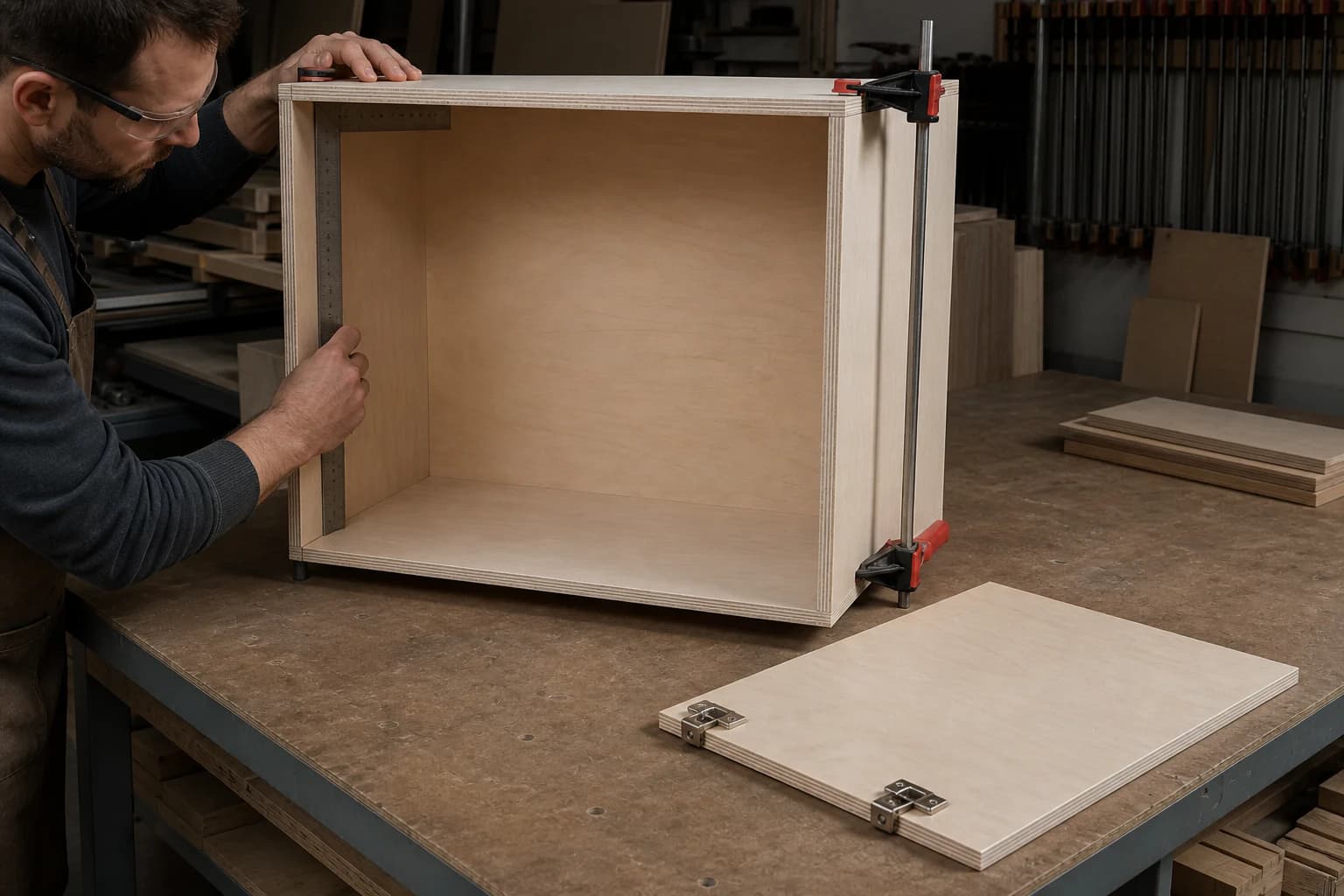
Start with the surface your customer will see and the joints your production line uses. Compare finished thickness, squareness, decor, edging and hinge or drawer-runner fixings. For kitchens, describe humidity, splashes and areas near plumbing so the panel and protection suit the location.
Shelves and work surfaces
Give the clear span, shelf depth, supports, expected load and acceptable deflection. Include any front-edge reinforcement and the surface covering. Compare the finished supported part, not two unsupported raw boards of different thicknesses.
Flat-pack and repeat assemblies
List the connector, screw, dowel or insert, hole position and assembly sequence. If the furniture will be dismantled, include that in the joint check. Before switching substrates, compare the actual drilled part and assembled joint with the fittings you will use.
Natural faces and visible edges
Consider veneer-faced plywood when wood grain or a selected layered edge is part of the design. Specify the face species, colour, grain, permissible repairs and finish. A concealed or fully faced part can have different appearance requirements from the visible door or shelf.
The Composite Panel Association describes particleboard in cabinets, furniture, shelving and decorative surfacing. For our plywood production options, see Furniture Grade Plywood and Furniture & Cabinetry Applications.
A flooring grade is a separate decision from a furniture board.
First state whether the panel carries floor loads or prepares a surface for the final covering. Choose the rated product and installation for that job.
Particleboard flooring
Chipboard is not limited to furniture: dedicated flooring products are available. For instance, EGGER P5 structural flooring is described as moisture-resistant chipboard manufactured to BS EN 312, with its own installation requirements. Select the specified floor product, not an ordinary cabinet board carrying a similar surface.
Plywood flooring
For load-bearing work, compare the plywood rating and design properties with the specified supports, loads and panel orientation. For underlayment, check the finished-floor manufacturer’s requirements for the substrate, thickness, joints and surface. Our Structural Plywood page helps start the plywood specification.
For vehicle decks and working platforms, include wear, grip and the installed support system. See Flooring, Stages & Platforms for those different requirements.
The same-looking surface can cover different boards.
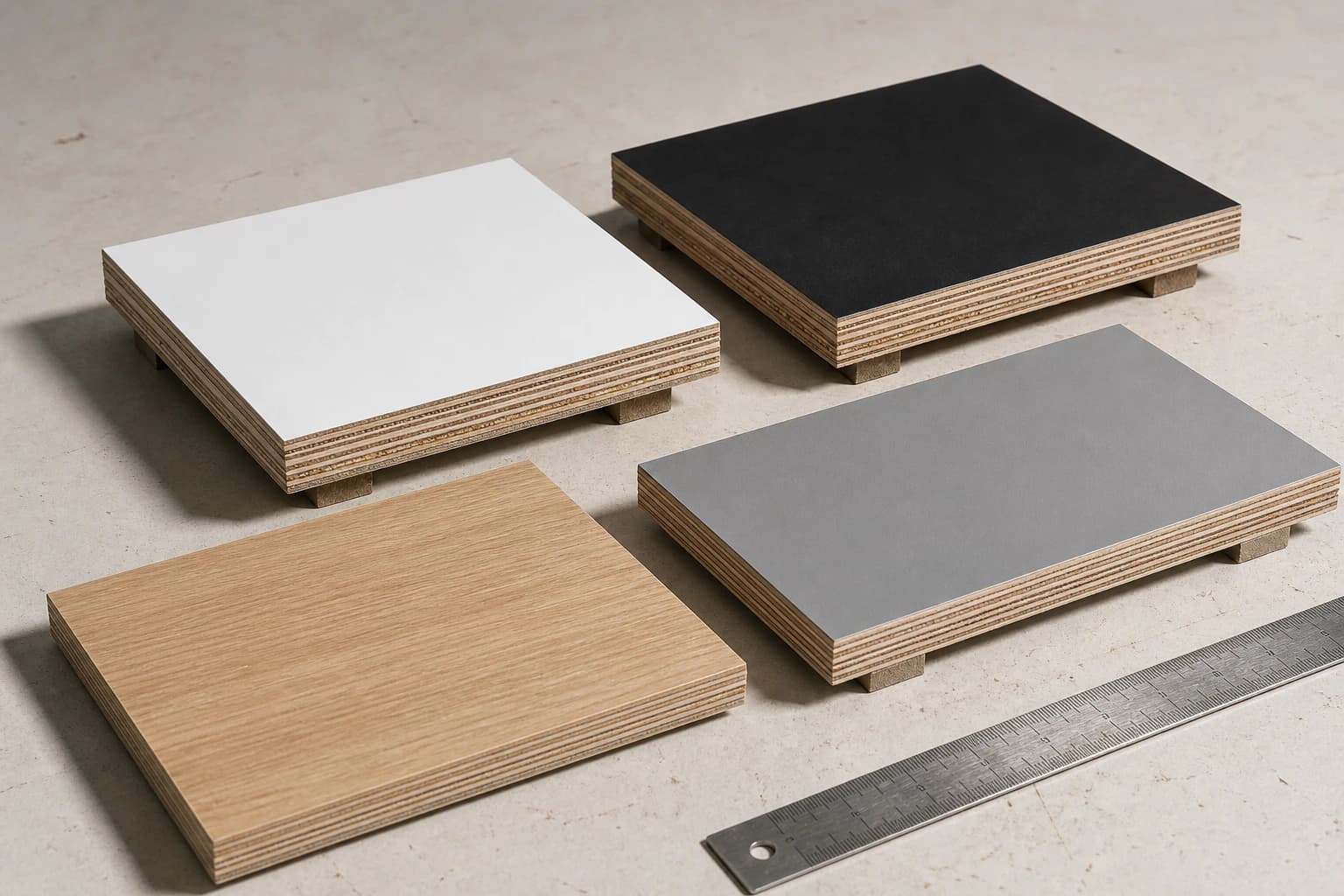
“Melamine board” or “laminated board” identifies a surface, not the entire panel. Specify the underlying board, finished thickness, face and reverse finish, and edge treatment.
Covered and faced components
Compare the decor, texture, backing balance, adhesion and cut-edge finish of the complete panel. Include edge-band thickness in finished dimensions and check how joints and hardware interrupt the face or edging.
Our Melamine Plywood and HPL Plywood use plywood substrates. Discuss the face and core together rather than comparing only the decorative colour.
Visible plywood grain and layers
For a natural veneer face, specify species, grain, colour and permissible repairs under the intended coating. If the plywood edge stays visible, choose the core arrangement and agree the inner joints, gaps and edge preparation that suit the design.
Use Surface & Overlay Options to plan the coating, veneer or laminate process for your plywood components.
Check fit, fixings, shelf support and handling weight.
Use properties for the offered grade where loads matter, and compare the real component with its tooling, finish and hardware. A material name is not a complete strength or joint specification.
Cutting and drilling
Use the intended tooling, support and machining sequence to check the face, cut edge, hole exits and finished dimensions. Include the coating or laminate in the trial because the surface and substrate are processed together.
Fixings and moving parts
Show where hinges, runners, connectors and other hardware transfer load into the panel. State the screw or fitting, pilot hole and edge distance. Compare the complete joint under the loads and repeated use the component needs.
Panel and assembly weight
Ask for finished kg per sheet or density for the offered construction. Add facings, edge treatments and fittings to estimate the complete unit, handling effort and delivery payload. A poplar-core and an all-birch plywood are different weight comparisons.
Production fit and repeat orders
Agree finished thickness, flatness, squareness and machining tolerances. Keep the component drawing, face finish, core choice and hardware details with the order so replacement and repeat-production parts fit the same assembly.
For a uniform rectangular board, calculated mass = length × width × thickness × density. Use metres and kg/m³, and identify whether the supplied density includes the facings. For a finished component, add separate edging, inserts and hardware as needed.
The CPA shelving bulletin overview explains why single-span and centre-supported shelves are different designs. For plywood core and calculated weight comparisons, see Birch vs Poplar Plywood.
Choose the grade before relying on a facing or a label.
Describe dry interiors, sustained humidity, splashes or exterior weathering, including how the part dries. Those conditions guide the board, glue bond, cut-edge protection and installation.
Dry and humid-use particleboard
Particleboard types are available with different moisture performance and intended applications. Use the product specification for the offered grade, then plan the edging, joints and hardware openings around the exposure. A decorative surface does not remove the need to protect vulnerable cuts and connections.
Plywood bond and product documents
For plywood, select the complete face, core and bond for the use, with suitable finish and protection. The bond classification describes glue-bond performance; it is not the whole component’s weather protection or load rating.
Tell our factory the destination and required emission, bond, sourcing or project documents. We can discuss the plywood construction and documentation with the quotation.
See Bonding & Emission Options and Standards & Certifications for the plywood information to include with your enquiry.
Compare the cost per usable part, not just the sheet price.
Particleboard can be an economical choice for appropriately faced interior components. When comparing a plywood alternative, include the finish, production work and order terms that your component needs.
Usable cutting yield
Compare the number of usable components from the offered sheet format. Include grain or decor direction, trimming, kerf, visible-face selection and the parts rejected by your finished-quality requirements.
Facing and edge work
Price the decor or veneer, backing balance, adhesive, edging, sanding and coating required by each option. Compare the same finished face and edge appearance, rather than one raw sheet with one ready-faced board.
Machining and assembly
Include drilling, routing, tooling, fittings, assembly labour and any rework. A lower board quotation is valuable when the completed parts also meet the fit, finish and service requirements.
Packing and delivered quantity
Use the same order quantity, currency and delivery basis. Include protective packing and identify freight and destination charges; compare production timing separately from transit time.
Compare one completed order: total board, facing, processing, hardware, packing and delivery cost divided by the number of usable components. Use your cutting yield and quality requirements when estimating that number.
For a flooring comparison, use cost per completed installed area on the same floor design. Include trimming and waste, joints, fixings, adhesive, surface preparation, installation and delivery, alongside the required panel grade and floor covering.
CUZI PLY plywood formats: regular 1220×2440, 1250×2500, 1525×3050 mm; on request 1250×3050, 1250×3660, 2100×2800, 1830×3660, 1250×3800 mm. Choose the sheet format around your cutting layout, then send thickness and quantity for a factory quotation.
Our Plywood Price Guide helps compare quotation units and delivery costs. Review the order details below before requesting your plywood quote.
Keep the panel, part and purchase terms together.
Send us the requirements you already know. Our manufacturing team will help complete the plywood specification, processing details and quotation for your order.
Identify both complete panels
Record the plywood face, core and bond, and the particleboard grade and producer. Keep finished thickness, facing, reverse finish, edging and component dimensions on the same specification. The same decor does not identify the same substrate.
Compare like-for-like properties
Use data for the offered grade and thickness. Identify the test method, direction, conditioning and whether a figure is a classification minimum, a declared design value or an individual test result. For a shelf or floor, include loads, spans, supports and the deflection limit.
Check the machined and assembled part
Compare cut edges, hole exits, edging, connector fit and the hardware you will use. Check the joint through the intended assembly and repeated use. Workmanship checks help confirm production fit; structural capacity needs the appropriate product and design information.
Agree the plywood order with our factory
Send your component list, quantity, destination and required delivery date to CUZI PLY. We specify the plywood construction and agreed processing, then confirm production, packing, payment and delivery terms in the quotation. Keep manufacture and shipping transit separate.
For performance comparisons, see Plywood Testing Methods. For handling before use, see Plywood Storage & Handling. These are the shared purchase conditions to agree with our factory:
- Order quantity & mix
- Tell us the sheet size, thickness mix and quantity you need. We confirm the minimum order and available mix for your selected construction.
- Production lead time
- We confirm the production schedule with your specification, order quantity and sample requirements. Production lead times are planning estimates, not transit times.
- Price & quotation unit
- Currency and price unit stated in your quotation. Your quote is based on the agreed dimensions, construction and quantity. Processing and requested testing are stated separately where applicable.
- Samples
- Tell us the plywood, thickness, finish and delivery country. We confirm sample availability, any sample and courier costs, and dispatch arrangements before proceeding.
- Packing & delivery
- We agree export packing, labels and the loading plan for your order. Share the destination country, named port or delivery point and preferred delivery term. Freight, insurance, duties and taxes are included only when stated in the quotation.
- Payment & order confirmation
- We agree the payment method, currency and any deposit and balance schedule in the quotation or proforma invoice. Your order confirmation sets out the product, quantity, packing and delivery arrangements.
Plywood and particleboard selection
Questions before you choose the board.
Is particle board the same as chipboard?
In this wood-panel comparison, yes: particleboard, particle board and chipboard refer to a panel made from bonded wood particles. Here chipboard does not mean paperboard for packaging. Ask for the substrate and grade as well as any decorative facing. Plywood is made from wood veneers, so it is a different construction.
Is plywood or chipboard better for kitchen cabinets?
Choose for each part. Particleboard with a suitable decorative facing can be a practical cabinet substrate. Plywood is worth considering for natural veneer appearance, selected layered edges or a particular core and fixing arrangement. Compare the carcass, shelf and door by finished thickness, joints, hardware, moisture conditions and delivered component cost. CUZI PLY can manufacture the plywood construction for those requirements.
Is plywood stronger than particleboard?
Compare the relevant properties of the offered grades at the same thickness and use conditions. For a shelf, specify load, span, support and acceptable deflection; for a joint, specify the fitting and fixing location. Plywood orientation and construction also matter. Use the rated board and design information required for structural work, rather than a universal strength multiplier.
Which board should I choose for shelves?
Start with the shelf dimensions, clear span, supports and the load it will carry. Include edge reinforcement, facing and the deflection you can accept. Both material choices need a grade and thickness that suit that shelf design. Comparing complete supported shelves is more useful than comparing the material names alone.
Can chipboard be used for flooring?
Yes, particleboard products are made for flooring, but select the specified flooring grade rather than general furniture board. Confirm the intended moisture conditions, thickness, supports, edge profile, fixings and floor covering with the product installation instructions. Structural plywood is another option when its rating and installation suit the project. An underlayment and a load-bearing subfloor are different jobs.
Is moisture-resistant chipboard or exterior-bond plywood waterproof?
Choose either material for the complete exposure and installation. A humid-use particleboard grade still has its own installation and protection requirements. An exterior plywood bond describes the glue bond, not a sealed finished component. Plan faces, cuts, joints, hardware openings, drainage and drying where the part can get wet.
Is melamine board plywood or particleboard?
Melamine describes the decorative surface, not the substrate. A melamine-faced board can use different underlying materials. Our Melamine Plywood uses a plywood substrate; specify its core, finished thickness, decor, reverse surface and edging when comparing it with a melamine-faced particleboard option.
Is particleboard lighter or cheaper than plywood?
Use the offered sheet mass or density and the actual quotation. Plywood cores, particleboard grades and decorative surfaces vary. Compare equal finished dimensions for weight, and usable cutting yield, facing, edging, machining, hardware, packing and delivery for cost. The cheapest raw sheet need not give the lowest cost per usable component.
Can I replace particleboard with plywood in an existing design?
Plan the change around the finished component. Check panel thickness, joinery, connector holes, hinge or runner fixings, edge treatment, surface finish and the assembly weight. For flooring, also check the rated product and installation. Send the component drawing and current board requirements to our factory so we can propose a plywood construction and quote.
What should I send CUZI PLY for a plywood quotation?
Send the application or component, panel dimensions and thickness, visible finish, edge treatment, machining and hardware, quantity and destination. Add load or weight targets, moisture conditions and required product documents where relevant. Our factory team will help select the plywood face and core, confirm production and packing, and arrange a plywood sample or quotation.
Are P2, P3 and P5 chipboard interchangeable?
No. Under EN 312, P2 is for interior fitments including furniture in dry conditions, P3 is non-load-bearing for humid conditions, and P5 is load-bearing for humid conditions. Choose the type and actual product for the job. A humid-use description, decorative surface or matching thickness does not establish the same floor or shelf performance.
What performance data should I compare before changing substrates?
Use the actual grade and thickness, with the test method, direction, conditioning and type of reported value identified. Classification minima, declared design values and individual test results serve different purposes. For a shelf or floor, relate the appropriate properties to the actual loads, spans, supports, joints and deflection limit. For furniture fittings, assess the real connector and finished joint.
How should I compare a plywood sample with my current chipboard?
Tell our factory which component, facing, edge treatment, machining and hardware you need to compare. We agree the plywood construction, piece sizes, any costs and courier arrangements. Check finish, cutting, drilling and assembly with your actual fittings. A workmanship check on a small piece does not establish a shelf load or a floor rating; use the relevant product and design information for those requirements.
Turn your component requirements into a plywood quote.
CUZI PLY manufactures your plywood in Linyi. Share the parts you make, the finish you want and the conditions they will face. We will help select the face, core and processing for your order.
- Part dimensions, finished thickness, visible faces and edges.
- Machining, hardware, supports and load or weight requirements.
- Quantity, destination, delivery timing and product documents.
Already using chipboard? Send the current component drawing and board requirements with your enquiry. We can discuss a plywood alternative, the machining and finish to compare, and sample costs and courier arrangements.
New to plywood construction? Start with Plywood Types, Construction & Uses or How to Specify Plywood, then bring your component requirements to our factory.