PLYWOOD BUYING GUIDECONSTRUCTION · SIZE · QUALITY · DELIVERY
How to Specify Plywood for a Factory Quote
Give our factory enough detail to quote the plywood your job actually needs. Start with the finished use, dimensions and quantity, then add the face, core, bond, finish and documents you already know. This guide shows how to turn a brief or drawing into an agreed panel specification, compare complete offers and avoid surprises in machining, packing or delivery.
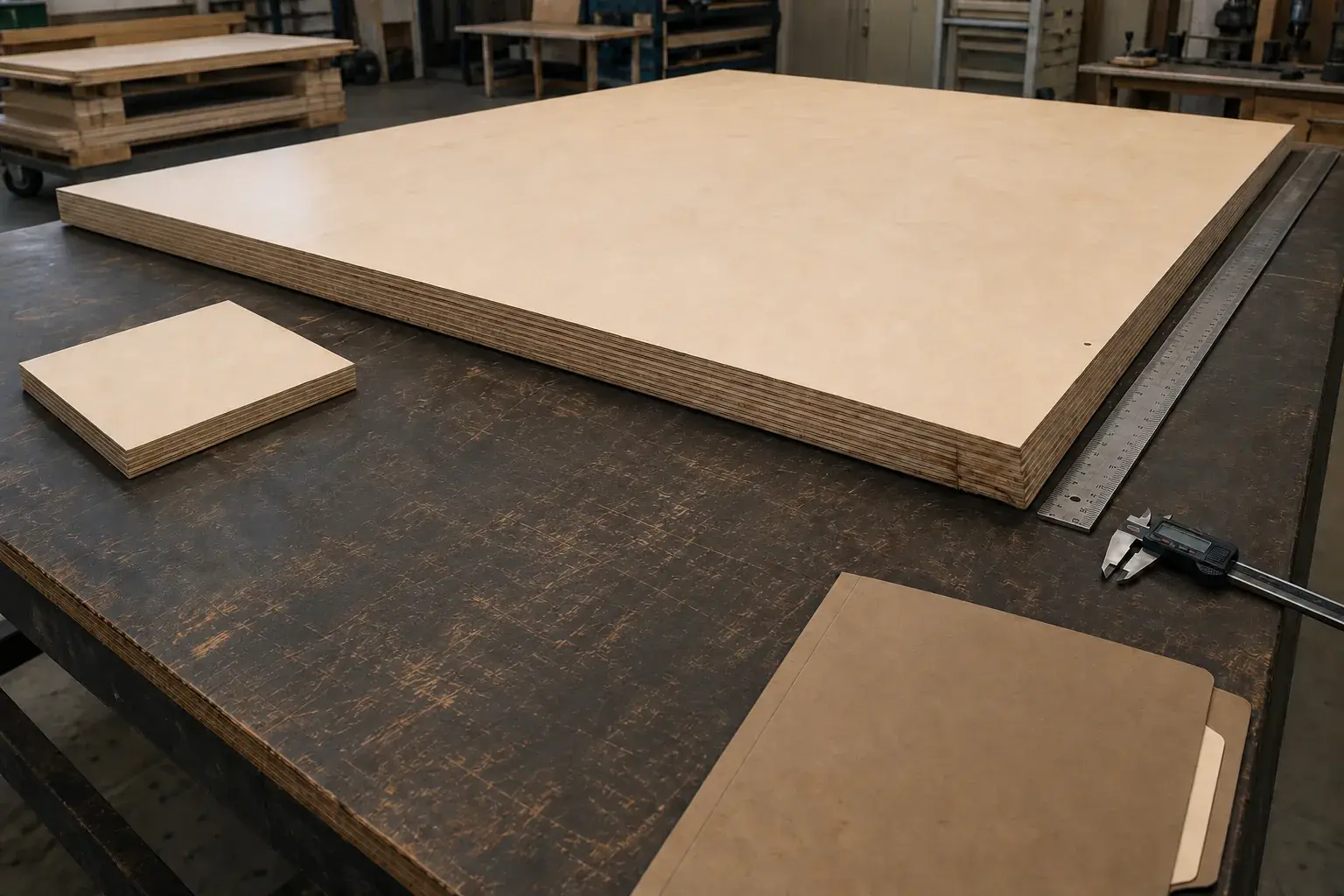
The answers that shape a comparable plywood specification.
What information is required to specify plywood?
Describe the finished component, exposure, visible faces, core, bond, sheet and finished dimensions, machining, quantity, packing and destination. Add the inspection and documents your project requires.
What if the buyer does not know the core or bond?
Provide the use, wetting conditions, machining, finish and target weight. We can then propose a named core lay-up and bond for your approval against a sample and the required tests.
Is product name plus thickness enough for a quote?
Add face and back grade, core species and lay-up, adhesive, moisture target, tolerance, processing and packing. Two 18 mm panels can differ substantially in those cost and quality drivers.
How should face, core and bond be written separately?
Write the face and back species and visual limits; then the core species sequence, ply count and gap limits; then the adhesive, exposure conditions and applicable bond test.
Which dimensions and tolerances must be confirmed?
Specify sheet length × width × nominal thickness in millimetres, finished cut size, thickness and size tolerances, squareness, grain direction, machining file revision and quantity by item.
Which documents and tests should be requested?
List the applicable product standard and edition, test method, required class, approved samples, first production sample check, lot results and shipment documents for the selected construction and destination.
How can two plywood quotations be compared?
Compare offers against the same specification and drawing revision. Check unit, included machining and testing, protected packing, Incoterms® rule and named place, lead time and written deviations before evaluating price.
What should be confirmed before repeat production?
Keep the signed specification, approved face and edge samples, first production sample result, packing instructions and purchase order together. Review any change to species, adhesive, thickness, finish, machining or documents before the next run.
A complete plywood RFQ and approval checklist.
Use this plywood specification checklist to agree what will be supplied, checked and delivered. Our factory can recommend the material choices you have not decided yet.
| Specification item | What to send | What we confirm with you |
|---|---|---|
| Application and exposure | Name the component, indoor or outdoor conditions, wetting and drying, support and intended finish. | Our recommended plywood construction for that use. |
| Face, back and core | State visible sides, veneer species, appearance grade, core species and cut-edge requirements. Write “Need advice” for undecided choices. | Face/back grades and the proposed veneer lay-up, with any alternatives clearly identified. |
| Bond and performance | Specify moisture exposure, bond requirement, emissions and any structural, marine, fire or flooring requirement. | The applicable product specification, performance class and documents to be supplied. |
| Dimensions and tolerance | Give width × length × thickness in millimetres, finished dimensions, face direction and permitted variation. | Finished thickness, size tolerances, squareness and measurement method. |
| Machining and finish | List cutting, holes, grooves, profiles, sanding, overlays, coating and edge treatment; identify the drawing revision. | Operations included in our price and work to be completed after delivery. |
| Quantity and repeat orders | Give sheets or parts for each size and thickness, first-order quantity and any repeat-order forecast. | Production quantity, minimum run and an agreed delivery schedule. |
| Material and quality checks | Identify the veneer, core and finish you want to compare, dimensional checks and any assembly or machining trial. | Reference identification, agreed acceptance limits and inspection arrangements. |
| Project documents | Name the required standard, class, report, certificate or declaration, including the project specification revision. | Documents applicable to the selected product and its intended use. |
| Packing and shipment | State face protection, pallet or crate, labels, destination country and port or delivery address. | Packing specification, shipment documents and the named place for delivery. |
| Price and timing | Ask for currency, price per sheet/part or m³, included work, Incoterms® rule, payment terms and target delivery date. | A complete factory quotation with validity, lead time, exclusions and any proposed changes. |
Plywood RFQ template: copy and complete
This plywood specification sheet is a starting point for your purchase enquiry. Replace the bracketed prompts with your requirements; leave “Need advice” where you want a recommendation. Send drawings by email or WhatsApp after contacting our team.
Product or application: [what you will make / Need advice]
Exposure and support: [indoor/outdoor, wetting, support spacing]
Visible face/back: [species, grade, finish / Need advice]
Core and bond: [preferred construction / Need advice]
Sheet size: [width × length × thickness, mm]
Finished parts: [dimensions and quantity for each part]
Tolerance and grain direction: [requirements / discuss with CUZI PLY]
Machining and finish: [included operations and work after delivery]
Drawing: [file name and revision; send by email or WhatsApp]
Quantity: [sheets or parts by size and thickness]
Material comparison: [face, core, finish and trial requirements]
Inspection: [measurements, acceptance limits and receiving checks]
Project documents: [standard/class/certificate/report, if required]
Packing and labels: [protection, pallet/crate and label requirements]
Destination: [country, port or delivery address]
Quotation basis: [currency/unit, Incoterms® rule and named place]
Timing: [target delivery date and repeat-order forecast]
Connect use, panel construction, inspection and delivery in one RFQ.
Use
Component · environment · exposure · support · finish · failure priority
Panel Specification
product option · face/back · core · bond · surface · dimensions · machining
Quality and receiving checks
Standards · method · classification · sample · first production sample · lot result
Commercial Comparison
Quantity · MOQ · packing · Incoterm and named place · timing · deviations
Tell us what the plywood will be used for.
Include the finished component, moisture exposure, visible faces, machining and finish requirements, how the panel will be supported, and the delivery destination. We'll recommend a suitable face, core, bond and thickness for your application.
| Specification item | Information to provide |
|---|---|
| Exact component or end use | Name the installed part, not only the industry |
| Interior, exterior or wet-dry cycle | Describe actual exposure and drainage |
| Visible faces | State one-face, two-face and reference range |
| Visible edges | State exposed, banded, sealed or concealed |
| Load and support | Provide support centres, expected loads and project design requirements. |
| Fastening interface | Name fastener, pilot, hardware and edge distance inputs |
| Machining operations | List saw, CNC, drilling, routing, laser or groove work |
| Coating, laminating or printing | Name primer, paint, veneer, HPL, melamine, film or print option |
| Cleaning and chemicals | Describe agents, frequency and dwell |
| Traffic and wear | Describe pedestrian, wheeled or handling contact |
| Expected service | State intended duration and replace/reuse logic |
| Priorities for the finished part | Tell us which finish, machining, moisture, weight and durability requirements matter most. |
| Delivery destination and project requirements | State the destination country and port, project specification and required documents. |
| Work after delivery | Explain who will machine, finish, assemble and install the supplied panels. |
What to include in different plywood specifications.
Start with the component you will make. Then use the product-specific details below to ask for the right construction, finish and documents.
CDX plywood specifications
For 1/2, 15/32 or 3/4 inch CDX, write the exact performance category and required finished thickness; these categories are not interchangeable. Include face/back grade, exposure classification, span or design requirement, product standard and required panel marking. For load-bearing use, your project specification determines the grade and design capacity.
Explore the plywood and order optionsMarine plywood specifications
A 12 mm marine panel still needs its veneer species, face/back quality, core construction, bond, finished thickness and tolerances specified. If your project requires BS 1088, state the edition and class and request the matching product documents. Include the boat component, coating and edge protection; a marine grade does not establish the strength of a complete hull or transom.
Explore the plywood and order optionsWBP plywood specification
For 12 mm or 18 mm WBP plywood, describe the actual wetting conditions and write the required bond-quality class and test standard alongside face, core and thickness. For a UK project, include the specified BS EN 636 use conditions and structural or non-structural requirement. The term WBP describes a bond expectation, not the complete panel construction or marine grade.
Explore the plywood and order optionsBirch and Baltic Birch plywood specifications
State whether you need birch faces over another core or an all-birch construction. Agree face/back grades, permitted repairs, core gaps, veneer lay-up, finished thickness and exposed-edge quality. Add the CNC or laser-cutting requirement and any finish so we can quote a panel suited to the finished component.
Explore the plywood and order optionsCompare all-birch constructionCommercial and hardwood plywood specifications
For general commercial panels, write the intended use, face/back grades, core species, bond and sanding requirement. For hardwood plywood, also specify the decorative veneer species, matching, visible sides and edge finish. A species or trade name alone does not define the core or permitted appearance variation.
Explore the plywood and order optionsCompare commercial plywoodFilm faced plywood specifications
Include core construction, finished thickness, bond, film colour and surface, edge sealing, panel dimensions and quantity. For formwork, state the concrete finish, support and fixing arrangement, cutting and intended site handling. Compare the full construction and included finishing rather than colour alone.
Explore the plywood and order optionsMDO plywood specifications
Specify the substrate grade and core, overlay on one or both sides, balancing back, bond, thickness and edge treatment. Explain whether the panel will be painted, printed or used for concrete forming; add the coating or finishing process and the surface quality your project requires.
Explore the plywood and order optionsFire-retardant and fire-rated plywood specifications
Identify the required fire test or classification, treatment, panel construction, thickness, finish and intended installation. For a fire-rated wall, ceiling or floor, provide the assembly specification, including support and layers. We match the plywood and available documents to that requirement; a treated panel and a rated assembly answer different questions.
Explore the plywood and order optionsPressure-treated plywood specifications
State the outdoor exposure or use category, treatment system, required retention and penetration where specified, core, bond and finished thickness. Include moisture condition at delivery, machining after treatment, coating and compatible fixings. These details connect the treatment requirement with the component you will actually install.
Explore the plywood and order optionsT1-11 plywood specifications
Give face texture, groove spacing and depth, edge-joint profile, panel thickness, exterior bond and coating plan. Include wall support and fixing requirements, cut-edge sealing and any structural grade needed by the project. Keep the groove profile and installation requirements together in the drawing.
Explore the plywood and order optionsContainer flooring plywood specifications
Provide the container or repair-floor drawing, panel dimensions, thickness, edge profile, support spacing, fixing positions and coating. Include the specified loading or rolling-load test and any treatment requirement. Panel supply is quoted against that schedule, with the relevant product and test documents requested before ordering.
Explore the plywood and order optionsTrailer floor plywood specifications
Specify concentrated or wheeled loads, support centres, panel joints, fixing layout, wear surface and wetting conditions. Add thickness, anti-slip pattern, edge protection, cut-outs and the required tests. The trailer design determines the necessary capacity; surface grip and panel strength should both be addressed.
Explore the plywood and order optionsFlexible plywood construction
If you require a five-ply construction, write that explicitly with the face/core species, finished thickness, bending direction, finished radius and support. Compare bending and finishing on your component before a repeat order. Ply count alone does not define a suitable bend radius or the finished curved assembly.
Explore the plywood and order optionsSpecifying 6 mm plywood
Identify what the thin panel must do: a cabinet back, door facing, lining or a cut component. State face/core construction, finished thickness and flatness, machining, finish and fixing arrangement. A 6 mm thickness specification by itself does not establish the panel's intended duty or structural capacity.
Explore the plywood and order optionsSpecify the face, core, bond and surface separately.
For each line, write the requested material or performance, our proposed construction, and the sample or document used for approval.
Face and back
Species, appearance grade, defect limits, visible sides and reference sample.
Core and lay-up
Species sequence, ply count, cross-banding, gaps, overlaps and edge appearance.
Bond and emissions
Adhesive family, intended exposure, emission requirement and applicable test method.
Surface and edges
Overlay or coating, sanding, balancing, factory edge treatment and later site sealing.
Moisture and density
State the target condition and measurement method where weight or machining depends on them.
Example: 18 mm painted cabinet panel
| Decision | Requested construction | Our proposed panel |
|---|---|---|
| product option | Painted interior cabinet carcass | Furniture Grade Plywood option |
| Face and back | Paint-ready visible face; concealed back | Calibrated paint-ready face; utility back within agreed range |
| Core family | Poplar/combi construction for stable machining | Poplar/eucalyptus combi core declared |
| Ply count and lay-up | 13-ply target at 18 mm; balanced cross-lamination | 13 plies with declared species sequence |
| Core gaps and overlap | No open edge void above approved reference; overlap not accepted | Repair and gap limits aligned to approved edge sample |
| Bond and exposure | Interior cabinet service; nominated low-emission bond specification | Adhesive family and emission requirement declared in technical document |
| Surface and finish | Buyer-applied primer and paint on two balanced faces | Sanded, calibrated faces supplied for buyer paint trial |
| Factory edge condition | Clean square edges for CNC nesting and later edge banding | Factory edges sanded; cut edges left for buyer machining |
| Change trigger | Prior notice before face source, core sequence, adhesive, sanding or thickness changes | Written notification and re-approval accepted |
Agree the visible finish and the cut-edge quality together.
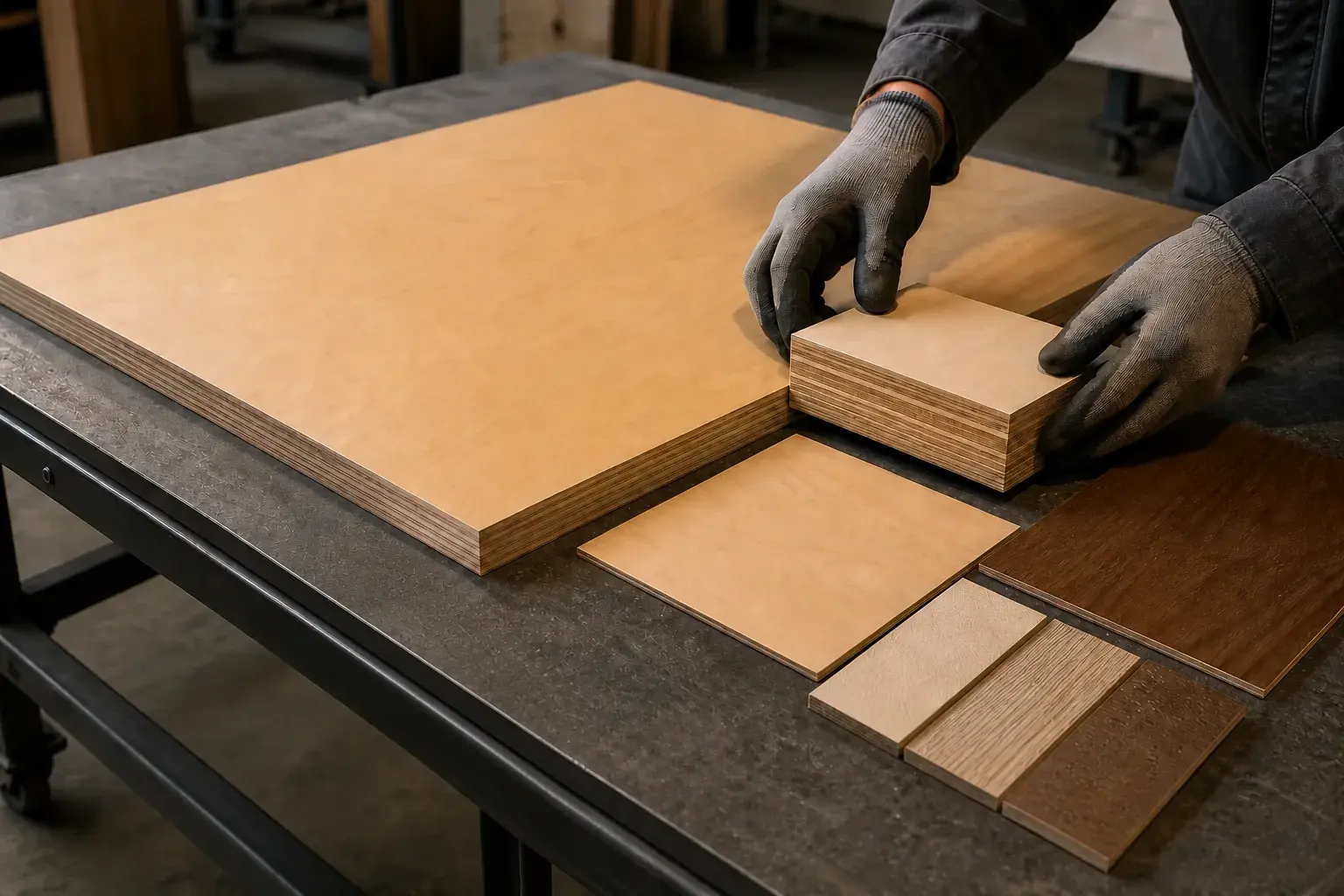
Agree the visible finish, concealed back grade and exposed-edge quality for your component. Match these requirements to the selected veneer and core construction.
Send a drawing that can be priced and manufactured.
Write nominal and finished dimensions in millimetres, thickness tolerance, face direction, machining file revision and quantity for each line item.
Where to order plywood sheets in specific sizes
Regular factory sizes: 1220×2440, 1250×2500, 1525×3050 mm. Available on request: 1250×3050, 1250×3660, 2100×2800, 1830×3660, 1250×3800 mm. Send the required thickness, quantity and finished dimensions to CUZI PLY for a made-to-order quotation. Plan full-sheet support, machining, packing and loading together.
For a custom length or width, use the documents applicable to the product construction, performance and intended use; a separate certificate is not needed simply for every millimetre variation. See sizes, finished thickness and tolerances.
Example: cabinet drawing CAB-18 Rev C
| Item | Drawing or order requirement | Our confirmation |
|---|---|---|
| Nominal sheet | 2440 × 1220 mm | 2440 × 1220 mm confirmed |
| Nominal thickness | 18 mm | 18 mm production target |
| Finished cabinet parts | Cut list attached to drawing CAB-18 Rev C | Nesting file accepted for manufacturability review |
| Thickness tolerance | Project tolerance to be approved after paint and hardware trial | Our production capability, confirmed for the order |
| CNC file | CAB-18-NEST Rev C | File received; checksum and revision recorded |
| Drilling schedule | Hinge and connector holes per CAB-18-HW Rev C | Tooling option confirmed; hardware pull-out remains buyer-owned |
| Face orientation | Visible face marked upward in nesting file | Face orientation included in cutting instruction |
| Trial quantity | One protected trial pallet | 48 sheets proposed for first production run |
| Repeat forecast | Monthly call-off forecast after trial approval | Capacity window reserved only after written schedule |
| details to confirm | Final paint build and finished-part tolerance | Await buyer paint trial result |
Choose the plywood standard and project requirements.
Include the named product standard and class, the required test or certificate, and the application. We help you identify the documents relevant to the plywood being ordered.
BS EN 636 plywood specifications
State the dry, humid or exterior use conditions, structural or non-structural duty, and required grade or properties. Keep the bond quality, dimensions, surface finish and project requirements in the same purchase specification.
BSI: plywood specificationsBS 1088 marine plywood specification
Name BS 1088, the edition and marine plywood class required by the project, together with the veneer construction, thickness, coating and installed component. Ask for the applicable product certificate or report when discussing the order.
BSI: marine plywood requirementsAPA plywood design specification and PDF
For engineering design, use APA’s Panel Design Specification, Form D510, available as a PDF through its official library. It explains panel selection and design methods; your designer chooses the applicable grade, load and support conditions. State the required PS 1 or PS 2 specification and marking separately in the order.
APA: Panel Design Specification and PDF downloadE1 plywood specification
Write the emission class, named test method and applicable destination requirement alongside the panel’s construction and finish. For US interior hardwood plywood, discuss TSCA Title VI documents as required for the product. An E1 description alone is not the same as US regulatory certification.
Compare bond and emission requirementsEPA: composite wood product requirements| Document or check | Identify by | Applies to |
|---|---|---|
| Buyer or project requirement | Exact specification title and revision | Exact construction and order |
| Destination legal/import requirement | Applicable authority and jurisdiction | Destination shipment |
| Product standard | Designation and current edition | Exact product scope |
| Test method | Method designation and edition | Nominated specimen and method |
| Classification or requirement | Requirement designation and class | Exact panel or assembly scope |
| Certificate or mark authorization | Scheme, scope and validity | Products, intended use and requirements covered |
| CUZI PLY declaration | Signed declaration and technical basis | Exact order and declared facts |
| Approved sample | Reference ID and acceptance range | Appearance or construction range |
| first production sample | Drawing revision and inspection record | first production sample |
| Lot or batch result | Lot ID, sampling and result | Named production lot |
| Shipment document | Invoice, packing list and nominated document set | Named shipment |
| Chain or sourcing claim | Claim type, scope and transaction records | Named material and transaction |
Reference samples, acceptance and repeat-order fields.
Agree the reference material, permitted variation and receiving checks before ordering. Keep dated confirmation with the specification so your next order starts from the same material and finish.
| What to agree | What to retain | For repeat orders |
|---|---|---|
| Reference identification | Material reference ID, date received and agreed drawing/specification revision. | Quote the same reference and revision on the next order. |
| Appearance range | Face/back species, grade, permitted repairs, colour or decor and visible-edge requirements. | Compare new production with the agreed range, not a single ideal photograph. |
| Core and bond | Veneer species and lay-up, agreed core quality, adhesive/bond and emission requirement. | Confirm any proposed material or construction change before production. |
| Dimensions and tolerance | Nominal and finished sizes, measurement points, thickness/size limits and squareness. | Measure against the same limits and state any revised dimensions. |
| Machining and finish | Drawing revision, grain direction, holes/profiles, hardware fit and finish trial. | Confirm updated drawings or finishing requirements in writing. |
| First production checks | Inspection date, panel or part identification, actual readings and agreed corrections. | Check affected features again when tooling, material or drawings change. |
| Product documents | Applicable standard, class, certificate or report reference and supplied product identification. | Use the documents applicable to the construction, performance and intended use. |
| Packing and receiving | Packing/label instructions, batch identification, receiving checks and notification period. | Carry the same protection and receiving instructions into the new order. |
| Order confirmation | Dated acceptance, agreed deviations, quotation, purchase order and our acknowledgement. | Confirm changed quantities, price, shipment terms and delivery dates for each order. |
For inspection and receiving arrangements, see Quality & Inspection. A material comparison helps you select the face, core and finish; the first production panel is checked against the agreed drawing and dimensions.
Check the first completed panel against the approved drawing.
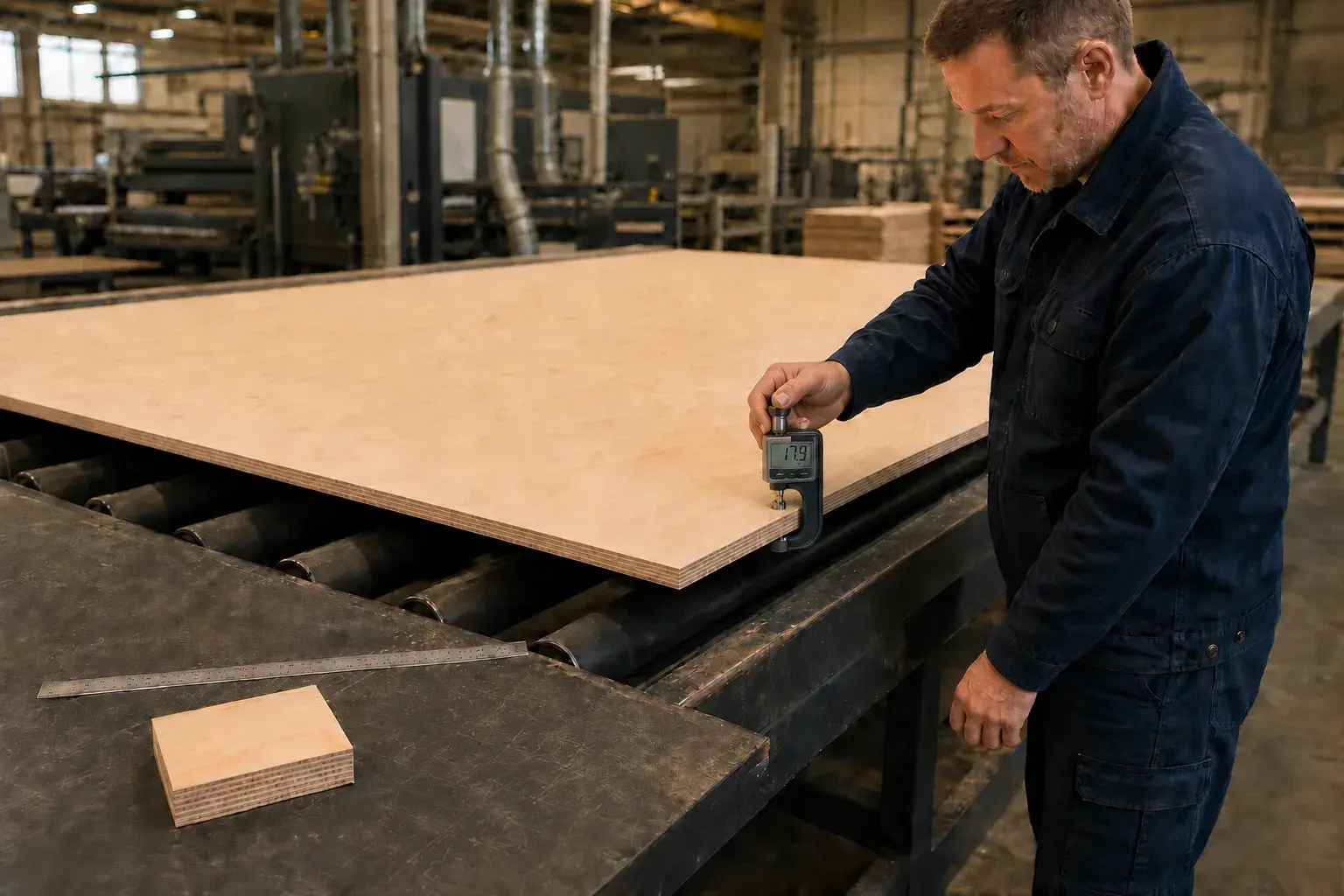
Measure at the agreed points and compare the readings with the finished-thickness tolerance on your order. Record the panel identification and measurement date for receiving and repeat-order checks.
Put quantity, processing, packing and delivery on the same basis.
Ask us to price the confirmed construction, drawing revision, unit, trial quantity, included work, Incoterms® rule and named place.
Example: 48-sheet cabinet trial order
| Comparison item | Requested basis | Quote A | Quote B |
|---|---|---|---|
| Specification revision | CAB-18 Rev C | Rev C confirmed | Rev B only |
| Trial quantity | 48 sheets on one protected pallet | 48 sheets included | MOQ stated as 96 sheets |
| Price unit basis | Per sheet for the confirmed 2440 × 1220 × 18 mm construction | Per sheet; construction tied to Rev C | Per sheet; lay-up not declared |
| Included machining | Nesting review and first production sample CNC trial | Included for supplied Rev C file | Cut sheets only |
| supporting documentation cost | Face range, edge sample and first production sample record | Edge sample included; first production sample open | Face photo only |
| Packing | Protected export pallet with face separators and agreed marks | Included | Standard pallet; face protection open |
| Trade rule | CFR Jebel Ali, Incoterms® 2020 | CFR Jebel Ali stated | CFR with named place missing |
| Lead time | 4 weeks after approval | 4 weeks | 5–6 weeks |
| Quotation validity | 30 calendar days from issue | 30 days | Not stated |
| Decision | Confirm the order after the construction, documents, packing and delivery term are agreed | Technically closest; first production sample still open | Construction, supporting documentation, packing and named place open |
See how the specification changes with the end use.
Compare offers against the same face, core, thickness and finish, then check the included machining, inspection, packing and delivery terms.
Painted cabinet component
- Application
- Interior cabinet carcass; concealed back; CNC and hardware drilling
- Product
- Furniture Grade Plywood recommendation option
- Panel construction
- Paint-ready face; declared poplar/combi core; interior project bond; balanced paint system
- Size and machining
- 2440 × 1220 × 18 mm nominal; cut list and machining file by revision; tolerance by approved drawing
- Acceptance
- Paint and hardware trial before production
- Quantity and packing
- One trial pallet then monthly forecast; protected face packing; destination and Incoterm remain open
Concrete formwork panel
- Application
- Wall forms; repeated wet/dry site cycle; supported joints and site cutting
- Product
- Film Faced Plywood option
- Panel construction
- Phenolic film; declared core/lay-up; exterior bond specification; factory edge sealing
- Size and machining
- 2440 × 1220 × 18 mm; support and cut plan owned by formwork designer
- Acceptance
- first production sample panel, edge coverage and drawing check
- Quantity and packing
- Trial quantity by pour plan; corner/face protection; destination open
Precision instrument flight case
- Application
- Reusable protective equipment case with road handling and hardware interfaces
- Product
- Flight-case application next steps with plywood recommendation open
- Panel construction
- Lightweight declared core; surface and balance option; edge/hardware trial
- Size and machining
- Cut parts from approved CNC revision; thickness selected after payload/hardware trial
- Acceptance
- Hardware fit, edge and first assembled case inspection
- Quantity and packing
- Trial case then repeat forecast; component packing and destination open
Exterior MDO traffic sign panel
- Application
- Exterior sign substrate with print/coating, drilled fixing and weather exposure
- Product
- HDO/MDO Plywood option
- Panel construction
- MDO/HDO overlay as nominated; declared substrate; exterior bond; balanced back and sealed edges
- Size and machining
- Project sheet/cut size; hole pattern and edge profile by drawing; oversize subject to validation
- Acceptance
- Print/coating trial, dimensional and edge inspection
- Quantity and packing
- Project quantity and spares; interleaved face protection; destination and trade basis open
Painted cabinet carcass — buyer requirement versus Quote A and Quote B
| Compare | Buyer requirement | Quote A | Quote B | Result |
|---|---|---|---|---|
| Specification revision | Buyer specification Rev C | Rev C acknowledged | Rev B referenced | Different |
| product option | Furniture panel selected after trial | Furniture Grade Plywood | Commercial Plywood | Different |
| Face requirement | Paint-ready face range | B/BB birch reference offered | BB/CC poplar reference offered | Different |
| Back requirement | Concealed back; repairs limited by schedule | Written schedule attached | Seller standard only | Open |
| Core family | Declared poplar/combi option | Poplar/eucalyptus combi | Poplar core | Different |
| Veneer construction | Balanced odd-ply lay-up; sequence declared | 13-ply sequence attached | 11 plies; sequence open | Open |
| bond specification | Conditioned-interior project requirement | MUF declared | UF declared | Different |
| emission requirement | Buyer-nominated method and limit | EN 717-1 option proposed | CUZI PLY declaration only | Open |
| Surface or overlay | Sanded face compatible with primer and paint | Paint trial included | Surface description only | Open |
| Edge treatment | Buyer finish on exposed machined edges | Edge sample included | Not stated | Open |
| Finished size | CNC cut list by drawing Rev C | Included after file approval | Cutting excluded | Different |
| Tolerance basis | Finished drawing requirement | ±0.4 mm declared | ±0.5 mm declared | Different |
| Machining | CNC nesting, drilling and hinge interface | Coupon and hardware trial offered | CNC coupon only | Open |
| Drawing revision | BOM and CNC file Rev C | Rev C accepted | Rev B quoted | Different |
Next stepRequest a revised Quote B against Rev C, with its core, samples, first production panel inspection, packing and named place confirmed.
Confirm the approved specification before production.
Product and drawing
Confirm the face, back, core, bond, finish, dimensions, tolerances and drawing revision. Record any agreed substitutions or changes with the order.
Quantity and price
Confirm quantities by size and thickness, included machining and finishing, currency, price unit, payment terms and quotation validity.
Material and quality
Keep the dated material reference, dimensional checks, accepted variations, inspection plan and required product documents with the purchase order.
Packing and delivery
Confirm protection, packing and labels, Incoterms® rule and named place, delivery schedule and receiving arrangements. Our order acknowledgement should match the specification and purchase order.
Further reading from standards bodies
Check the edition and product scope required by your project or destination.
State face and back grades, core construction and bond quality as separate items. View International Organization for Standardization (ISO) reference ↓
Agree dimensions, tolerances and the measurement method for receiving checks. View International Organization for Standardization (ISO) reference ↓
Name both the test method and required performance when specifying tests. View British Standards Institution (BSI) reference ↓
Use EN 636 to specify intended conditions and the properties required for the project. View British Standards Institution (BSI) reference ↓
International Organization for Standardization (ISO)Plywood — Classification by surface appearance — Part 1: GeneralISO 2426-1:2020, Edition 2
Visit official source ↗International Organization for Standardization (ISO)Plywood — Tolerances on dimensionsISO 1954:2013, Edition 2
Visit official source ↗International Organization for Standardization (ISO)Wood-based panels — Determination of moisture contentISO 16979:2003, Edition 1
Visit official source ↗International Organization for Standardization (ISO)Wood-based panels — Determination of densityISO 9427:2003, Edition 2
Visit official source ↗British Standards Institution (BSI)Plywood — SpecificationsBS EN 636:2012+A1:2015
Visit official source ↗British Standards Institution (BSI)Plywood — Bonding quality — Part 1: Test methodsBS EN 314-1:2004
Visit official source ↗British Standards Institution (BSI)Plywood — Bonding quality — Part 2: RequirementsBS EN 314-2:1993
Visit official source ↗International Organization for Standardization (ISO)Plywood — Bonding quality — Part 1: Test methodsISO 12466-1:2007
Visit official source ↗International Organization for Standardization (ISO)Plywood — Bonding quality — Part 2: RequirementsISO 12466-2:2007
Visit official source ↗National Institute of Standards and Technology (NIST)Voluntary Product Standard PS 1-22 — Structural PlywoodDOC PS 1-22
Visit official source ↗Standards AustraliaStructural plywood — Part 0: SpecificationsAS/NZS 2269.0:2012 Amd 1:2015
Visit official source ↗Ministry of Agriculture, Forestry and Fisheries of Japan (MAFF)Japanese Agricultural Standard for PlywoodJAS 0233:2026
Visit official source ↗International Organization for Standardization (ISO)Sampling procedures for inspection by attributes — Part 1ISO 2859-1:2026, Edition 3
Visit official source ↗International Chamber of Commerce (ICC)Incoterms® 2020Incoterms® 2020 rules
Visit official source ↗International Plant Protection Convention (IPPC)Adopted International Standards for Phytosanitary MeasuresISPM 15 — Regulation of wood packaging material in international trade
Visit official source ↗Continue into the product or technical detail you need.
DECISION QUESTIONS
Before the purchase order
Choose the right specification.
What is the minimum information for an initial factory quote?
Send the use, finished sheet or part dimensions, thickness, quantity and destination. Add visible-face, machining, finish and required-document details where known. Mark the choices you want us to recommend. We can discuss options first, then confirm the supply specification and commercial terms before production.
How should I specify cut or machined plywood parts?
Identify each part, finished dimensions, quantity, face direction, reference edges, holes, grooves, tolerances and finish. Keep the drawing revision clear and state which operations you will do after delivery. Discuss drawings with our team by email; we confirm the priced processing and any open details in writing.
What should happen when a drawing changes after the quotation?
Send the revised drawing or requirements and identify what changed. We review material, machining, quantities, inspection, packing, price and timing before confirming the change. Keep the agreed revision with the order so your factory supply and your workshop are working to the same dimensions and finish.
What is the minimum information for a plywood RFQ?
Start with the use, dimensions, thickness, quantity and destination. Add face, core, bond, processing, packing and required documents where known. Copy the RFQ template on this page and write “Need advice” for undecided choices; our factory will recommend the construction and confirm the full quotation with you.
What if the core or bond is unknown?
Describe machining, exposure, finish, weight, supporting documentation and failure priorities. A recommendation can then be compared and approved in writing.
Can a grade shorthand stand alone?
No. Tie it to a named system or written defect range and keep face, core and bond in separate fields.
Which size and tolerance data are required?
Give nominal and finished dimensions, units, thickness, orientation, tolerances, machining, quantity by line and the current drawing revision.
What is the difference between an approved sample and first production sample?
An approved sample defines the agreed appearance and material reference. A first production sample checks the panel or component against the agreed construction and drawing.
Which certificates and test records should be requested?
Send the standard, performance class and intended use specified by your project. Ask us for the applicable product certificate, declaration or test report, including the producer/product identification and reference number. Custom length or width alone does not call for a new certificate for every dimension; the document's product and performance scope remains the basis for selection.
How should two quotations be compared?
Align specification revision, units, supporting documentation, processing, packing, trade rule, named place, timing and deviations before comparing price.
Can a trial order be below the normal MOQ?
Tell us the quantity and purpose of your first order. We will confirm the minimum production run, material, processing, packing, price and timing for the selected construction. Separate a material request from a production trial so each can be priced and arranged appropriately.
How should packing and Incoterm be written?
Name the packing method, label file, Incoterms® 2020 rule and the exact named place or port; do not rely on an unqualified three-letter term.
Which destination inputs belong to the importer?
Legal entry, tariff classification, product claims, marks, documents and project acceptance remain subject to importer or destination authority confirmation.
What must trigger change control?
Tell us when the drawing, species, core, bond, finish, thickness, machining, project requirement or packing changes. We confirm the revised construction, checks, price and delivery schedule before making the affected panels. Keep the updated specification with the order and the reference material.
What happens after the RFQ is submitted?
Our team checks your requirements, prepares a quotation and asks for any drawings or product documents needed. We confirm the specification, samples and order details with you before production begins.
Share the known details for a panel recommendation and quotation.
A drawing, reference sample and destination make the first response more precise. You can also describe the result you need when material choices are still open.
Your component
Tell us what you will make, how it will be used and the dimensions. Write “Need advice” for the material choices you want us to recommend.
Your order
Share the thickness and quantity for each size, destination and target delivery date. Add machining, finish and packing requirements where known.
Your project requirements
Include the specified standard, grade and documents, or discuss the checks required for the finished application. Send drawings by email or WhatsApp after contacting us.
Material before the order
Request the veneer, core and finish you want to compare. We will discuss dimensions, quantity, destination and any machining or assembly trial needed.
Talk directly to our factory
Let’s plan your plywood order.
Tell us what you’re making, the quantity and destination. Our team will help you choose a panel and prepare a quote.