CUZIPLYFactory-direct plywood
Get a quote
EXPORT PACKING GUIDEPACKING · LOAD PLANNING · SHIPPING RECORDSUPDATED 2026-09-21

Plywood Packing & Container Loading

Protect plywood from the factory to the receiving warehouse with a pack designed for the actual panels. Compare flat, side and upright packing; choose bearers, face and edge protection, straps and moisture control for the finish and handling equipment. Then calculate pack weights, check the assigned container's door and floor, plan support and securing, and record the loaded quantity for shipping documents. Use the worked example below to estimate an order, then enter your own dimensions and measured weights in the calculator.

Compare packing methods
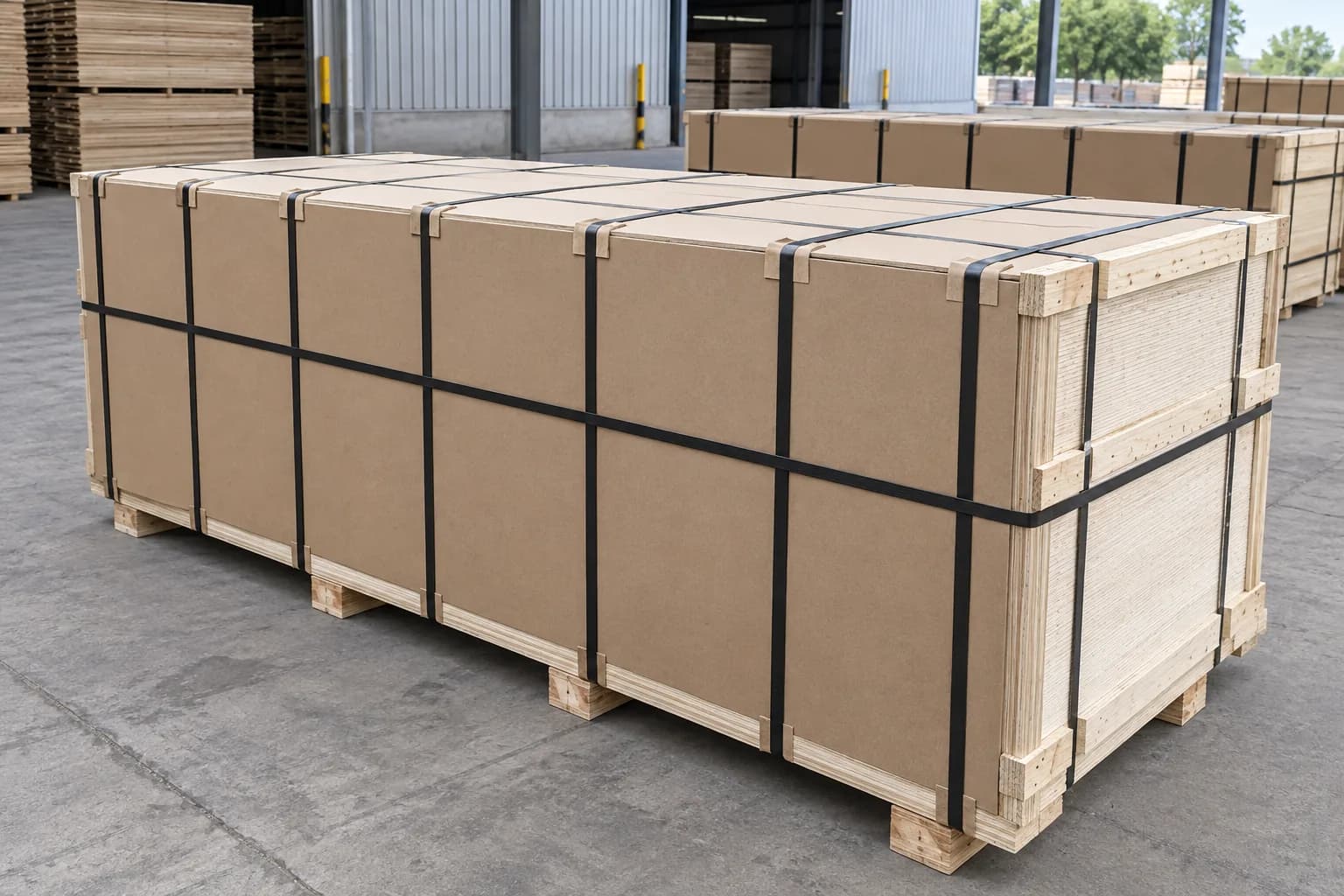
Wide flat plywood export pack protected with packing boards, corner guards, black straps and separated pallet feet in a covered warehouse
Flat-pack supports, corner protection and strap positions are selected for the panel size and handling method.
Choose the pack
Flat, side or upright packing matched to the panel and unloading equipment.
Calculate the load
Compare sheet, pack, cargo and container mass with usable space and payload.
Protect the shipment
Check container condition, support, securing, moisture and receiving.
COMMON PACKING QUESTIONS

Understand quantity, weight and protection before you place an order.

How is a plywood export pack specified?

Freeze the released lot, finished dimensions and actual mass basis before selecting support, protection, handling and identification.

Depends onSurface sensitivity, pack limit, equipment, transport climate and receiving method change the construction.Issue one pack brief with unresolved points held open.

How many plywood sheets fit in a container?

For example, 96 sheets of 1220 × 2440 × 18 mm plywood at a measured 32.5 kg per sheet make two 48-sheet packs in the calculator below. Each pack is 1670 kg with 110 kg packaging. A shipment quantity is then set by pack dimensions, payload, floor loading, door entry and unloading equipment.

Depends onActual panel and pack dimensions, measured mass, container plate data, door aperture and discharge capability control the result.Enter the order's figures in the calculator and check the assigned container.

How are unit mass, pack mass, payload and VGM kept separate?

Record panel unit mass, product net mass, pack gross mass, cargo-in-CTU mass, tare and packed-container gross as separate values.

Depends onMeasured values, packaging, dunnage, securing and the actual container tare must reconcile.Send the final mass record to the Export and VGM option.

How should bearers, top and bottom sheets, edge protection and straps be selected?

Select each element from load path, surface sensitivity, pack geometry, lifting and transport exposure rather than a universal recipe.

Depends onPack mass, fork entry, surface, span, strap compatibility and unloading method matter.Approve the pack construction and first completed pack.

What must be checked before loading an empty container?

Confirm identity, CSC and responsible party data, dimensions, door aperture, floor, walls, roof, doors, cleanliness, dryness and permitted securing options.

Depends onCarrier, option and actual equipment restrictions remain shipment-specific.Reject, replace or record acceptance before cargo enters.

How are long, oversize and surface-sensitive panels handled?

Use an equipment-specific geometry and full-support review with dedicated face, edge and handling protection.

Depends on1220×3800, 1525×3050 and 2100×2800 mm panels do not imply one container or fork solution.Confirm door entry, load path, equipment and discharge before packing.

How are movement, moisture and condensation controlled?

Combine load-path control, blocking or approved securing, dry inputs and an option-specific barrier, ventilation or desiccant decision.

Depends onCargo moisture, climate, dwell, pack permeability and receiving storage change the answer.Record the chosen controls and inspection points.

What loading records are handed to Export and the buyer?

Hand over actual pack IDs, count, measured mass, container identity, load plan, exceptions, photos, moisture controls and VGM input status.

Depends onThe pack record does not prove carrier acceptance, customs release or damage-free arrival.Reconcile the record with Export before document release.
PACKING INFORMATION

Start with the panel, pack, handling and destination details.

What to provideHow it affects packingWhat to recordConfirm before packing
Product, SKU and surfaceProtection and compatibility optionExact identity and surface sensitivityMixed or unidentified product
Released lotLot separation and release linkLot and release referenceRelease or NCR status open
Finished length, width and thicknessPack footprint and clearancesMeasured finished dimensionsTolerance or format unresolved
Sheet count and order mixPack count and loading sequenceSKU count reconciliationMixed-SKU sequence unknown
Unit or lot mass basisMeasured or planned calculation optionMethod, instrument and valueNo traceable mass basis
Sheets per pack and stack heightPack geometry and stabilityCount and finished pack heightHandling limit unresolved
Face, back and edge sensitivityInterleaf, cover and edge optionProtection specificationCompatibility not confirmed
Long or oversize optionFull-length support and entry checkFormat-specific feasibilityDoor or support geometry unknown
Lifting, fork and discharge equipmentFork entry and lifting arrangementCapacity and load-centre recordEquipment data absent
Maximum pack massPack split and handling checkpointsApproved pack-mass ceilingresponsible party or site limit unknown
Support and bearer optionLoad path and spacing decisionMaterial, orientation and positionUnsupported span remains
Wrap, barrier, desiccant and ventilationMoisture-control optionMaterials, quantity basis and closureClimate or compatibility unknown
Strap, corner and edge protectionRestraint and pressure optionMaterial, count basis and protectorsSurface damage or stability risk
Solid-wood component and biosecurityDestination confirmation optionComponent scope and supporting documentationDestination or material unknown
Actual container identity and dataEquipment-specific load planID, plate, dimensions and conditionAssigned CTU not inspected
Destination, mode, climate, storage and receivingoption and unloading controlsNamed option and receiving capabilityCritical downstream input open
FROM FACTORY TO CONTAINER

Follow the packing sequence from finished sheets to a recorded container load.

  1. Receive released lot

    Information needed
    Lot release and count
    Packing action
    Match physical lot to approved identity
    Who checks it
    Packing lead
    Ready when
    Any release mismatch
    Record
    Released packing lot
    Next step
    Pack brief
  2. Freeze pack brief

    Information needed
    All sixteen inputs
    Packing action
    Close or label unknown decisions
    Who checks it
    Technical and packing
    Ready when
    Unsupported assumption
    Record
    Approved pack brief
    Next step
    Mass and geometry
  3. Establish actual mass and geometry

    Information needed
    Finished panels and scale option
    Packing action
    Measure and calculate without merging mass layers
    Who checks it
    Quality and packing
    Ready when
    Measured/planned conflict
    Record
    Mass and geometry file
    Next step
    Support design
  4. Design support and protection

    Information needed
    Load path and surface options
    Packing action
    Specify bearers, protection, straps and moisture controls
    Who checks it
    Packing engineer
    Ready when
    Universal recipe substituted
    Record
    Pack construction file
    Next step
    First pack
  5. Build and identify packs

    Information needed
    Approved construction
    Packing action
    Build, inspect and identify each pack
    Who checks it
    Packing team
    Ready when
    Damage, instability or ID error
    Record
    Accepted packs
    Next step
    CTU inspection
  6. Inspect actual CTU

    Information needed
    Assigned equipment
    Packing action
    Inspect identity, plate, aperture, floor and condition
    Who checks it
    Loading lead
    Ready when
    Condition or data unacceptable
    Record
    CTU readiness record
    Next step
    Load-plan approval
  7. Approve load plan

    Information needed
    Packs and CTU data
    Packing action
    Check geometry, mass, distribution, transport and handling
    Who checks it
    Logistics and technical
    Ready when
    Any limiting condition open
    Record
    Approved loading brief
    Next step
    Loading
  8. Load and secure

    Information needed
    Approved plan
    Packing action
    Control lift, placement, support, voids and moisture option
    Who checks it
    Loading lead
    Ready when
    Person in danger zone or plan deviation
    Record
    Controlled load
    Next step
    Reconciliation
  9. Reconcile count and weight

    Information needed
    Physical load and records
    Packing action
    Record IDs, count, mass, photos and exceptions
    Who checks it
    Packing and Export
    Ready when
    Record does not match load
    Record
    Loading record
    Next step
    Export/VGM
  10. next steps

    Information needed
    Reconciled pack/load file
    Packing action
    Transfer actual data and unresolved conditions
    Who checks it
    Export coordinator
    Ready when
    Missing actual data
    Record
    Controlled next steps
    Next step
    Carrier, buyer and receiving option
PACK CONSTRUCTION

Keep the full sheet footprint supported and protect faces, edges and strap paths.

Wide flat plywood export pack protected with packing boards, corner guards, black straps and separated pallet feet in a covered warehouse
Full-support export pack construction

Record pack identity, packing boards, strap layout, separated pallet feet, lifting direction and unresolved limits before release.

PACK COMPONENTS

Choose support, protection and straps for the panel and handling conditions.

ComponentPurposeSelection inputPack specificationProtects against
Lot separationPrevent identity mixingRelease and SKU planPack-to-lot mapWrong product loaded
Sheet count and stack heightControl geometry and handlingPanel count and equipmentCount and heightUnstable or overweight pack
Top protectionProtect upper faceSurface and stacking exposureMaterial and coverageFace abrasion
Bottom protectionSeparate panel from supportSurface and skid interfaceMaterial and coverageMoisture or abrasion
Face or interleaf optionProtect sensitive facesOverlay and finishInterleaf typeScuff or imprint
Edge protectionProtect exposed edgesEdge finish and strap optionCoverageCrush and water entry
Corner protectionSpread local strap loadCorner geometry and tension optionProtector positionCorner crush
Bearer or skid materialCreate load pathPack mass and biosecurityMaterial identitySupport failure
Bearer orientation and spacingTransfer load to floor and forksPack span and equipmentMeasured positionSag or point loading
Fork entry and lift optionAllow controlled handlingFork length, spacing and load centreEntry directionFork damage or drop
Wrap or barrierManage exposureClimate and permeabilityMaterial and closureWet or trapped pack
Desiccant or ventilationControl condensation optionMoisture and voyage modelBasis and placementCondensation
Strap material, quantity and tensionStabilize the packMass, surface and handlingApproved optionLoose or damaged load
Strap edge protectorPrevent concentrated pressureStrap and edge interfaceProtector locationCut strap or crushed edge
Pack labels and handling marksMaintain identity and handling cuesBuyer and logistics briefApplied mark listMisrouting or wrong handling
Long or oversize full-length supportPrevent unsupported geometryExact size and lift optionSupport mapSag, twist or edge impact
EMPTY CTU

Inspect the assigned container before a pack crosses the door threshold.

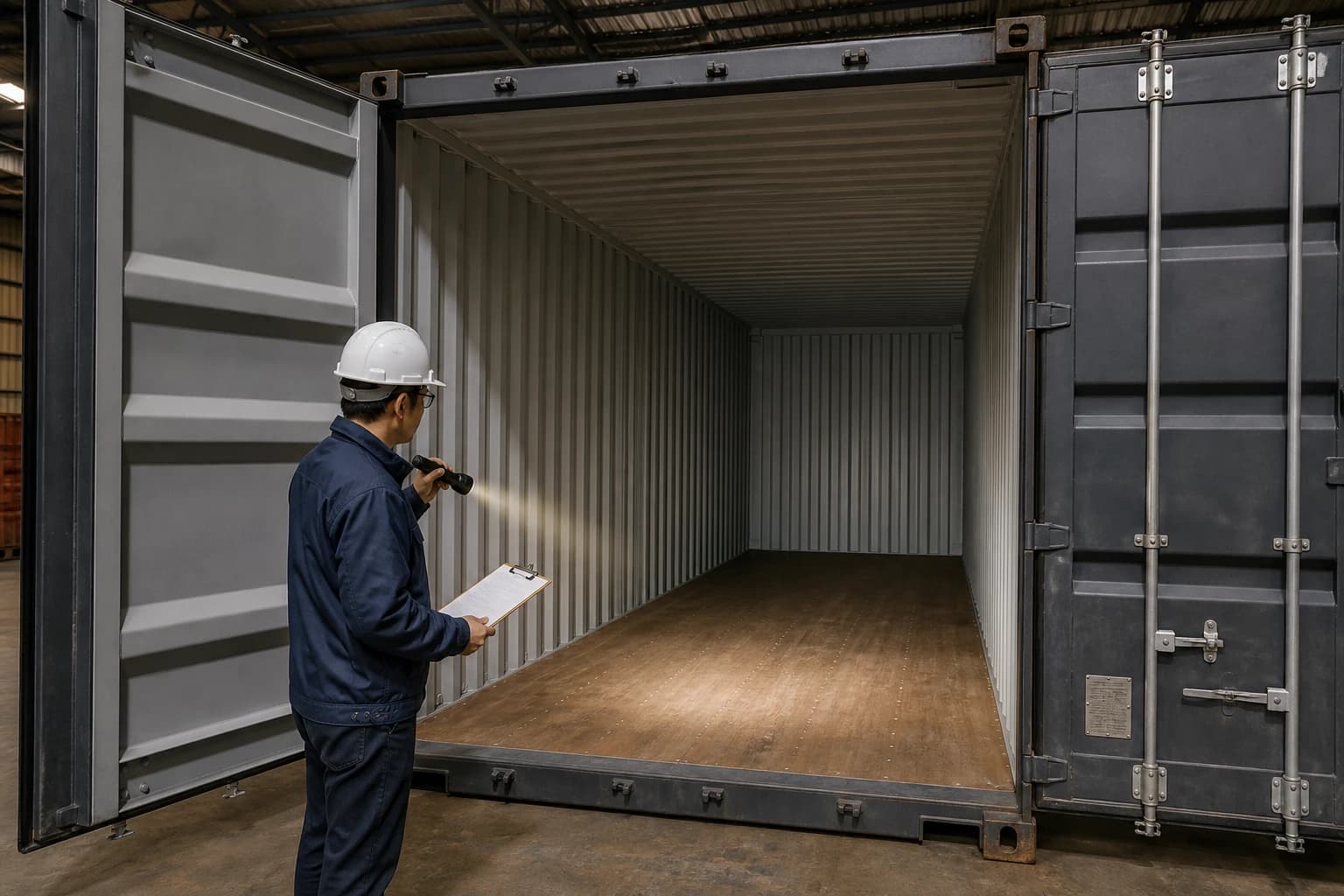
Inspector safely checking the clean floor, walls, roof and open rear doors of an empty general-purpose freight container
Empty-container readiness inspection

Inspect the assigned CTU and record actual identity, plate, aperture, floor, dryness and exceptions.

CONTAINER CHECKS

Inspect the assigned container's identity, usable space, condition and securing points.

CheckWhere to confirmWhat to inspectRecord
Container identity and typeresponsible party/carrier recordMatch assigned unitID and type
CSC plate and examinationActual plate/responsible party dataRead status and datesPlate review
Maximum gross, tare and payloadActual plate and responsible partyReconcile stated valuesMass limits
Actual internal dimensionsPhysical measure/responsible partyCheck clear dimensionsMeasured dimensions
Door aperturePhysical measureCheck width and heightDoor opening
Floor condition and rating sourceresponsible party/carrier and visual checkInspect damage and load optionFloor source and condition
Walls, roof and end wallVisual inspectionCheck deformation, holes and repairsCondition photos
Doors, locking gear and sealsVisual and functional checkOpen, close and inspectDoor condition
Lashing points and methodsresponsible party/carrier instructionsIdentify approved attachmentSecuring map
Cleanliness, odour and prior cargoVisual and sensory checkCheck compatibilityInspection note
Dryness and water ingressVisual and leak supporting documentationInspect dry floor, roof and sealsDryness record
Damage, deformation and repairsVisual inspectionIdentify affected areasException record
Protrusions, nails and sharp pointsVisual/tactile safe checkRemove or isolate hazardsHazard closure
Contamination or pest supporting documentationVisual inspectionEscalate supporting documentationBiosecurity note
option and carrier restrictionsCarrier/forwarderCheck equipment-specific rulesInstruction revision
Reject, replace and record authorityProject responsibility matrixConfirm the responsible contactDecision record
LOAD CALCULATOR

Calculate sheet, pack, cargo and packed-container mass separately.

The sample starts with 96 sheets in two 48-sheet packs. Enter your own dimensions, measured weights and container figures to compare an order.

  1. finished length
  2. finished width
  3. finished thickness
  4. planning density
  5. measured unit mass
  6. sheet count
  7. sheets per pack
  8. packaging mass per pack
  9. finished pack dimensions
  10. calculated pack count
  11. dunnage and securing mass
  12. actual container tare
  13. maximum gross mass input
  14. option, floor and handling limits
Mass layerCalculation
Planned unit masslength (m) × width (m) × thickness (m) × planning density (kg/m³)
Product net massselected unit mass × total sheet count
Per-pack gross massactual sheets in that pack × selected unit mass + packaging mass for that pack
Cargo-in-CTU massproduct net mass + total packaging mass + dunnage and securing mass
Packed-container gross / VGM inputcargo-in-CTU mass + actual container tare
Equipment payload referencemaximum gross mass input − actual container tare
Lowest feasible constraintminimum feasible result across mass, geometry, door entry, floor/point load, option, carrier, handling, securing and receiving checkpoints
Planning unit mass
32.149 kg/sheet
Measured unit mass
32.5 kg/sheet
Selected mass basis
measured
Selected unit mass
32.5 kg/sheet
Pack count
2
Actual sheets by pack
48 / 48
Gross mass by pack
1,670 / 1,670 kg
Product net mass
3,120 kg
Total packaging mass
220 kg
Cargo-in-CTU mass
3,415 kg
Actual tare input
2,280 kg
Packed gross / VGM input
5,695 kg
Equipment payload reference
28,200 kg
Gross-mass input margin
24,785 kg

Example · Replace planning assumptions with measured panel and pack data, dunnage, securing, tare, container plate, carrier instructions and transport conditions. The feasible result must satisfy mass, geometry, door, floor and point-load, handling, securing and receiving requirements together.

PACK ORIENTATION + GEOMETRY

Choose flat, side, vertical or mixed loading from the finished pack and measured container.

Current loading examples use an approximate 2.1 m usable width × 2.6 m usable height. Measure the assigned container and finished packs before release.

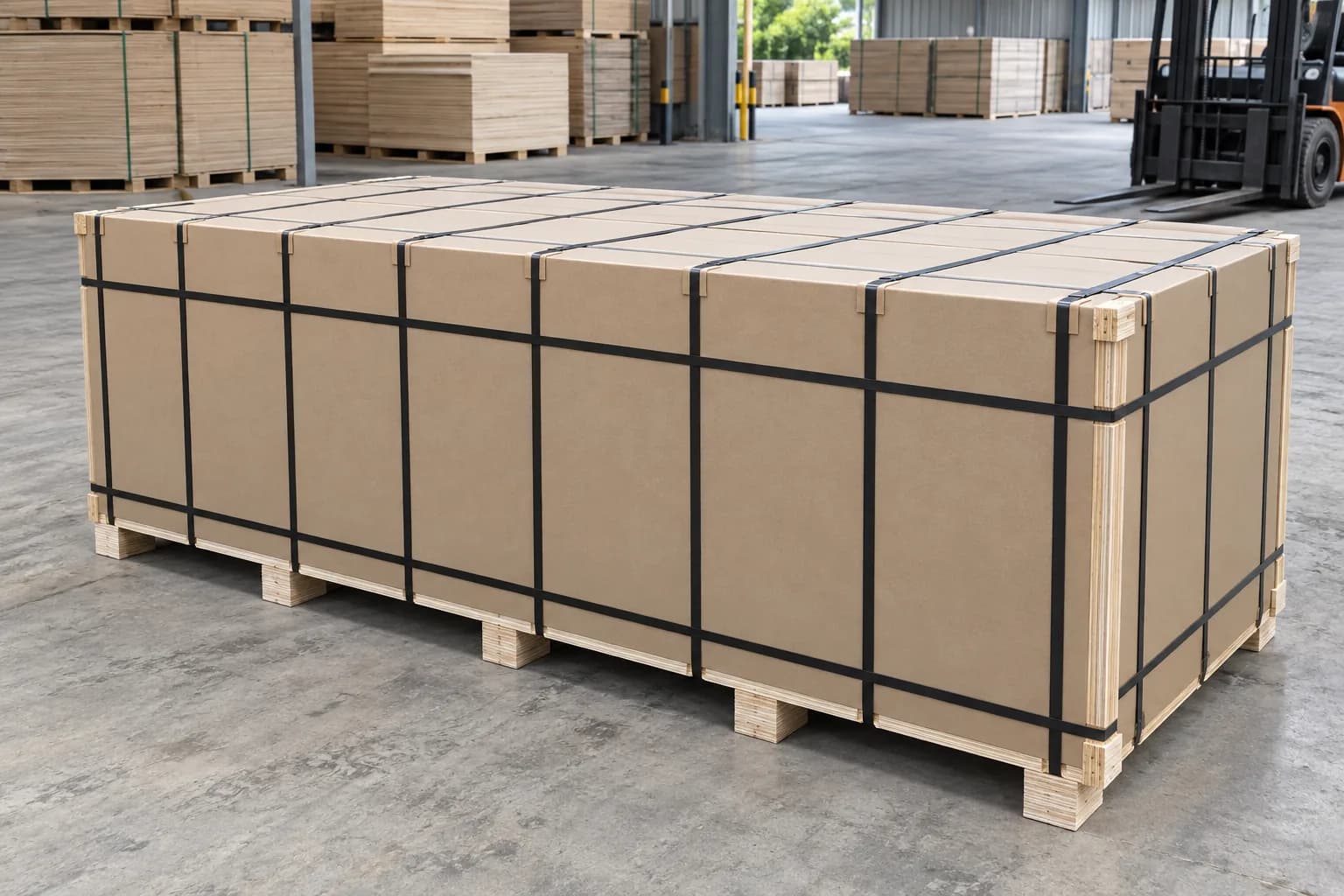
Wide horizontal plywood flat pallet with protective packing boards black straps corner protection and separate pallet feet
Packing method

Flat Pallet

Use when the finished board and pack geometry can remain horizontal through packing, lifting, container entry and receiving.

Protect the top, bottom and all four sides; option the straps over protected edges; keep the pallet feet as separate short blocks with clear fork entry.
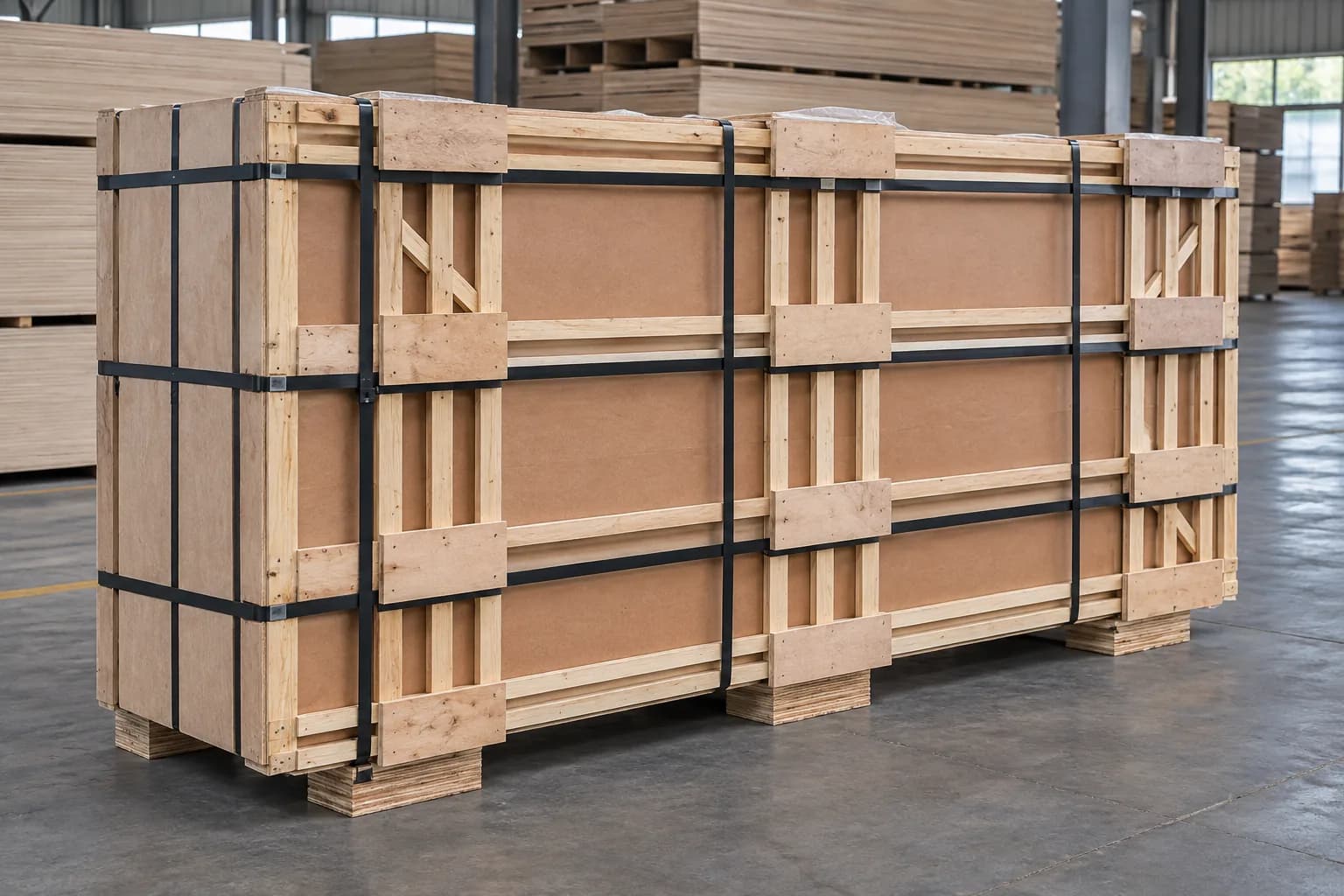
Long low plywood side pallet with timber side frames black straps protective boards and separate pallet feet
Packing method

Side Pallet

Use when the panel format, bundle geometry or container plan requires the sheets to travel on edge with a dedicated side frame.

The timber side frame, packing boards, strap path and pallet feet work as one handling construction; the frame is not replaced by straps alone.
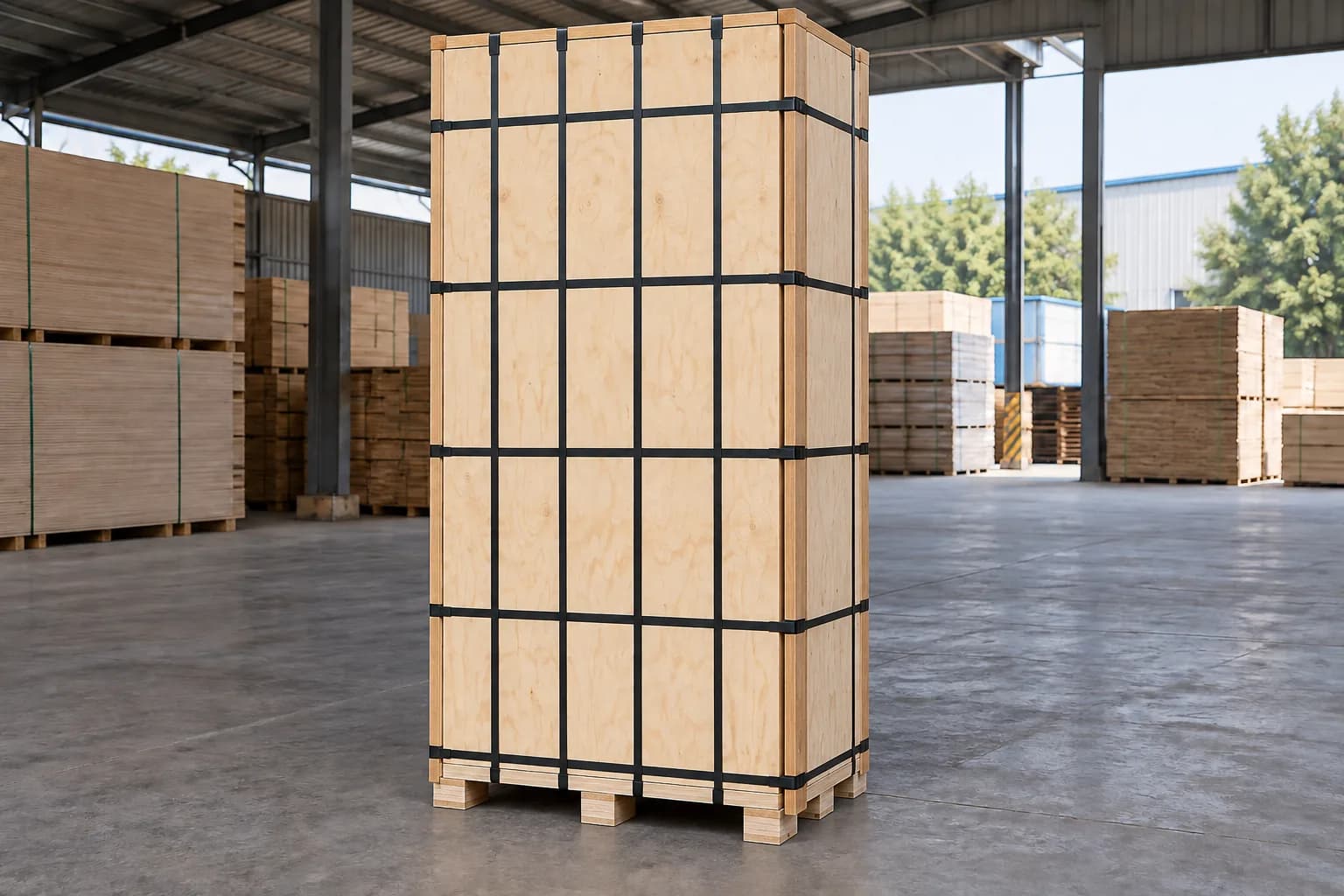
Tall vertical plywood pallet in correct one-to-two face proportion with dense black strap grid protective boards and separate feet
Packing method

Vertical Pallet

Use only when the packed height, door aperture, handling equipment, stability option and receiver unloading method have all been confirmed.

A 1220 × 2440 mm panel reads as a 1:2 face when upright. Use full face and side protection, dense strap options and discrete pallet feet.
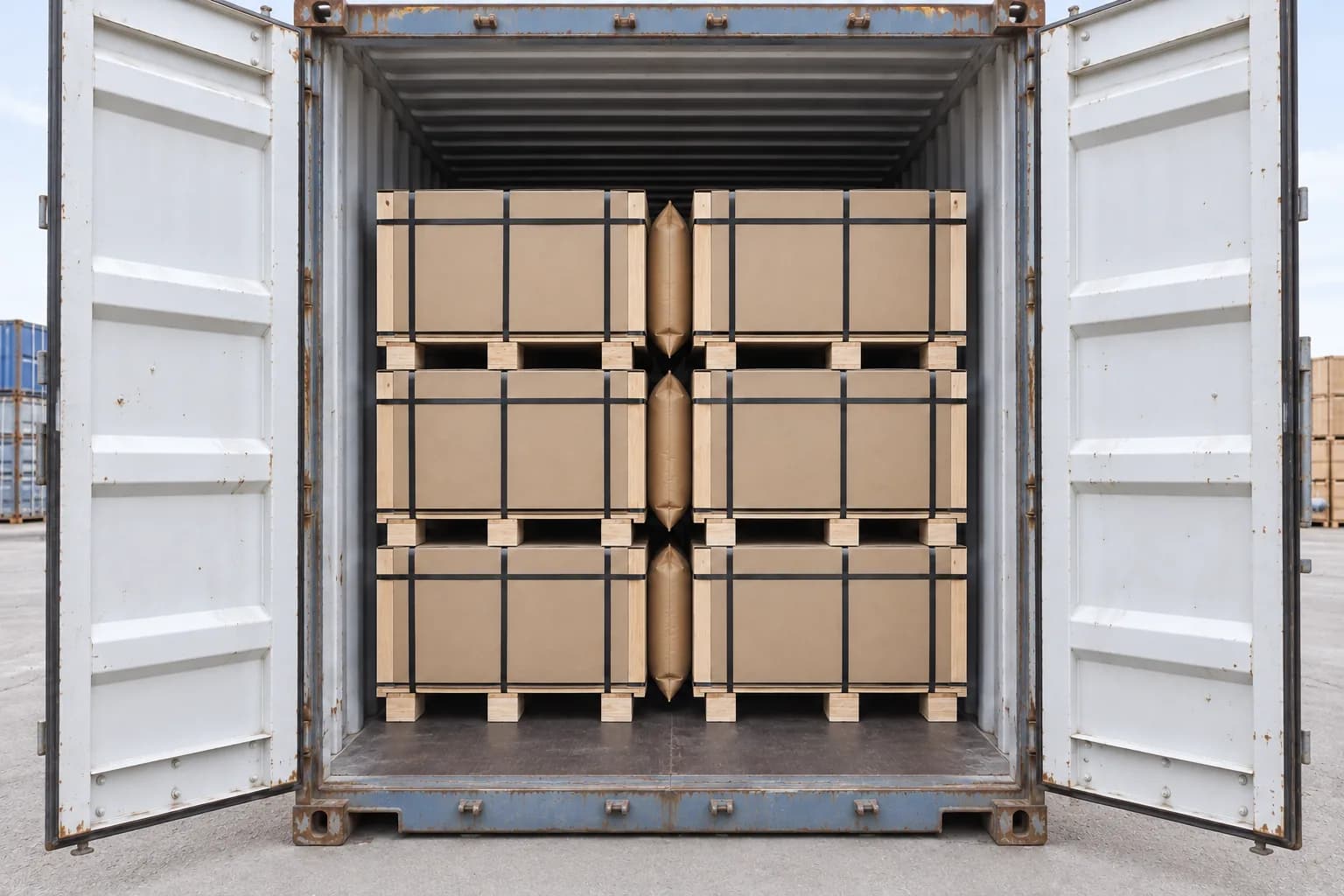
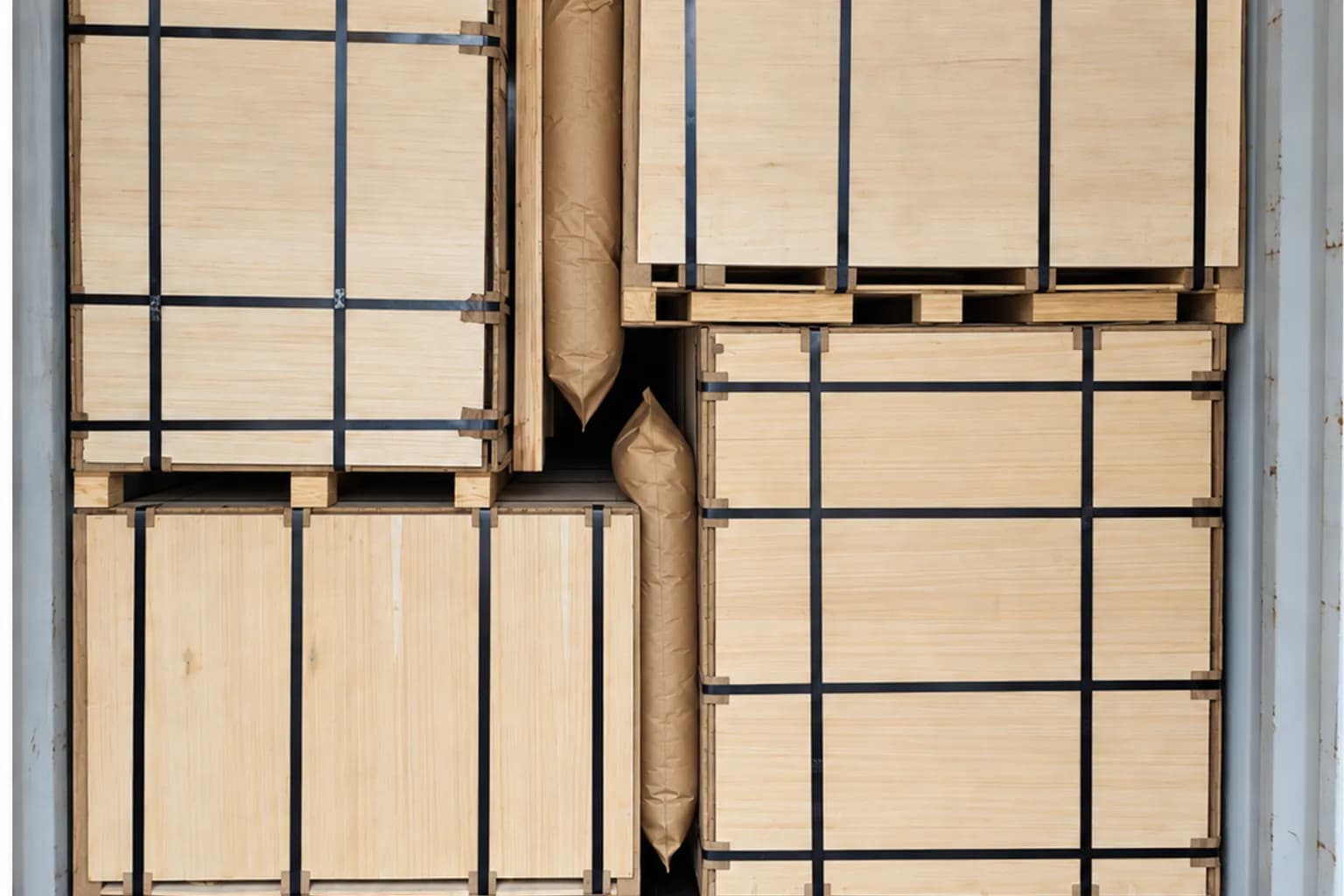
Two columns of narrow flat plywood pallet packs fitted inside a tall freight container with snug dunnage airbags
Container loading

All-flat pallet loading

For the current planning option, use two-across all-flat loading only when finished board width is below 1000 mm and both finished pack widths fit the measured usable width.

The working cross-section is approximately 2.1 m wide × 2.6 m high. Actual pack outer dimensions, door aperture, payload, support and unloading limits still control release.
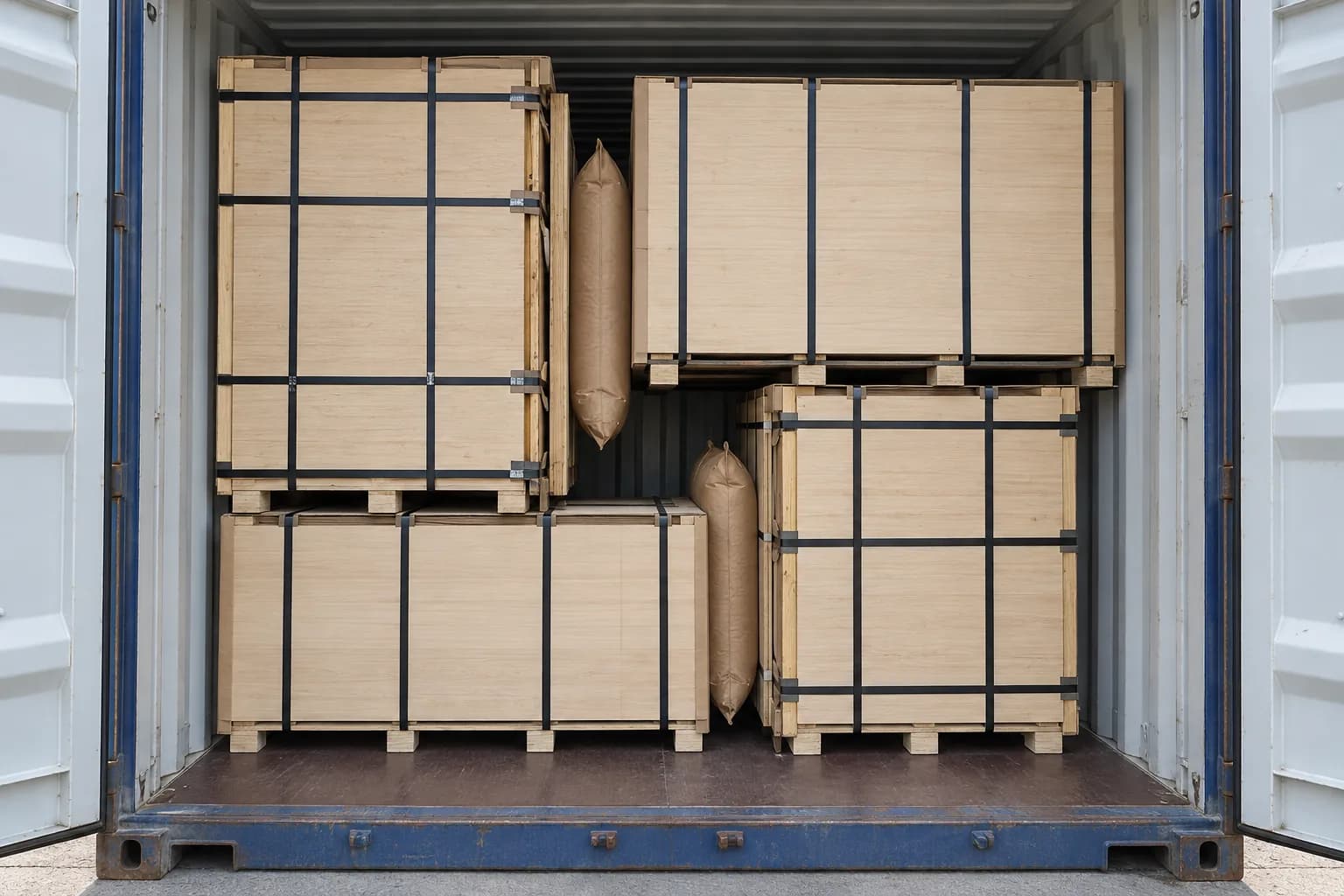
Mixed plywood container load combining flat pallets and side pallets with aligned supports and fitted dunnage airbags
Container loading

Mixed flat + side pallet loading

Use when one orientation alone leaves unusable geometry and the actual panel sizes allow flat and side packs to close the container cross-section together.

Align every upper support with the pack below, retain separate pallet feet and fit airbags only in the remaining supported voids.
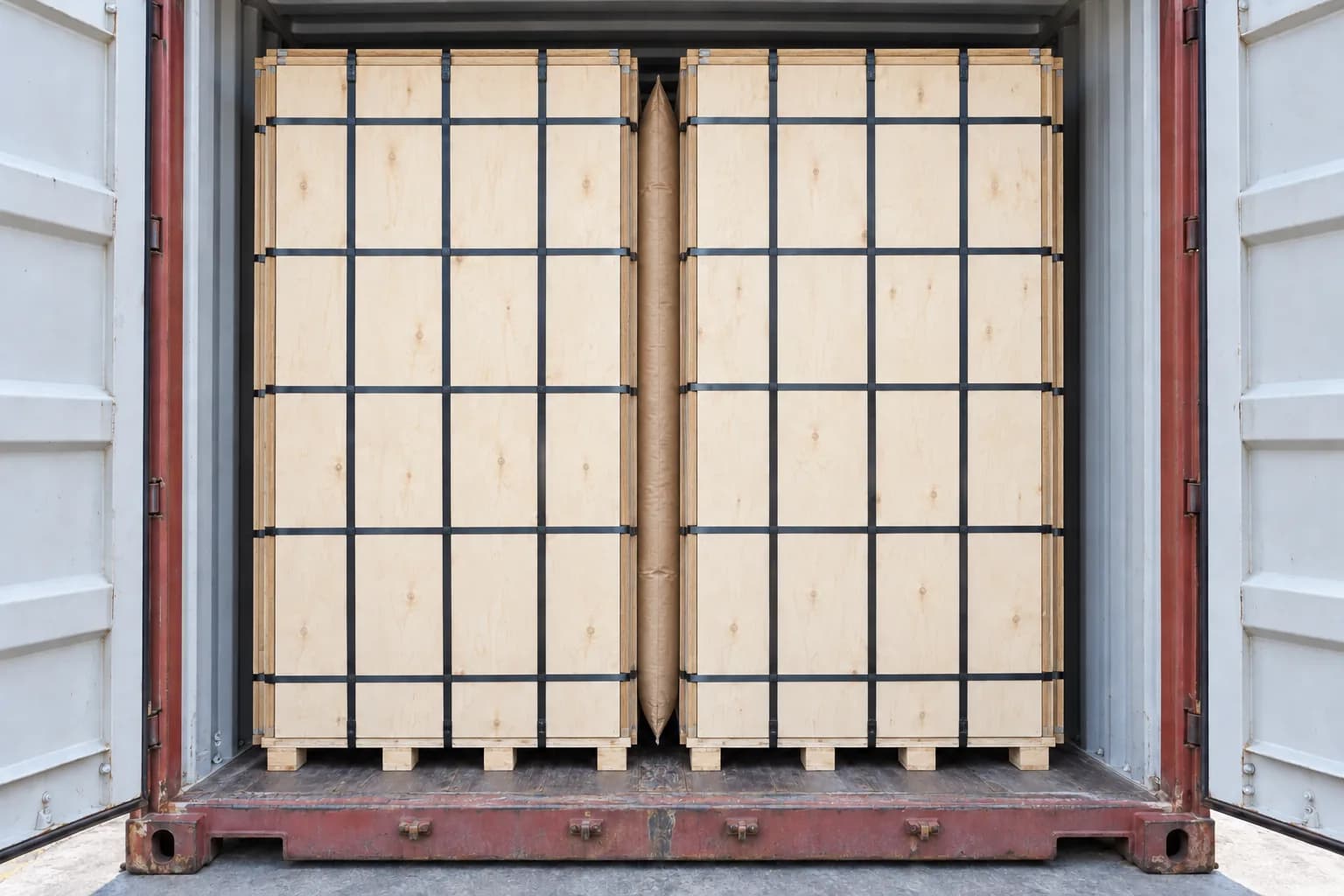
Two large vertical plywood pallet packs nearly filling a tall freight container with a slim central dunnage airbag
Container loading

Vertical pallet loading

Use when two finished upright packs nearly close the measured container width and the packed height remains within the usable height and door opening.

The working cross-section is approximately 2.1 m wide × 2.6 m high. Keep the centre void narrow, support the full load path and size the airbag to contact both packs.
DecisionGeometry inputLoad-path decisionSupporting documentsStop conditionNext relevant page
pack orientationActual pack and assigned CTU dimensionsRecord the supported option without assuming a nominal containerMeasured layout and equipment fileClearance, support or handling remains unresolvedPacking/loading lead
door-entry feasibilityActual pack and assigned CTU dimensionsRecord the supported option without assuming a nominal containerMeasured layout and equipment fileClearance, support or handling remains unresolvedPacking/loading lead
internal width, height and length clearanceActual pack and assigned CTU dimensionsRecord the supported option without assuming a nominal containerMeasured layout and equipment fileClearance, support or handling remains unresolvedPacking/loading lead
long-panel orientationActual pack and assigned CTU dimensionsRecord the supported option without assuming a nominal containerMeasured layout and equipment fileClearance, support or handling remains unresolvedPacking/loading lead
oversize feasibilityActual pack and assigned CTU dimensionsRecord the supported option without assuming a nominal containerMeasured layout and equipment fileClearance, support or handling remains unresolvedPacking/loading lead
pack footprintActual pack and assigned CTU dimensionsRecord the supported option without assuming a nominal containerMeasured layout and equipment fileClearance, support or handling remains unresolvedPacking/loading lead
stacking layersActual pack and assigned CTU dimensionsRecord the supported option without assuming a nominal containerMeasured layout and equipment fileClearance, support or handling remains unresolvedPacking/loading lead
bearer-to-floor load pathActual pack and assigned CTU dimensionsRecord the supported option without assuming a nominal containerMeasured layout and equipment fileClearance, support or handling remains unresolvedPacking/loading lead
point and floor loadingActual pack and assigned CTU dimensionsRecord the supported option without assuming a nominal containerMeasured layout and equipment fileClearance, support or handling remains unresolvedPacking/loading lead
longitudinal distributionActual pack and assigned CTU dimensionsRecord the supported option without assuming a nominal containerMeasured layout and equipment fileClearance, support or handling remains unresolvedPacking/loading lead
transverse distributionActual pack and assigned CTU dimensionsRecord the supported option without assuming a nominal containerMeasured layout and equipment fileClearance, support or handling remains unresolvedPacking/loading lead
centre-of-gravity optionActual pack and assigned CTU dimensionsRecord the supported option without assuming a nominal containerMeasured layout and equipment fileClearance, support or handling remains unresolvedPacking/loading lead
door-end clearanceActual pack and assigned CTU dimensionsRecord the supported option without assuming a nominal containerMeasured layout and equipment fileClearance, support or handling remains unresolvedPacking/loading lead
unloading sequence, equipment and mixed-SKU accessActual pack and assigned CTU dimensionsRecord the supported option without assuming a nominal containerMeasured layout and equipment fileClearance, support or handling remains unresolvedPacking/loading lead
CONTROLLED LOADING

Keep people outside the danger zone while full fork support and clearances remain visible.

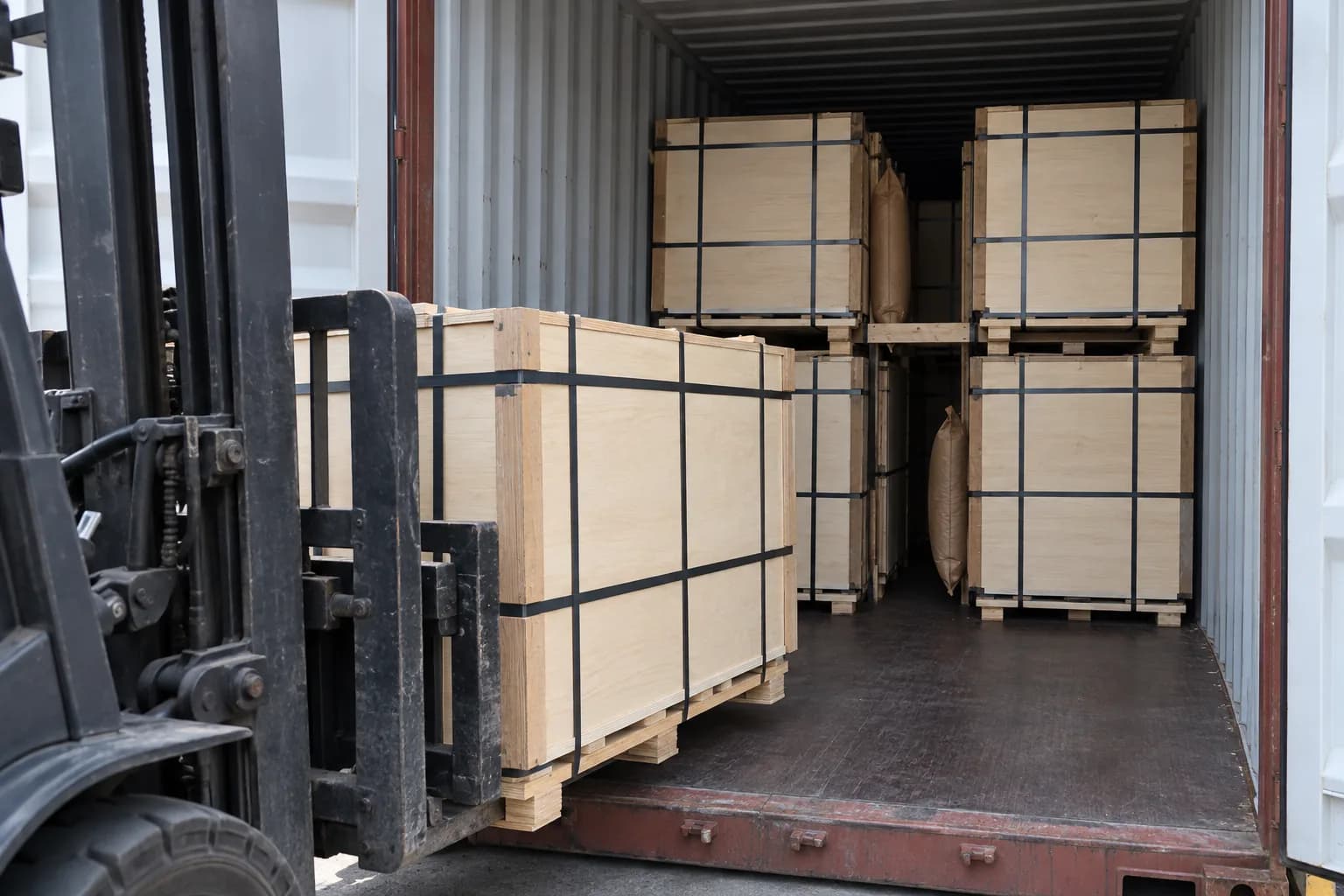
Industrial forklift placing a long strapped flat plywood pallet into a freight container with a spotter remaining clear of the movement zone
Lengthwise pack loading operation

Use approved equipment, full fork support, door clearance and a no-person danger zone during movement.

LOADING AND SECURING

Support each pack and control movement during transport.

ExampleValues in this example use one consistent set of pack and container inputs.

What to protectCheck againstPacking or loading actionRecord
Lifting-equipment capacity and load centreExample packs are 1670 kg each; actual forklift plate and load centre remain openValidate equipment for the actual pack centre before movementEquipment identity, rated capacity and approval contact
Fork length, spacing and entryExample full panel footprint and support mapConfirm full engagement under the supported pallet optionFork dimensions, entry direction and observed clearance
Pack stability during travelTwo example packs of 48 sheetsApprove low-speed travel and stability controls for the siteTravel option, operator and exception record
Door and frame clearanceAssigned container door opening and frame clearanceMeasure the assigned door before loadingDoor width, height and clearance record
Floor contact and supportExample pack gross 1670 kg; actual floor data openMap supports to acceptable floor/load pathsSupport positions and floor-source reference
Load sequenceTwo equal example packsSet a sequence that preserves access and distributionPack order and placement sequence
Longitudinal movementActual option acceleration and restraint data openDefine an option-specific blocking or restraint decisionLongitudinal restraint file and responsible approver
Transverse movementActual CTU geometry and option data openClose side clearance or approved restraint optionTransverse clearance and control record
Vertical movement and stack restraintTwo example packs; stacking approval openConfirm stack interface and vertical controlStack geometry and restraint record
Blocking and bracingActual attachment and floor rules openUse only carrier/responsible party-approved methodsMaterial, location and approval reference
Friction and void controlExample surfaces are raw/sanded; actual interface requiredRecord compatible interface material and void treatmentInterface material and placement supporting documentation
Strap or lashing optionExample packaging mass is 110 kg/pack; strap design openApprove option, protectors and attachment without face damageStrap/lashing map and inspection point
Door-end restraint and opening safetyActual door-end clearance and unloading method openProvide controlled opening and receiving sequenceDoor-end control and receiving next steps
Final danger-zone and closure checkTwo packs, 3415 kg cargo-in-CTU planning massKeep personnel clear, reconcile placement, then closeFinal loading check, photos and exceptions
MOISTURE, CONDENSATION + STORAGE CONTROLS

Convert moisture, climate, dwell and receiving conditions into reviewable decisions.

ExampleMoisture decisions use the worked-file inputs together with the applicable shipping and receiving documents.

TriggerDecisionSupporting documentsFailure modeReview point
Released panel moisture not recordedHold the example load until representative readings are linkedLot moisture method, locations and readingsWet cargo enters a closed CTUBefore pack closure
Pack timber or protective material condition unknownConfirm dry compatible materialsMaterial identity and moisture conditionMoisture introduced by packagingBefore pack build
Assigned container dryness unverifiedInspect the actual CTU for water ingress and dry surfacesDated empty-CTU condition recordWater enters or remains below packsBefore loading
Shipment climate and dew-point risk unresolvedModel the named itinerary and dwell sequenceItinerary, dates, climate source and assumptionsCondensation occurs despite a dry startBefore moisture-plan approval
Raw/sanded faces and edges require protectionChoose protection compatible with the released surfaceApproved protection material and contact testStaining, imprint or edge wettingAt first-pack inspection
Wrap permeability or closure method not confirmedSelect barrier/ventilation strategy from the option modelWrap specification, closure map and approvalMoisture is trapped inside a nominally sealed packBefore wrapping all packs
Desiccant option requestedCalculate from defined volume, climate and material inputsCalculation basis, product identity and placementUnverified quantity is treated as sufficientBefore CTU closure
Ventilation requestedConfirm CTU and carrier compatibilityVentilation decision and carrier instructionOpenings conflict with exposure or equipmentBefore loading approval
Rain or wash exposure possibleProvide covered transfer and exception responseWeather/transfer plan and wet-event recordA wet pack is loaded without reviewAt every exposed transfer
Transit or terminal dwell changesReassess duration and temperature cycleUpdated itinerary and moisture reviewOriginal plan no longer represents the optionAt option revision
Receiving storage/unpacking unknownObtain protected storage and controlled opening planBuyer/receiver instruction and capacityCondensation or water damage after arrivalBefore delivery points
Condensation or moisture exception observedQuarantine, document and re-evaluate affected packsPhotos, readings, NCR and dispositionException is hidden by final wrappingBefore Export release
FINAL LOAD

Reconcile support, voids, access, door-end clearance and unload sequence before closing.

Mixed flat and side plywood pallet packs fitted inside a freight container with separated pallet feet and snug dunnage airbags in the remaining voids
Supported final-load study

The final record reconciles each pack orientation, support points, fitted airbags, door-end clearance, count, mass and unloading sequence.

LOADING RECORD + NEXT STEP FIELDS

Reconcile the physical load before its documents move to Export, VGM and the receiver.

ExampleMasses and pack counts below belong to the same recalculable worked file.

Record responsibilitySupporting documentsReconciliation targetUnresolved stopNext step
Quality — released lot and SKUReleased-lot record for 1220×2440×18 mm raw/sanded plywoodPhysical product identity and 96-sheet countRelease or NCR status openPacking lead
Packing — pack IDs and countTwo example pack records; order-specific shipment IDs remain open2 packs × 48 sheetsPack identity or count mismatchQuality and Export
Packing — sheet count by packCount sheet showing [48, 48]96-sheet order totalTail/mixed pack not reconciledExport
Packing — finished pack dimensionsMeasured dimensions for each physical packDoor, floor and support modelActual dimensions absentLogistics
Quality — measured unit massExample measured value 32.5 kg/sheet and methodPlanned 32.14944 kg versus selected measured basisInstrument/method not approvedPacking and Export
Packing — packaging mass110 kg per example packTotal packaging mass 220 kgMaterials or mass vary from briefMass reconciliation
Packing — pack gross massesRecalculated [1670, 1670] kgPhysical scale values and pack IDsCalculated and measured gross conflictLoading lead
Loading — dunnage and securing massExample 75 kg planning inputActual materials loadedActual mass not capturedExport/VGM responsible party
Logistics — assigned CTU and plateTare 2280 kg and maximum gross mass 30480 kg are example inputs; assigned CTU details remain openAssigned CTU plate and responsible party dataNo assigned CTU inspectionLoading lead
Loading — orientation and sequenceApproved placement diagram for two packsActual positions and unload sequencePlan deviation or clearance openReceiver
Loading — support and securing mapBearer, floor contact, blocking and lashing recordActual CTU and equipment rulesSupport or attachment approval openCarrier/forwarder
Packing — moisture controlsoption model, material list and review pointsActual pack/CTU conditionClimate, dwell or compatibility unresolvedExport and receiver
Loading — photos and exceptionsDated images and exception/NCR referencesPhysical load and release decisionsMissing or inconsistent supporting documentationQuality and Export
Export — mass/VGM input next stepsProduct net 3120 kg; cargo 3415 kg; packed gross input 5695 kgApproved VGM method, actual tare and final recordsPlanning figures treated as verified VGMShipper/carrier process
PACKING STANDARDS

Check the guidance that applies to container packing, weight and wood packaging.

United Nations Economic Commission for Europe (UNECE)IMO/ILO/UNECE Code of Practice for Packing of Cargo Transport Units (CTU Code)International

CTU Code 2014 · Packing, CTU fitness, load distribution, securing and moisture-control principles

Open official source ↗
International Labour Organization (ILO)Safety in the supply chain in relation to packing of containersInternational

ILO CTU Code publication identity · Joint ILO/IMO/UNECE code identity and worker-safety purpose

Open official source ↗
United Nations Economic Commission for Europe (UNECE)Proposals for amendments to the CTU CodeInternational

CTU Code revision work 2025–2027 · Existence of proposed chapters, annexes and revision work

Open official source ↗
International Maritime Organization (IMO)Verification of the gross mass of a packed containerInternational maritime transport

SOLAS VGM guidance · VGM condition, two methods, component sum and non-entitlement scope

Open official source ↗
International Maritime Organization (IMO)International Convention for Safe Containers (CSC)International

CSC 1972 as amended · Safety approval plate, inspection and maintenance framework

Open official source ↗
International Organization for Standardization (ISO)Series 1 freight containers — Classification, dimensions and ratingsInternational

ISO 668:2020 + Amd 1:2022 · Container classification, external dimensions and rating framework

Open official source ↗
International Organization for Standardization (ISO)Series 1 freight containers — Specification and testing — Part 1: General cargo containers for general purposesInternational

ISO 1496-1:2013 + Amd 1:2016 + Amd 2:2024 · General-purpose container specification and testing identity

Open official source ↗
International Organization for Standardization (ISO)Freight containers — Coding, identification and markingInternational

ISO 6346:2022, Edition 4 · Coding, identification and marking framework for freight containers

Open official source ↗
International Organization for Standardization (ISO)Packaging — Distribution packaging — Graphical symbols for handling and storage of packagesInternational

ISO 780:2015 · Handling symbols when necessary

Open official source ↗
International Organization for Standardization (ISO)Packaging — Complete, filled transport packages and unit loads — Conditioning for testingInternational

ISO 2233:2000 · Conditioning-method identity for a defined test programme

Open official source ↗
International Organization for Standardization (ISO)Packaging — Complete, filled transport packages — Compression and stacking tests using a compression testerInternational

ISO 12048:1994 · Compression and stacking test-method identity

Open official source ↗
International Organization for Standardization (ISO)Packaging — Complete, filled transport packages — Stability testing of unit loadsInternational

ISO 10531:1992 · Unit-load stability test identity

Open official source ↗
International Organization for Standardization (ISO)Packaging — Complete, filled transport packages and unit loads — Vertical random vibration testInternational

ISO 13355:2016 · Vertical random vibration test-method identity

Open official source ↗
International Plant Protection Convention (IPPC)Adopted International Standards for Phytosanitary Measures — ISPM 15International plant health

ISPM 15 adopted-standard requirements · Regulated solid-wood packaging scope and processed-wood exemption option

Open official source ↗
Australian Government Department of Agriculture, Fisheries and ForestryTimber and bamboo packagingAustralia

Australian timber-packaging import pathway · Australia requires BICON confirmation and separates solid-timber packaging from plywood/reconstituted components

Open official source ↗
EXAMPLES, RELATED GUIDES AND FAQS

Compare three packing examples, then find the product or destination guidance you need.

Standard 1220 × 2440 raw/sanded plywood pack

Known inputs1220 × 2440 × 18 mm; planning density 600 kg/m³; measured unit mass 32.5 kg; 96 sheets; 48 sheets per pack; 110 kg packaging per pack; 75 kg dunnage/securing; tare 2280 kg; maximum-gross input 30480 kg.

Pack-mass calculationTwo packs of 48 sheets; each gross pack mass is 1670 kg. Product net is 3120 kg, packaging totals 220 kg, cargo-in-CTU is 3415 kg and packed-container gross/VGM input is 5695 kg.

Geometry limitsMass arithmetic does not establish pack dimensions, door entry, floor contact, point loading, clearances or discharge feasibility.

Pack constructionFull-support raw/sanded option with support, protection, identification, fork entry and strap details still released against actual handling inputs.

View full packing and loading details

StatusExample

Unknown inputsActual CTU identity, internal and door dimensions, plate and floor data, handling equipment, carrier/option limits, securing approval and receiving capability.

Unit-mass calculationPlanned 32.14944 kg/sheet remains recorded; measured 32.5 kg/sheet is the selected mass basis.

Actual CTU data requiredActual container identity and plate, internal dimensions, door aperture, floor condition and carrier instructions.

Floor/load distributionSupport positions, contact option, longitudinal and transverse distribution require the actual pack and CTU; no generic floor approval is inferred.

Moisture controlPanel/pack moisture, CTU dryness, itinerary, dwell, barrier or ventilation and receiver storage remain option-specific decisions.

Securing methodBlocking, bracing, lashing/strap compatibility, door-end restraint and approved attachment points remain open to the loading responsible party.

Maximum feasible result sourceThe lowest closed result across mass, geometry, door, floor/point load, option, carrier, handling, securing and receiving constraints.

Stop pointsStop if release, measured mass, actual CTU, equipment, support, moisture, securing, option or receiver inputs remain unresolved.

Export preparationReconcile product net 3120 kg, cargo 3415 kg and packed gross/VGM input 5695 kg with actual records; do not treat this Example as verified VGM.

Surface-sensitive Film / HDO-MDO / Melamine / HPL pack

Known inputs1220 × 2440 × 18 mm; planning density 650 kg/m³; measured unit mass 34.8 kg; 80 sheets; 40 sheets per pack; 115 kg packaging per pack; 85 kg dunnage/securing; tare 2280 kg; maximum-gross input 30480 kg.

Pack-mass calculationTwo packs of 40 sheets; gross masses 1507 and 1507 kg. Product net 2784 kg, packaging 230 kg, cargo 3099 kg and packed gross/VGM input 5379 kg.

Geometry limitsFace protection cannot reduce the support footprint, fork engagement, door clearance or actual equipment checks.

Pack constructionApproved non-marking interleaf/contact layer, top/bottom and edge/corner protection, isolated strap options and full-support construction selected for the released surface.

View full packing and loading details

StatusExample

Unknown inputsReleased face/back system, approved contact materials, finished pack dimensions, assigned CTU, option exposure, carrier restraints, handling equipment and receiving method.

Unit-mass calculationPlanned 34.82856 kg/sheet remains visible; measured 34.8 kg/sheet is selected without overwriting the plan.

Actual CTU data requiredActual clean/dry CTU, clear dimensions, floor and wall condition, approved attachments and option-specific exposure supporting documentation.

Floor/load distributionProtection layers are not structural support; bearers and CTU contact must still transfer the pack mass through an approved load path.

Moisture controlBarrier, ventilation or desiccant selection must be compatible with the overlay/laminate and actual moisture/climate model.

Securing methodAvoid direct strap or blocking pressure on the decorative surface; compatible protectors and attachment methods require approval.

Maximum feasible result sourceThe least feasible quantity after surface protection increases pack geometry and all mass, CTU, option, handling and receiver checkpoints close.

Stop pointsStop for an unapproved contact material, pressure mark, wet pack, unresolved clearance, unsupported surface or unapproved securing option.

Export preparationTransfer released surface identity, protection specification, pack IDs/count/masses, exceptions and receiver unpacking instructions with actual VGM inputs.

Long and oversize equipment-specific feasibility file

Known inputsThree independent planning branches: 1220 × 3800 × 18 mm, 1525 × 3050 × 18 mm and 2100 × 2800 × 18 mm at 650 kg/m³, each with explicit count, per-pack packaging, dunnage, tare and maximum-gross inputs.

Pack-mass calculation1220 × 3800 mm: 2 packs (20+20 sheets), cargo 2569.648 kg; 1525 × 3050 mm: 2 packs (20+20 sheets), cargo 2576.7850000000003 kg; 2100 × 2800 mm: 2 packs (16+16 sheets), cargo 2641.472 kg

Geometry limitsEach format is a separate equipment-specific feasibility branch; a positive mass margin never selects a CTU, orientation or door-entry option.

Pack constructionContinuous support, protected ends/edges, verified lift and fork interfaces and format-specific stiffness/handling controls are required.

View full packing and loading details

StatusExample

Unknown inputsMeasured unit/pack mass, actual pack dimensions, assigned equipment and CTU, entry/orientation, floor/point load, long-fork capacity, lifting, option and destination discharge capability.

Unit-mass calculation1220 × 3800 mm: planned 54.2412 kg/sheet; 1525 × 3050 mm: planned 54.419625 kg/sheet; 2100 × 2800 mm: planned 68.796 kg/sheet

Actual CTU data requiredAssigned CTU/equipment type, clear internal/door dimensions, plate, floor, attachment, carrier and option restrictions for the chosen branch.

Floor/load distributionLong/oversize bearer positions, contact length, point loads and centre-of-gravity option require an approved measured load-path drawing.

Moisture controlThe larger exposure area and possibly longer dwell remain inputs to the same cargo/pack/CTU/option moisture assessment.

Securing methodFormat-specific blocking, bracing, lateral/longitudinal control and door-end opening safety must be approved against the actual equipment.

Maximum feasible result sourceA responsible equipment and logistics review selects the lowest feasible outcome among three branches; the website does not choose one.

Stop pointsStop if any measured pack geometry, full-support option, fork/lift capacity, entry, floor, carrier or receiving condition is open.

Export preparationSend only the selected and verified branch, actual pack/CTU records, load plan, exceptions and VGM inputs; discard unused comparison branches.

DECISION QUESTIONS

Before the purchase order

Choose the right specification.

How many plywood sheets fit in a 20ft, 40ft or 40HC container?

No fixed count is published. The feasible quantity is the lowest closed result across actual panel and pack geometry, mass, door entry, floor/point load, option, carrier, handling, securing and receiving constraints.

Why can two 18mm plywood orders have different container quantities?

Because 18 mm alone does not fix format, core/density, measured unit mass, count per pack, protection, CTU, option or handling limits. Compare released dimensions and measured pack data against the assigned equipment before stating quantity.

Should measured weight or calculated density be used?

Keep both. Calculated density produces the planned unit-mass record; a valid measured unit mass becomes the selected basis without erasing the plan, then actual packs and cargo must reconcile before VGM next steps.

How are net mass, pack gross mass, payload and VGM different?

Net mass is the selected unit mass times the sheet count; each pack gross adds its own packaging; equipment payload is maximum gross minus actual tare; packed-container gross is a VGM input, not a verified VGM result.

How are bearer spacing and fork entry selected?

Select them from actual pack span, mass, stiffness, fork length/spacing, load centre, floor path and unloading equipment. Record the support map and equipment approval instead of using universal bearer spacing.

How are Film, HDO/MDO, Anti-Slip, Melamine or HPL faces protected?

Use a surface-specific approved option. Film, HDO/MDO, Anti-Slip, Melamine and HPL require different contact, interleaf, edge/corner, strap-pressure, wrap and temperature/moisture checks before pack approval.

How are thin laser-cutting panels kept flat?

Use continuous flat support, controlled stack height, compatible top/bottom protection and handling that avoids unsupported edges. Confirm actual sheet format, calibration, pack geometry, fork option and receiver storage.

Can 1220×3800, 1525×3050 or 2100×2800 panels be container loaded?

Only after an equipment-specific feasibility review. Each of 1220×3800, 1525×3050 and 2100×2800 mm needs its own unit mass, pack, door-entry, full-support, fork/load-centre, floor, option and unloading checks.

What is checked on an empty container before loading?

Check identity, CSC and responsible party data, actual clear and door dimensions, floor, walls, roof, doors, cleanliness, dryness, damage and permitted securing methods. Reject, replace or record acceptance before cargo enters.

How are movement and door-end risk controlled?

use requirements-specific distribution, blocking, bracing or approved securing, preserve door-end clearance and define controlled opening/unloading. Record actual positions and exceptions; closed doors alone are not cargo restraint proof.

Does ISPM 15 apply to plywood packs and solid-wood bearers in the same way?

No. Processed plywood and solid-wood bearers, pallets, blocks or dunnage are assessed separately. Confirm actual components, destination conditions and importer instructions before applying the relevant ISPM 15 option.

What packing/loading supporting documentation is handed to Export and the buyer?

Transfer pack and lot IDs, counts, measured/calculated mass layers, actual CTU identity, load/support/securing map, moisture controls, photos, exceptions, VGM input status and receiver unloading/storage instructions.

PACKING + CONTAINER RFQ

Send the panel, pack, handling equipment, destination and loading requirements together.

Lot and panel

  1. Product or SKU
  2. Released lot
  3. Face or surface sensitivity
  4. Length
  5. Width
  6. Thickness
  7. Total sheet quantity or mix
  8. Measured unit or lot mass or density basis

Pack construction

  1. Sheets per pack or stack height
  2. Maximum pack mass
  3. Top and bottom protection
  4. Interleaf or face protection
  5. Edge and corner protection
  6. Bearer or skid material, orientation and spacing
  7. Strap option and protectors
  8. Wrap, barrier, desiccant and ventilation option

Handling and equipment

  1. Fork entry or lifting points
  2. Loading equipment, fork length and capacity
  3. Discharge equipment
  4. Long or oversize dimensions
  5. Storage before loading
  6. transport climate or moisture exposure
  7. Solid-wood components or ISPM 15 trigger
  8. Handling marks, labels or private label

Actual container and load plan

  1. Container type to confirm
  2. Actual container ID or responsible party data
  3. Actual tare, maximum gross, payload and CSC source
  4. Internal and door dimensions
  5. Floor, point-load, carrier or road limit
  6. Pack orientation and load sequence
  7. Blocking, bracing, securing and void arrangement
  8. VGM weighing or data next steps method to confirm

Destination and supporting documentation

  1. Destination country and final place
  2. Shipment mode and window
  3. Importer, carrier or forwarder instructions
  4. Required pack or load photos
  5. Count, weight and load-plan record
  6. Receiving, unloading and storage instructions
  7. Exception and change approval
  8. Attachments and unresolved questions

Product: To be confirmed · Destination: To be confirmed · Preferred Incoterm: To be confirmed

Plywood enquiry

Tell us what you need.

Send the plywood type, finished dimensions, sheet quantity, measured mass or density, preferred pack construction, handling equipment, destination and receiving requirements. Include the container type, VGM method and Incoterm if already selected; we can confirm the remaining details with your quotation.

CHAT WITH CUZI PLY

By sending this request, you allow CUZI PLY to use the submitted details to respond. Read the Privacy Policy.