Economy
Economy Shuttering Panel
General shuttering and short-program formwork where an approved sample defines the acceptable result
Suitable markets: Value-led distributor and contractor orders after destination review
CUZI PLY film faced plywood is configured for concrete formwork, shuttering and demanding site use by combining the working overlay, core species and lay-up, exterior bond, thickness and tolerances, sealed factory edges and export packing as one construction. The selected overlay system and wear option influence surface durability and release behaviour; the core, bond and edge controls influence dimensional stability and wet-service reliability. WBP is not a certification. Quotations should be compared only after the complete construction, intended concrete finish and site method agree.
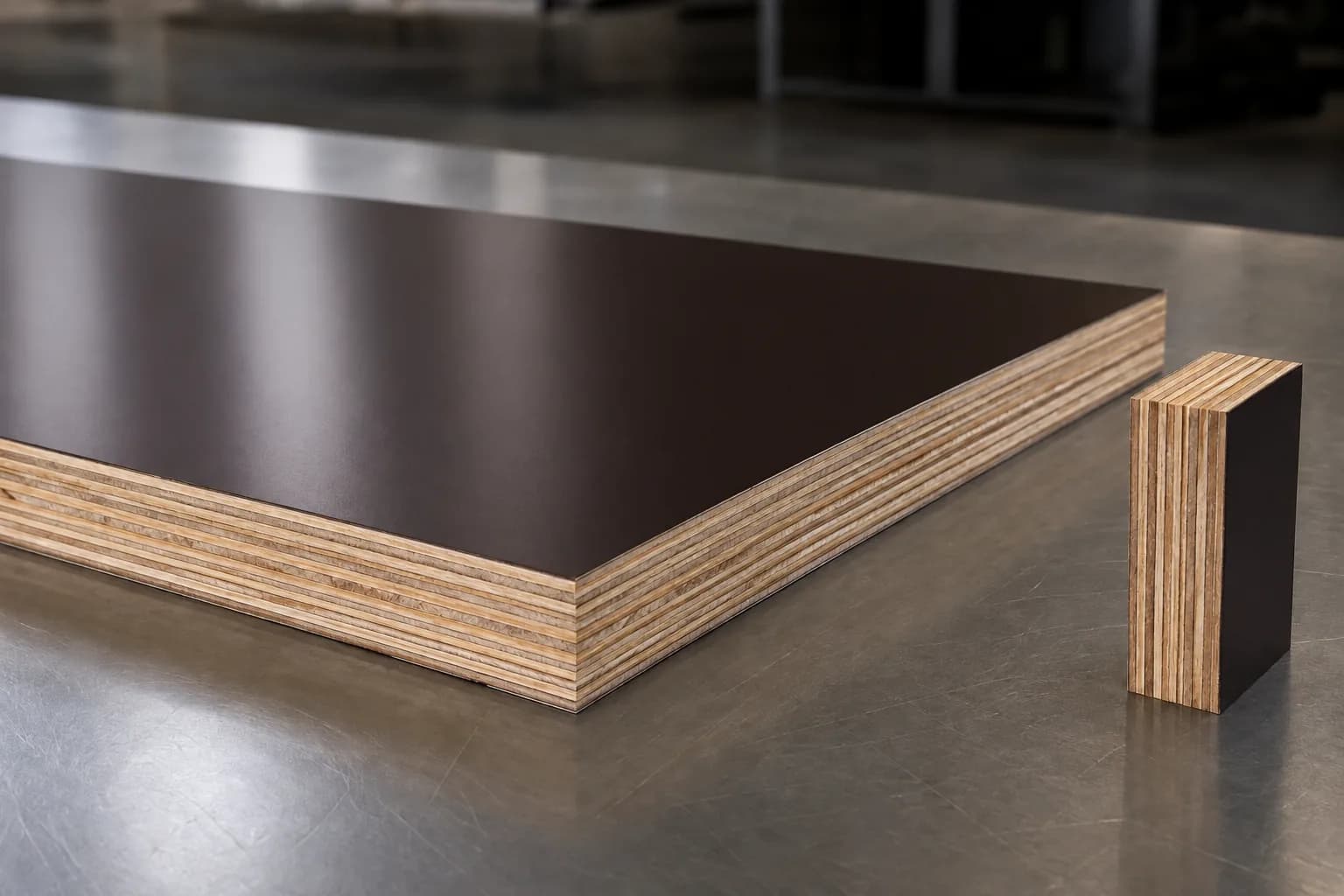
Read the thin phenolic face, surface continuity and cross-laminated core together before selecting a configuration.
Standard Export is the baseline for recurring supply. Economy is cost-led; Professional / Premium supports demanding surfaces or project qualification.
Economy
General shuttering and short-program formwork where an approved sample defines the acceptable result
Suitable markets: Value-led distributor and contractor orders after destination review
Standard Export
Recurring slab, wall and general formwork supply with a defined finish and handling plan
Suitable markets: Middle East, Central Asia, Latin America, Africa and EN-aligned projects
Recurring export choiceProfessional / Premium
Qualified formply, demanding concrete-face work and project-controlled premium surface programmes
Suitable markets: Australia and named projects requiring an exact standard, test or submittal option
Film faced plywood combines overlay, core, bond, edge treatment and dimensional control. Brown and black are surface choices, not quality grades.
The working face is normally resin-impregnated paper consolidated with plywood under heat and pressure. Its nominal paper weight, resin system, surface finish and face/back arrangement are order inputs, but they do not describe the inner veneers. A 120 g/m² brown face can sit over very different poplar, combi, eucalyptus, hardwood or birch constructions. The edge therefore belongs in the same material decision as the face.
The overlay reduces moisture contact and concrete adhesion at an intact face; it does not make exposed cuts, drilled holes or damaged corners self-sealing. Factory edge coating and the buyer's site resealing responsibilities are separate controls. PP-faced constructions can also be reviewed, but the PP system is specified by its own material and performance data rather than being presented as phenolic paper grammage.
Compare each input against its stated scope.
Compare the same overlay, core, bond, dimensions and packing requirements across all three configurations.
Compare each row across the three constructions. On a phone, each field lists Economy, Standard Export and Professional / Premium in that order.
| Specification | Economy | Standard Export | Professional / Premium |
|---|---|---|---|
| Best-fit order option | Cost-led shuttering with approved utility sample | Recurring export formwork with controlled panel file | Qualified formply or premium-surface project |
| Face overlay family | Phenolic resin-impregnated paper | Phenolic resin-impregnated paper | Premium phenolic paper or separately specified PP surface system |
| Nominal film paper weight / PP system | 90–120 g/m² phenolic paper | 120–180 g/m² phenolic paper | 180–220 g/m² phenolic paper or separately defined PP system |
| Film colour | Brown or black by sample | Brown, black or order colour by sample | Approved colour, sheen and batch reference |
| Surface finish / texture | Smooth utility face by sample | Controlled smooth face with gloss/texture limit | Premium smooth or defined PP texture; mock-up if critical |
| Face/back arrangement | Film both faces or working face with balancing back | Matched face/back arrangement in order | Qualified system; each face identified |
| Overlay integrity acceptance | No open delamination; sample limits | Continuity, adhesion and defect plan | Measured/sample acceptance with change control |
| Concrete-face expectation input | General result; no architectural promise | Named slab/wall result and reference | Project finish, mock-up and acceptance authority |
| Release-agent compatibility input | Buyer names intended release option | Release and cleaning reviewed with sample | Release/concrete/mock-up system fixed before qualification |
| Reuse statement scope | No fixed cycles; site method controls | Expectation only after sample and use plan | Target tied to qualified panel and controlled use |
| Core species | Poplar or utility combi | Selected poplar, combi or eucalyptus | Selected eucalyptus, hardwood or birch option |
| Core lay-up | Balanced utility cross-lay | Calibrated cross-lay with selected inner veneers | Project lay-up tied to surface, stiffness and qualification |
| Veneer / ply group | Ply count set by thickness | Controlled ply group recorded by thickness | Selected group fixed in approved construction |
| Core gap / overlap control | Declared limit and edge sample | Written gap, overlap and joint limits | Strict void and joint acceptance by sample and plan |
| Repairs / patches rule | Repairs declared in utility sample | Location, size and face-effect limits | Project prohibition or measured acceptance |
| Adhesive / bond system | Phenolic or buyer-approved exterior-bond specifications | Exterior phenolic construction | Exterior phenolic or project-specified complete system |
| Bond test methods | Buyer-defined test; no shorthand claim | EN 314-1 method and EN 314-2 Class 3 target | AS 6669 or named project requirements for approved construction |
| Density indicative price ranges | About 520–650 kg/m³; confirmed from actual lay-up | About 580–720 kg/m³; confirmed from actual lay-up | About 650–780 kg/m³ or calculated for approved project core |
| Moisture indicative price ranges | 8–12%; method and lot sampling agreed | 8–12%; method and lot sampling agreed | 8–12%; method and lot sampling agreed |
| Nominal thicknesses | 9, 12, 15, 18 and 21 mm | 12, 15, 18, 21 and 25 mm | 12, 15, 18, 21 and 25 mm; project thickness by review |
| Thickness tolerance | Target ±0.5 mm; method confirmed | Target ±0.3–0.5 mm by thickness | About ±0.3 mm where construction allows |
| Conventional sizes | 1220×2440 and 1250×2500 mm | 1220×2440 and 1250×2500 mm; 1500×3000 by review | Conventional sizes plus approved project formats |
| 1220×3800 mm option | Not assumed | After press, lay-up, film, flatness, handling and packing validation | project requirements after technical and loading review |
| 1250×3800 mm option | Not assumed | After construction, press, overlay continuity, flatness, full-length support, packing, container and loading validation | project requirements after complete panel, support, packing, payload and qualification validation |
| 1525×3050 mm option | Not assumed | Buyer/project review; not regular stock | Project review of overlay, press, flatness and qualification |
| 2100×2800 mm option | Not assumed | Not a Standard Export default | Feasibility after press, lifting, support, packing and payload review |
| Length / width tolerance | Order tolerance and sampling confirmed | Production and lot-sampling target | Drawing/standard target and method |
| Squareness | Utility limit with sample check | Lot plan and rejection threshold | project requirements with recorded result |
| Edge straightness | Utility order limit | Nominated measurement method | Drawing option with recorded result |
| Flatness / warp | Supported sample and utility limit | Conditioning, support and lot acceptance | Project support, conditioning and measured acceptance |
| Factory edge seal | Compatible factory coat by order | Compatible multi-coat edge seal | Approved chemistry, colour, coverage and inspection |
| Site-cut / hole resealing next steps | Buyer reseals exposed cuts and holes | Compatible field material and instruction | Drawing-led reseal and repair acceptance |
| Machining / drilling input | Cut list before production | Tooling, edge distance, holes and reseal planned | Drawing, tolerance, support and reseal approved |
| Batch inspection | Face, edge, thickness, moisture and pack sample | Overlay, core edge, bond, dimensions, moisture and packing plan | Project inspection, supporting documentation index and release authority |
| Approved sample / change control | Retained utility face and edge sample | Signed overlay/core/edge sample; changes reviewed | Approved construction; no substitution without written approval |
| Packing / stack support | Dry pallet, wrap, corners and aligned bearers | Full-width support, face protection, aligned bearers and parallel straps | Oversize cradle, lifting, full-length support and loading validation |
| Documentation / qualification processes | Order specification and inspection summary | technical documents, requested test records and shipment documents | Named submittal, sample, reports, marking and lot release |
Select the supplied panel together with your formwork design, support spacing, ties, release agent and stripping method.
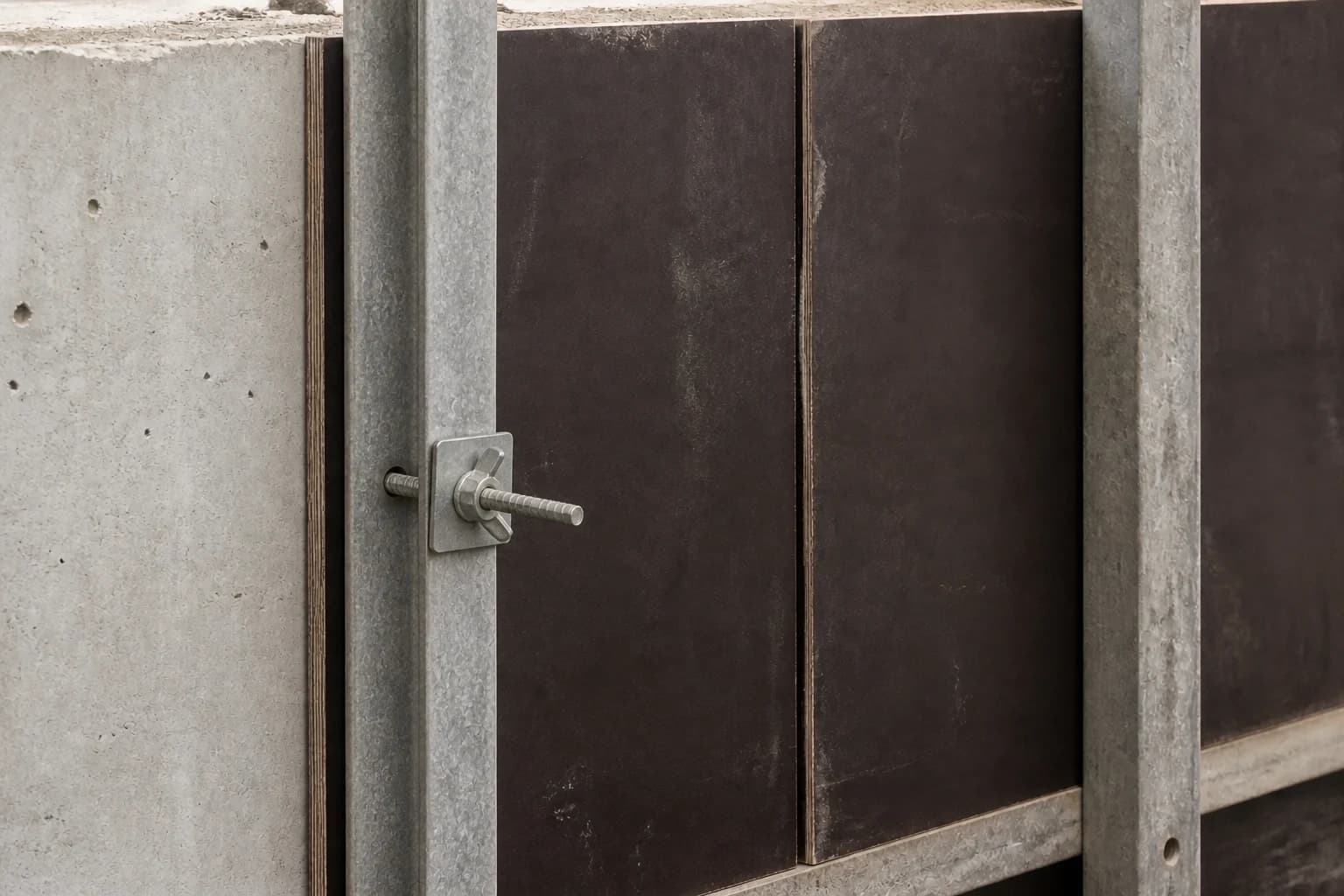
Six controls connect the face sample to the core, bond, dimensions, original edges and released batch.
Freeze the species sequence, veneer group, cross-lay construction and permitted repairs against the approved edge sample.
State joint, gap, overlap and void limits; inspect the exposed edge and relevant cut samples by the agreed lot plan.
Name the adhesive construction, sampling, test method and bonding-class target for the exact panel instead of relying on WBP shorthand.
Record nominal thickness, tolerance, measurement method, conditioning and moisture range before production release.
Confirm compatible edge-seal chemistry, colour, coats, continuity, drying or cure condition and inspection method for the original factory edges.
Retain the approved overlay, core, edge and dimensional reference; option material or process changes through written reapproval.
Availability applies to the stated programme, not every film-faced construction.
1220×2440×18 mm, one full-container planning basis. Source review: 2026-08-20. No fixed Incoterm or port is implied.
90–120 g/m² phenolic paper; poplar/utility combi core.
120–180 g/m² phenolic paper; calibrated selected core; multi-coat edges.
Selected core, premium overlay, tighter control and scoped supporting documentation.
A 1.220 × 2.440 × 0.018 m sheet contains 0.0535824 m³. The three bands equal USD 15.00–19.29, 21.43–25.72 and 27.86–47.69 per sheet mathematically, excluding tax, distribution, freight, port, Incoterm and destination costs. This is comparison arithmetic.
Quotation variables: Overlay, face/back, core, lay-up, bond, tolerance, oversize option, sample, supporting documentation, quantity, packing and timing.
“Available on request” and “Project-specific” describe availability; they are not claims of current certification.
Exact configuration, sample, inspection and change record.
Named test method and bonding-class target for the ordered construction.
Plywood specification option; the overlay remains separately specified.
Triggered only by the applicable construction-use declaration pathway.
Triggered only by the named testing or conformity option.
Exact Australian construction, dimensions, supporting documentation and marking scope.
Exact method, class, panel and destination scope.
Covered material, order scope and matching transaction records.
Transaction-specific operator, timing and due-diligence responsibilities.
Company-system supporting documentation, not product-performance qualification.
Packing geometry identifies the calculation inputs. Final sheet count follows construction, density, thickness, pallet build, container opening and legal payload.
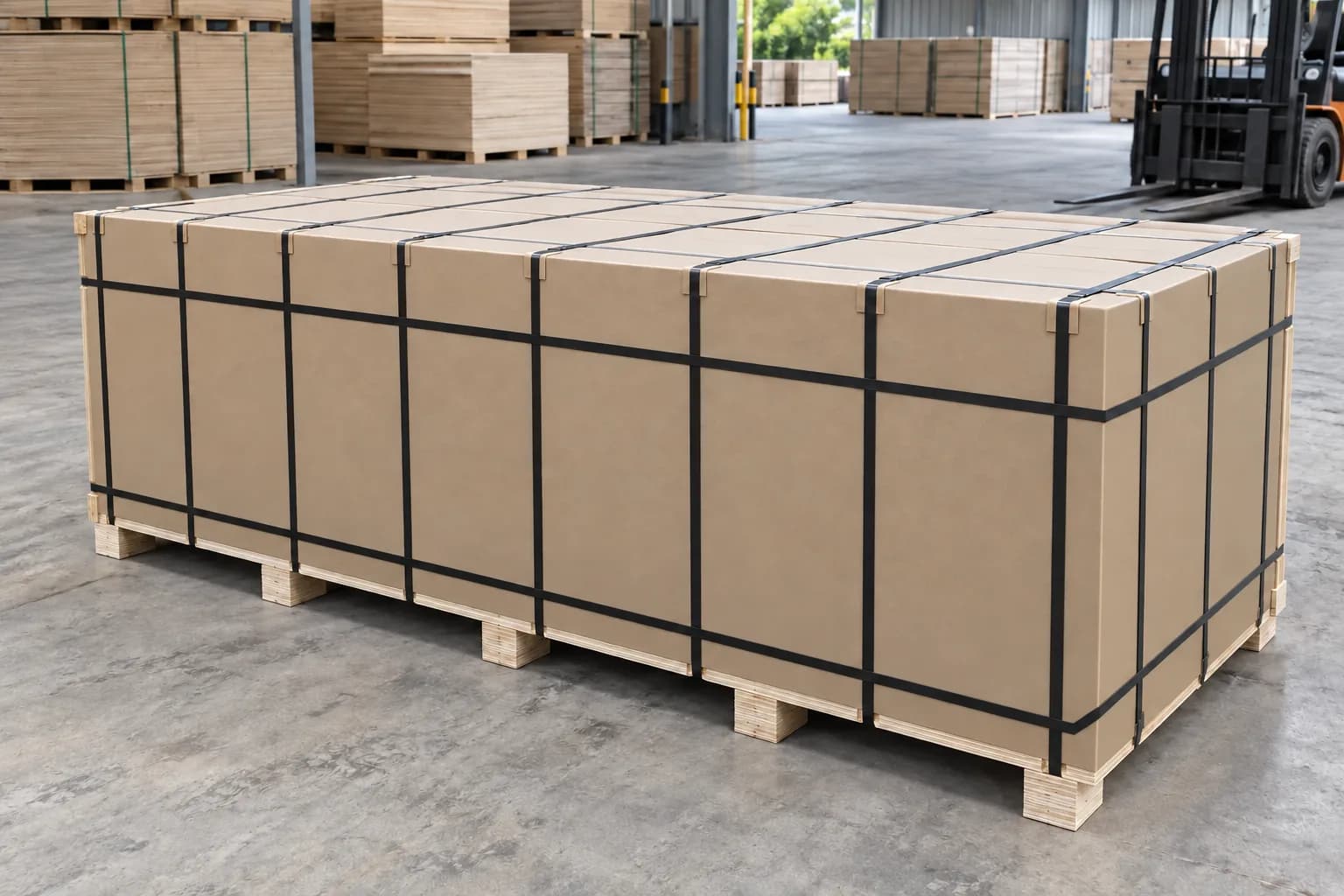
Factory treatment, site repair and storage are separate responsibilities. The order and site method must connect them.
Protect the working faces and corners, isolate straps from the film, align full-width supports and confirm pallet, forklift, container-opening and payload inputs.
Freeze the overlay system, colour and finish, face/back arrangement, core and lay-up, bond specifications, edge treatment, dimensions, tolerances and appearance reference.
Reconfirm any change to veneer source, core sequence, overlay, adhesive, pressing, calibration, edge coating or packing before the affected batch is released.
Confirm the panel specification, reference sample and export packing requirements with us before ordering.
Stay for overlay, core, bond, dimensions, edges and packing.
Move for supports, ties, pressure, release and stripping.
Move when resin-fibre overlay or paint/sign performance controls.
Move when a marine standard and veneer-quality option controls.
Move when pattern, wear and installed flooring control.
Move when grade and design properties control.
Film, core, bond and site use
It is cross-laminated plywood with a resin-treated working surface. Specify overlay, face/back, core, lay-up, bond, thickness, tolerances, original edges and supporting documentation together; a dark face alone proves none of them.
No. Film faced plywood uses resin-impregnated paper for the stated construction. HDO and MDO are resin-fibre overlay families with separate density, finish, supporting documentation and price options.
No. Approve colour by sample. It does not prove paper weight, resin, adhesion, core, void control, bond class, edge protection, tolerance or qualification.
State nominal g/m², approved reference, face/back arrangement, colour, finish, continuity and acceptance. Film weight is not a grade; specify a PP system independently of phenolic-paper grammage.
Choose for mass, edge quality, stiffness, machining, flatness, budget and supporting documentation. Declare species sequence, veneer group, gap/overlap limits, repairs and the approved edge sample.
No. WBP is exterior-bond shorthand, not certification. Name the adhesive construction, sampling, method and requirement—for example EN 314-1 with an EN 314-2 Class 3 target.
No universal count applies. Reuse depends on the approved panel, pressure, supports, concrete, release agent, stripping, cleaning, edge repair, storage and rejection practice.
Clean and dry the exposed core, then apply the compatible waterproof edge-sealing paint. Assign coat count, cure time and reinspection; an untreated cut is not a factory-sealed edge.
options cover 9, 12, 15, 18, 21 and 25 mm. Conventional formats are 1220×2440 and 1250×2500 mm. The 1220×3800, 1250×3800, 1525×3050 and 2100×2800 mm options require programme-specific validation; 1250×3800 is not assumed in Economy and enters Standard or Premium only after construction, press, overlay continuity, flatness, full-length support, packing, container and loading review.
Name construction, use, destination and decision. EN requests identify the EN 314 method/class and triggered EN 636, EN 13986 or EN 326 option; Australian requests define the AS 6669:2016 scope.
Plywood enquiry
State concrete-face expectation, system, overlay, face/back, core, lay-up, bond/supporting documentation, exact size including whether 1250×3800 mm is requested, thickness, tolerance, press and flatness option, factory edge seal, site resealing, full-length support, sample, quantity, pack base, container/loading constraints, destination and date. Our team can recommend the suitable Incoterm for the destination and order volume.; no fixed port or reuse cycle is assumed.
CHAT WITH CUZI PLY↗