Okoume or eucalyptus
Both material options are available. Tell us which face will remain visible, your finishing method and the component you will make. We set out the face and core arrangement in the offered construction.
Bring curved furniture and interior designs into production with CUZI PLY flexible plywood. Our factory supplies okoume and eucalyptus options in 5–30 mm thicknesses, with longitudinal or transverse bending configurations selected for your component.
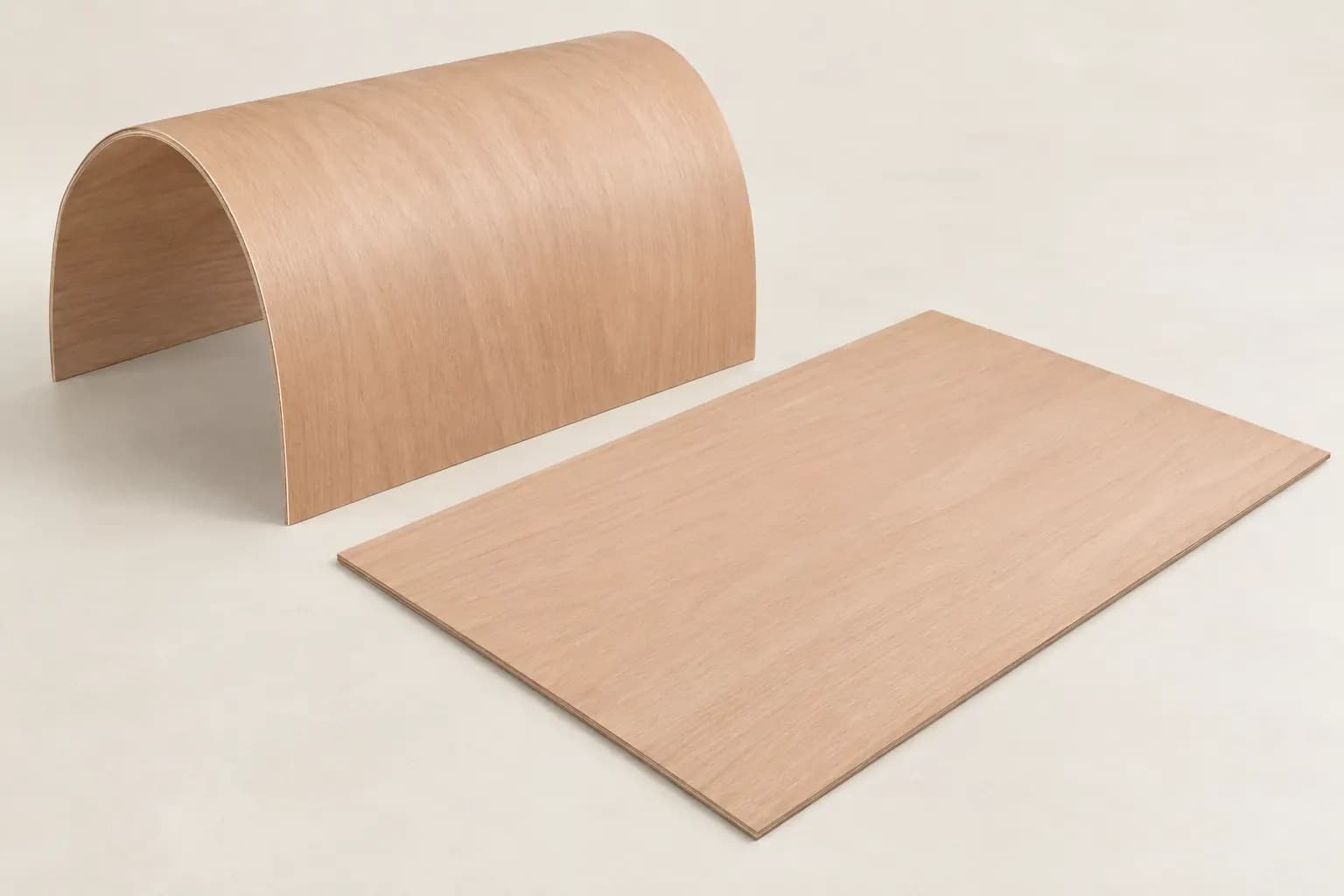
Plan the sheet direction, curve and supporting frame together. Specify thickness, trimming allowances and the final veneer, laminate or paint finish for the parts you make.
The material, thickness and bending direction work together. Send us the curve you need, not just a request for the thinnest sheet.
Both material options are available. Tell us which face will remain visible, your finishing method and the component you will make. We set out the face and core arrangement in the offered construction.
Match thickness to the required curve, support and assembly. Send us your part dimensions and forming method so we can help select a configuration for your design.
Choose the configuration that follows your part layout. Mark the bending dimension and straight axis on a sketch so the order and cutting plan use the same direction.
Order the longitudinal or transverse configuration that follows your component layout. Plan the forming direction before arranging parts on the sheet.
Long-grain bending plywood and cross-grain bending plywood are trade descriptions that can refer to veneer orientation. Use sheet length, sheet width and the required curve when describing your part, and keep that direction on each cut-part label.
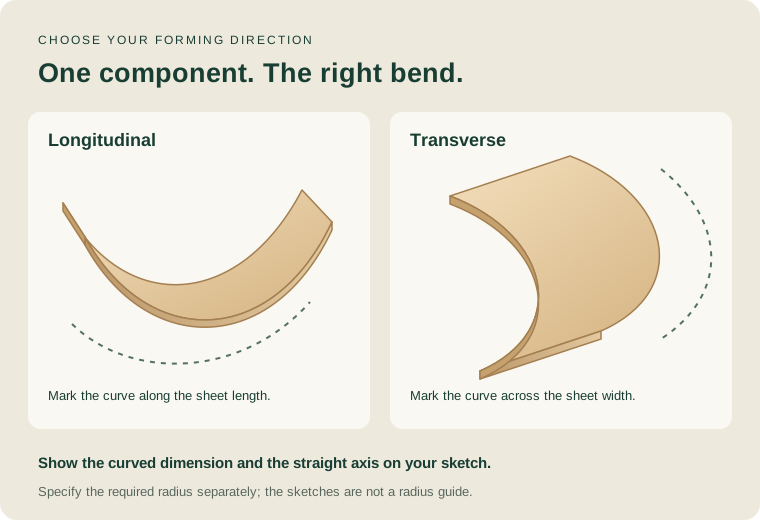
Show the curve relative to the sheet length and identify the dimension that remains straight.
Show the curve across the sheet width, including the part orientation and joint positions.
State whether your radius is measured on the inside or outside of the component. We review it with the selected thickness, material and forming setup to help you plan the trial and production.
Our factory supplies the agreed panel construction. Start with the confirmed material, thickness and direction options; add the component dimensions, forming setup and finish that make the offer useful for your production.
| Field | Available options and order details |
|---|---|
| Material options | Okoume or eucalyptus. Select the material with the visible face, finish and finished component in mind. |
| Face, back & inner veneers | We state the face/back selection and inner veneer arrangement in the offered construction. Name a required face or core rather than assuming the material name identifies every layer. |
| Panel thickness | 5–30 mm. Select the sheet thickness for your curve and assembly; for a layered component, also state the final build-up thickness. |
| Bending configuration | Longitudinal or transverse. Mark the curve against sheet length and width, and identify the axis that stays straight. |
| Required radius | State the inside or outside radius and the finished profile. We match the construction to the forming setup and arrange a trial for the required curve. |
| Layer arrangement | Specify single-sheet forming or a build-up of several sheets, with the support, joint positions, adhesive and final surface. Agree the veneer schedule for the selected panel. |
| Sizes & cutting layout | Choose from the sheet formats below or provide a part list. Include bending direction, trimming allowance and the reference edges used to measure the parts. |
| Dimensions & tolerances | State panel thickness, part dimensions, permitted variation and the measurement conditions. We agree the tolerances for the supplied panels or cut parts in the order. |
| Face preparation & finish | Define visible faces, sanding and repairs with the intended veneer, laminate or paint. Check the final appearance on the formed component. |
| Bond & indoor emissions | Include the component environment, destination and required bond or emission documents. We specify these with the actual panel construction and finish. |
| Panel or part supply | Our flexible plywood is supplied for your forming and assembly. If you need cut parts or edge preparation, include the part list so our quotation states the processing included. |
| Packing & identification | Agree supported flat packing, dimensions, quantities and clear material/thickness/direction labels. Include unloading and storage requirements for the destination. |
Mark a target radius for the selected construction rather than choosing by thickness alone. Check it with the support, joining method and surface planned for the finished part.
Use a section or template to show the curve, straight axis and inside or outside radius. Include the final finish when locating the finished surface.
Use the forming direction agreed for the supplied sheet. Keep the reference edges and trimming allowances consistent across repeat parts.
Use the planned former, support and joining method. For layered parts, include the actual sheets and adhesive in the trial; check the shape after it leaves the former.
Check surface cracking, veneer separation, profile, joins and visible edges with the intended finish. Record the configuration, setup and acceptable result for repeat orders.
For veneer or laminate, include the facing thickness, bending direction, adhesive and balancing layer in the build-up. Follow the facing and adhesive manufacturers’ forming recommendations. For paint, agree face preparation, repairs and edge treatment, then assess the finish on the curve and joins you will produce.
Use the finished thickness and profile to check adjoining parts. Tell us whether you need raw sheets or cut blanks; forming and the completed assembly remain part of your component process.
Flexible plywood: choose a lay-up and direction for the curve, then form the panel or bond several sheets on the intended former. Check the released shape, surface and final thickness.
Kerf bending: cutting slots into a panel changes its section and the backing needed for the component. A kerf-cut conventional panel is a different construction from an uncut flexible sheet. Include the machining, support and finished surface in the part specification.
Water or steam bending: a method used for solid timber does not automatically suit bonded plywood. Moisture, heat and drying affect the veneers and adhesive; use a process suited to the particular panel and check the finished component. Do not assume soaking makes an ordinary sheet equivalent to bending plywood.
Plan cutting and machining requirementsChoose the panel for the complete component, including its support, joints and final surface.
Plan the curve, straight joins and supporting frame together. State whether the outside face will be painted, veneered or covered.
For your enquiry: Send the end-panel height, inside or outside radius, return edges, required thickness and face finish.
Include the overall sweep, height and joint positions. Specify the finished surface and how the curved front attaches to its support.
For your enquiry: Send the profile and part lengths, support positions, join layout, decorative surface and repeat-part quantity.
Show the finished component dimensions, edge treatment and assembly. Match the panel thickness and forming direction to the actual part.
For your enquiry: State single-sheet or layered forming, the final thickness, fitting references, visible edges and intended joining method.
For a circular surround, state the inside diameter or radius, height, joint position and finished wall thickness. For curved strips, give the width, developed length, curve and trimming allowance. Keep bend direction consistent across the cutting layout and identify matching parts. We quote sheets or cut blanks for your forming and assembly.
Use our factory sheet-format options as the starting point. Send your flexible-panel thickness, direction and quantity so we can quote the construction, cutting layout and packing together.
Compare sizes and finished-thickness requirementsBuy directly from our factory in Linyi, Shandong, China. We operate 10 production lines across our plywood range. Tell us what you are making and how many parts or sheets you need. Our factory team proposes the panel configuration and sets out the order quantity, price, production timing, sample arrangement and delivery terms.
For a trial, use the forming setup and finish planned for the finished component. We agree the piece size, quantity and courier costs before sending it.
Include your thickness or size mix and target delivery date. We confirm minimum quantities, any sample and courier costs, the supplied processing and the production schedule in the offer. Production time is separate from shipping transit. Your quote states the currency, price unit, named port or delivery point, delivery term and validity; freight and destination charges are included only when stated.
Tell us the intended use and named product or emission requirements. We set out the construction and applicable documents with the offer, so you can check the supplied board against your project needs.
Custom sheet dimensions are a manufacturing choice. Product reports cover the construction, properties, intended use and conditions described in them; an altered length or width is not, by itself, a new product category. For exterior or load-carrying components, specify the required product properties and complete installation design with your project team.
Bend radius describes the shape you need; bending strength and stiffness describe how a panel responds to load. For load-carrying parts, use the specified construction, design values, spans, supports and fixings in the engineering design. Compare plywood strength and stiffness requirements.
Keep the face/core arrangement, veneer schedule, thickness, sheet format, bend direction and tolerances together in the order description. Record the agreed trial setup and finish for repeat parts.
Use bond information to check the intended environment. Use the applicable emission report for the panel construction, destination and indoor use, including the planned facing or coating.
State any required standard, sourcing claim or wood-origin information. We identify the applicable product and transaction documents; our China manufacturing location and the wood’s source country are separate details.
Use the packing list and pack labels to match material, thickness, direction and quantity at receipt. Agree flat support, protection, pack dimensions and unloading for the destination.
Flexible & bending plywood
Flexible plywood, also called bending plywood or bendy plywood, is selected for curved cabinet ends, furniture fronts, reception desks and interior details. Tell us the finished curve, supporting frame and visible surface so we can propose the construction for your component.
We supply okoume and eucalyptus options in 5–30 mm thicknesses. Specify the material, panel thickness and surface you need. Tell us your visible face and core preferences so we can recommend the face and core arrangement for your component.
Yes. Both configurations are available. Mark the bend on a sketch relative to the sheet length and width, and show which dimension stays straight. This is clearer than using long-grain or cross-grain trade names alone.
No single minimum radius is stated for the whole range. The required curve must be considered with the material, thickness, direction, forming method and final finish. Give us the inside or outside radius and assess the selected panel on your forming setup before committing the full order.
Check the formed surface, joints, support and face preparation with your intended finish. A flat panel check alone does not establish how the completed curved component will look. Tell us which surface is visible and how the part will be formed and fixed.
Bending capability does not establish a structural grade or exterior classification. If your part carries a design load or will be exposed outdoors, send those requirements with the enquiry so the product and supporting documents can be selected for that use.
Use Request a Sample and include the material, thickness, finished curve and bending direction. We agree the panel or component size, quantity and courier arrangement with you. Check it using the support, forming method and finish planned for production.
Send your component or sheet dimensions, thickness, material, bend direction, curve, quantity and destination. Include the finish and any required product documents. Our quotation sets out the offered construction, order quantity, price, production timing and delivery terms.
See Sheet sizes for our regular and made-to-order formats. Select a size with the bending direction, usable-part layout, trimming allowance and packing in mind. A custom length or width is a manufacturing choice; applicable product documents follow the construction, properties and intended use stated in them.
A part formed from several sheets, adhesive and a decorative surface can have a different finished thickness from a single supplied panel. Specify the thickness of each sheet, the number of sheets in the build-up and the final component dimensions. Check the formed profile and joint fit with the materials and finish you plan to use.
We supply flexible plywood panels for your forming and assembly. Include a part list if you need cutting or edge preparation; the quotation states the supplied dimensions, direction, tolerances and processing. Finished curved furniture or a complete installation is a separate scope from supplying the plywood.
6 mm and 18 mm are within our 5–30 mm supply range, but thickness alone does not define the bend radius. A quarter inch converts to 6.35 mm and three-eighths to 9.525 mm; trade thickness labels may be nominal. State the required finished thickness and tolerance rather than treating 6 mm and 1/4 inch as identical. For a design calling for 3 mm, our listed range starts at 5 mm; ask us to review the curve and build-up before substituting a thicker sheet.
This flexible plywood range offers okoume and eucalyptus constructions selected for curved components. A birch face, marine designation or a trade name does not identify the same lay-up or bending behaviour. If your design specifies another panel, send its construction, thickness, direction and required curve so we can discuss the appropriate product. Do not transfer a bend radius or product report from one construction to another.
We manufacture in Linyi, Shandong, China, with 10 production lines across our plywood range. We supply flexible plywood directly for export, including orders for Australia, Europe and North America. Send your delivery country, port or address and quantity for a factory quotation; our export service is separate from local retail stock or same-day collection.
Send the sheet or part quantity, thickness mix and destination. We confirm the minimum order, any mixed sizes, price unit, currency, sample costs, payment schedule and packing in the quotation. Production timing is separate from shipping transit; freight, insurance, duties and taxes are included only when stated in the offer.
Compare flat okoume-faced and all-okoume panels for the other parts in your assembly.
Choose flat cabinet and furniture parts to accompany your curved components.
Understand face and core choices before specifying the construction.
Turn your component requirements into a clear factory enquiry.
Compare face preparation, applied surfaces and edge coverage for your component.
Plan samples, quotation, order confirmation and export delivery with our team.
Start with the material, thickness and shape you need. We will help complete the panel and order details.