What is the core of plywood?
The core is the internal veneer or strip-built construction between the face and back.
Specify its species, layer sequence, grain direction, joining, repairs and moisture separately from the visible face.Select the plywood core from the complete veneer construction: face and back, inner species, layer sequence, grain direction, gaps and repairs, bond, moisture, thickness and machining duty. Compare poplar, combi, hardwood/eucalyptus, birch-based, all-birch and lumber-core options, then turn the choice into a repeatable RFQ.
Build a core specificationUse these answers to compare quotations on the same construction basis and prepare a complete RFQ.
The core is the internal veneer or strip-built construction between the face and back.
Specify its species, layer sequence, grain direction, joining, repairs and moisture separately from the visible face.Birch-faced plywood can use poplar, combi, hardwood or birch inner veneers; all-birch uses birch veneers throughout the defined lay-up.
The quotation identifies the complete construction and the approved production sample.Combi describes a mixed-species veneer construction selected to balance weight, machining and cost.
List the actual species, layer order, symmetry and permitted substitutions for a comparable quotation.Poplar commonly supports lighter panels, while hardwood/eucalyptus commonly supports denser edges and fastening applications.
Confirm density or panel weight, machining result and fastening requirement for the exact construction.It uses multiple wood veneers bonded with adjacent grain directions arranged for panel balance.
The specification also covers veneer quality, gaps, repairs, bond, moisture and finished thickness.It uses a strip or block wood centre with crossbands and outer veneers.
Specify strip species, width, joint pattern, moisture, crossbands and machining requirements as one construction.Red core is a commercial colour description used for some darker inner veneers.
Use the actual species or composition, density or panel weight and layer sequence in the purchase specification.Record application, face and back, core species, layer sequence, dimensions, weight, defect limits, moisture and machining.
Approve a representative sample and document any later material or process change before production.Visible species, appearance, grain and finishing requirement
Specify the inner core on its own line.Species, grade and balancing requirement
Confirm the back independently from the face.Inner layer below face/back supporting balance and surface
Its role and species are construction-specific.Internal species, thickness, joining, repair and moisture controls
Names such as combi require the complete sequence.Adhesive system and bond requirement for the intended service
Name the test method and product construction in the order.Face direction, lay-up and product axis recorded separately
Use the product-specific strength direction for structural calculations.Target, tolerance, sanding or calibration and measurement points
Record both ply count and measured finished thickness.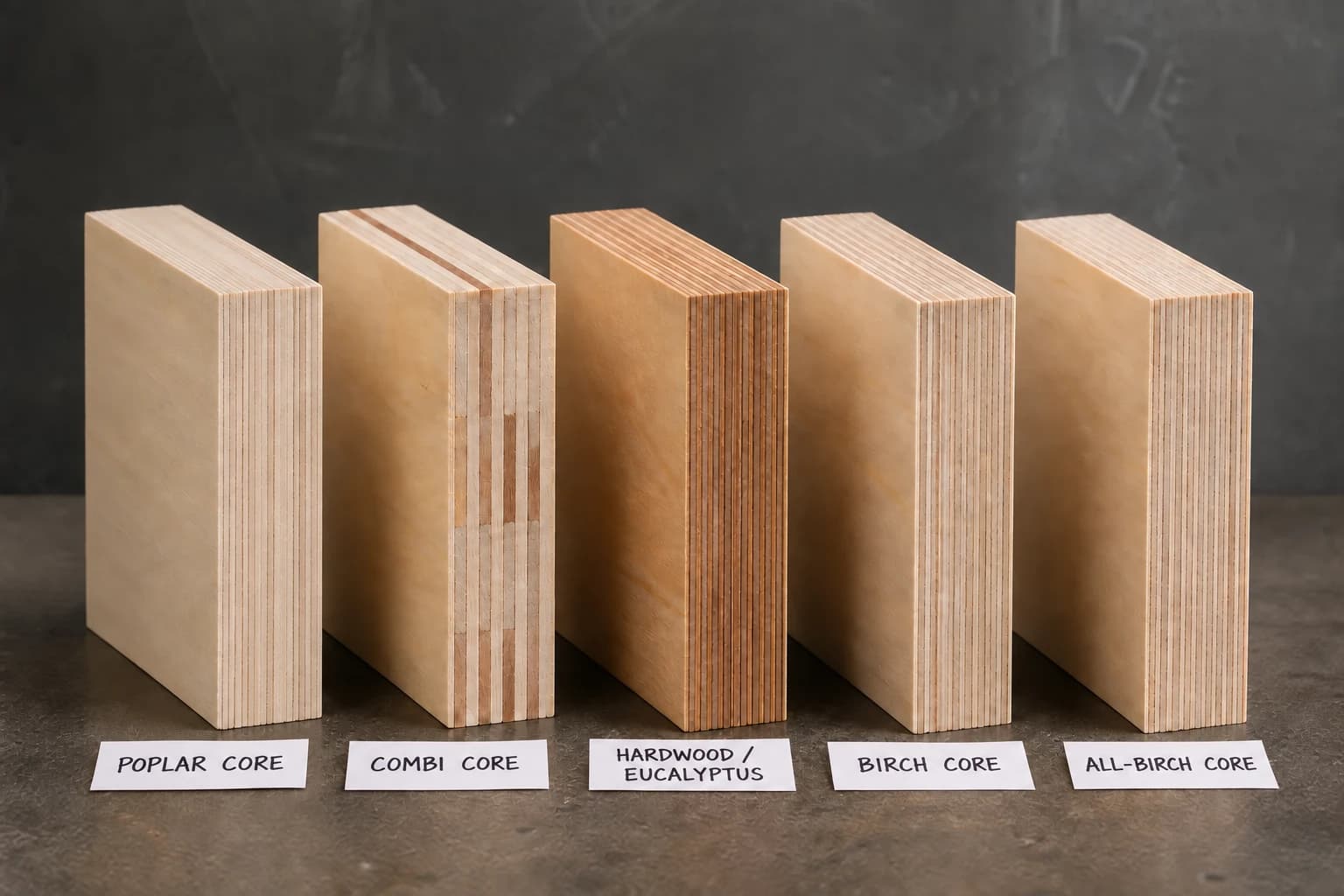
Poplar, combi, hardwood/eucalyptus, birch-core and all-birch constructions share one plane so face, edge and declared material family can be compared together.
| Core family | Construction identity | Weight | Machining / edge | Surface / flatness | Fastening | Suitable products | Order controls | Confirm in the quotation |
|---|---|---|---|---|---|---|---|---|
| All-poplar veneer core | Pale poplar veneers in a disclosed symmetric sequence | Relatively light; quote declared density or finished-panel weight | General conversion, furniture, lining and packing | Confirm outer crossbands, calibration and face support | Approve the actual component and fastener | Poplar / Commercial / Packing | Species, ply sequence, gaps, overlaps, moisture and substitutions | Confirm weight and performance by thickness and construction |
| Hardwood / eucalyptus veneer core | Named hardwood/eucalyptus species or disclosed combination | Generally denser; actual value follows the selected construction | Robust edges and industrial machining; approve the tool result | Control repairs, uniformity and sanding | Approve the component, fastener and edge distance | Hardwood / Structural / Furniture | Species, source, density, lay-up and required testing | Add the required structural grade or test separately |
| Combi / mixed veneer core | Two or more named veneer species in a recorded sequence | Selected recipe balances weight and handling | Balances yield, edge quality and cost | Symmetry and outer crossbands support a consistent face | Approve the exact recipe and joint | Commercial / Furniture Grade / Film Faced | Species, ratio or ply count, sequence, symmetry and substitutions | Write the exact formula in the quotation |
| Birch-core / birch-dominant | Birch inner veneers or a defined birch-dominant sequence | Typically denser than many poplar constructions | Exposed edges, CNC and precision components | High-ply construction supports a uniform edge with consistent veneer control | Confirm construction, joint geometry and test requirement | Birch / Furniture Grade / Laser Cutting | Identify birch-faced, birch-core, birch-dominant or all-birch | State the birch content and complete layer sequence |
| CUZI PLY factory-produced all-birch plywood lot | All-birch plywood manufactured and controlled by CUZI PLY in our factory. | Declare construction, density or finished-panel weight | High-ply exposed edges and precision components | Confirm lot, grade, repairs and China processing | Approve the named product and joint requirement | Baltic Birch | CUZI PLY, species, lot, transaction, China process and inspection | Confirm customs origin and admissibility for the named shipment |
| Lumber core / blockboard | Wood strips or blocks with crossbands, face and back | Depends on strip species, geometry and moisture | Furniture and project-selected components | Control crossbands, face/back and strip joints | Confirm strip direction, fastener and operation | Project-selected / available on request | Strip species and width, joints, moisture, crossband, face/back and thickness | Specify as a strip-core panel construction |
Record face-grain direction relative to panel length and width, together with the cutting layout and any product strength-axis instruction.
Use product-specific test values when the panel forms part of a structural design.List every inner veneer by species or approved material family and record the grain direction of each layer.
Combine ply count with species, layer sequence and grain direction.Where the product design requires a balanced lay-up, record the centre ply, corresponding layers and symmetric relationship; confirm any deliberate asymmetric construction before production.
Confirm balance against the exact ordered layer sequence.Record veneer-thickness ranges, joining, gaps, overlaps, repairs and moisture before lay-up.
These measurable fields make high-ply and thin-veneer descriptions comparable.Reconfirm the complete construction before applying an approved result to another thickness, size or product format.
Record the sizes and thicknesses covered by the approved sample and inspection plan.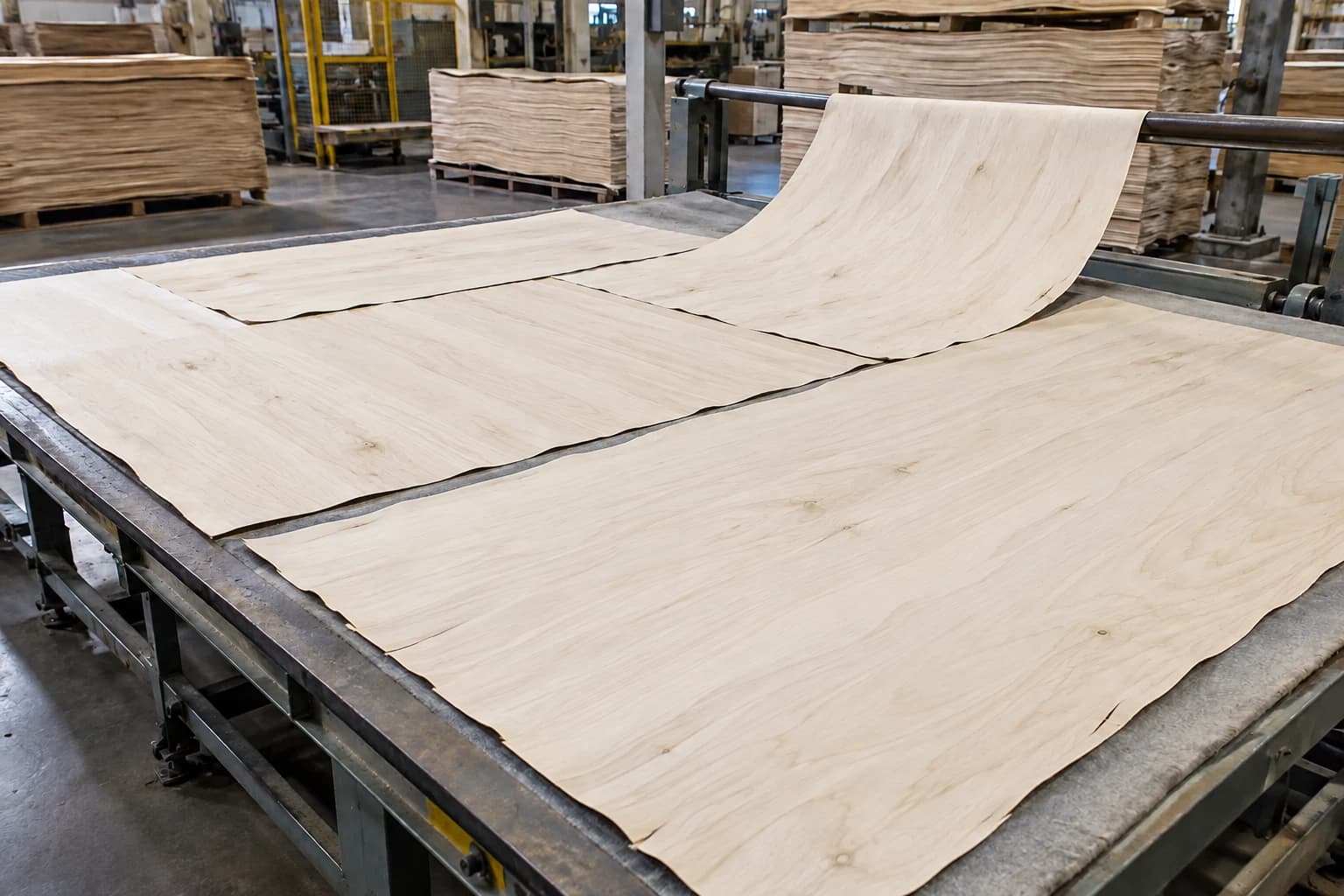
Complete thin veneers remain supported on the lay-up table while alternating grain direction and sequence are checked before pressing.
Core: Poplar core
Choose when: Light furniture/interior-use options with birch appearance
Confirm: Face grade, poplar species, crossbands, density/weight and machiningCore: Combi core
Choose when: Balanced cost, weight and processing option
Confirm: Every inner species, sequence, symmetry and substitutionsCore: Birch core / birch-dominant
Choose when: Machined edge and higher-ply component option
Confirm: Birch proportion, other inner species and complete layer sequenceCore: All-birch substrate
Choose when: Qualified high-ply edge and precision option
Confirm: Full substrate lot and transaction/process fileCore: Selectable veneer core
Choose when: Appearance-led furniture or interior component
Confirm: Decorative face separately from poplar/combi/hardwood/birch coreSet permitted width, length, frequency and location, together with the sampling method used for lot acceptance.
Written acceptance limitConnect selected-core and void-control wording to measurable limits.Define overlap limits, local thickness changes, surface telegraphing and the locations included in sampling.
Surface-support controlInspect both the visible face and representative inner lay-up locations.Define a void, its permitted limit, inspection method, sample locations, lot size and acceptance decision.
Order-specific inspectionUse representative locations and the agreed sampling plan for production-lot acceptance.Record approved repair types, dimensions, quantity, location and any prohibited zones for the intended use.
Approved repair ruleSet repair limits for the intended use and visible-edge requirement.Record each layer's target thickness or range, identify critical layers and retain the applicable inspection record.
Lay-up schedule fieldRecord veneer thickness and layer sequence together with total ply count.For many dry export constructions, use 8–12% as the indicative price ranges, then confirm the product target, meter method, test locations and measurement time in the order.
Veneer + finished-panel controlThe final range follows the named product, destination and agreed measurement method.Record every layer's species, grain direction, centre ply and corresponding symmetric relationship.
Approved constructionAttach the complete lay-up schedule to combi and high-ply orders.Set finished thickness, tolerance, measurement points, sanding or calibration method and flatness acceptance.
Finished-panel acceptanceApprove results for the sizes and thicknesses listed in the order.Name the intended exposure, adhesive system, test method, specimen conditioning and acceptance requirement for the exact construction.
See Bonding & Emission OptionsKeep the core schedule and bond requirement together in the purchase specification.Link the approved sample, inspection plan, supplier or material lot, production lot, retained sample and change record.
Repeat-order controlA change to material, sequence, repair or process requires renewed approval where the order specifies it.Edge breakout, veneer continuity, tolerance and tool option
Approve a representative cut on the exact construction.Core reveal, small-part yield, flatness and holding
Provide drawing, tool/process inputs and trial acceptance.Hole-edge continuity, breakout and hardware interface
Record hole diameter, edge distance and inspection.Species sequence, gaps, repairs and visual consistency
Define the edge as a visible acceptance surface.Calibration, edge quality and adhesive/substrate next steps
Confirm the downstream banding system and trial.Fastener type, direction, edge distance and component use
Approve screw holding with the selected construction and joint geometry.Surface support, telegraphing, balance and pressing conditions
Confirm the selected HPL, melamine, film or decorative-veneer system.Width × length × finished thickness × declared density
Use the ordered construction's declared density and moisture condition.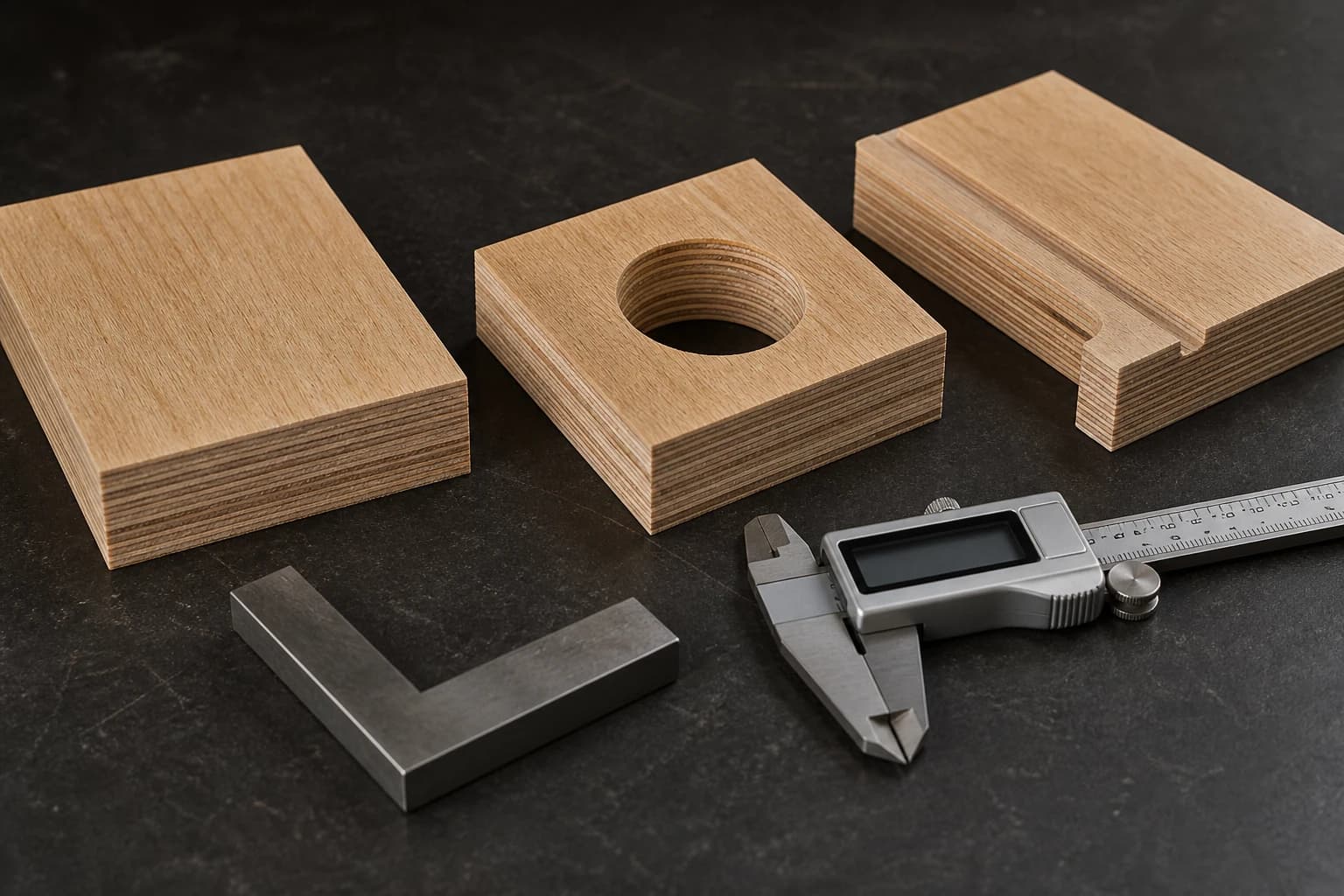
Straight-cut, drilled and CNC-routed samples show veneer continuity, edge quality and the features used for machining approval.
Our order documents identify the all-birch construction, production lot, factory processing and destination information. The importer uses the shipment records to complete any destination-specific origin, tariff or admissibility review.
Compare poplar construction, panel weight, dimensions and processing requirements.
↗General-purpose supplyCommercial PlywoodConfigure face, core, bond, dimensions and quotation level together.
↗Furniture and CNCFurniture, Cabinetry & Interior PanelsMatch the panel to component machining, finishing and hardware.
↗Exposed edges and high plyBaltic Birch PlywoodReview all-birch substrate identity, grade and processing in China.
↗Crates and casesPacking PlywoodChoose the panel construction for handling, fixing and packing duty.
↗Precision componentsLaser Cutting & Precision ComponentsCoordinate the drawing, machine trial and finished-part requirements.
↗This example is arranged in the same order a buyer can use for quotation, sample approval and repeat supply.
Technical references last checked 2026-08-29. Product specifications, approved samples and inspection records are prepared for the ordered construction.
Face, back, crossband, core veneer and glue line are distinct positions in a plywood construction.
Specify the visible-face species and internal core construction as separate order fields.
Adjacent veneer grain directions are commonly alternated, with symmetry and layer order defined for the selected product.
Lumber core, blockboard and battenboard form a strip-core construction family distinct from veneer-core plywood.
Compare birch and other veneer-core families by construction, weight, machining, exposed-edge quality and fastening duty.
Strength, stiffness and fastening requirements are connected to the exact construction, test method and product grade.
Gaps, overlaps, repairs, veneer uniformity, moisture, symmetry and finished thickness can all be written as measurable inspection controls.
CUZI PLY factory-produced all-birch plywood lot may be processed in China for a confirmed order specification.
Repeat supply uses an approved construction, representative sample, inspection plan and written change record.
Reference topic: Plywood — Vocabulary
Last checked: 2026-08-29
View referenceReference topic: Plywood — Classification and terminology
Last checked: 2026-08-29
View referenceReference topic: Veneers — Terms, physical characteristics and tolerances
Last checked: 2026-08-29
View referenceReference topic: Wood-based panels — Blockboards and battenboards
Last checked: 2026-08-29
View referenceReference topic: Mechanical Properties of Wood-Based Composite Materials
Last checked: 2026-08-29
View referenceReference topic: Plywood
Last checked: 2026-08-29
View referenceReference topic: Hardwood Plywood Core Guide
Last checked: 2026-08-29
View referenceReference topic: Durable birch plywood for demanding applications
Last checked: 2026-08-29
View referenceReference topic: Expert Opinions on Plywood Applications and Production
Last checked: 2026-08-29
View referenceThe order specification records the core species, composition and complete veneer sequence.
Product specification and approved sampleThese documents identify the exact construction supplied for the order.Selected-core orders state measurable gap, open-joint, repair and inspection limits.
Inspection plan and approved sampleThe quotation links each descriptive term to an acceptance limit.CUZI PLY factory-produced all-birch plywood is linked to its production lot, manufacturing, inspection and packing records.
Qualified-lot sourcing and shipment documentsShipment documents provide the information required for destination customs review.Changes to species, layer sequence, repairs or processing are submitted for written approval before repeat production.
Approved change recordThe agreed construction remains consistent across the named order programme.Before the purchase order
Name face and back separately, then list inner species, veneer sequence, symmetry, gap and repair limits, 8–12% moisture where appropriate, finished thickness, density or panel weight, machining and sample acceptance.
It is a mixed-veneer construction. A comparable quotation names the species, ratio, layer order, crossbands, symmetry and permitted substitutions used for the offered panel.
Choose from the required panel weight, edge and machining result, fastening operation and product use. Poplar often supports lighter panels and hardwood/eucalyptus denser panels; confirm the declared values for the offered construction.
Check the complete lay-up. Birch-faced plywood may use poplar, combi, hardwood, birch-dominant or all-birch inner construction; all-birch orders identify birch veneers throughout the specified sequence.
It is a separate project construction for uses that benefit from strip/block wood, crossbands and outer veneers. Specify strip species and width, joints, moisture, crossbands, face/back, thickness and machining.
Use the colour description together with the actual species or composition, layer sequence, density or panel weight, moisture and inspection requirements.
Define selected material, permitted gap and open-joint limits, repair limits, inspection method, sample locations, lot size and acceptance decision. This turns the description into a measurable purchase requirement.
Compare ply count with veneer species and thickness, sequence, symmetry, joining, repairs, moisture, bond and finished calibration. The complete construction determines the processing result.
State a declared-density or finished-panel-weight requirement for the exact size, thickness and moisture condition. Calculate panel weight from width × length × finished thickness × declared density, then verify the approved production sample.
Retain the written construction, approved sample, inspection plan and lot identification. Supplier, species, layer sequence, repairs, veneer thickness and processing changes receive written approval before production.
Plywood enquiry
Send the application, destination, face and back, core family and species, veneer sequence, dimensions, moisture, density or weight, defect limits, machining, quantity, packing and drawings.
CHAT WITH CUZI PLY↗